Cybersecurity
July 30, 2026
For MSPs and security teams, the challenge is rarely a lack of tools. It is the opposite: too many disconnected systems producing too many alerts without enough context.
A security assessment checks whether your safeguards work as intended and where gaps create business risk. For a rapid needs assessment, start with your most important systems, review the controls that protect them, check available evidence, and rank the gaps by impact. The result should be a short list of actions your team can own and track.
A quick review helps set priorities, but it cannot prove every control is effective. Testing, document reviews, and staff interviews can add depth when the risk calls for it.

At its core, a security assessment is a systematic evaluation of an organization’s management, operational, and technical controls. Rather than asking whether you own a specific security tool, an assessment asks a fundamental question: Are your safeguards implemented correctly, operating as intended, and meeting your stated risk requirements?
In modern enterprise architectures, controls span multiple dimensions:
The foundational authority on this discipline—the Technical guide to information security testing and assessment (Scarfone et al., 2008)—draws clear distinctions between assessments, testing, and examinations. Organizations often confuse these terms, running an automated scan and declaring their entire posture verified. Periodic cyber security health checks can provide high-level posture verification, but structured assessments go deeper by correlating technical outputs with operational reality.
| Dimension | Security Assessment | Security Testing | Security Examination |
|---|---|---|---|
| Primary Goal | Determine overall control effectiveness and business risk | Exercise one or more controls under active conditions | Inspect static artifacts, configurations, or documents |
| Methods Used | Testing, examination, and structured interviewing combined | Vulnerability scanning, penetration testing, fuzzing | Configuration review, log analysis, policy auditing |
| Output | Holistic risk analysis with prioritized remediation roadmap | Raw lists of verified flaws or exploitation paths | Compliance checks, misconfiguration gaps, policy drift |
| Scope | Enterprise, system, or facility-wide governance & tech | Specific assets, networks, or applications | Static files, architecture plans, system baselines |
A thorough security evaluation avoids relying on a single method. Instead, it balances three standard assessment techniques:
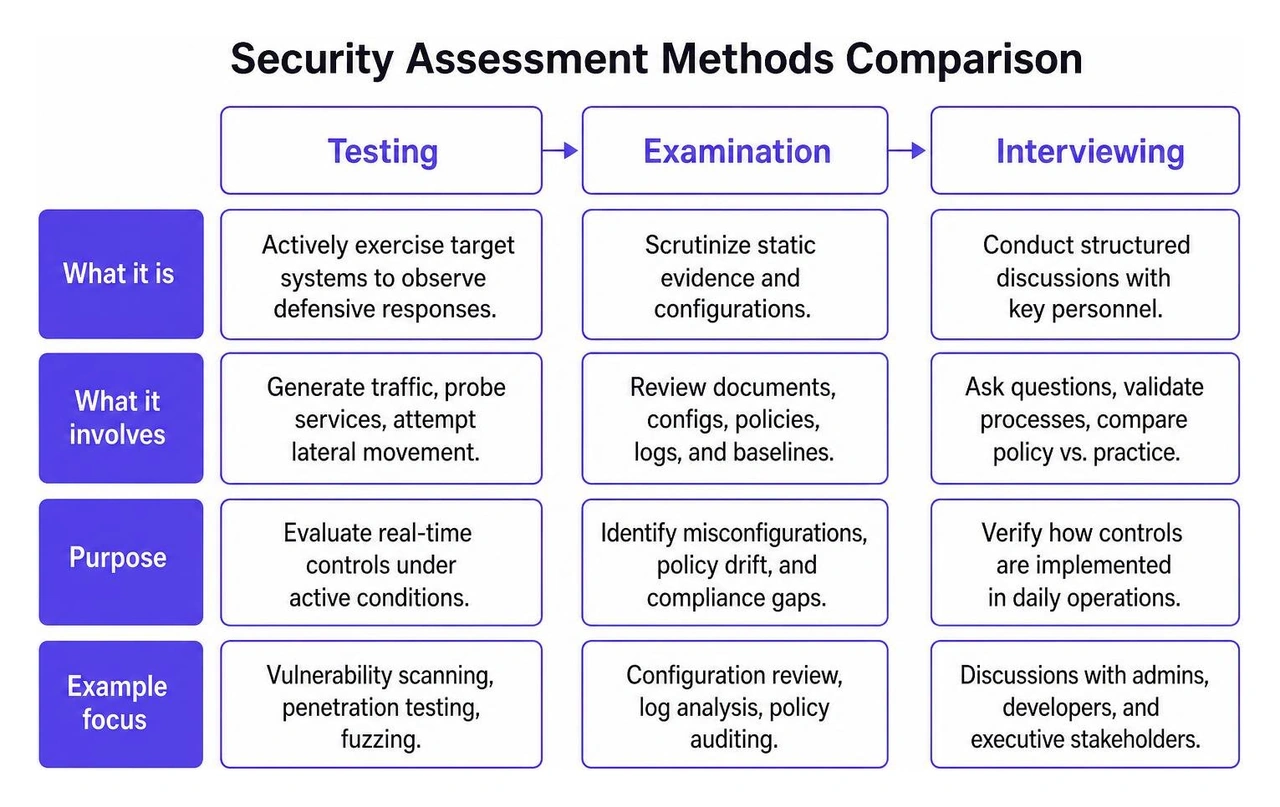
Not every assessment requires months of intrusive testing. Security evaluations exist along a spectrum designed for different operational realities.
On the rapid end of the spectrum is the Security Assessment at First Entry | CISA (SAFE). Developed by the Cybersecurity and Infrastructure Security Agency, SAFE is an on-site physical evaluation designed to assess a facility's baseline security posture and deliver an actionable report in under two hours. Protective Security Advisors evaluate perimeter boundaries, access points, surveillance coverage, and emergency protocols, offering voluntary mitigation options tailored to real-world facility constraints. SAFE forms part of CISA's broader Resilience Services | Cybersecurity and Infrastructure Security Agency CISA initiative, giving critical infrastructure owners quick, accessible risk snapshots.
At the other end of the spectrum sit comprehensive federal evaluations, such as those structured around NIST SP 800-53A. These multi-week or multi-month reviews systematically evaluate hundreds of technical, operational, and management controls across complex information systems. While SAFE provides rapid, high-impact physical validation, a NIST-aligned evaluation provides deep, auditable assurance for high-impact environments.

How you position an assessor changes what you learn about your defenses. Evaluating your perimeter requires different techniques and vantage points than auditing internal trust relationships.
Technical testing uses active techniques to discover and validate security flaws across network segments and applications:
While automated scanning offers broad coverage, it lacks business context and frequently surfaces false positives. Manual exploitation provides deep, verified evidence of risk. Organizations navigating active testing often reference our penetration testing complete guide 2026 to establish clear boundaries, or engage dedicated penetration testing services to validate defensive resilience without disrupting production environments.
Active scanning alone cannot expose deeper governance and configuration flaws. As outlined in the interagency bulletin on SECURITY ASSESSMENTS: TOOLS FOR MEASURING THE EFFECTIVENESS OF SECURITY CONTROLS, static examinations provide the context needed to understand why vulnerabilities exist in the first place:
A successful assessment depends on structured governance and rigorous operational hygiene. Without clear parameters, technical testing can inadvertently cause service outages, corrupt production databases, or expose sensitive personal data.

Logistical preparation requires balancing three core priorities:
Executing an effective evaluation follows a structured, five-stage lifecycle:
For many enterprises, security evaluations serve as the engine for mandatory compliance and accreditation programs:
The most common failure mode of a security evaluation is treating the final report as a finished project. A static assessment represents a single snapshot of your security posture at one specific moment. Within days of receiving a report, software patches, cloud configuration updates, and infrastructure changes introduce new risks.
Relying entirely on periodic audits creates visibility blind spots:
Most regulatory baselines require formal assessments annually or following major architectural changes (such as data center migrations or core application overhauls). However, organizations operating dynamic cloud environments should combine annual comprehensive evaluations with continuous vulnerability scanning and continuous exposure monitoring.
A vulnerability scan is an automated, technical tool that identifies potential software vulnerabilities and configuration mismatches. A security assessment is a broader evaluation that reviews management policies, operational workflows, and technical safeguards, validating findings in the context of actual business risk.
Begin by establishing an accurate asset inventory covering hardware, software, and cloud resources. Gather your core documentation—including network topology diagrams, security policies, and incident response playbooks—and assign dedicated technical liaisons to coordinate logistics during testing.
A well-executed assessment does more than point out flaws; it provides the clarity you need to allocate security resources effectively and protect core business operations.
Turning assessment findings into lasting operational resilience requires connected intelligence across your entire infrastructure. Emphasizing modular integration rather than a rip-and-replace approach, WhiteDog’s Unified Cybersecurity Platform complements and extends existing tools, helping organizations maximize their existing security investments. Built on WhiteDog’s Open XDR framework, Delta 360 (Δ360) adds a unified operational and security layer across Microsoft and third-party tools to improve correlation, visibility, security hardening, threat detection, exposure management, and response across email, DNS, identity, endpoint, network, cloud, and data.
WhiteDog brings together exposure management, MDR, XDR, and its top-tier Delta Detection & Response (DDR) offering, with fully managed 24/7 SOC capabilities and incident response included in MDR, XDR, and DDR. WhiteDog’s continuous attack surface management and 24×7 security operations build on correlated intelligence to identify threats earlier and respond with confidence. To learn how unified visibility and continuous monitoring can strengthen your security posture, discover unified security operations with WhiteDog.
K A Scarfone, M P Souppaya, A Cody, A D Orebaugh. "Technical guide to information security testing and assessment.." 2008. DOI 10.6028/nist.sp.800-115.


For MSPs and security teams, the challenge is rarely a lack of tools. It is the opposite: too many disconnected systems producing too many alerts without enough context.

AWS Managed Security Services: Compare Providers Survival Guide - Learn about aws managed security services

Ultimate Checklist for Comparing Cyber Security Managed Service Providers - Learn about cyber security managed service providers

Quantum computing may not replace today's AI data centers overnight, but it could fundamentally change the economics of compute. Learn what comes next.

Discover the top benefits of ZTNA over VPN: enhanced security, reduced attack surface, scalability & seamless access for hybrid work. Ditch VPN now!

Protect your clients with an email threat detection MSP that stops advanced phishing, BEC, and ransomware before damage occurs.