Cybersecurity
October 1, 2026
Implement data governance to improve data quality, ensure compliance, and reduce risk across your enterprise lifecycle.
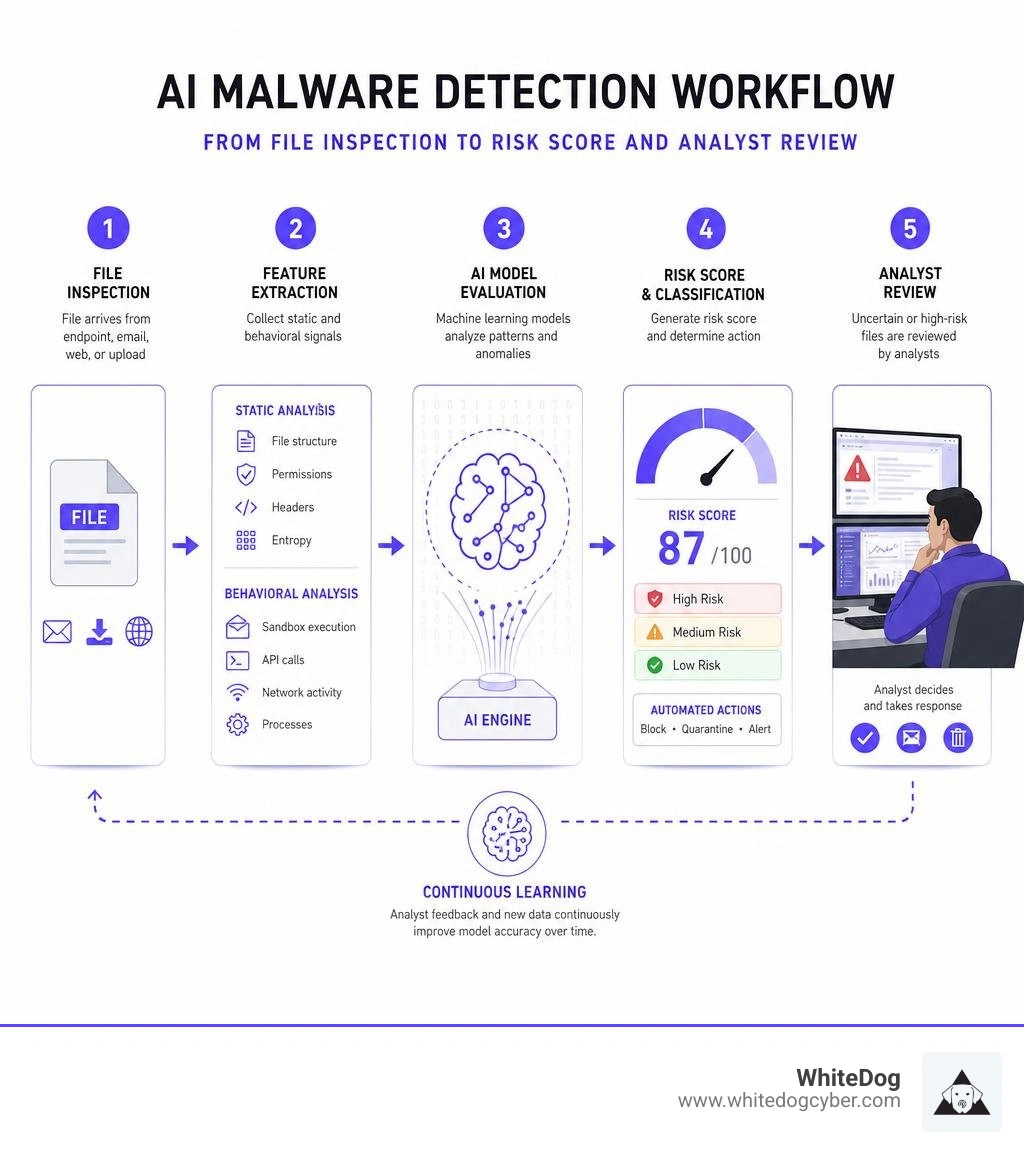
AI based malware detection helps security teams identify suspicious files and activity without relying only on known file hashes or signatures. A practical approach is to:
This matters because attackers can alter code, pack files, or create new variants that do not match an existing signature. AI models can learn patterns in raw bytes, PE headers, Android permissions, network flows, API calls, and even binary files converted into grayscale images. These methods can improve detection of previously unseen and polymorphic threats, but they still need careful tuning to control false positives and false negatives.
For enterprise teams, AI detection works best as part of a layered program rather than a stand-alone tool. WhiteDog's Open XDR provides unified visibility and detection across Microsoft and third-party tools, while MDR, XDR, and Delta Detection & Response (DDR) add fully managed 24/7 SOC capabilities with incident response included. Built on correlated intelligence, continuous attack surface management and 24/7 security operations help teams identify threats earlier and respond with confidence while extending existing Microsoft security investments.
I am Shahin Pirooz, a cybersecurity and cloud-services executive with more than two decades of experience building managed technology services and security programs. In this guide, I will explain AI based malware detection in practical terms for leaders who need stronger outcomes without adding more operational complexity.
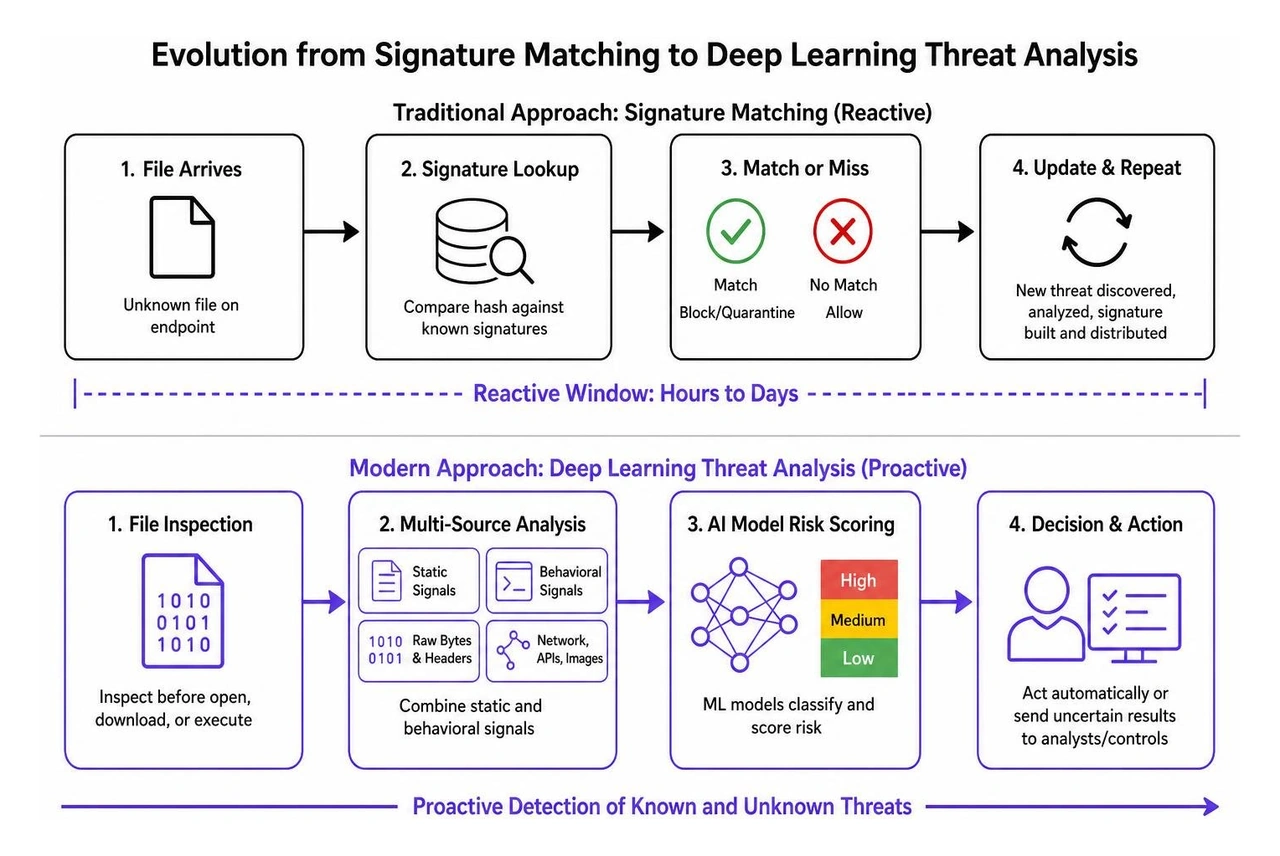
Traditional antivirus technologies rely on deterministic signature matching and static hash databases (like SHA-256 or MD5 lookups). When an unknown binary arrives on an endpoint, the signature scanner compares its hash against a repository of known malicious files. If an exact match exists, the engine flags and quarantines the file.
This model creates a fundamental structural vulnerability: someone must become a victim first. Once a victim falls prey to a threat, researchers analyze the binary, extract an indicator of compromise (IoC), generate a signature, and distribute definition updates worldwide. In modern enterprise environments facing high volumes of novel binaries, this reactive defense window leaves organizations vulnerable for hours or days.
Modern AI based malware detection shifts the security model from reactive lookup to proactive classification. By analyzing file representations through trained statistical classifiers and deep neural networks, machine learning models evaluate structural patterns, code abstractions, and intent before execution.
Adversaries routinely bypass hash lookups using simple obfuscation tactics. Crypters, custom packers, dead-code insertion, instruction substitution, and register swapping alter a binary's surface byte sequence without altering its underlying execution logic.
As highlighted in our analysis of AI and polymorphic attacks, modern threats actively use automated techniques to generate infinite syntactically distinct variations of the same payload. When adversaries modify a single benign byte or compile source code with different seed values, the resulting cryptographic hash changes entirely, rendering static signature databases blind to the threat.
To overcome signature brittleness, modern AI-driven threat detection systems extract telemetry across two operational phases: static feature extraction and dynamic behavioral observation.
Selecting an algorithm for AI threat classification requires balancing inference latency, memory footprint, explainability, and detection accuracy.
Different threat landscapes demand tailored model architectures. In desktop environments (Windows PE binaries, DLLs), classical supervised learning algorithms such as Random Forest (RF) and Support Vector Machines (SVM) deliver high precision when applied to structured header features. In mobile environments, deep neural networks handle multi-dimensional permissions and dynamic traffic flows effectively.
Threat intelligence reports recorded 5.7 million malicious Android packages in 2020, up sharply from 2.1 million in 2019. Benchmark studies on mobile threat detection demonstrate that classical algorithms and sequential deep learning models achieve high accuracy on standard evaluation corpora:
| Algorithm / Architecture | Target Platform | Evaluated Benchmark Dataset | Accuracy Metric | Key Technical Strength |
|---|---|---|---|---|
| Support Vector Machine (SVM) | Android Mobile | CICAndMal2017 | 100.00% ($R^2 = 1.00$) | Optimal hyper-plane separation over normalized network flow vectors |
| Long Short-Term Memory (LSTM) | Android Mobile | Drebin | 99.40% ($R^2 = 0.9739$) | Models long-range sequential API call dependencies |
| Random Forest (RF) | Windows PE (.exe / .dll) | MDAML Corpus | 99.00% (98.63% Val Score) | Fast tabular inference over PE header structural features |
| CNN-LSTM Hybrid | Android Mobile | Drebin | 97.20% | Convolutions capture spatial local patterns; LSTM handles sequence tracking |
| K-Nearest Neighbors (KNN) | Android Mobile | CICAndMal2017 | 90.00% | Instance-based clustering for distinct mobile botnet flows |
In Windows binary triage, the Random Forest model implemented within the MDAML project achieved a 99.13% average training score and a 98.63% validation score across 3,923 evaluated binaries. The model achieved 0.99 precision and 1.00 recall for malicious executables by evaluating critical PE header metrics: section entropy variations, imported functions (e.g., VirtualAllocEx, WriteProcessMemory), and anomalous compilation timestamps.
A major advance in binary classification involves translating raw executable files into non-executable sensory modalities. Converting binary files into graphical images draws inspiration from medical imaging systems that apply deep convolutional networks to identify cellular anomalies in tissue scans and radiographs.

As demonstrated in recent Malformer multi-modal transformer research, unifying multiple orthogonal representations—combining assembly text, Control Flow Graphs (CFG), byte images, and 16 kHz audio waveforms—yielded a 98.3% classification accuracy and a 0.9833 F1-score across 201,549 binary samples. This quadrimodal approach outperformed unimodal baseline detectors by 4.6 to 17.6 percentage points because obfuscation techniques that conceal one modality (such as instruction substitution altering text tokens) rarely mask structural visual textures or control-flow graphs simultaneously.
Deploying machine learning models in enterprise environments requires a multi-tier pipeline to balance low endpoint latency with thorough analysis.
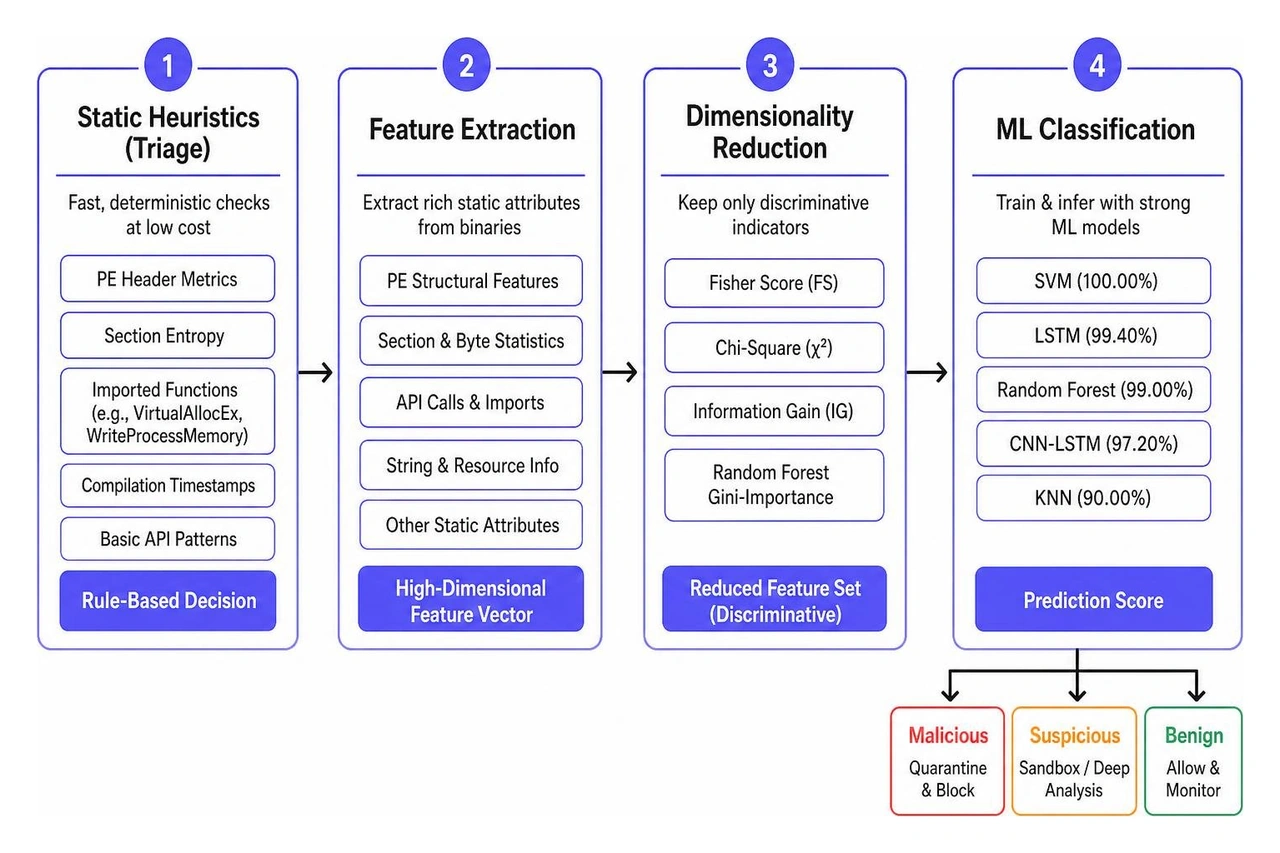
Production security models must process thousands of extracted attributes per binary without suffering from the "curse of dimensionality" or model overfitting.
AI models are trained and validated on industry benchmark repositories:
While academic benchmarks provide standardized baseline environments, production models often face synthetic bias: real-world file feeds exhibit imbalanced benign-to-malicious ratios, corrupt headers, and evasion techniques not captured in curated datasets.
Over time, static ML classifiers experience performance degradation—known as concept drift—as threat actors adopt new compilers, runtime packers, and evasion tactics. For example, standard Gradient Boosted Decision Tree (GBDT) classifiers can see F1-scores drop significantly over a 12-month period as malware packaging evolves.
Recent research demonstrates two methods for mitigating concept drift:
To protect enterprise operations, AI malware detection models must be deployed across entry vectors rather than isolated in offline analysis environments.
Securing file entry points requires pre-execution inspection at the gateway, browser, and email client levels:
Machine learning models face practical challenges in production:
AI systems convert binary files by reading raw, uncompressed 8-bit byte values ($0\text{--}255$) and mapping them directly to 2D pixel coordinates, where each byte value corresponds to a grayscale pixel intensity ($0 = \text{black}$, $255 = \text{white}$). Fixed matrix widths are established based on total file size, converting code sections, imported tables, and resource segments into distinct visual textures. Computer vision models (such as CNNs and Vision Transformers) then analyze these images for structural anomalies, high-entropy packed segments, and known malicious patterns without executing the code.
Signature scanners rely on exact cryptographic hash matches or static byte patterns. Threat actors using automated tools can alter variable names, swap registers, insert junk instructions, and re-encrypt payloads for every target. This changes the file's hash and byte sequence entirely while preserving its malicious behavior. Because static signature databases require an initial victim to create and distribute definitions, they cannot reliably detect novel zero-day variants.
No single algorithm fits every operational scenario. For static analysis of Windows PE files, Random Forest provides an effective combination of high accuracy (over 98%), low computational overhead, and clear feature explainability. For complex dynamic telemetry and mobile application analysis, Long Short-Term Memory (LSTM) networks and hybrid CNN-LSTM models are effective at tracking sequential API calls and network flow dependencies. At enterprise scale, hybrid pipelines that combine static decision trees with dynamic behavioral models deliver the most reliable results.
AI based malware detection provides essential capabilities for identifying zero-day exploits, polymorphic binaries, and novel cyber threats that bypass traditional signature lookups. By combining static feature extraction, visual binary transformations, multi-modal transformers, and behavioral analysis, organizations can detect threats earlier and reduce attack dwell time.
However, standalone detection models are not a complete security program. Sustainable enterprise resilience requires deploying detection capabilities within a unified operations strategy:
By combining continuous attack surface management with 24/7 security operations, WhiteDog Cyber helps organizations correlate intelligence across disparate data feeds, eliminate alert noise, identify malicious activity earlier, and respond with confidence.


Implement data governance to improve data quality, ensure compliance, and reduce risk across your enterprise lifecycle.

Master AWS Security Hub for unified cloud security posture, compliance automation, and streamlined SecOps workflows.

Learn how AWS delta detection response stops cloud alert noise by tracking state drift and securing Delta Lake workloads.

Master modern threat detection with unified visibility across cloud, identity, and AI agents for faster response.

Learn how cloud security protects your data in 2026, covering shared responsibility, zero trust, and posture management to prevent breaches.

Verify AWS KMS FIPS compliance with this step-by-step guide covering FIPS 140-3 HSMs, endpoints, and auditing for regulatory alignment.