Cybersecurity
August 5, 2026
An Essential Guide to Understanding n-Soc Meaning and Its Applications - Learn about n-soc
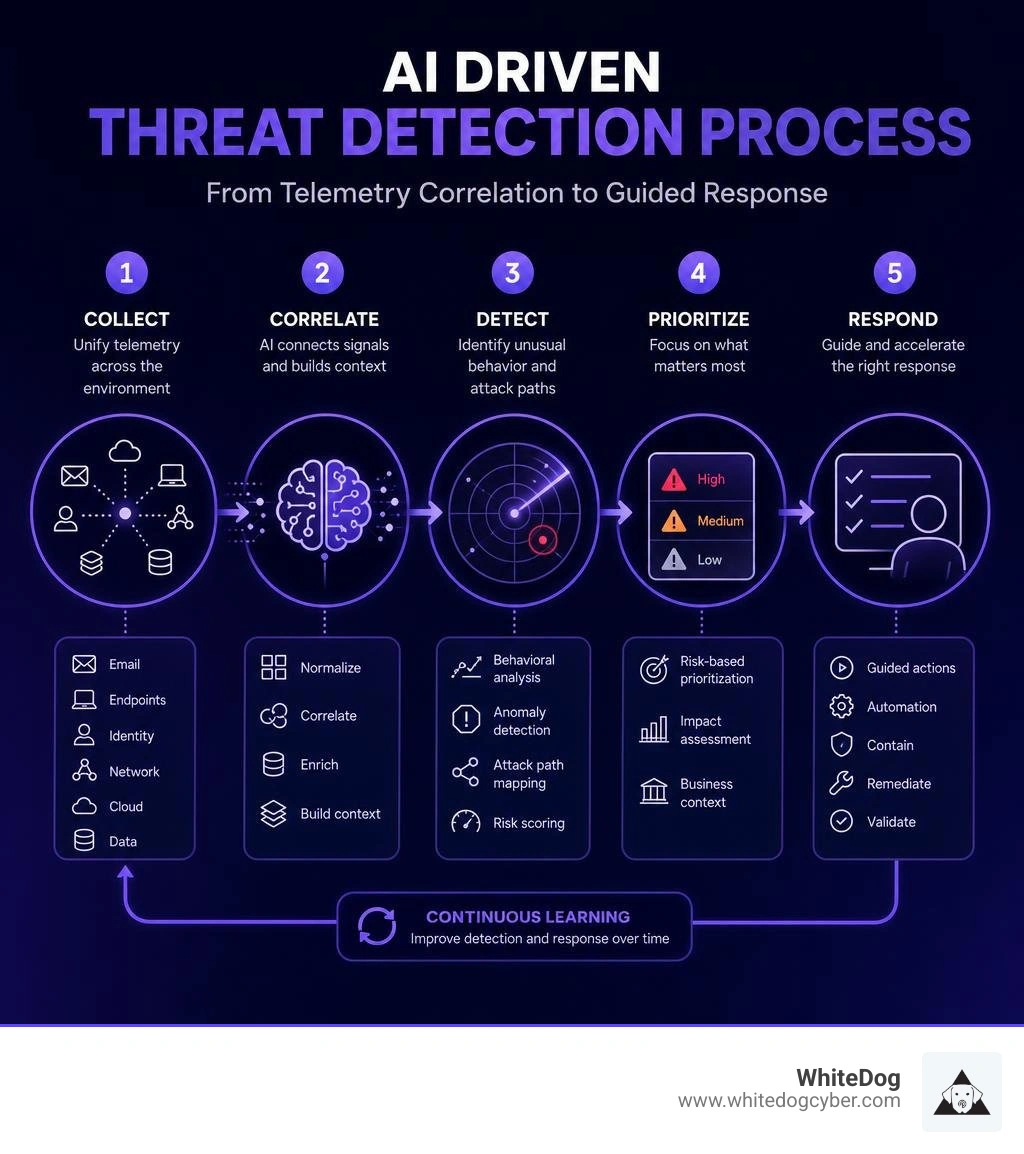
AI driven threat detection uses machine learning and security-focused AI to connect signals across your environment, spot unusual behavior, prioritize real risk, and help teams act before an attack spreads. Instead of reviewing separate alerts from email, endpoints, identity, networks, and cloud services, it correlates that data to reveal likely attack paths and recommend the next best response.
For security leaders, the practical goal is simple: reduce alert noise, find meaningful threats sooner, and give lean teams clearer remediation guidance. Modern systems can also help identify fast-changing risks, including AI-written phishing, fraudulent activity, deepfakes, and attacks that change their code to evade signature-based controls.
The best results come when AI supports a connected security program, not another isolated tool. WhiteDog’s Unified Cybersecurity Platform can extend existing Microsoft and security investments with correlated visibility across email, DNS, identity, endpoint, network, cloud, and data. Its continuous attack surface management and 24x7 security operations use that intelligence to identify threats earlier and respond with confidence.
I’m Shahin Pirooz, a cybersecurity and cloud technology executive with more than two decades of experience building managed security and cloud services. In this guide, I will explain how AI driven threat detection can strengthen security outcomes while reducing operational complexity.
The evolution of security operations has moved from static file signatures to dynamic, predictive modeling. Early intrusion detection systems relied on exact hashes and deterministic heuristics. If an adversary changed a single byte of malware, the entire detection pipeline failed.
To bridge this operational gap, modern defensive architectures rely on advanced machine learning algorithms trained across decades of global telemetry and standardized attack taxonomies. When evaluating AI in the SOC: What's Real, What's Hype, and What's Next, security leaders recognize that real enterprise value stems from context generation rather than generic conversational prompts.
By training models against real-world intelligence and the MITRE ATT&CK framework, modern defensive engines evaluate intent, technique execution, and environmental deviation rather than static indicators of compromise (IOCs).
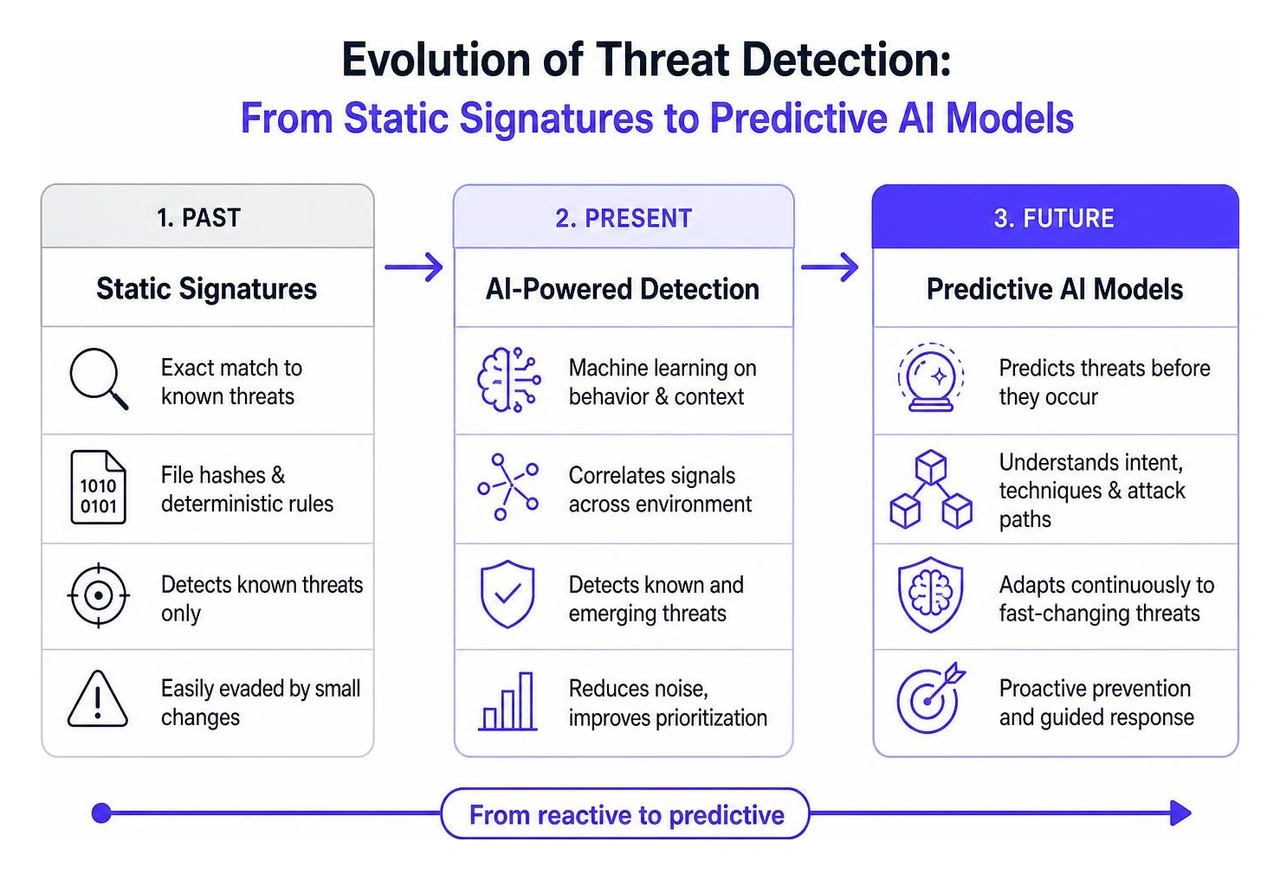
Modern detection platforms operate continuously across multiple operational vectors:
| Capability | Legacy Signature Systems | Predictive AI Threat Detection |
|---|---|---|
| Detection Method | Known file hashes, IP blocklists, and rigid regex rules | Statistical baselines, behavioral analysis, and machine learning models |
| Response Horizon | Reactive (post-execution alerting) | Proactive (pre-exploitation and early-stage containment) |
| Telemetry Context | Isolated per-sensor alerts (siloed visibility) | Unified cross-domain correlation (identity, cloud, endpoint, network) |
| Handling of Novel Threats | Zero efficacy against zero-day or polymorphic variants | Identifies abnormal intent and novel attack paths automatically |
| Analyst Impact | High alert volume, severe alert fatigue, high false positives | Prioritized risk scores, reduced noise, and guided remediation paths |
Threat actors do not move in isolated silos. An intrusion may begin via a phishing email, pivot through an Azure AD identity compromise, traverse the local network via legitimate administrative tools, and ultimately exfiltrate data from an AWS S3 bucket.
Traditional SIEM deployments often struggle to surface these multi-stage tactics because they collect logs without contextual binding. Moving Beyond Traditional SIEM: Actionable Security Intelligence requires unifying telemetry across email, DNS, identity, endpoint, network, and cloud services into a single graph model. Cross-domain correlation transforms millions of isolated event logs into a coherent threat narrative.
A major advancement in security intelligence is the shift toward agentic AI. Unlike traditional, passive machine learning models that simply score alerts, agentic systems use autonomous reasoning to evaluate multi-step incidents, formulate response plans, and execute containment actions within strict policy boundaries.
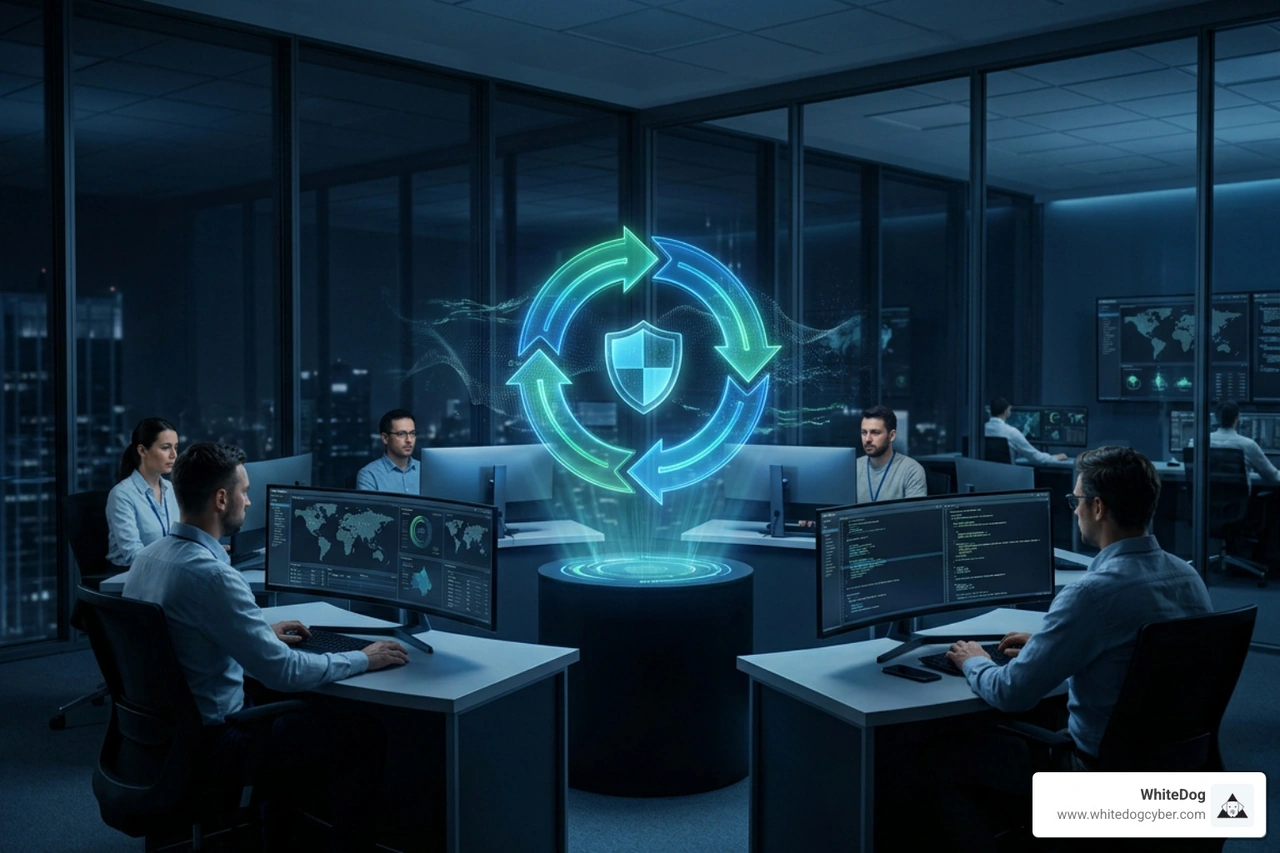
These intelligent agents operate in continuous feedback loops. When novel telemetry enters the system, the agentic engine evaluates the context against global threat research, determines the operational risk, and suggests or initiates precise countermeasures. However, deploying dynamic systems requires rigorous operational oversight, underscoring Why Agentic AI Needs Guardrails to prevent unintended service disruptions.
In high-velocity security operations, seconds matter. While unmonitored Attackers Linger for Months: We Find Them in Minutes when teams leverage correlated telemetry alongside automated triage workflows.
Agentic systems enhance human teams by:
Adversaries are adopting generative models to scale social engineering and malware development. This has created a new class of threats:
Predictive AI systems defend against these techniques by analyzing the underlying behavioral patterns, communication anomalies, and operational metadata rather than relying on static file indicators.
The cybersecurity AI ecosystem broadly divides into two main categories: open-source research models and commercial, enterprise-grade security platforms.
Open-source models (such as those shared on repositories like Hugging Face or GitHub) allow developers and academic researchers to study security-specific Large Language Models (LLMs), test fine-tuning methodologies, and analyze curated vulnerability datasets. These models serve as an essential proving ground for cybersecurity experimentation.
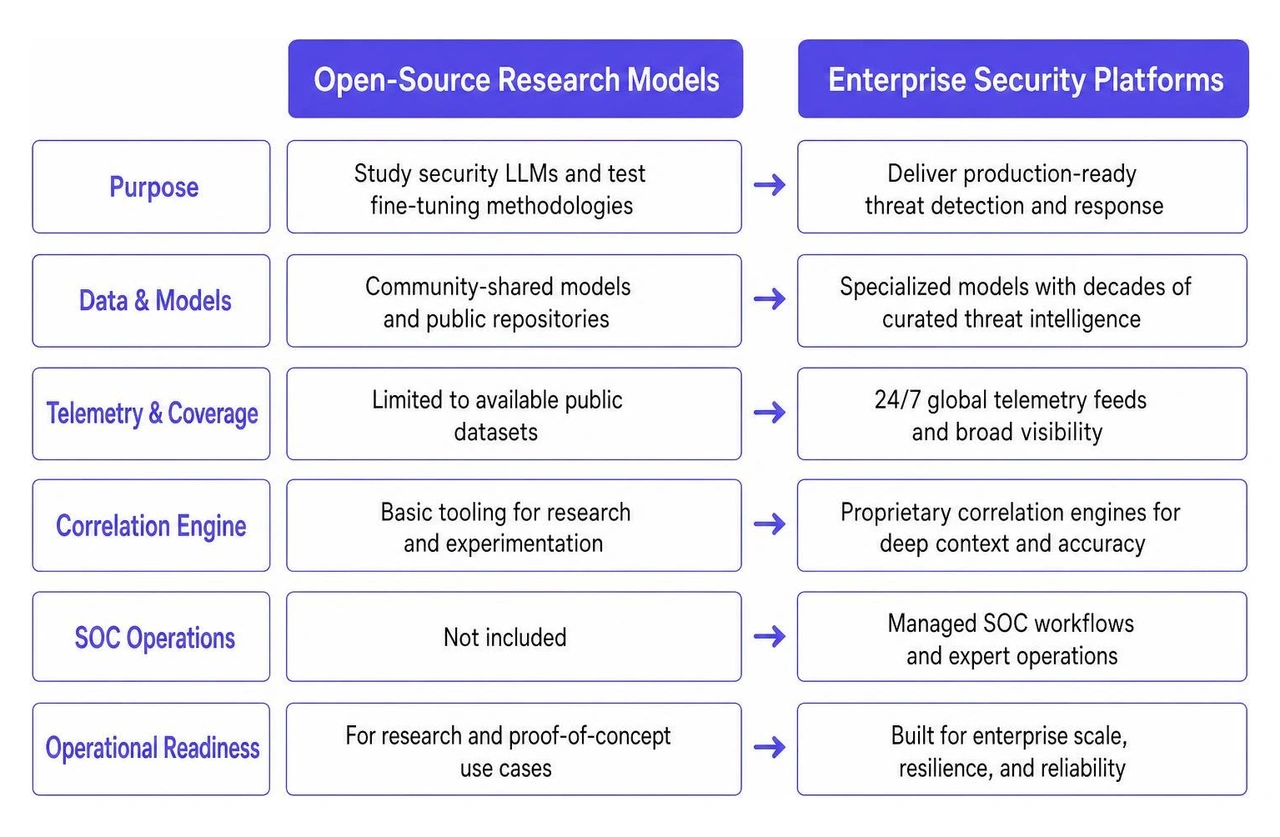
However, enterprise platforms differ significantly in operational capability. Commercial platforms combine specialized machine learning models with decades of curated threat intelligence, 24/7 global telemetry feeds, proprietary correlation engines, and managed SOC workflows to deliver production-ready resilience.
Deploying AI in enterprise environments introduces critical data governance requirements. A primary concern for CISOs and IT leaders is ensuring that proprietary enterprise data, intellectual property, and regulated customer records are never ingested into public training sets.
Enterprise-grade AI security platforms address this through strict data isolation architectures:
When implemented effectively, predictive security AI delivers measurable operational outcomes. In complex environments, such as large healthcare systems and distributed enterprise organizations, AI-driven exposure management and risk calculation enable lean teams to prioritize the vulnerabilities that pose active risk.
Organizations shifting toward next-generation defenses increasingly evaluate Introducing Delta Detection & Response (DDR) as a way to focus on the delta—the meaningful behavioral changes that indicate compromise—rather than drowning in alert noise. Incident response is included directly within MDR, XDR, and DDR, eliminating the need for standalone incident response retainers.
To maximize the impact of AI-driven threat detection:
Traditional heuristics use pre-defined rules and "if-then" logic to identify known malicious behaviors. While effective against slight variations of known threats, heuristics generate high rates of false positives and fail against novel attack vectors. Predictive AI analyzes multidimensional behavioral baselines, intent, and cross-domain telemetry to forecast attack paths and identify zero-day threats before execution.
Yes. Because AI detection models evaluate deviations from normal operational behavior rather than relying on known vulnerability signatures, they can detect the anomalous exploitation techniques, privilege escalations, and persistence mechanisms characteristic of zero-day attacks.
Enterprise-grade platforms enforce strict tenant isolation and use data-scrubbing pipelines. Machine learning models are trained exclusively on curated threat intelligence and vulnerability research. Customer operational data is used only for real-time risk scoring and alert generation within the customer's isolated environment—never for global model training.
Securing modern hybrid enterprises requires moving past disconnected tools and reactive alert triage. WhiteDog provides a Unified Cybersecurity Platform that brings together MDR, XDR, Delta Detection & Response (DDR), exposure management, and complementary security capabilities with correlated intelligence and 24/7 SOC expertise. Incident response is included across MDR, XDR, and DDR to provide active containment without separate retainers.
By delivering unified visibility across email, DNS, identity, endpoint, network, cloud, and data, WhiteDog integrates modularly with your existing security investments—including Microsoft environments—without requiring a rip-and-replace approach. Our continuous attack surface management and 24x7 security operations build on correlated intelligence to identify threats earlier and respond with confidence.
Ready to simplify your cybersecurity operations and strengthen enterprise resilience? Explore advanced threat detection and response platforms with WhiteDog today.

An Essential Guide to Understanding n-Soc Meaning and Its Applications - Learn about n-soc

For MSPs and security teams, the challenge is rarely a lack of tools. It is the opposite: too many disconnected systems producing too many alerts without enough context.

AWS Managed Security Services: Compare Providers Survival Guide - Learn about aws managed security services

Ultimate Checklist for Comparing Cyber Security Managed Service Providers - Learn about cyber security managed service providers
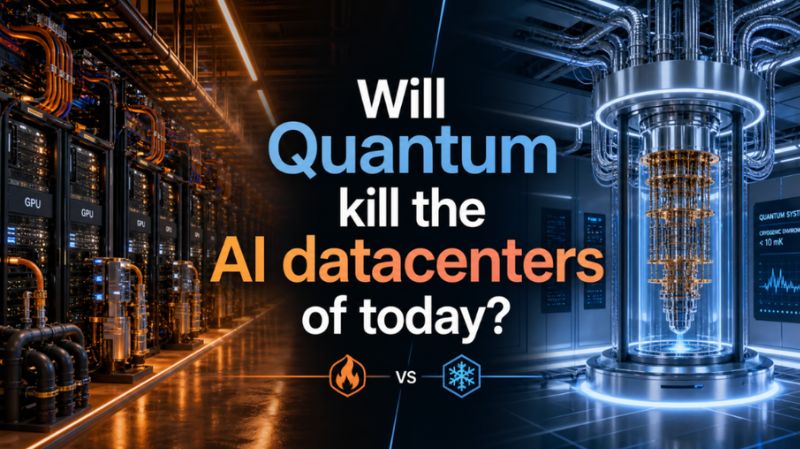
Quantum computing may not replace today's AI data centers overnight, but it could fundamentally change the economics of compute. Learn what comes next.

Discover the top benefits of ZTNA over VPN: enhanced security, reduced attack surface, scalability & seamless access for hybrid work. Ditch VPN now!