Cybersecurity
July 9, 2026
Run better cyber security health checks with MSPs: Boost resilience, cut risks, and ensure compliance via continuous monitoring and NIST-aligned audits.
To run an AWS data governance audit, identify your sensitive data and the AWS accounts that hold it. Review IAM and Lake Formation permissions, check CloudTrail access logs and AWS Config findings, then use AWS Audit Manager to organize evidence against your policies. Assign owners to fix any gaps and monitor for changes.
AWS secures the underlying cloud infrastructure, but your organization must govern how its data is classified, accessed, and used. A repeatable audit helps uncover untracked data copies and permissions that have changed over time, reducing compliance and business risk.
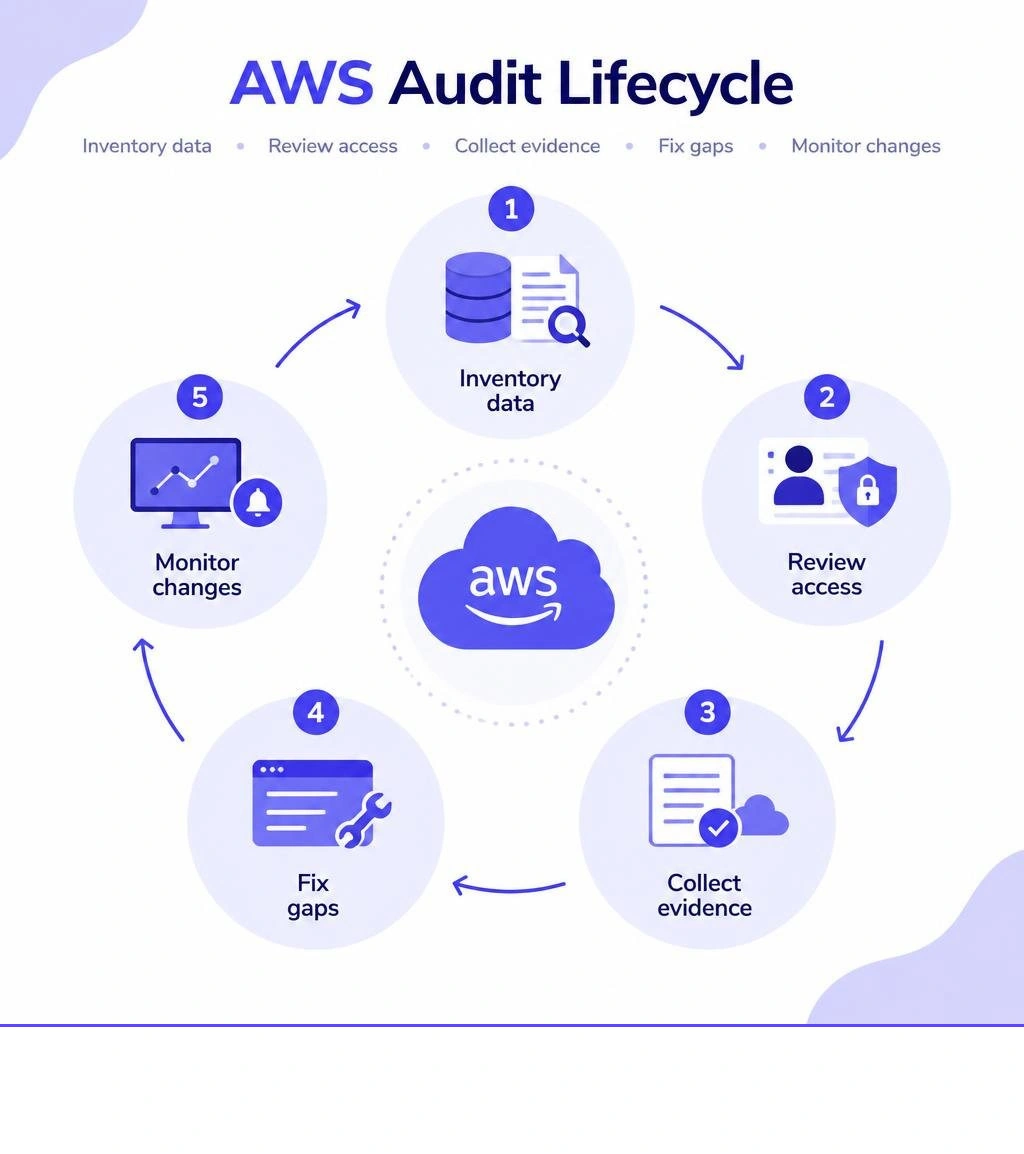
Enterprise data estates on Amazon Web Services expand rapidly as development teams spin up distributed S3 data lakes, Amazon RDS clusters, Redshift warehouses, and OpenSearch domains. While this agility accelerates digital transformation, it often outpaces traditional oversight. Comprehensive data governance provides the operational framework necessary to balance accessibility with control, ensuring data remains discoverable to authorized analysts while preventing unauthorized exposure across multi-account architectures.
According to a 2024 MIT CDOIQ survey of Chief Data Officers, 45% identify data governance as their top strategic priority. However, research from Gartner indicates that only 60% of organizations have implemented a formal governance strategy, leaving 40% struggling with fragmented policies or uncertainty over where to begin. Auditing these environments is the mechanism that validates whether policies translate into real-world technical enforcement.
Without routine validation against an established AWS data governance framework, organizations risk significant data sprawl. Shadow datasets multiply, data lineage disappears, and broad IAM permissions expand the blast radius of potential credential compromises. A structured audit ensures that every data asset across your cloud architecture maintains defined ownership, clear lineage, and appropriate access boundaries.
Cloud data stores represent prime targets for malicious actors. Industry research indicates that 82% of data breaches involve data stored in the cloud, with the average breach costing organizations USD 4.5 million. Furthermore, 67% of breaches are first reported by third parties rather than internal teams, highlighting critical visibility gaps in cloud environments.
Conducting rigorous reviews aligned with audit and compliance in cloud computing allows security teams to systematically uncover vulnerabilities before exploitation occurs. Structured audits map cloud configurations directly to mandatory security compliance standards:
Executing a comprehensive cloud security audit across complex AWS estates introduces distinct operational hurdles:
Addressing these issues requires automated verification and unified logging across every layer of the AWS ecosystem.
Auditing AWS data governance relies on an integrated suite of native services designed to track configurations, log interactions, and evaluate access permissions across distributed accounts. AWS records 600 billion auditing API events daily and processes over 5 billion resource configuration checks each month, illustrating the massive scale at which native tools operate.
| AWS Governance Service | Primary Audit Function | Key Governance Output | Integration Points |
|---|---|---|---|
| AWS CloudTrail | API and user activity logging | Immutable access records, identity audit trails | CloudWatch Logs, Amazon S3, EventBridge |
| AWS Config | Resource configuration tracking | Point-in-time state changes, drift detection | AWS Systems Manager, EventBridge, Audit Manager |
| AWS Lake Formation | Fine-grained data access control | Cell, column, and row-level permission policies | AWS Glue Data Catalog, Amazon Athena, Redshift |
| Amazon Macie | Sensitive data discovery | PII identification, unencrypted S3 bucket alerts | AWS Security Hub, EventBridge |
| AWS Audit Manager | Automated compliance evidence gathering | Audit-ready assessment reports, control mapping | AWS Config, CloudTrail, Security Hub |
Establishing an AWS continuous compliance architecture ensures these tools interoperate seamlessly, feeding actionable configuration data into centralized repositories for ongoing evaluation.
Visibility forms the bedrock of any audit. AWS CloudTrail must be configured as a multi-region organizational trail, capturing management events and S3 data-plane events across all member accounts. Storing these logs in a dedicated, tamper-proof security account with S3 Object Lock prevents log tampering. Utilizing CloudTrail Lake enables auditors to run complex SQL queries directly against years of historical access logs without managing external ETL infrastructure.
Simultaneously, AWS Config records point-in-time configuration snapshots of every storage volume, database instance, and security group. Custom or managed Config rules continuously assess resource alignment with corporate guardrails, flagging non-compliant configurations such as unencrypted EBS volumes or public S3 buckets.
For analytics estates, AWS Lake Formation access governance replaces broad IAM bucket policies with granular access controls. Lake Formation Tag-Based Access Control (LF-TBAC) enables administrators to govern permissions using business metadata tags rather than complex policy strings. Auditors can inspect Lake Formation permissions to verify row-, column-, and cell-level filtering across Amazon Athena, Redshift Spectrum, and Amazon EMR workloads from a single interface.
AWS Audit Manager framework capabilities transform manual audit preparation into an automated, continuous process. The service maps AWS resource configurations and activity logs directly to control requirements defined by industry standards, including HIPAA, GDPR, PCI DSS v4.0, and SOC 2.
Audit Manager continuously queries CloudTrail, Config, and Security Hub to automatically collect compliance evidence. Organizations can also build custom frameworks tailored to internal governance charters. For example, a custom control can track whether all S3 buckets containing customer telemetry enforce KMS customer-managed keys (CMKs) and strict LF-TBAC tagging.
Within multi-account environments managed by AWS Organizations, Audit Manager aggregates evidence into a designated audit account. Team leads use delegation workflows to review control assessments, attach manual operational context, and generate cryptographically verified assessment reports that external auditors can validate for authenticity.
Executing an audit requires a systematic approach to scoping, evidence gathering, policy verification, and remediation.
A reliable data governance architecture requires consistent metadata tagging. Organizations should establish a mandatory tag schema enforced through AWS Organizations Tag Policies:
DataClassification: Public, Internal, Confidential, RestrictedDataOwner: Engineering, Finance, AnalyticsComplianceScope: GDPR, HIPAA, PCI-DSS, NoneRetentionPeriod: 90-Days, 1-Year, 7-YearsAuditors must review tag compliance via AWS Config rules (required-tags). Research shows that targeting a 95% resource tagging compliance rate provides the necessary foundation for scalable automated governance.
Next, verify cryptographic standards. Data stores must enforce encryption at rest utilizing FIPS-compliant AWS KMS key management with defined key rotation schedules, avoiding default shared keys for sensitive datasets.
Finally, audit identity boundaries. Utilize IAM Access Analyzer to identify cross-account trust configurations and public resource shares. Review IAM policies to replace wildcard (*) actions on data APIs with specific, least-privilege permissions, ensuring developers access datasets solely through approved service roles. For operational automation on instances handling governed pipelines, ensure baseline controls like the Amazon Linux firewall are audited alongside cloud-native access policies.
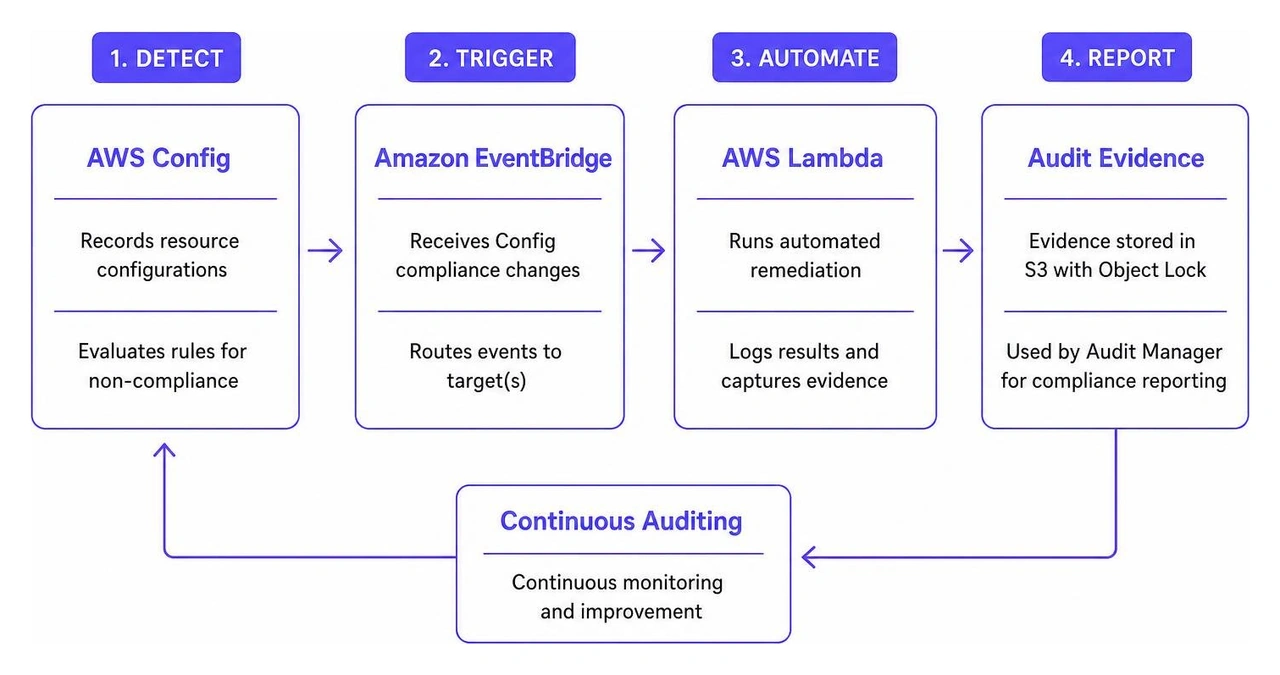
Modern cloud auditing relies on active, continuous remediation rather than passive, manual observation. Pair detection services with automated correction pipelines to eliminate configuration drift instantly:
Automating policy enforcement reduces the manual governance burden by up to 40% in the first year while dropping the Mean Time to Remediate (MTTR) critical compliance gaps to under 24 hours. Incorporating tagging automation strategies ensures resources remain continuously compliant throughout their lifecycle.
The rapid adoption of Generative AI and Large Language Models (LLMs) introduces significant data governance challenges. In an AWS 2025 Chief Data Officer study, 59% of respondents agreed that the volume of work required to prepare data for generative AI implementations is daunting, while 39% cited data challenges like cleaning, integration, and storage as primary barriers.

Auditing AI workloads ensures that sensitive enterprise information is not inadvertently ingested into public models or exposed across training datasets without authorization.
Auditing data pipelines feeding Amazon SageMaker, Amazon Bedrock, and analytics engines requires specialized governance checkpoints:
Unsupervised data growth leads to unmanaged repositories. Amazon Macie leverages machine learning and pattern matching to continuously scan Amazon S3 buckets, discovering and classifying sensitive data such as personally identifiable information (PII), credentials, and financial records. Macie findings feed directly into AWS Security Hub, alerting teams to exposed sensitive objects.
Simultaneously, AWS Glue Data Quality automates data validation by evaluating datasets against defined rulesets (e.g., uniqueness, completeness, freshness). Ensuring high data quality prevents flawed data from corrupting downstream machine learning models or executive reporting.
These automated profiling metrics populate the AWS Glue Data Catalog, giving data stewards centralized dashboards to monitor data reliability, lineage, and compliance postures across the entire organization.
Tracking quantitative metrics is essential for evaluating governance progress and demonstrating audit readiness to leadership.
Organizations should monitor specific key performance indicators to track governance effectiveness over time:
To systematically evaluate your data architecture, leverage prescriptive guidance for data assessments alongside the AWS Well-Architected Framework Data Analytics Lens and Machine Learning Lens. This structured technical assessment evaluates your data pipelines across five foundational areas:
Conducting periodic reviews against the Well-Architected framework provides a clear gap analysis, guiding ongoing technical hardening as detailed in our cloud security guide for 2026.
Organizations should maintain continuous, automated audit monitoring using AWS Config, CloudTrail, and Security Hub to detect drift in real time. Formal audit reviews—including comprehensive access recertifications, evidence compilation in AWS Audit Manager, and Well-Architected reviews—should occur quarterly. In addition, major architectural modifications, cloud migrations, or new regulatory compliance cycles should automatically trigger an out-of-band audit review.
AWS Config evaluates specific technical configurations of AWS resources against predefined rules in real time (e.g., verifying whether an S3 bucket is encrypted). AWS Audit Manager operates at the compliance governance layer, automatically aggregating findings from AWS Config, CloudTrail, and Security Hub and mapping that technical data directly to external regulatory frameworks (like SOC 2, HIPAA, or GDPR) to produce auditor-ready compliance reports.
AWS Lake Formation centralizes data security policy definition across S3 data lakes and integrated analytical engines (Athena, Redshift, EMR). Instead of auditing individual S3 bucket policies and IAM roles across multiple accounts, auditors inspect a single, unified permission matrix within Lake Formation. Lake Formation enforces and logs cell-, row-, and column-level access controls, providing definitive proof of exactly which users and roles accessed specific data elements.
Building an effective data governance audit strategy on AWS requires moving away from point-in-time spreadsheets toward an automated, continuous compliance model. By pairing visibility services like AWS CloudTrail, Config, and Lake Formation with the automated evidence collection of AWS Audit Manager, organizations can systematically reduce breach risk, secure sensitive AI pipelines, and maintain compliance across distributed environments.
Managing complex cloud telemetry across evolving enterprise environments requires deep operational expertise. WhiteDog Cyber helps organizations simplify cybersecurity operations through a unified platform that connects visibility, detection, response, and risk management.
WhiteDog's Unified Cybersecurity Platform brings together MDR, XDR, our top-tier Delta Detection & Response (DDR) offering, exposure management, and complementary capabilities to deliver unified visibility across email, DNS, identity, endpoint, network, cloud, and data. Incident response is built directly into MDR, XDR, and DDR without requiring separate incident response retainers. By integrating natively with services like AWS Security Hub, WhiteDog correlates disconnected cloud signals into high-fidelity intelligence.
Combining modern automation with skilled human analysis reduces repetitive work, eliminates alert fatigue, and helps teams prioritize critical exposures. WhiteDog’s continuous attack surface management and 24x7 security operations build on correlated intelligence to identify threats earlier and empower enterprise teams to respond with confidence. Explore how our unified security operations and continuous posture management can protect your critical cloud data assets today.


Run better cyber security health checks with MSPs: Boost resilience, cut risks, and ensure compliance via continuous monitoring and NIST-aligned audits.

Discover how cyber security health checks strengthen your defenses, reduce risk, and support compliance across regulated industries and SMEs.

Discover co-managed security for MSP: Share responsibilities, boost efficiency, and scale cybersecurity without losing control.

Master your CMMC compliance assessment with this definitive guide covering levels, timelines, and certification requirements for DoD contractors.

Master CMMC compliance certification for DoD contractors. Guide to levels, assessments, timelines & prep for FCI/CUI security.

Master internet threat protection with layered defense strategies that reduce risk and stop modern attacks before they compromise your enterprise.