
Cybersecurity
August 14, 2026
Compare MSP MDR detection services to reduce dwell time and boost efficiency with a unified 24/7 SOC platform.
Achieving and verifying AWS KMS FIPS compliance requires ensuring cryptographic operations execute within AWS KMS's native FIPS 140-3 Level 3 hardware security modules (HSMs) and configuring client connections to target FIPS-validated regional endpoints (such as setting use_fips_endpoint = true in the AWS CLI or SDKs). While AWS KMS automatically protects key material inside validated hardware boundaries, end-to-end compliance mandates connecting via TLS endpoints terminated by certified cryptographic modules.
Federal Information Processing Standard (FIPS) 140-3 defines baseline security requirements for cryptographic modules across federal and regulated environments. According to the technical design documented in AWS Key Management Service - AWS KMS Cryptographic Details, all KMS key generation, signing, verification, and symmetric wrapping take place entirely within hardened cryptographic boundaries. Cryptographic operations occur strictly inside volatile memory, ensuring zero plaintext key exposure to persistent storage.
The AWS KMS HSM fleet operates on a distributed architecture designed for 99.999999999% (eleven 9s) durability. Every customer master key (CMK) is encrypted under an internal domain key hierarchy before being committed to persistent storage. When an API call such as Encrypt, Decrypt, or GenerateDataKey arrives, the encrypted key token travels to an authenticated HSM over an encrypted communication channel.
Inside the HSM, the domain key decrypts the customer key inside volatile memory. The requested cryptographic operation completes, the resulting ciphertext or data key is returned to the user, and the volatile memory is immediately cleared. Under the audited security parameters described in the FIPS 140-3 Non-Proprietary Security Policy, the module enforces physical zeroization routines that purge all active cryptographic variables if physical tampering or environmental anomalies (such as voltage or temperature fluctuations) are detected.
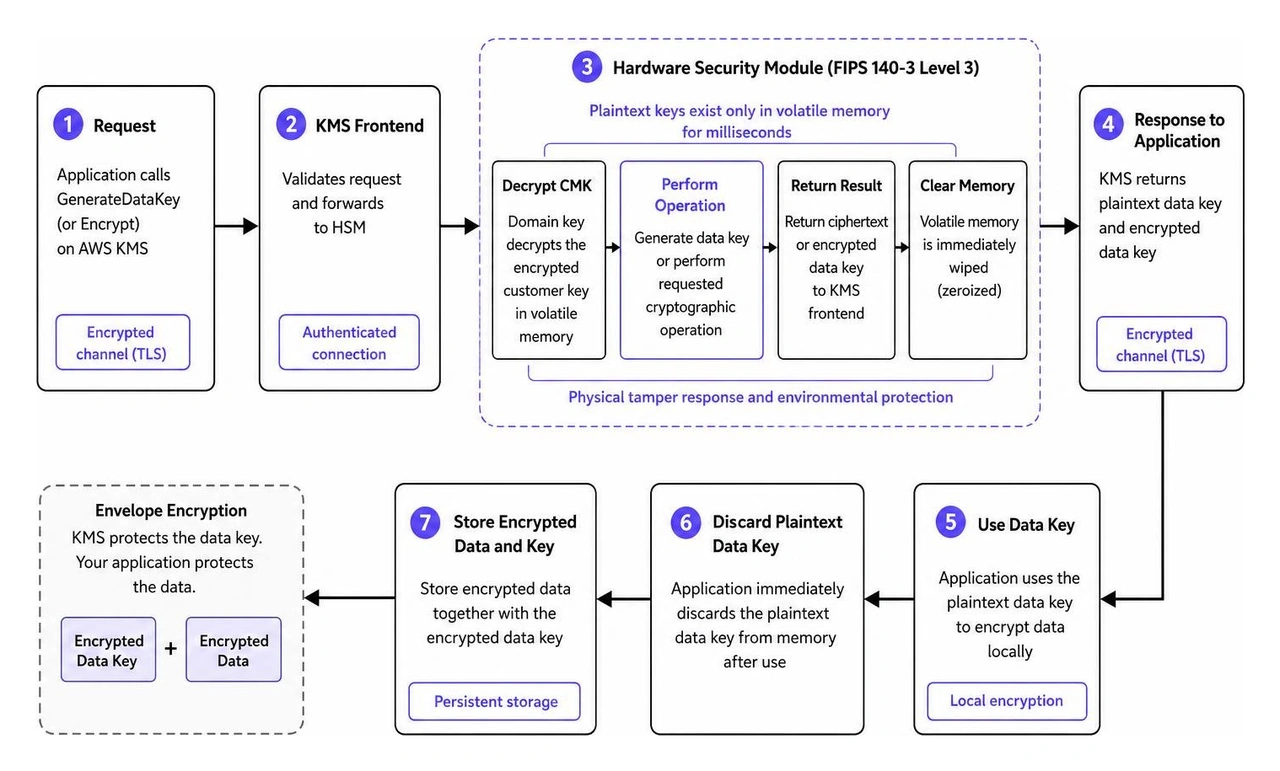
This structure powers envelope encryption, where KMS generates a unique plaintext data key alongside an encrypted copy of that data key. Your application uses the plaintext key to encrypt large volumes of data locally (avoiding the 4 KB direct KMS payload limit) and then immediately discards the plaintext key from memory, retaining only the encrypted version alongside the data.
Historically, AWS KMS operated under FIPS 140-2 Level 2 overall validation, achieving Level 3 ratings only across select sub-categories such as physical security and authentication. Under the updated NIST cryptographic validation program, AWS KMS transitioned to full FIPS 140-3 Security Level 3 validation across all applicable module categories.
As outlined in the AWS KMS Level 3 transition overview, moving from FIPS 140-2 Level 2 to FIPS 140-3 Level 3 introduces several technical advantages:
This level of validation gives enterprises complete cryptographic assurance without the administrative burden of provisioning and managing custom cryptographic appliances.
Choosing between AWS KMS and AWS CloudHSM historically created a trade-off between operational simplicity and strict regulatory certification. Because AWS KMS now delivers FIPS 140-3 Level 3 compliance out of the box, organizations can achieve high-tier compliance without incurring the management overhead of single-tenant hardware.
| Feature / Requirement | AWS Key Management Service (KMS) | AWS CloudHSM |
|---|---|---|
| Validation Level | FIPS 140-3 Security Level 3 | FIPS 140-3 Security Level 3 |
| Tenancy Model | Multi-tenant logical isolation | Single-tenant dedicated hardware |
| Key Exportability | Root keys cannot be exported in plaintext | Full control over key export / PKCS#11 |
| AWS Service Integration | Native across 100+ AWS services | Requires custom application logic or proxy |
| High Availability | Managed automatically across AZs | Customer-managed cluster synchronization |
| Operational Overhead | Serverless, fully managed | Firmware patching, capacity scaling, backups |
| Disaster Recovery | Multi-Region keys with automatic replication | Manual cross-region cluster configuration |
For workloads that require direct access to PKCS#11, JCE, or Microsoft CryptoNG APIs, or where an enterprise security policy strictly dictates single-tenant physical isolation, AWS CloudHSM remains an essential service. However, for most compliance mandates, AWS KMS fulfills the hardware-level security requirements at a fraction of the architectural complexity.
Validating an encryption architecture against modern regulatory standards requires demonstrating both algorithm correctness and key lifecycle control. AWS KMS FIPS validation directly maps to major compliance requirements:
AWS KMS operates FIPS 140-3 Level 3 validated HSMs across all standard commercial AWS Regions and AWS GovCloud (US) Regions. When deploying workloads globally, security teams must note one key exception:
In the AWS China (Beijing) Region (operated by Sinnet) and the AWS China (Ningxia) Region (operated by NWCD), the underlying HSMs are certified under the State Cryptography Administration (OSCCA) Commercial Cryptography standards rather than NIST FIPS 140-3. If your enterprise operates across international boundaries, ensure compliance policies accommodate sovereign regional cryptographic standards where NIST validation is legally superseded.
Meeting FIPS compliance requirements involves two components: validating that key operations occur inside certified HSMs (handled automatically by KMS) and configuring your clients to connect over FIPS-validated transport endpoints.
Connecting to a standard KMS endpoint routes requests over TLS, but regulatory frameworks like FedRAMP often require the TLS session itself to be terminated by an independently validated cryptographic module. Detailed technical endpoint specifications are maintained in the Federal Information Processing Standard (FIPS) 140-3 - Amazon Web Services documentation.
To route API traffic through FIPS-validated endpoints, configure your SDKs and CLI to target the regional FIPS subdomain or enable system-wide FIPS modes.
When using the AWS CLI, you can direct traffic to the regional FIPS endpoint by adding the --endpoint-url flag or enabling the global FIPS setting:
Option A: Global Configuration via AWS CLI ProfileConfigure your AWS configuration file (~/.aws/config) to enforce FIPS endpoint resolution automatically across all supported services:use_fips_endpoint = true
Option B: Environment Variable DeclarationFor containerized applications or Lambda functions, set the environment variable:AWS_USE_FIPS_ENDPOINT=true
Option C: Explicit Regional Endpoint TargetYou can directly target the regional FIPS endpoint in your API calls, such as:kms-fips.us-east-1.amazonaws.com
For deeper implementation questions on client-side behavior, consult the official FAQs | AWS Key Management Service (KMS).
When establishing connections to KMS FIPS endpoints, the TLS handshake requires TLS 1.2 or TLS 1.3 with approved cipher suites offering perfect forward secrecy (PFS), such as ECDHE-RSA-AES128-GCM-SHA256 or ECDHE-ECDSA-AES256-GCM-SHA384. For private networking without exposure to the public internet, establish an AWS PrivateLink interface VPC endpoint targeting the KMS FIPS endpoint inside your VPC.
As quantum computing architectures advance, standard asymmetric algorithms like RSA and elliptic curve cryptography become vulnerable to Shor's algorithm. AWS KMS incorporates hybrid post-quantum key agreement schemes into its transport infrastructure.
KMS supports hybrid post-quantum TLS using algorithms like ML-KEM (formerly Kyber) and post-quantum digital signature standards such as ML-DSA (formerly Dilithium) alongside classical algorithms:
This hybrid approach ensures that systems deployed today maintain backward compatibility while remaining resilient against "harvest now, decrypt later" adversary campaigns.
Achieving compliance is not a point-in-time configuration; it requires continuous auditing and exposure management. Because cryptographic keys represent the root of trust for cloud data, unauthorized key policy changes or anomalous decryption volume can indicate severe risk.
Every action taken against a KMS key is captured in AWS CloudTrail. A compliant monitoring configuration should audit:
Decrypt, GenerateDataKey, and ReEncrypt events to identify unusual data access volumes or unapproved IAM roles attempting access.PutKeyPolicy, ScheduleKeyDeletion, and DisableKey actions, which could indicate privilege escalation or attempts to disrupt service availability.Enterprise cloud environments often span thousands of identities, multiple accounts, and hybrid resources. Misconfigurations in KMS key policies—such as overpermissive wildcards in the Principal block—can expose data across organizational boundaries even when the underlying HSM remains completely secure.
Maintaining visibility requires continuous posture assessment. At WhiteDog Cyber, we deliver continuous attack surface management and 24×7 security operations building on correlated intelligence to identify threats earlier and respond with confidence.
Our Delta 360 (Δ360) platform, built on an Open XDR framework, adds a unified operational and security layer across Microsoft and third-party tools to improve correlation, visibility, security hardening, threat detection, exposure management, and response. Rather than requiring a rip-and-replace approach, our platform emphasizes modular integration, complementing and extending Microsoft environments to help organizations maximize their existing Microsoft investments.
When evaluating cybersecurity operations, enterprises must recognize distinct service boundaries:
By combining unified telemetry ingestion with 24/7 human analysis, security operations teams eliminate alert noise, identify compromised cloud credentials before unauthorized KMS API calls can occur, and accelerate remediation workflows across the entire enterprise.
No. AWS manages the underlying hardware fleet transparently. All existing customer-managed keys (CMKs) and AWS-managed keys automatically leverage FIPS 140-3 Level 3 validated HSMs without requiring key recreation, rotation, or infrastructure downtime.
FIPS-validated HSMs represent the secure physical hardware where key material is stored and cryptographic algorithms are executed. FIPS endpoints represent the HTTPS web service interfaces that terminate TLS sessions using FIPS-validated cryptographic software modules (such as the AWS-LC or OpenSSL FIPS modules). True end-to-end compliance requires using both.
FIPS 140-3 Level 3 validated HSMs protect KMS keys in all standard AWS commercial Regions and AWS GovCloud (US) Regions. The only exceptions are the AWS China (Beijing) and AWS China (Ningxia) Regions, which employ hardware security modules approved by China's OSCCA regulatory body.
AWS KMS provides enterprise-grade cryptographic security by combining fully managed key lifecycle controls with FIPS 140-3 Security Level 3 hardware isolation. By verifying regional availability, enforcing FIPS transport endpoints, configuring least-privilege key policies, and enabling continuous audit logging, organizations can confidently meet strict regulatory standards while minimizing infrastructure complexity.
However, robust encryption algorithms are only as effective as the identity controls and monitoring infrastructure that surround them. To protect your cloud workloads against emerging threats and exposure risks, visit WhiteDog Cyber to explore how our unified cybersecurity platform, exposure management, and 24×7 security operations building on correlated intelligence to identify threats earlier and respond with confidence can secure your enterprise.


Compare MSP MDR detection services to reduce dwell time and boost efficiency with a unified 24/7 SOC platform.

Compare MSP MDR platform architecture vs. tool sprawl to reduce risk, improve detection, and scale your security operations.
The Ultimate Guide to Cybersecurity for Small Business - Learn about cyber security for small business

Beginner's Guide to IoT DDoS Risks and Security - Learn about internet of things ddos

An Essential Guide to Understanding n-Soc Meaning and Its Applications - Learn about n-soc

For MSPs and security teams, the challenge is rarely a lack of tools. It is the opposite: too many disconnected systems producing too many alerts without enough context.