Cybersecurity
July 14, 2026
Discover how 24/7 threat response services deliver rapid detection, containment, and recovery to reduce risk and strengthen your security posture.
Modern enterprise architectures demand flexibility, predictability, and scalable oversight. As organizations transition away from legacy infrastructure, cloud based endpoint management replaces maintenance-heavy local servers with turnkey SaaS delivery. This operational paradigm shift enables centralized administration of distributed physical, virtual, and mobile devices regardless of their physical location or network attachment.
A modern SaaS endpoint management platform minimizes administrative burden while extending policy control beyond traditional corporate network perimeters, establishing uniform compliance across global operations.
According to industry standards set by research firms like Gartner, an enterprise-ready platform must deliver specific core operational features to ensure complete lifecycle management:
The shift to cloud based endpoint management removes physical infrastructure constraints and single points of failure. Traditional client management tools required dedicated distribution servers, domain controller dependencies, and heavy VPN bandwidth to push configurations or software updates to off-network users.

Cloud architectures communicate directly over secure HTTPS channels, managing distributed endpoints anywhere an active internet connection exists. Advanced platforms can also leverage local peer-to-peer patch distribution—where one endpoint on a local subnet downloads an update package directly and securely shares it locally with neighbor devices. This dramatically conserves WAN network bandwidth while accelerating deployment speeds.
By utilizing cloud-native elasticity, auto-scaling platforms easily grow alongside your business without requiring costly hardware refreshes. Cloud management platforms significantly reduce infrastructure overhead, with enterprises achieving between $722K and $1.5M in IT infrastructure savings over three years while driving a projected ROI between 94% and 217%.
Transitioning to cloud-native device management delivers tangible financial and operational advantages while elevating the organization's cybersecurity posture.
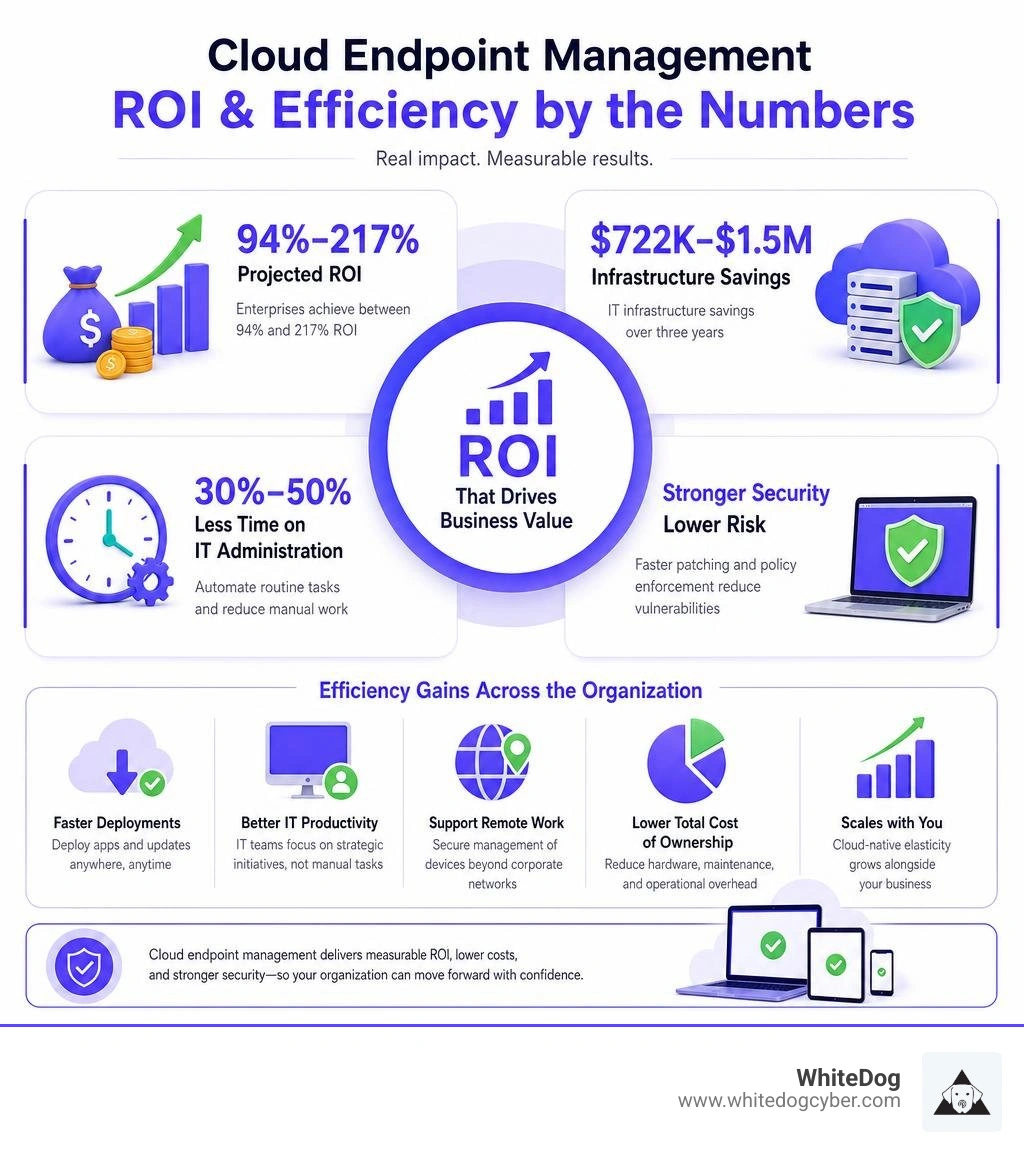
Unpatched software remains one of the primary vectors for initial cyber intrusion across modern IT environments. Maintaining resilience requires active patch management covering operating systems as well as hundreds of third-party enterprise software applications.
SaaS management platforms automate vulnerability scanning, patch testing, and deployment schedules. By continuously assessing risk exposure using standards defined by NIST and threat intelligence feeds, IT operations teams prioritize critical vulnerabilities before attackers exploit them.
Automated patch distribution ensures remote laptops receive security updates promptly, maintaining alignment with Zero Trust principles. While robust management provides continuous operational oversight, true cyber resilience requires recognizing that Endpoint Security Isn't Enough on its own; device posture must be correlated across all enterprise telemetry vectors.
Transitioning device administration tasks to the cloud drastically reduces operational friction and frees up valuable engineering bandwidth:
Deploying a cloud based endpoint management platform across a hybrid or global workforce requires strategic planning, policy alignment, and systematic execution.

Managing distributed devices across home networks, public Wi-Fi, and remote branch offices requires a modern, VPN-free management architecture. Cloud endpoint consoles push over-the-air configurations, policy changes, and application packages straight to devices over standard web connections.
By shifting from traditional perimeter-based security to cloud-delivered identity and baseline configuration policies, organizations achieve operational flexibility without sacrificing security controls. Learn more about Redefining Security in a World With No Edge to understand how perimeterless architectures strengthen remote operational management.
Peer implementation reviews highlight clear best practices for executing a seamless deployment and avoiding common migration pitfalls:
To maintain complete operational integrity, IT leaders must distinguish between operational device administration and active cyber defense, while understanding how both disciplines reinforce one another.
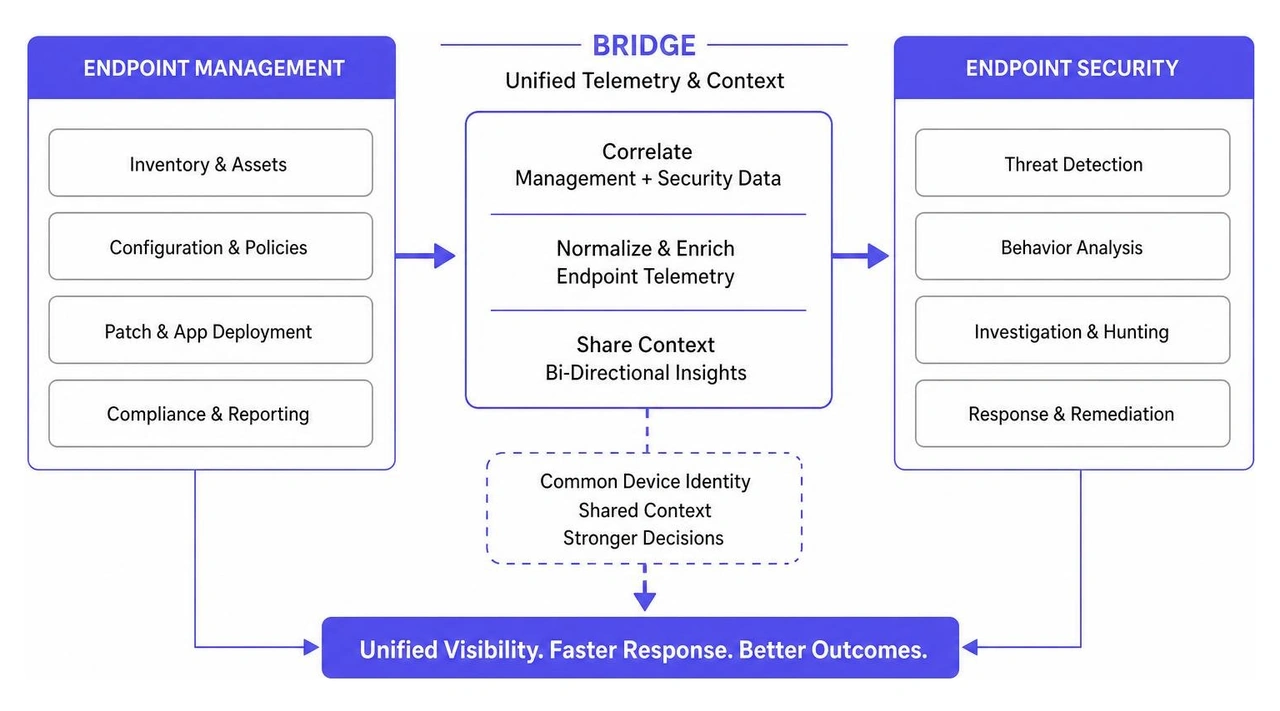
Endpoint management focuses on foundational operational hygiene: provisioning hardware, enforcing configuration baselines, deploying software patches, and tracking IT assets. Endpoint security focuses on detecting active cyber threats, analyzing malicious file execution, isolating infected hosts, and remediating attack activity.
While management platforms keep software updated to minimize the attack surface, sophisticated attackers frequently bypass preventive controls. Achieving true resilience requires integrating operational endpoint data into a broader security context.
Instead of isolating device status in an operational silo, advanced platforms correlate raw security telemetry across email, DNS, identity, endpoint, network, and cloud layers to reveal complete attack chains. Discover how our One Comprehensive XDR Platform unifies telemetry to provide cross-domain visibility.
Modern endpoint management relies heavily on artificial intelligence and machine learning to optimize operations and reduce manual workload:
Cloud endpoint management uses lightweight agent software installed on the endpoint that communicates securely via HTTPS directly with cloud-hosted management services. This allows IT teams to monitor health, deploy patches, enforce configuration profiles, and push software directly to devices over any internet connection, eliminating reliance on internal corporate networks or VPN connections.
Endpoint management is an operational function focused on maintaining device hygiene, asset inventory, patch levels, baseline configurations, and software deployment. Endpoint security focuses on active threat prevention, behavioral threat detection, Incident Response, and threat hunting. While management minimizes the attack surface by keeping systems patched and configured correctly, security monitors for and neutralizes active threats attempting to breach those endpoints.
Automated patch management continuously scans devices for missing operating system and application updates, pushing security fixes as soon as they are released. By removing the delays associated with manual patching workflows, organizations close known security vulnerabilities before threat actors can exploit them, significantly reducing the exposure window for zero-day and unpatched software risks.
Selecting the right cloud based endpoint management platform requires balancing operational automation, remote workforce capabilities, and baseline security controls. Centralizing configuration management and patch automation eliminates manual overhead, streamlines onboarding, and strengthens basic digital hygiene.
However, managing device configurations is only one piece of a robust enterprise defense. Modern threat landscapes require continuous, cross-stack visibility to protect distributed organizations effectively against sophisticated threat actors.
WhiteDog operates as a Unified Cybersecurity Platform and a curated, actively managed security stack where best-in-class tools are integrated through correlation and operated by a 24/7 SOC that continuously investigates, triages, and responds to threats. Unlike traditional SIEM-centric approaches that rely primarily on passive log ingestion and often drown operations teams in uncorrelated alerts, WhiteDog's platform mechanism is built for precision and fast action. The platform collects raw telemetry, filters and deduplicates data, normalizes asset context, enriches events with threat intelligence, and produces prioritized detections. By correlating intelligence across email, DNS, identity, endpoint, network, and cloud layers, WhiteDog reveals complete attack chains within a single unified timeline.
WhiteDog's continuous attack surface management and 24/7 security operations build on this correlated intelligence to identify threats earlier and respond with confidence. For organizations seeking total cyber resilience, WhiteDog supports existing security investments, our curated stack, or both through modular integration without requiring a rip-and-replace approach. Options range from Open XDR for unified visibility and telemetry correlation to MDR, XDR, and our top-tier offering, Delta Detection & Response (DDR). Incident response is included in MDR, XDR, and DDR, backed by a 24/7 SOC to drive down dwell time and protect critical assets around the clock.
Explore Managed Security Solutions to learn how WhiteDog elevates your security strategy.


Discover how 24/7 threat response services deliver rapid detection, containment, and recovery to reduce risk and strengthen your security posture.

Upgrade your MSP email gateway security in 2026. Ditch legacy failures, embrace AI-driven ICES, Zero Trust, and unified protection against phishing & BEC.

Run better cyber security health checks with MSPs: Boost resilience, cut risks, and ensure compliance via continuous monitoring and NIST-aligned audits.

Discover how cyber security health checks strengthen your defenses, reduce risk, and support compliance across regulated industries and SMEs.
Discover co-managed security for MSP: Share responsibilities, boost efficiency, and scale cybersecurity without losing control.
Master your CMMC compliance assessment with this definitive guide covering levels, timelines, and certification requirements for DoD contractors.