Cybersecurity
August 17, 2026
Compare cloud based endpoint management options with this checklist covering security, remote workforce support, and operational efficiency.
Executing a meaningful cloud security audit requires moving past disjointed checklists and establishing a structured, repeatable control program. With the global cloud computing market projected to reach approximately $2.3 trillion by 2030, enterprise attack surfaces have expanded exponentially. Today, 89% of organizations operate in multi-cloud environments, and 73% manage hybrid infrastructures. This scale makes visibility difficult to maintain without foundational architecture.
An effective cloud audit program rests on three integrated pillars: strong governance, posture management across configurations and sensitive data, and continuous threat telemetry. When these components operate in silos, security blind spots emerge. To find your gaps before attackers do, internal audit teams and security leaders must evaluate technical controls alongside operational policies.
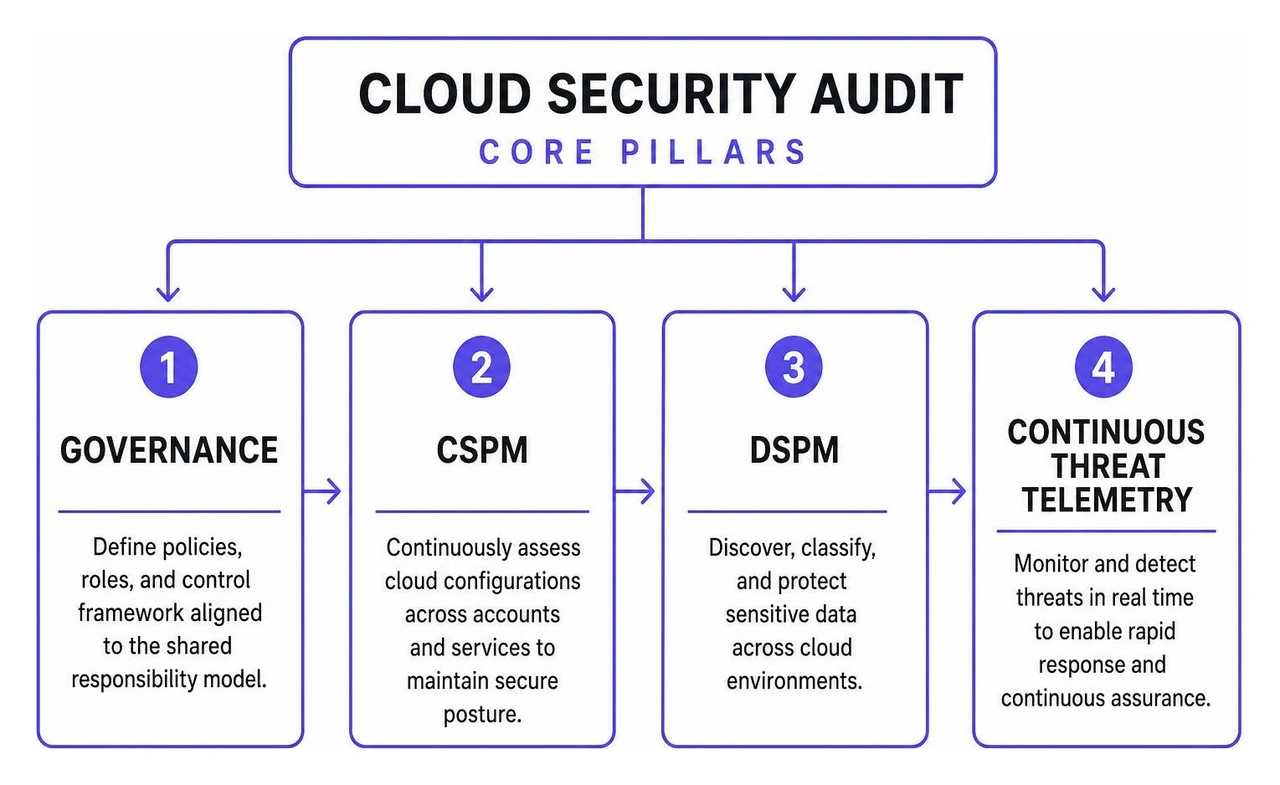
The shared responsibility model forms the cornerstone of all cloud security architecture, yet it remains one of the most frequent sources of audit failure. Cloud service providers (CSPs) secure the underlying infrastructure—the security of the cloud—while the enterprise remains entirely responsible for customer data, access management, operating systems, network configurations, and application workloads—the security in the cloud.
When evaluating cloud program governance, auditors must examine:
Technical evaluation requires continuous visibility across both infrastructure configurations and data assets. Traditional point-in-time reviews often miss the dynamic changes inherent to automated cloud deployments.
Cloud Security Posture Management (CSPM) tools automate the continuous discovery of configuration drift, misconfigured storage buckets, open security groups, and neglected compute instances. Given that 32% of cloud assets are neglected—running unsupported operating systems or remaining unpatched for over 180 days—CSPM provides auditors with objective evidence of baseline compliance.
Data Security Posture Management (DSPM) extends this oversight to data stores. With 38% of organizations maintaining databases with sensitive data exposed to the public, DSPM pinpoints where unstructured and structured sensitive data resides, maps access permissions, and discovers shadow data stores created by automated pipelines.
Connecting posture management with active threat telemetry is essential. A misconfiguration combined with an overly permissive identity creates an immediate attack chain. Understanding the anatomy of a cyber attack: why layered protection matters allows auditors to verify whether detective controls can spot active lateral movement before an incident escalates.
Selecting the appropriate audit framework ensures comparability, consistency, and alignment with regulatory mandates. Rather than building proprietary checklists from scratch, enterprise audit teams should anchor their programs to mature industry standards.
For organizations running multi-cloud environments, leveraging native tools like Google Cloud's Audit Manager overview helps streamline compliance mapping across distinct infrastructure standards.
Each major cloud service provider uses distinct nomenclature, policy structures, and access models. A security group rule in AWS functions differently than a Network Security Group (NSG) in Azure or a VPC firewall rule in Google Cloud Platform (GCP).
| Audit Domain | AWS Native Implementation | Microsoft Azure Implementation | Google Cloud Platform (GCP) Implementation |
|---|---|---|---|
| Identity Governance | AWS IAM Roles, Policies, SCPs | Microsoft Entra ID, Conditional Access | Cloud IAM, Organization Policies |
| Posture Management | AWS Security Hub, Config | Microsoft Defender for Cloud | Security Command Center |
| Data Encryption | AWS KMS, CloudHSM, S3 SSE | Azure Key Vault, Azure Storage Encryption | Cloud KMS, CMEK |
| Activity Logging | AWS CloudTrail, GuardDuty | Azure Monitor, Microsoft Sentinel | Cloud Logging, Cloud Audit Logs |
| Compliance Auditing | AWS Audit Manager | Azure Policy Compliance | GCP Audit Manager |
Standardizing controls across these distinct provider services prevents configuration drift. Periodic assessments often fail to capture ephemeral resources; understanding security drift: why your pen test is already outdated reinforces the necessity of mapping continuous, policy-as-code baselines across every provider.
Organizations must balance internal technical evaluations with objective external assessments. Both approaches offer unique advantages, and high-performing security programs frequently combine both into a unified audit cycle.
| Evaluation Criterion | In-House Cloud Security Audit | Third-Party Security Evaluation |
|---|---|---|
| Context & Knowledge | Deep institutional knowledge of application logic and business workflows. | Objective viewpoint free from internal organizational politics. |
| Operational Cadence | Continuous, integration with sprint cycles and CI/CD pipelines. | Periodic (annual, semi-annual), milestone-driven. |
| Resource Cost | Internal personnel overhead and tooling licensing. | Fixed or variable consulting engagement fees. |
| Primary Value | Rapid detection of configuration drift and process gaps. | Unbiased validation, customer trust, regulatory attestation. |
| Potential Pitfalls | Risk of blind spots and security maturity plateaus: the tool sprawl trap. | Limited contextual understanding of custom internal architectures. |
Cloud security programs cannot audit every control domain simultaneously without exhausting operational resources. A phased, multi-year roadmap establishes control maturity systematically while adapting to emerging technologies like generative AI workloads and automated deployment pipelines.
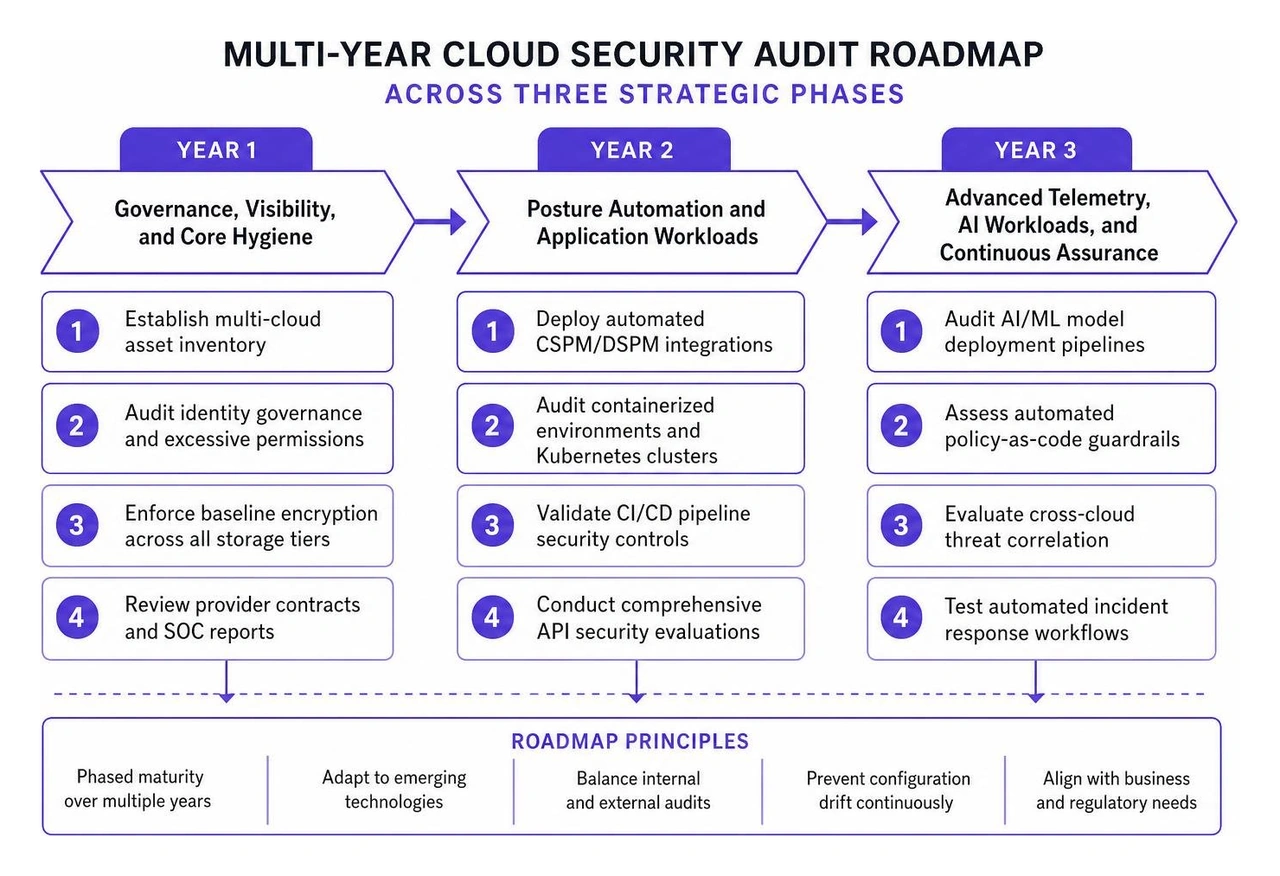

To execute a comprehensive assessment, auditors should follow a structured, phased approach that guarantees rigorous evidence collection and verifiable risk discovery.
Identity is the primary security boundary in modern cloud architectures. Auditing Identity and Access Management (IAM) requires verifying that least-privilege principles are strictly enforced. Internal auditors must evaluate credential sprawl, inspect machine identity roles assigned to compute workloads, and ensure that cross-account access trusts are tightly constrained.
Simultaneously, auditors must evaluate cryptographic hygiene. Encryption must be enforced by default across all storage tiers and databases, with key management policies enforcing automated rotation.
Assessing these defenses against real-world bypasses is critical. Many organizations discover that you passed the pen test and still got breached because basic controls like API token protection, vendor integration scopes, and egress filtering were overlooked during surface-level compliance reviews.
Audit findings must be scored and prioritized according to actual business impact rather than raw vulnerability counts. Combining asset criticality, exposure level, and exploitability helps teams focus on high-risk issues first.
When remediating, security teams should implement fixes directly into Infrastructure-as-Code (IaC) templates (e.g., Terraform, OpenTofu, Ansible) to ensure misconfigurations are permanently eliminated rather than temporarily patched in cloud consoles. Because modern threat actors execute attacks rapidly, attackers will get in. speed is your defense; establishing automated remediation pipelines ensures high-risk exposures are resolved within hours rather than waiting for the next audit cycle.
Modern cloud architectures generate far too much telemetry for manual sampling methods to remain effective. Auditors are increasingly adopting AI-powered tools and open-source automation to analyze configurations at scale.
Next-generation frameworks such as the CloudAudit open-source tool demonstrate how automated pipelines combine deterministic rule checking with semantic AI analysis to discover exposed storage containers, unredacted secrets, and complex configuration flaws across multi-cloud footprints.
Automation enhances the audit lifecycle through:
Deploying intelligent telemetry across the environment fundamentally reduces adversary dwell time. While industry benchmarks reveal that attackers linger for months, we find them in minutes when continuous automated analysis replaces periodic, manual reviews.
The primary objective is to evaluate an organization's cloud environment against established security standards and governance policies. It verifies control effectiveness, identifies technical vulnerabilities and misconfigurations, ensures regulatory compliance, and provides actionable recommendations to minimize enterprise risk.
The most significant challenges include visibility silos across disparate cloud platforms, configuration drift caused by rapid developer deployments, identity and credential sprawl across different provider IAM structures, and managing the complexity of multi-provider shared responsibility models.
Automation replaces manual, periodic sampling with continuous full-population testing. It accelerates evidence collection, dynamically maps configurations against security frameworks, eliminates repetitive manual analysis, and reduces alert fatigue by correlating telemetry into prioritized risk findings.
A successful cloud security audit is not a static compliance event—it is an ongoing operational discipline. By anchoring assessments to established frameworks, integrating posture management with threat detection, and maintaining clear governance across hybrid and multi-cloud footprints, organizations can proactively identify exposures before they lead to operational disruption.
At WhiteDog Cyber, we help organizations simplify cybersecurity operations through a unified platform that connects visibility, detection, response, and risk management. Our Delta 360 (Δ360) platform, built on an Open XDR framework, adds a unified operational and security layer across Microsoft and third-party tools. Rather than requiring a rip-and-replace approach, we complement and extend existing Microsoft Security and Microsoft 365 investments through modular integration, helping organizations maximize their existing infrastructure while enhancing correlation, security hardening, threat detection, and exposure management.
We provide distinct operational offerings tailored to enterprise needs: Open XDR delivers unified visibility and detection across email, DNS, identity, endpoint, network, cloud, and data environments, while our MDR, XDR, and top-tier Delta Detection & Response (DDR) offerings provide fully managed 24/7 SOC capabilities with incident response included without requiring separate retainers. By combining continuous attack surface management and 24×7 security operations with correlated intelligence, our expert analysts help organizations identify threats earlier and respond with confidence.
Whether preparing for an internal evaluation or pursuing structured regulatory readiness like a cmmc compliance assessment, building a resilient cloud posture starts with complete visibility and continuous control validation.

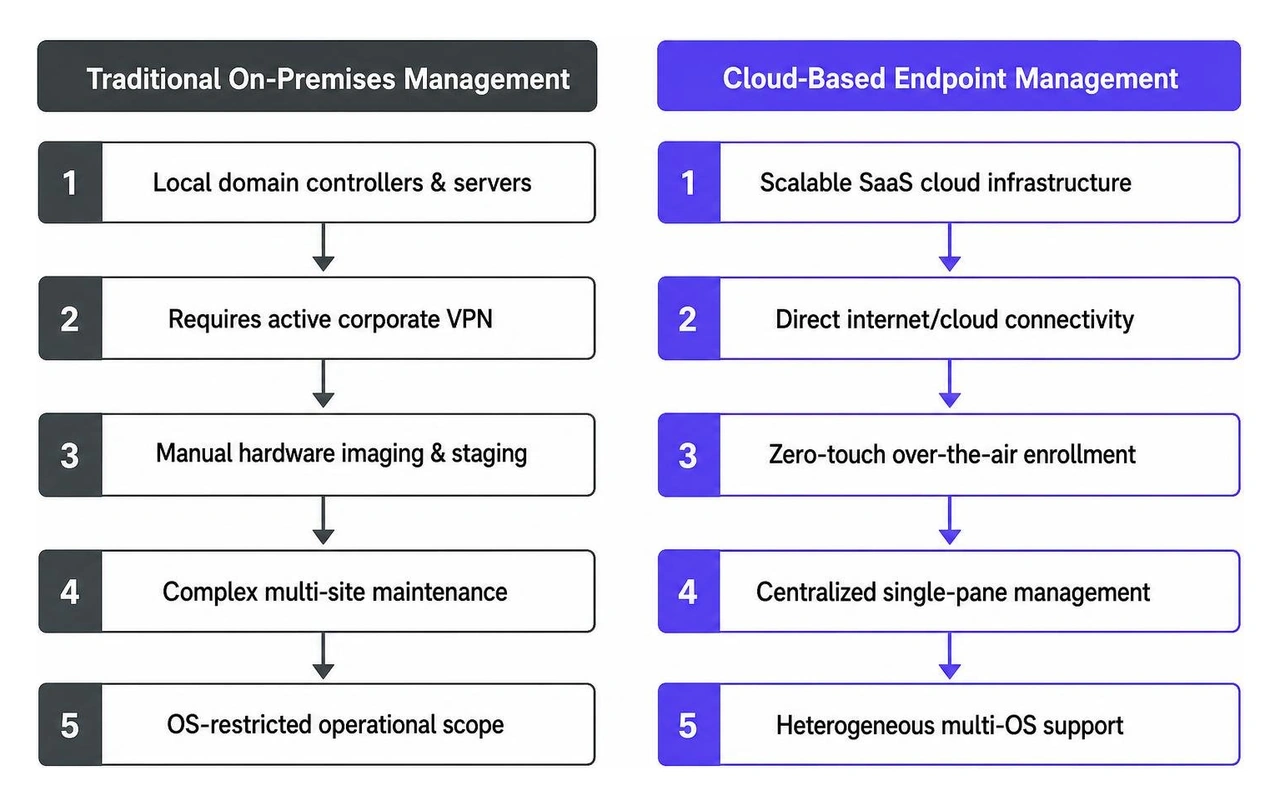
Compare cloud based endpoint management options with this checklist covering security, remote workforce support, and operational efficiency.

Compare MSP MDR detection services to reduce dwell time and boost efficiency with a unified 24/7 SOC platform.
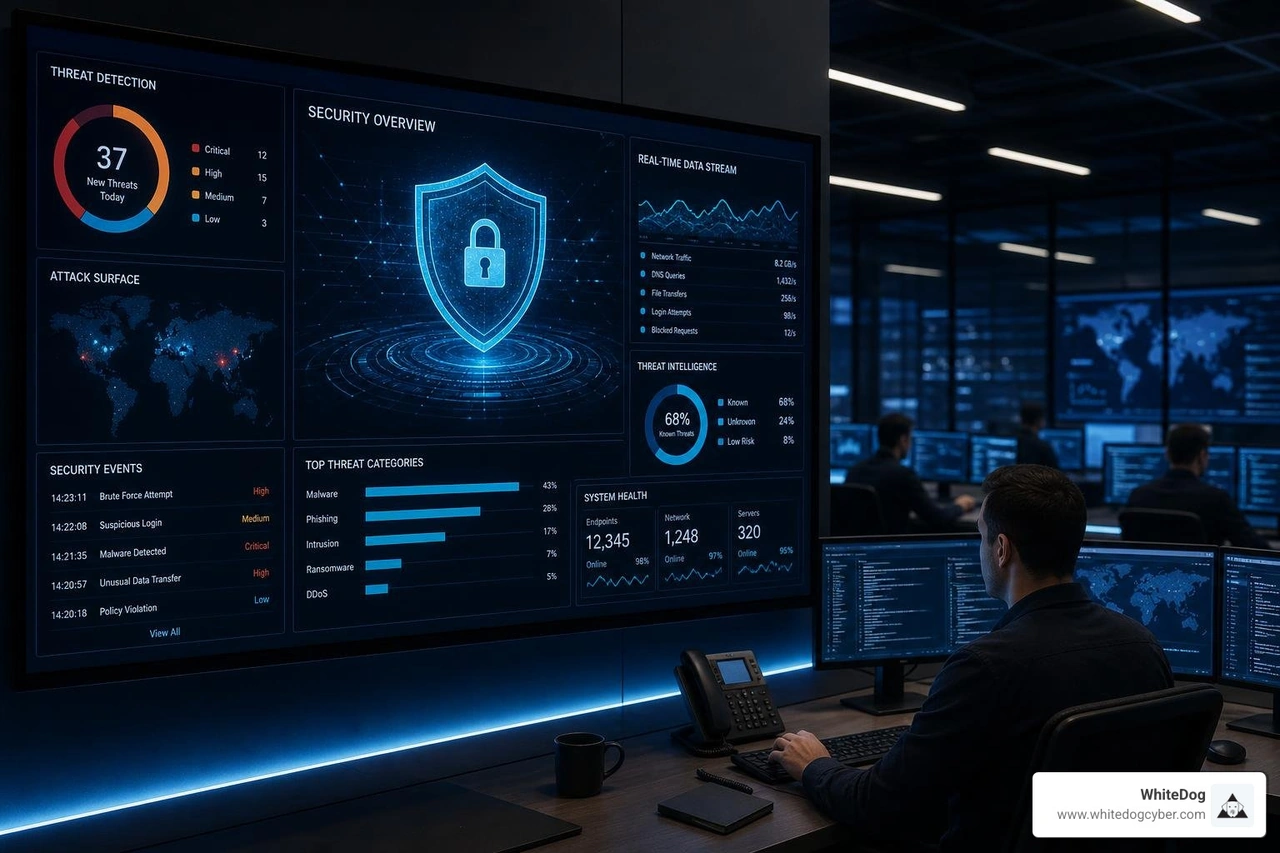
Compare MSP MDR platform architecture vs. tool sprawl to reduce risk, improve detection, and scale your security operations.
The Ultimate Guide to Cybersecurity for Small Business - Learn about cyber security for small business

Beginner's Guide to IoT DDoS Risks and Security - Learn about internet of things ddos

An Essential Guide to Understanding n-Soc Meaning and Its Applications - Learn about n-soc