Cybersecurity
July 29, 2026
AWS Managed Security Services: Compare Providers Survival Guide - Learn about aws managed security services
At its core, endpoint detection & response (EDR) operates as a continuous flight data recorder for endpoints across your infrastructure. The term itself was coined by industry analyst Anton Chuvakin in 2013 to describe a new class of host-centric security technologies that went far beyond passive file scanning. Rather than waiting for a known bad file signature to match, EDR software records process execution, registry modifications, network connections, memory access, and user interactions directly at the host level.
This continuous recording establishes a deep baseline of activity on laptops, servers, and workstations. When suspicious behavior occurs—such as a PowerShell script attempting to dump LSASS memory or an unverified binary initiating outbound connections to a foreign IP address—the EDR solution detects the anomaly, logs the event, and triggers containment protocols. This temporal tracking allows security teams to map out full attack stories, performing thorough forensic analysis and executing targeted threat hunting. To better understand these baseline concepts, you can review our guide on EDR Solution Meaning.
The transition from legacy antivirus to modern endpoint detection & response represents a fundamental shift in defensive architecture. Legacy antivirus relies almost exclusively on static signature detection: if a hash matches a known database of malicious files, it blocks execution. However, modern threat actors bypass signature scanners using fileless malware, polymorphic code, and living-off-the-land techniques (using native administrative tools like WMI or PowerShell).
EDR captures endpoint-system-level behaviors continuously. By assessing threat patterns over time, EDR identifies malicious activity even when no traditional malware payload exists on disk. While legacy tools simply inform you that a file was quarantined, EDR provides a comprehensive timeline showing how the attack gained initial access, what lateral movement was attempted, and what changes were made. Realizing that simple signature checks fail against advanced tactics reinforces why Endpoint Security Isn't Enough.
Cybersecurity risk management has shifted from reactive incident cleanup to Continuous Threat Exposure Management (CTEM). In this paradigm, endpoint detection & response serves as a vital telemetry engine. By continuously recording host behavior, EDR helps lower attacker dwell time—the period an adversary operates undetected inside a network—by catching subtle indicators of compromise early in the attack cycle.
Rather than relying on isolated security alerts that generate massive noise, modern security frameworks integrate endpoint telemetry with broader operational environments. WhiteDog’s continuous attack surface management and 24x7 security operations build on correlated intelligence across your environment to identify threats earlier and respond with confidence. This proactive methodology allows security analysts to perform targeted threat hunting across endpoint telemetry before an adversary can achieve actions on objectives. For organizations evaluating white-label delivery models, exploring a White Label EDR Solution provides valuable operational leverage.
Navigating modern threat detection terminology often feels like wading through an alphabet soup of security acronyms. While EDR, Extended Detection and Response (XDR), and Managed Detection and Response (MDR) share common goals, their technical scope, delivery mechanisms, and operational burdens differ significantly.
| Capability / Dimension | Endpoint Detection & Response (EDR) | Extended Detection & Response (XDR) | Managed Detection and Response (MDR) |
|---|---|---|---|
| Primary Scope | Endpoint host telemetry (laptops, servers, workstations). | Cross-domain integration (endpoint, email, network, cloud, identity, DNS). | Outsources detection, investigation, and response operations across EDR/XDR toolsets. |
| Data Normalization | Host process execution, local logs, host registry, local network. | Multi-vector telemetry correlation and attack chain stitching. | Ingests multi-vector data into a 24x7 SOC workflow. |
| Management Responsibility | In-house IT or security team manages alerts and response. | Managed in-house unless coupled with a managed service partner. | Fully outsourced human analyst team, SOC, and threat hunting experts. |
| Primary Advantage | Deep, granular visibility into endpoint process behavior. | Eliminates cross-tool silos and uncovers complete attack chains. | Relieves internal staff from 24x7 triage, alert fatigue, and threat analysis. |
| Typical Target Organization | Mature internal security teams managing dedicated endpoints. | Complex environments seeking unified multi-vector visibility. | Organizations requiring 24/7 SOC coverage without building in-house operations. |
The fundamental difference between these architectures lies in their data collection scope. Standard endpoint detection & response focuses purely on host telemetry. While this provides unrivaled visibility into endpoint process trees, modern attacks frequently span multiple vectors before reaching an endpoint, such as phishing emails, identity compromise, or cloud misconfigurations.

XDR expands visibility beyond the host, ingesting data from network logs, email gateways, identity providers, DNS, and cloud workloads. As a Unified Cybersecurity Platform, WhiteDog supports modular integration with existing tools, its curated stack, or both—correlating intelligence across email, DNS, identity, endpoint, network, and cloud to reveal full attack chains. For organizations exploring Open XDR capabilities, our platform focuses on unified visibility and detection across existing investments without requiring tool replacement or forcing proprietary software lock-in.
Deploying software is only half the battle; the real work begins when alerts start firing. Managing standalone endpoint detection & response internally requires a mature security team capable of performing continuous triage, investigating complex process trees, and executing containment protocols around the clock.
Unlike traditional SIEM-centric approaches that simply hoard log data and flood dashboards with raw alerts, a true Next-Generation Security Operations Center (N-SOC) platform operates through a refined mechanism: it collects raw telemetry, filters and deduplicates noise, correlates related events, normalizes data to specific assets, enriches events with threat intelligence, and produces prioritized detections.
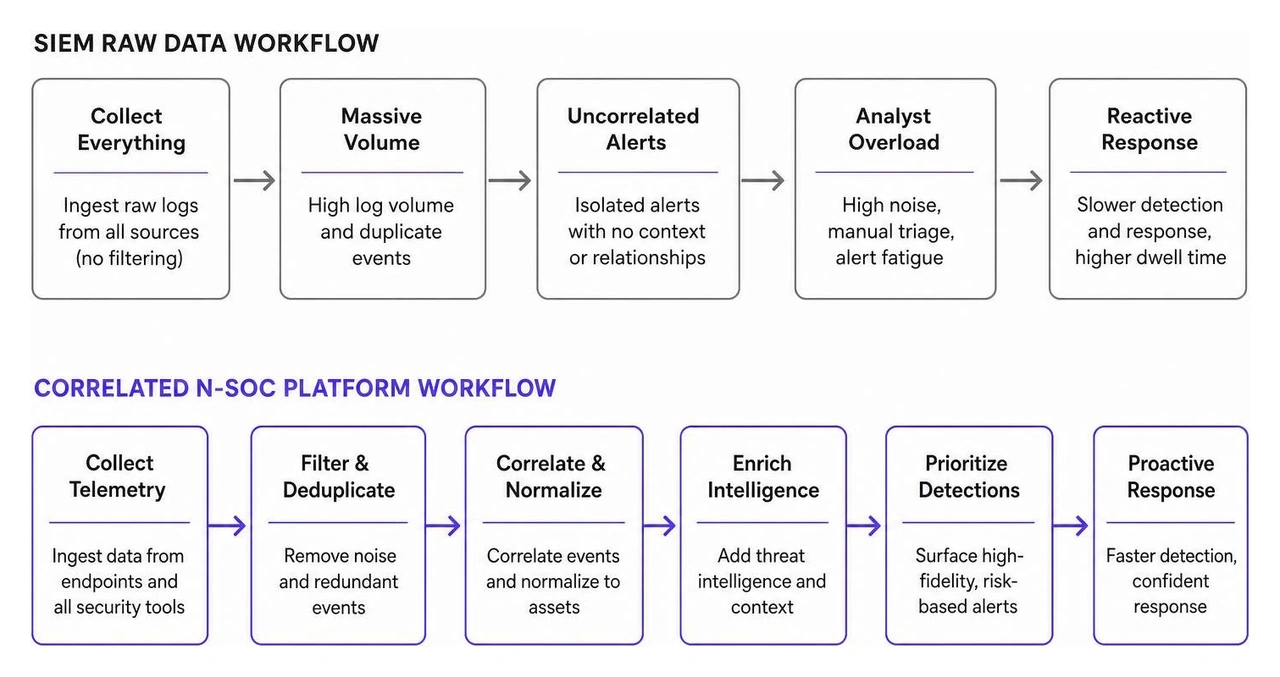
This operational efficiency is where managed services excel. Gartner estimates that 50% of organizations will be using MDR services for threat monitoring, detection, and response by 2025. WhiteDog’s MDR, XDR, and Delta Detection & Response (DDR) offerings feature a fully managed 24/7 SOC with incident response included across MDR, XDR, and DDR, providing human analyst expertise that continuously investigates, triages, and responds to threats. Within our service tiering, Delta Detection & Response (DDR) stands as our top-tier offering, providing complete end-to-end security fabric management and rapid containment across all vectors.
Choosing the right security architecture requires balancing IT maturity, infrastructure complexity, total cost of ownership, and risk reduction objectives.

Standalone endpoint detection & response provides deep, host-centric monitoring and automated containment features (such as network isolation of an infected laptop). It excels at stopping host-based execution of malicious scripts and ransomware encryption routines.
However, standalone EDR has explicit telemetry boundaries. It cannot observe an unauthorized cloud bucket access attempt, a rogue API execution, or an email forwarding rule creation that occurs entirely off the host. Without cross-domain correlation, security teams risk severe alert fatigue—sorting through disconnected host alerts without realizing they stem from a single, broader identity compromise. When organizations lack internal resources to parse these events, exploring specialized Managed Detection and Response Tools or full service partnerships becomes essential.
Successfully rolling out endpoint detection & response requires careful orchestration to maximize protection while maintaining system performance and regulatory compliance.

When deploying EDR across enterprise infrastructure, security teams should adhere to the following framework:
From a regulatory standpoint, EDR plays an essential role in satisfying mandates under frameworks like PIPEDA, HIPAA, PCI-DSS, and CMMC. EDR continuously records host behaviors, generating immutable audit trails and granular forensic logs. These logs allow organizations to prove to regulatory bodies that sensitive data was not exfiltrated during a security incident, fulfilling compliance reporting mandates with empirical forensic data.
While standalone endpoint detection & response offers powerful protection against host-based execution and fileless malware, it is limited by its telemetry boundaries. Adversaries frequently target cloud environments, identity providers, and email systems before ever touching an endpoint. To catch complete attack chains across these non-endpoint vectors, organizations require multi-vector correlation through unified visibility or managed SOC capabilities that oversee the entire threat exposure surface.
EDR solutions continuously track and store endpoint system behaviors, establishing detailed forensic logs of process executions, file access, and network connections. In regulated industries governed by frameworks like PIPEDA or PCI-DSS, these granular logs serve as definitive audit trails. In the event of an investigation, EDR telemetry allows security teams to prove whether sensitive files were accessed or exfiltrated, significantly streamlining regulatory compliance reporting.
Total Cost of Ownership (TCO) extends beyond software licensing fees. Standalone EDR and XDR toolsets require significant internal resource allocation, including hiring, training, and retaining 24/7 security analysts to triage alerts and perform incident response. In contrast, MDR offerings aggregate software and operational overhead into a predictable service model. WhiteDog provides fully managed SOC services with incident response included across MDR, XDR, and Delta Detection & Response (DDR).
Navigating the threat landscape requires moving past legacy signature scanners toward continuous, multi-vector protection. While endpoint detection & response provides essential visibility into host-level attacks, achieving comprehensive defense across modern environments demands unified intelligence that spans endpoints, cloud workloads, identity layers, and network channels.
WhiteDog serves as a Unified Cybersecurity Platform and a curated, actively managed security stack where best-in-class tools are integrated through correlation and operated by a 24/7 SOC that continuously investigates, triages, and responds to threats. Whether supporting your existing security investments, delivering our curated stack, or deploying our top-tier Delta Detection & Response (DDR) offering, our platform reduces operational complexity, slashes attacker dwell time, and delivers true risk reduction.
To see how our platform transforms endpoint telemetry into unified 24x7 security operations, explore our Unified Cybersecurity Solutions.


AWS Managed Security Services: Compare Providers Survival Guide - Learn about aws managed security services

Ultimate Checklist for Comparing Cyber Security Managed Service Providers - Learn about cyber security managed service providers
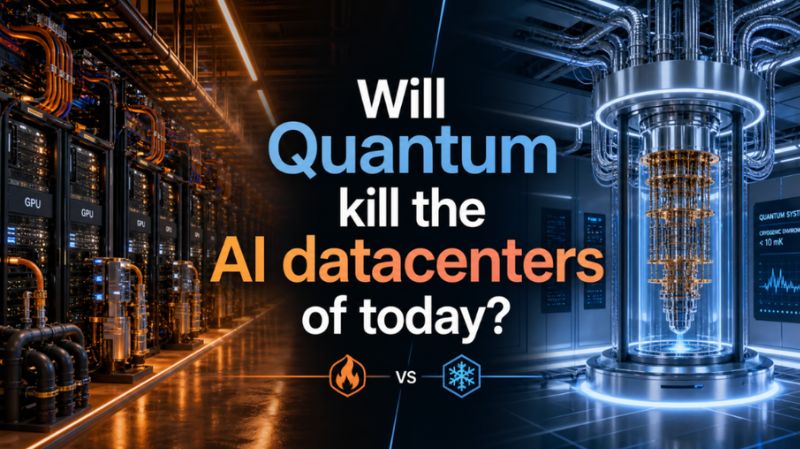
Quantum computing may not replace today's AI data centers overnight, but it could fundamentally change the economics of compute. Learn what comes next.

Discover the top benefits of ZTNA over VPN: enhanced security, reduced attack surface, scalability & seamless access for hybrid work. Ditch VPN now!

Protect your clients with an email threat detection MSP that stops advanced phishing, BEC, and ransomware before damage occurs.

Master cybersecurity incident response training to strengthen enterprise defenses, reduce dwell time, and accelerate threat containment with WhiteDog’s Delta Detection & Response (DDR).