Cybersecurity
September 17, 2026
Verify AWS KMS FIPS compliance with this step-by-step guide covering FIPS 140-3 HSMs, endpoints, and auditing for regulatory alignment.
Internet security threats are malicious acts carried out by individuals or groups to steal data, disrupt systems, or extort organizations. Here is a quick overview of the most critical threats you face in 2026:
Most Common Internet Security Threats:
The scale of the problem is hard to overstate. Cybercrime damage was projected to hit $6 trillion globally as early as 2021. By 2026, the threat landscape has grown dramatically more complex — and faster. The fastest recorded attacker breakout time is now 27 seconds. That is how long it can take for an intruder to move from initial access to your broader network.
What has changed is not just the speed. It is the model. Sophisticated attackers no longer need to force their way in. They log in using stolen credentials, blend into legitimate cloud tools like Google Drive or Microsoft Teams, and persist invisibly for months. Hijacked networks, cryptocurrency heists, and corporate espionage are now everyday occurrences — not headline exceptions.
For MSPs managing security across multiple client environments, this creates a compounding problem. More threats, more tools, more alerts — and not enough time or staff to act on any of it quickly enough.
I'm Shahin Pirooz, a senior cybersecurity executive with over 20 years of experience building managed security and cloud services, and I've spent my career focused on the practical challenge of defending organizations against internet security threats at scale. In the sections below, I'll break down exactly how these threats work, who is behind them, and what a practical, unified defense looks like in 2026.
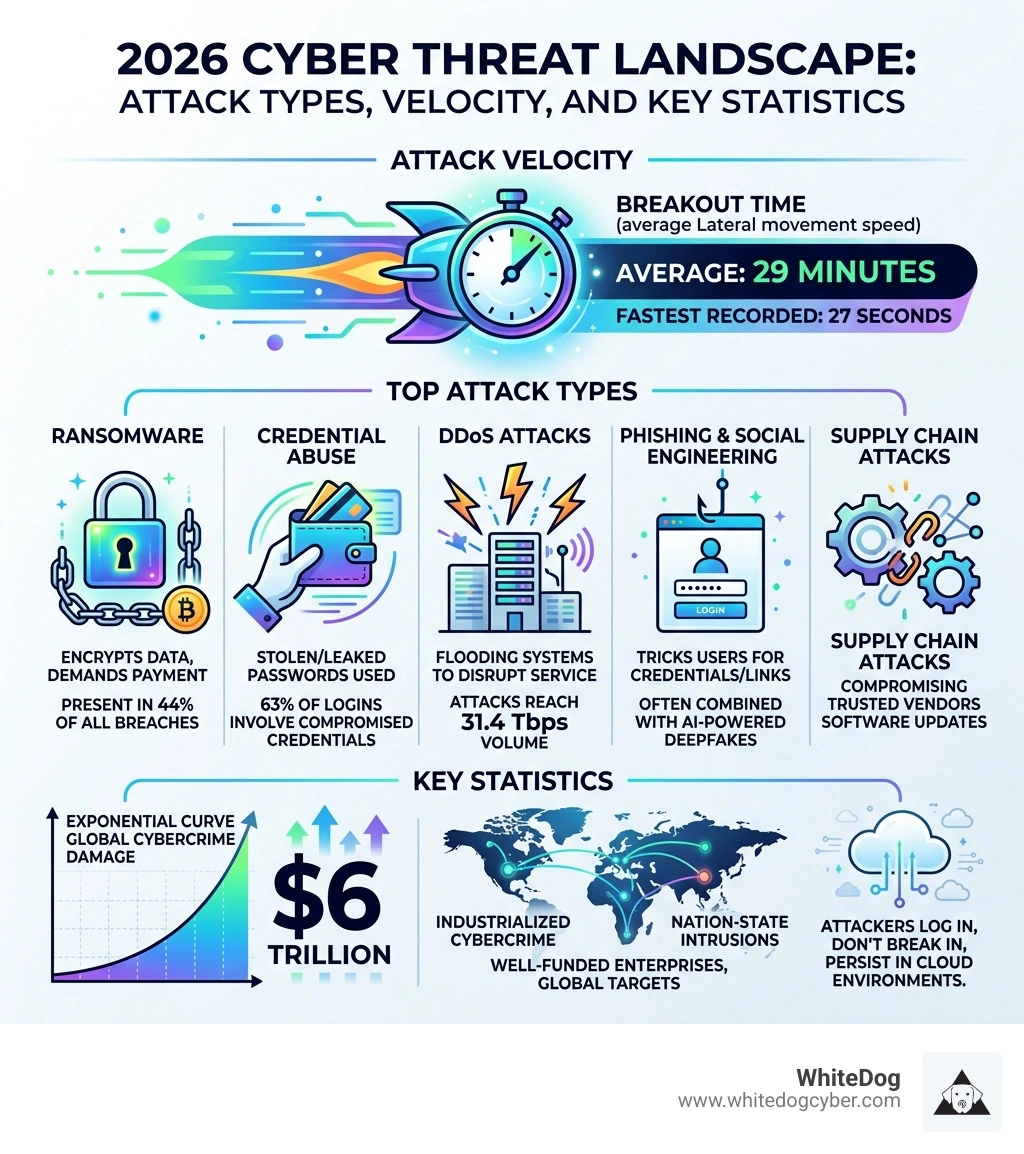
Welcome to the era of industrialized cybercrime. In 2026, we no longer think of attackers as lone hackers in hoodies. Instead, we are up against highly organized, well-funded enterprises that operate with the efficiency of a Fortune 500 company. These adversaries have weaponized the internet, moving away from "brute force" entry toward a model of high-trust exploitation.
The most alarming metric we track is "breakout speed"—the time it takes an attacker to move laterally from a compromised machine to other parts of your network. According to the 2026 Cloudflare Threat Report: How adversaries are weaponizing the Internet, the baseline for massive DDoS attacks has reached a staggering 31.4 Tbps. But it’s the speed of intrusion that should keep you up at night. eCrime actors are now moving from initial compromise to lateral movement in an average of 29 minutes, with the fastest recorded "breakout" occurring in just 27 seconds.
This acceleration is driven by "malware-free" attacks. Today, 82% of detections involve attackers using legitimate tools—like PowerShell or administrative credentials—to navigate your network. They aren't "breaking in"; they are "logging in." This makes traditional antivirus almost useless, as there is no malicious file to detect. To understand why this matters, we have to look at the Anatomy of a Cyber Attack: Why Layered Protection Matters. Without a unified view of your telemetry, these 27-second intrusions happen in the dark, leaving you to find the wreckage weeks or months later.

Artificial Intelligence has reached a critical turning point. It is no longer just a buzzword; it is a force multiplier for internet security threats. Attackers are now using GenAI to automate the discovery of sensitive data and perform "automated fuzzing"—a technique where AI scans millions of lines of code to find vulnerabilities that humans would miss. In one instance, AI-powered fuzzing uncovered a 20-year-old flaw in OpenSSL that had been hiding in plain sight.
We are also seeing the rise of polymorphic malware. This is malicious code that uses AI to rewrite its own signature every time it replicates, making it invisible to signature-based defenses. You can learn more about this in our guide on AI and Polymorphic Attacks: A Growing Cybersecurity Threat.
Perhaps most disturbing is the use of deepfake personas. In 2026, fraudsters are using AI-generated voice and video to interview for remote IT positions, embedding themselves directly into corporate payrolls for espionage. When an attacker is your "new hire," the traditional perimeter simply doesn't exist.
The phrase "Living off the Land" has evolved into "Living off the Cloud." Attackers are increasingly exploiting the "connective tissue" of modern business: SaaS-to-SaaS integrations. By compromising a single over-privileged API, a threat actor can cascade through hundreds of corporate environments.
We see this frequently with "invisible cloud persistence." Attackers use legitimate cloud ecosystems—like Google Calendar event descriptions or Microsoft Teams messages—to host command-and-control (C2) instructions. To a standard firewall, this looks like benign enterprise traffic.
The goal of these attacks is often token theft. Why bother cracking a password when you can harvest an active session token? This allows attackers to bypass Multi-Factor Authentication (MFA) entirely and move straight to post-authentication actions. This shift from Static Trust vs Dynamic Risk: How Attacks Bypass Security highlights why identity—not the network—is the new perimeter.
Cyber threats are no longer just criminal; they are geopolitical. The 2025 Annual Threat Assessment of the U.S. Intelligence Community makes it clear that nation-state actors are "burrowing" into U.S. critical infrastructure to establish destructive capabilities.
These actors often use "Shadow Agents"—foreign IT workers who obfuscate their locations to gain employment at Western firms. This is a massive Shadow Agents: A CIO's Security Blind Spot because these individuals have legitimate access to the very systems they intend to compromise.

Behind most internet security threats lies a thriving eCrime ecosystem. It operates on an affiliate model. You have "Initial Access Brokers" who do the hard work of breaking into a network, then sell that access to "Ransomware-as-a-Service" (RaaS) operators.
This specialization allows even low-skilled criminals to launch sophisticated attacks. The scary part? Attackers Linger for Months: We Find Them in Minutes because our 24/7 SOC looks for the subtle "reconnaissance" signals that occur long before the ransom note appears. In the eCrime world, "dwell time" is an attacker's best friend, giving them time to map your network and exfiltrate data.
If you want to compromise a thousand companies, you don't attack them individually. You attack the one supplier they all have in common. This is the logic behind supply chain attacks. By compromising build tools or code-signing certificates, attackers can inject malware into "trusted" software updates.
| Feature | Phishing | Vishing | Smishing |
|---|---|---|---|
| Medium | Voice Call | SMS / Text | |
| Tactics | Fake links, malicious attachments | Deepfake voice, social pressure | Urgent alerts, fake package tracking |
| Goal | Credential theft, malware | Wire transfers, MFA codes | Quick clicks, mobile malware |
Managing this risk requires a Software Bill of Materials (SBOM) to understand what is actually running in your environment. Hackers love Targeting the Big Get: How Hackers Exploit Key Suppliers & Platforms because it offers the highest return on investment for their efforts.
Ransomware has evolved from simple data encryption to "triple extortion": encrypting data, threatening to leak it on public data leak sites, and harassing the victim's clients or employees.
A major trend in 2026 is the targeting of virtualization infrastructure. Hypervisors (like VMware) are critical blind spots because they often lack Endpoint Detection and Response (EDR) visibility. If an attacker compromises the hypervisor, they control every virtual machine running on it. To defend against this, you must Ransomware-Proof Your Data: Transform Your Microsoft 365 Backup Strategy using immutable, air-gapped backups that attackers cannot delete or encrypt.
Social engineering is no longer just about "Nigerian Prince" emails. It’s about "MFA Fatigue," where attackers spam your phone with push notifications until you click "Approve" out of sheer annoyance.
It’s also about deepfake vishing, where an AI impersonates your CEO’s voice on a call to authorize an emergency wire transfer. Traditional training isn't enough anymore. You need Beyond Phishing Simulations: Real Protection for Email Attacks that can detect the technical anomalies in an email’s metadata, regardless of how convincing the message looks to a human.
So, how do we fight back? It starts with a Zero Trust architecture. The core principle is simple: "Never trust, always verify." Every user, device, and application must be continuously authenticated, regardless of whether they are inside or outside the corporate network.
We also utilize the CISA Known Exploited Vulnerabilities (KEV) catalog. Instead of trying to patch everything, we prioritize the vulnerabilities that are actually being used by attackers in the wild. This is a critical part of Zero Trust in a Bot-Driven World: Securing the Internet's Next Era. Micro-segmentation—the practice of dividing your network into small, isolated zones—is also vital. Think of it like a submarine: if one compartment floods, the others remain dry.
The biggest challenge for CIOs today isn't a lack of tools; it's "tool sprawl." Most organizations have 20+ security products that don't talk to each other. This creates a "swamp" of alerts that overwhelms IT teams.
At WhiteDog, we do things differently. We provide a Unified Cybersecurity Platform that integrates the best-in-class tools into a single, correlated security timeline. Our platform doesn't just collect logs (like a traditional SIEM); it collects raw telemetry, filters out the noise, correlates it to your specific assets, and enriches it with global threat intelligence.
The result? Our 24/7 SOC produces prioritized detections, not just more alerts. Our top-tier offering, Delta Detection & Response (DDR), includes fully managed incident response with no retainers. Whether it’s Open XDR for unified visibility or full MDR for managed response, we focus on the only metric that matters: reducing risk and dwell time.
Explore how WhiteDog simplifies your security stack
The landscape is dominated by credential abuse (63% of logins use leaked credentials), ransomware (now present in 44% of breaches), and AI-driven social engineering. We are also seeing a massive surge in supply chain attacks and hypervisor targeting, where attackers go after the infrastructure that hosts your data rather than the data itself.
Nation-states like China, Russia, Iran, and North Korea provide the "R&D" for the cybercrime world. They develop sophisticated exploits (like zero-days) for espionage. Once these tools are used, they often leak into the broader eCrime ecosystem, where they are used by common criminals for financial gain. They also target critical infrastructure, such as power grids and water systems, to establish "battlefield" advantages.
A cyber incident is any event that compromises the integrity, confidentiality, or availability of an asset (like a malware infection). A data breach is a specific type of incident where sensitive data is confirmed to have been disclosed to an unauthorized party. Not all incidents become breaches, but every breach starts as an incident.
The reality of 2026 is that the "perimeter" is gone. Your network is a target not because you’ve done something wrong, but because you have resources—data, compute power, or financial access—that others want to exploit. The industrialization of internet security threats means that attackers are faster, smarter, and more persistent than ever before.
However, you don't have to face these threats alone. By moving from a "tool-centric" approach to a unified, managed platform, you can reduce your risk and improve operational efficiency. The goal isn't just to build a higher wall; it's to ensure that when an attacker does get in, they are detected and evicted in minutes, not months.
We encourage you to Prepare to Be Hacked by assuming a breach will happen and building the resilience to survive it. Remember: Attackers Will Get In: Speed is Your Defense. Let's make sure your defense is faster than their 27-second breakout.


Verify AWS KMS FIPS compliance with this step-by-step guide covering FIPS 140-3 HSMs, endpoints, and auditing for regulatory alignment.

Navigate security compliance requirements across ISO 27001, SOC 2, and GDPR with a strategic blueprint for sustainable compliance management.

Learn how AI phishing detection stops next-gen attacks that bypass traditional defenses, with practical capabilities to evaluate.

Evaluate your cloud security audit options with this actionable checklist covering multi-cloud frameworks, CSPM, DSPM, and AI-driven automation.

Learn the five pillars of MSP risk reduction to secure operations, manage vendor risk, and build defensible compliance.

Learn how AI based malware detection stops polymorphic threats and zero-day attacks using deep learning, behavioral analysis, and multi-modal pipelines.