Category Name
May 4, 2026
Discover MDR in cyber security: 24/7 monitoring, proactive hunting & rapid response. Bridge skills gaps, beat ransomware—expert guide for 2026.
The best managed detection and response tools don't just generate alerts — they cut through the noise, correlate signals across your entire environment, and put the right humans on the right threats, fast. If you're evaluating MDR options, it is critical to understand how different approaches to detection and response impact your security posture:
| Approach | Primary Focus | Key Capabilities & Outcomes |
|---|---|---|
| Endpoint-Only MDR | Endpoint telemetry (EDR) | Fast device containment; misses cloud, identity, and network vectors |
| SIEM-Centric MDR | Log aggregation and alerting | Broad log collection; high ingestion costs and alert fatigue |
| WhiteDog Unified MDR/DDR | Multi-vector correlation & active response | 24/7 SOC containment; IR included; 30-day onboarding guarantee |
Most organizations reach a breaking point with their current security stack. Tools multiply. Alerts pile up. Your team spends more time managing dashboards than stopping threats. The average cost of a data breach now exceeds $4.4 million — and AI-driven attacks are accelerating at 89% year-over-year. That pressure lands hardest on MSPs trying to deliver enterprise-grade security outcomes across dozens of client environments without burning out their teams.
The shift from traditional managed security services to modern MDR is a shift from alerting to acting. Where legacy MSSPs handed you a ticket, MDR providers hunt, investigate, contain, and remediate — around the clock. The difference isn't just operational. It's measurable in dwell time, breach frequency, and business continuity.
I'm Shahin Pirooz, a cybersecurity executive with over two decades of experience building managed security and cloud services — and managed detection and response tools sit at the center of the platforms I've architected throughout my career. In this guide, I'll break down how these tools work, what separates the best from the rest, and how WhiteDog's unified approach helps MSPs deliver real security outcomes through seamless modular integration rather than a complex rip-and-replace approach.
To understand why modern security leaders are shifting their budgets toward managed detection and response, we must first look at what MDR actually is. Gartner defines MDR services as providing remotely delivered Security Operations Center (SOC) functions for rapid detection, analysis, investigation, and response through threat disruption and containment.
In practice, this means MDR is not just a software package you install and check on once a week. It is an active partnership. It combines advanced, multi-vector technology with around-the-clock human expertise to monitor endpoints, networks, cloud workloads, and identity systems. To explore the foundational concepts of this service, you can read our deep dive on MDR in Cyber Security.
The primary goal of MDR is simple: risk reduction and operational efficiency. By continuously analyzing behavioral telemetry, MDR tools identify malicious activity that traditional perimeter defenses miss, allowing experts to disrupt and contain threats before they turn into full-scale business crises.
For years, organizations relied on Managed Security Service Providers (MSSPs) to watch their digital gates. However, legacy MSSPs operate on a fundamentally different model than MDR.
MSSPs are primarily focused on device management and log aggregation. They monitor your firewalls, collect your logs, and send you an email when something looks suspicious. They "throw the alert over the fence" for your internal IT team to handle. If a ransomware attack begins at 2:00 AM on a Sunday, an MSSP might successfully generate a high-priority ticket. But if your team is asleep, that ticket sits unread while your systems are encrypted.
MDR, on the other hand, shifts the focus from alerting to active response and incident remediation. When an MDR tool detects a threat, the associated SOC does not just send an email; they take immediate, remote mitigative actions. This might include isolating an infected endpoint, revoking compromised credentials, or blocking malicious IP addresses.
For modern MSPs who want to offer these advanced capabilities without the massive capital expense of building a proprietary security operations center, leveraging a co-managed platform is the logical step forward. You can learn more about how this operational model works by reading about MSP SOC as a Service.
There is often a great deal of confusion around the acronyms EDR, XDR, and MDR. It helps to think of EDR and XDR as the engines, while MDR is the driver.
Without MDR, an XDR platform is just another sophisticated dashboard requiring constant attention. Here is a direct comparison of how standalone tools stack up against a fully managed MDR service:
| Capability | Standalone EDR / XDR Tools | Fully Managed MDR Service |
|---|---|---|
| Primary Focus | Software-based telemetry collection | Human-led threat containment & risk reduction |
| Coverage Hours | 24/7 automated collection (no human triage) | 24/7 active monitoring & expert investigation |
| Alert Management | Generates alerts; requires internal triage | Filters, deduplicates, and validates true positives |
| Response Authority | Manual execution by your internal IT team | Automated & human-led remote containment |
| Threat Hunting | Limited to automated, rule-based queries | Proactive, behavioral, and ad-hoc threat hunting |
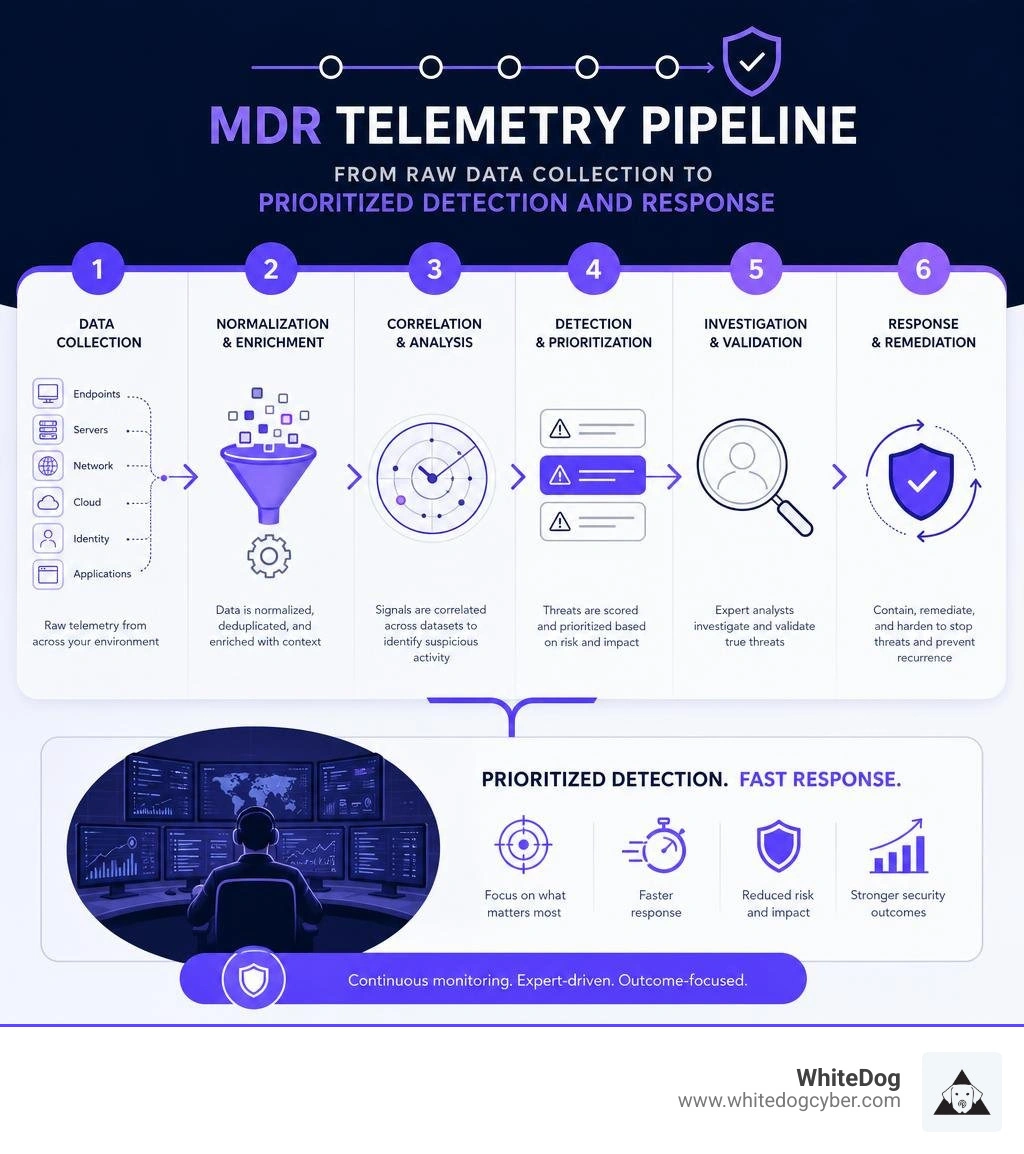
To understand why some security platforms feel like a chaotic storm of false positives while others deliver quiet, predictable protection, we have to look under the hood. The core architecture of a modern MDR platform must ingest massive volumes of data and translate them into a single, cohesive narrative.

When an organization suffers from tool sprawl, security analysts are forced to jump between five or six different consoles to piece together an attack. A compromised user signs into Microsoft 365 from an unusual location, creates an email forwarding rule, accesses a sensitive SharePoint folder, and then pivots to an on-premises endpoint. In a siloed environment, these look like isolated, minor events.
An advanced MDR platform eliminates this blind spot by collecting, normalizing, and correlating these signals into a single, unified security timeline.
The journey from a raw digital event to a validated security response follows a strict, highly engineered pipeline:
By using machine learning alongside behavioral analytics, the platform can identify stealthy, living-off-the-land attacks that do not rely on traditional malware, but rather exploit legitimate administrative tools.
Even the most sophisticated AI models have limitations. In fact, industry data shows that up to 95% of generative AI pilots fail to deliver reliable, autonomous security outcomes. Why? Because adversaries are human, creative, and adaptive.
This is why the human element—the Security Operations Center (SOC)—is the heart of any true MDR service.
When a prioritized detection is produced, our 24/7 SOC analysts step in to investigate. They perform proactive threat hunting to uncover hidden lateral movement, validate whether an anomaly is a true positive or a benign business process, and coordinate rapid containment. This human-in-the-loop model is what reduces dwell time from weeks to minutes, stopping attacks before they can cause material damage.
When evaluating managed detection and response tools, you should look beyond basic alerting and ensure the solution delivers these five core capabilities.

Cybercriminals do not keep business hours. Many of the most devastating ransomware attacks are launched on holiday weekends or in the dead of night when internal IT teams are offline.
Continuous 24/7 monitoring ensures that your environment is never left unguarded. However, passive monitoring is no longer enough. Advanced MDR tools must actively hunt for threats. Threat hunting is a proactive exercise where security experts use behavioral analytics to search through your telemetry for subtle signs of attacker presence that automated rules might have missed, mapping findings directly to the MITRE ATT&CK framework.
Endpoints are the most common entry point for cyberattacks, but they are rarely the only target. Modern threats move fluidly across your entire ecosystem.
By integrating endpoint security, identity and access management (IAM), cloud workloads, and network telemetry into a single correlated timeline, your security team gains complete visibility. If an attacker compromises a cloud credential and attempts to download sensitive data to an endpoint, multi-vector correlation ensures the SOC sees the entire attack path, not just a disconnected endpoint alert.
When a high-severity threat is detected, every second counts. If a malicious process is actively encrypting files on a server, waiting for an internal administrator to log in and review the alert is a recipe for disaster.
The best MDR tools combine automated playbooks with human-led decision-making to execute rapid containment. This includes:
Stopping an active attack is only half the battle. To ensure the adversary cannot simply log back in using a different backdoor, you must understand exactly how they got in.
MDR tools provide deep digital forensics and root cause analysis. Analysts reconstruct the entire attack path, identifying the initial point of entry (whether it was a phishing email, an unpatched vulnerability, or a compromised third-party credential) and providing actionable remediation guidance to close the security gap permanently.
The most effective way to handle a security incident is to prevent it from happening in the first place. Modern MDR services are shifting from a purely reactive posture to an exposure-informed defense.
By combining threat detection with exposure intelligence, these tools help you identify external-facing vulnerabilities, misconfigured cloud assets, and weak identity controls. This allows you to prioritize your patching efforts based on real-world risk, systematically reducing your attack surface over time.
Selecting an MDR provider is not just a technology purchase; it is a strategic decision that impacts your operational overhead, your team's daily workload, and your overall risk profile.
When evaluating potential partners, you should look closely at their integration capabilities, their onboarding timelines, and whether they offer a co-managed model that respects your internal team's expertise. Rather than suggesting a "rip and replace" of your existing investments, we emphasize a modular integration approach that layers seamlessly over your current security stack. To explore how we structure these services to fit different business needs, you can review our core offerings on our solutions page.
At WhiteDog, we believe that security is not one-size-fits-all. We have structured our platform to allow organizations to choose the exact level of management and visibility they need, with incident response (IR) fully included across all tiers:
To learn more about how our advanced tiers compare to traditional market options, you can read our announcement Introducing Delta Detection and Response or explore our detailed piece on A New Cybersecurity Category Built to Close the Gaps XDR Leaves Behind.
The transition to an MDR service should not feel like an invasive, multi-month software overhaul. We designed our onboarding process to be fast, predictable, and frictionless, backed by our 30-day onboarding guarantee with no added fees.
During onboarding, we map your critical business systems, establish clear communication channels, and define joint incident response playbooks. This ensures that when a threat is detected, our SOC and your internal team work as a single, coordinated unit, executing pre-approved containment playbooks without hesitation.
Traditional SIEM (Security Information and Event Management) platforms are notorious for high licensing costs, massive ingestion overhead, and complex maintenance requirements. They collect everything, charge you by the gigabyte, and leave your team to build the correlation rules. This inevitably leads to a flood of poorly prioritized alerts and severe alert fatigue.
WhiteDog bypasses the SIEM bottleneck by focusing on outcomes rather than data volume. Our platform collects raw telemetry, filters out the noise, correlates events across domains, normalizes them to assets, and enriches them with real-time threat intelligence. This process delivers high-confidence, prioritized detections directly to our 24/7 SOC, allowing us to execute active responses rather than simply generating more dashboard noise.
No, MDR does not replace cyber insurance. Instead, they work hand-in-hand. Think of MDR as your building's active fire suppression system, while cyber insurance is your financial policy against fire damage.
In the current threat landscape, insurance underwriters have become incredibly strict. To qualify for a policy—or to keep your premiums reasonable—insurers now routinely require proof of active, 24/7 security monitoring and rapid response capabilities. Implementing a robust MDR solution not only reduces your overall risk of a catastrophic breach, but it also provides the documented compliance and operational readiness that insurers demand.
With many legacy enterprise providers, onboarding can drag on for three to six months as teams struggle to write custom parsers and integrate legacy tools.
WhiteDog eliminates this delay with our 30-day onboarding guarantee. Because our platform is built to integrate seamlessly with your existing security tools, we can connect your telemetry sources, tune our correlation engines to your specific environment, and achieve full operational readiness with our 24/7 SOC within a single billing cycle — with zero hidden setup fees.
The modern threat landscape moves too quickly for manual, fragmented security tools. Relying on disconnected alerts and legacy monitoring systems leaves your organization exposed to rapid, AI-driven attacks that can compromise an environment in minutes.
By consolidating your security operations onto a unified platform, you gain the 24/7 protection, proactive threat hunting, and automated containment capabilities needed to keep your business resilient. If you are ready to eliminate tool sprawl, reduce your operational overhead, and secure your environments with an elite, co-managed SOC, explore our tailored offerings on our solutions page and let's build a safer digital future together.


Discover MDR in cyber security: 24/7 monitoring, proactive hunting & rapid response. Bridge skills gaps, beat ransomware—expert guide for 2026.

Discover why Cincinnati businesses swap DIY IT for cincinnati managed security services. Boost protection, cut costs, ensure compliance.

Inside this little corner of the molt‑i‑verse, the agents have started… improvising