Category Name
May 4, 2026
Discover MDR in cyber security: 24/7 monitoring, proactive hunting & rapid response. Bridge skills gaps, beat ransomware—expert guide for 2026.
Managed detection & response (MDR) is a fully managed cybersecurity service that combines 24/7 expert monitoring, AI-driven threat detection, and active incident response — so threats are stopped before they become breaches.
What MDR does, in plain terms:
This is different from simply buying security tools. MDR is an operated service — with real analysts, real response, and real accountability.
Today's threat landscape doesn't give organizations the luxury of slow response times. Adversaries can execute end-to-end attacks in under 60 minutes. Meanwhile, most internal security teams are stretched thin, dealing with alert overload, tool complexity, and a persistent cybersecurity talent shortage. Even organizations that invest heavily in security technology often find that tools alone aren't enough — someone has to operate them, 24 hours a day, 7 days a week.
That's exactly the gap MDR fills. Research from Gartner defines MDR as remotely delivered SOC functions for rapid detection, analysis, investigation, and response through threat disruption and containment. In practice, that means organizations get access to a full security operations center — without having to build or staff one themselves. The results speak for themselves: organizations using MDR report paying significantly less on cyber insurance than those relying on endpoint protection alone.
For MSPs managing security across multiple clients, the complexity compounds quickly. Juggling separate tools, separate alerts, and separate response workflows for every client isn't scalable. A unified MDR platform changes that equation entirely.
I'm Shahin Pirooz, a cybersecurity executive with over two decades of experience building managed security and cloud services — including architecting the subscription and MSP models that underpin modern managed detection & response platforms today. In this guide, I'll walk you through everything you need to know to evaluate, select, and get real value from an MDR service.
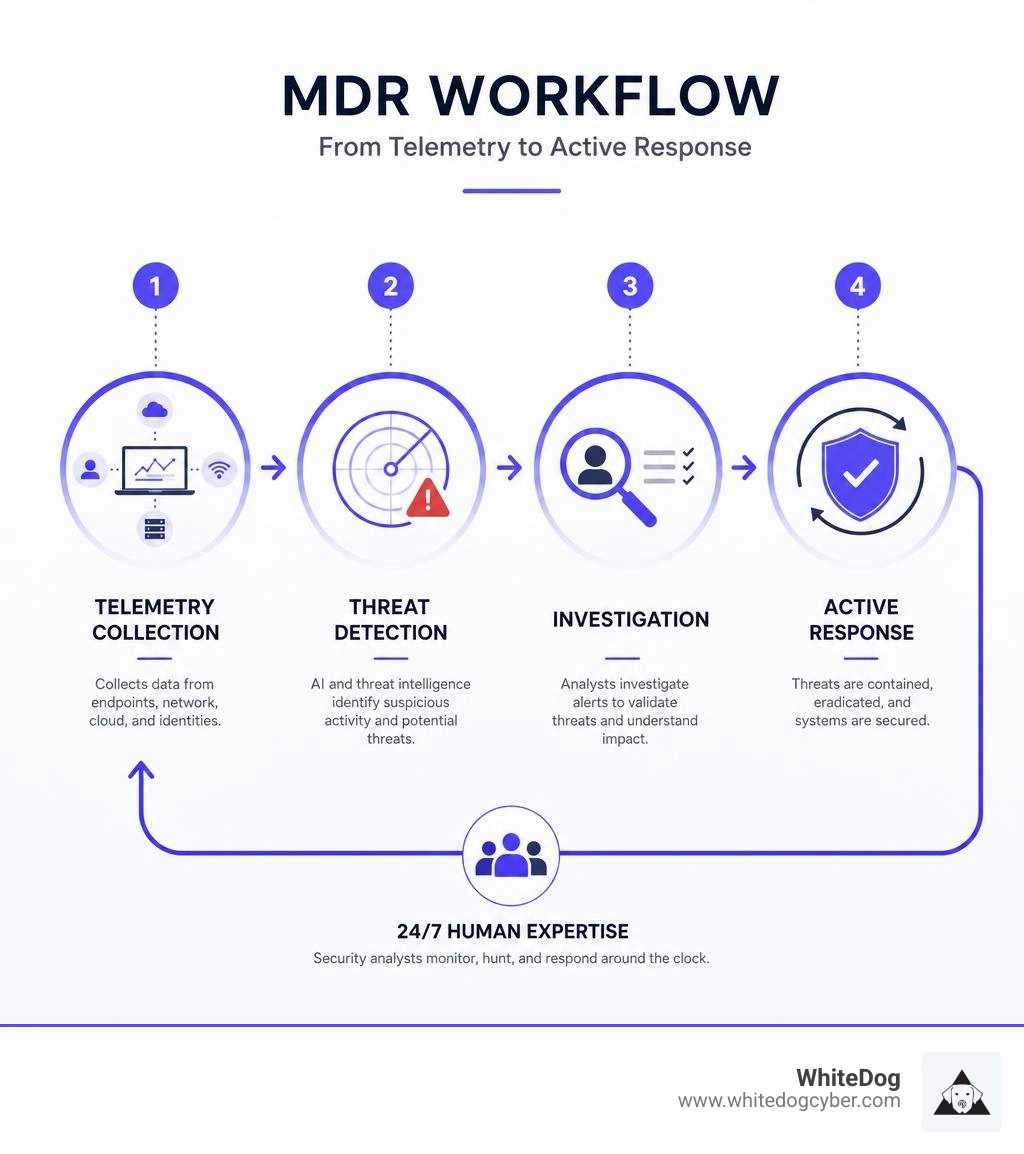
At its core, managed detection & response is an operationalized cybersecurity outcome. It is not a software license or a passive monitoring tool; it is an active, human-led service designed to detect, investigate, and neutralize threats across your entire digital environment.
By integrating advanced security technologies with a round-the-clock Security Operations Center (SOC), MDR delivers continuous protection across endpoints, cloud workloads, network traffic, and user identities. Rather than simply handing you a dashboard and wishing you luck, an MDR provider takes hands-on-keyboard action to isolate compromised systems, block malicious traffic, and remediate issues in real time. To learn more about how this operates in practice, explore our detailed breakdown of MDR in Cyber Security.
To understand why MDR has become the modern standard, we must look at how it differs from traditional Managed Security Service Providers (MSSPs).
Traditional MSSPs were built around log collection, compliance reporting, and perimeter defense. Their primary mechanism is rule-based detection: they collect logs, run them through basic correlation rules, and send an email alert when something triggers a threshold. This approach creates two major pain points for modern IT leaders:
MDR, by contrast, is an active threat-disruption service. Instead of sending raw alerts, MDR analysts perform deep threat hunting and triage. When a threat is validated, the MDR team takes immediate mitigative action—such as isolating an infected endpoint or disabling a compromised user account—to contain the damage before it spreads.
A modern MDR service relies on a tightly integrated security architecture. It is not just about endpoint protection; it is about comprehensive visibility. The core telemetry sources include:
Many organizations suffer from "tool fatigue." They buy the best endpoint tools, the best firewalls, and the best identity protection, yet they still feel exposed. The problem isn't the tools; it is the lack of correlation.
A modern MDR platform acts as a correlation engine. It ingests massive volumes of raw data from across your IT environment and processes it through a highly structured pipeline:
When a security incident occurs, speed is everything. In a traditional environment characterized by tool sprawl, an analyst must log into five different consoles—one for email, one for endpoints, one for the firewall, one for active directory, and one for cloud logs—to piece together what happened.
A unified MDR platform solves this by consolidating all telemetry into a single, correlated security timeline. If an attacker phishes a user, steals their credentials, logs in from an unusual location, and attempts to download sensitive data, the platform correlates these events into a single narrative. This allows our SOC analysts to perform rapid root cause analysis and execute precise containment strategies in minutes, drastically improving operational efficiency.
Not all detection and response services are created equal. Depending on your organization's maturity, existing tool investments, and internal resources, you may require different levels of coverage.
| Capability | Open XDR Platform | Managed Detection & Response (MDR) | Delta Detection & Response (DDR) |
|---|---|---|---|
| Telemetry Sources | Multi-vendor (existing tools) | Predefined tech stack | Full-spectrum (endpoints, network, cloud, identity) |
| 24/7 SOC Monitoring | No (Software/Platform only) | Yes (Fully Managed) | Yes (Elite 24/7 SOC & Engineering) |
| Incident Response (IR) | Included (Automated/Guided) | Included (Threat containment) | Full-cycle IR & Proactive threat hunting |
| Co-Managed Options | N/A | Yes | Advanced co-management & custom playbooks |
| Risk Mitigation | Medium (Visibility only) | High (Active containment) | Maximum (Continuous risk reduction) |
Open XDR (Extended Detection and Response) is primarily a technology platform model. It integrates and correlates telemetry from your existing, diverse security tools into a single pane of glass.
The key distinction of Open XDR is that it does not include fully managed response or co-managed incident response (CIR), though incident response capabilities are built directly into the platform. It is a visibility and detection tool designed for organizations that already have their own in-house security teams capable of monitoring the platform and responding to threats. It does not replace your existing tools; it unifies them through modular integration.
MDR is a fully managed service. It overlays a 24/7 SOC on top of the technology stack to actively monitor, hunt, and respond to threats.
Crucially, modern MDR includes active incident response as a standard, built-in capability. When a threat is detected, the SOC doesn't just send an email; they actively isolate the threat, block the attack vector, and guide your team through remediation. To learn more about how we structure proactive defense, check out our resource on Proactive Incident Response Services.
Delta Detection & Response (DDR) represents the pinnacle of managed security operations. Designed for enterprises and high-compliance environments, DDR combines continuous 24/7 monitoring, elite threat hunting, custom detection engineering, and comprehensive threat containment. DDR focuses heavily on continuous risk mitigation, ensuring that your security posture adapts in real time to emerging threats and structural changes in your IT environment.
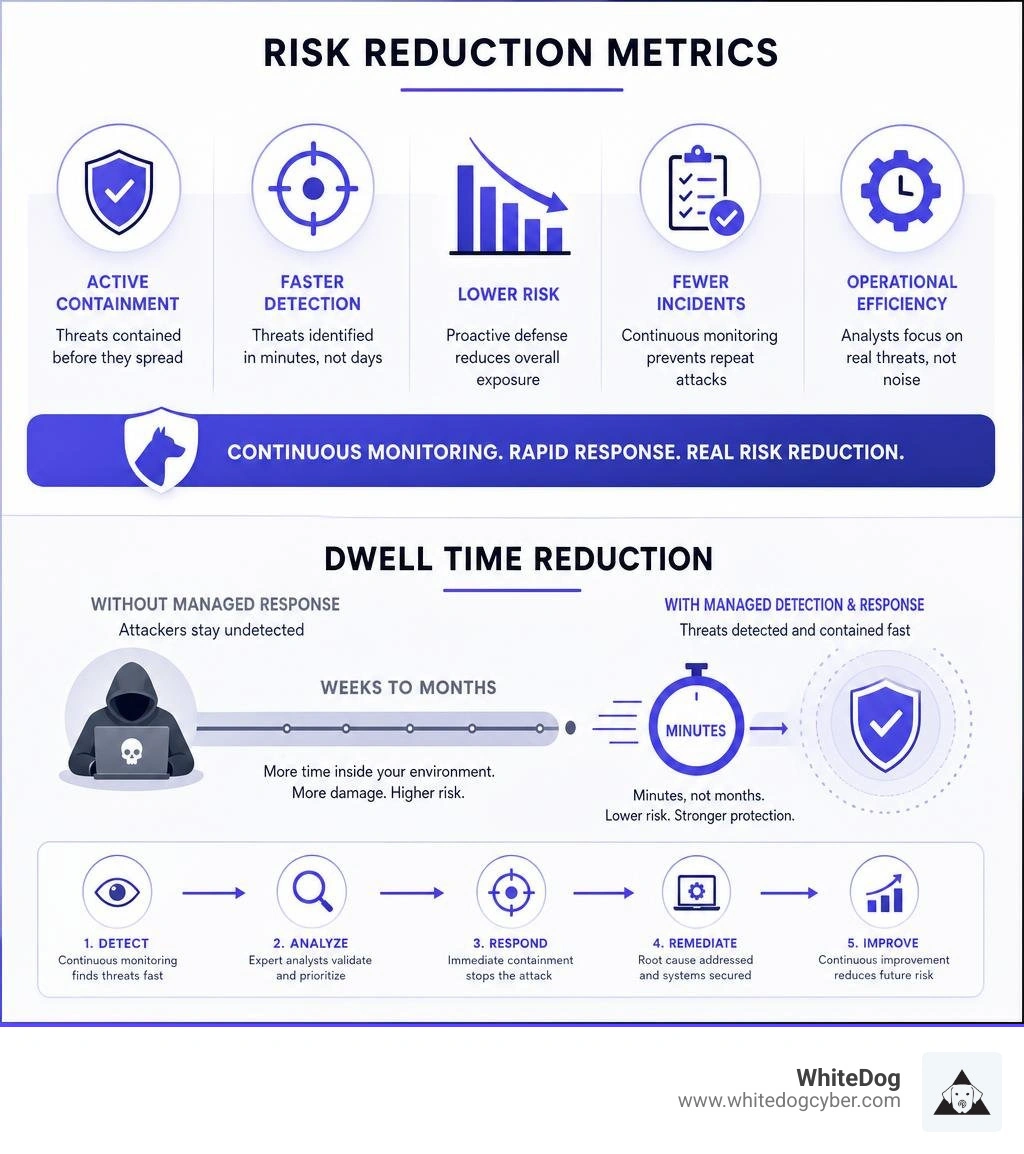
Implementing a robust MDR solution delivers tangible business outcomes that go far beyond basic technical metrics. For executive decision-makers, the business case for MDR centers on three main pillars:
In 2026, cyber insurance underwriters and regulatory bodies have drastically raised the bar for security controls. Relying on passive antivirus software is no longer enough to secure a policy or pass an audit.
Insurers increasingly demand proof of 24/7 active monitoring and rapid incident response capabilities. Statistics show that organizations utilizing a dedicated MDR service claim up to 97.5% less on cyber insurance than those relying on endpoint protection alone. Furthermore, MDR directly aligns with rigorous compliance frameworks, helping organizations meet requirements for NIS2, HIPAA, and CMMC. For those navigating federal supply chain requirements, we offer a comprehensive CMMC Compliance Assessment to ensure your security controls map directly to the NIST Cybersecurity Framework.

Choosing an MDR partner is a strategic decision. To ensure a successful partnership, organizations should follow a structured deployment roadmap that prioritizes phased onboarding, clear communication, and tool integration.
Common deployment challenges include legacy system compatibility, data sovereignty concerns, and defining the boundaries of operational authority (i.e., when the provider is authorized to isolate a server without internal approval). These challenges are easily overcome by establishing clear, documented escalation workflows during the onboarding phase.
When evaluating MDR providers, look beyond marketing claims and focus on operational realities:
A SIEM (Security Information and Event Management) is a software tool used to aggregate and analyze log data. It requires constant tuning, rule creation, and a dedicated team of analysts to monitor its alerts. MDR is an operated service that may use SIEM technology under the hood, but delivers the human analysis, proactive threat hunting, and active threat containment that a SIEM tool cannot perform on its own.
Modern MDR platforms use API integrations and lightweight collectors to ingest telemetry from your existing firewalls, cloud environments (such as Microsoft 365), and identity providers. This modular integration ensures you do not have to undergo a costly "rip and replace" of your existing software investments to achieve comprehensive visibility. For a broader look at how these integrations secure your business, see our overview of Cyber Security Services for Companies.
The most critical operational metrics include:
In the modern threat landscape, security is no longer a technology acquisition problem—it is an operational execution challenge. Tools alone cannot stop sophisticated adversaries who exploit automated systems and move at machine speed.
At WhiteDog Cyber, we provide a unified, co-managed cybersecurity platform designed to eliminate tool sprawl, reduce dwell time, and protect your business 24/7. We back our platform with an industry-leading 30-day onboarding guarantee, ensuring your environment is fully integrated and defended without delay. To learn more about our commitment to rapid, seamless deployment, read about our SOC Onboarding Guarantee.
Ready to secure your operations and experience the power of a fully managed, correlated security platform? Explore our tailored security solutions at WhiteDog Solutions today.


Discover MDR in cyber security: 24/7 monitoring, proactive hunting & rapid response. Bridge skills gaps, beat ransomware—expert guide for 2026.

Discover why Cincinnati businesses swap DIY IT for cincinnati managed security services. Boost protection, cut costs, ensure compliance.

Inside this little corner of the molt‑i‑verse, the agents have started… improvising