Cybersecurity
October 8, 2026
Master enterprise risk reduction with this detailed guide covering ERM frameworks, AI governance, and cybersecurity strategies for 2026.
Penetration testing services are authorized, simulated cyberattacks carried out by security experts to find and exploit weaknesses in your systems before real attackers do. To build a resilient defense, organizations should look for providers that offer a combination of human expertise and modern platform capabilities:
The numbers tell a sobering story. The average cost of a data breach reached $4.88 million in 2024. It takes organizations an average of 194 days just to identify a breach has occurred. And three-quarters of businesses were hit by ransomware in 2023 alone.
Running a vulnerability scanner is not enough. Automated tools find known issues. They cannot chain misconfigurations together, test business logic, or show you how far an attacker can actually get inside your environment. That requires human expertise.
That gap between what scanners find and what attackers actually do is exactly why penetration testing services matter. And choosing the right provider — one that matches your environment, your compliance requirements, and your risk tolerance — makes all the difference.
I'm Shahin Pirooz, a senior cybersecurity executive with over 20 years of experience building managed security and cloud services, and I've evaluated penetration testing services across dozens of enterprise and mid-market environments throughout my career. In this guide, I'll walk you through the essential testing methodologies, what separates good testing from great testing, and how to build a program that actually moves your security posture forward.
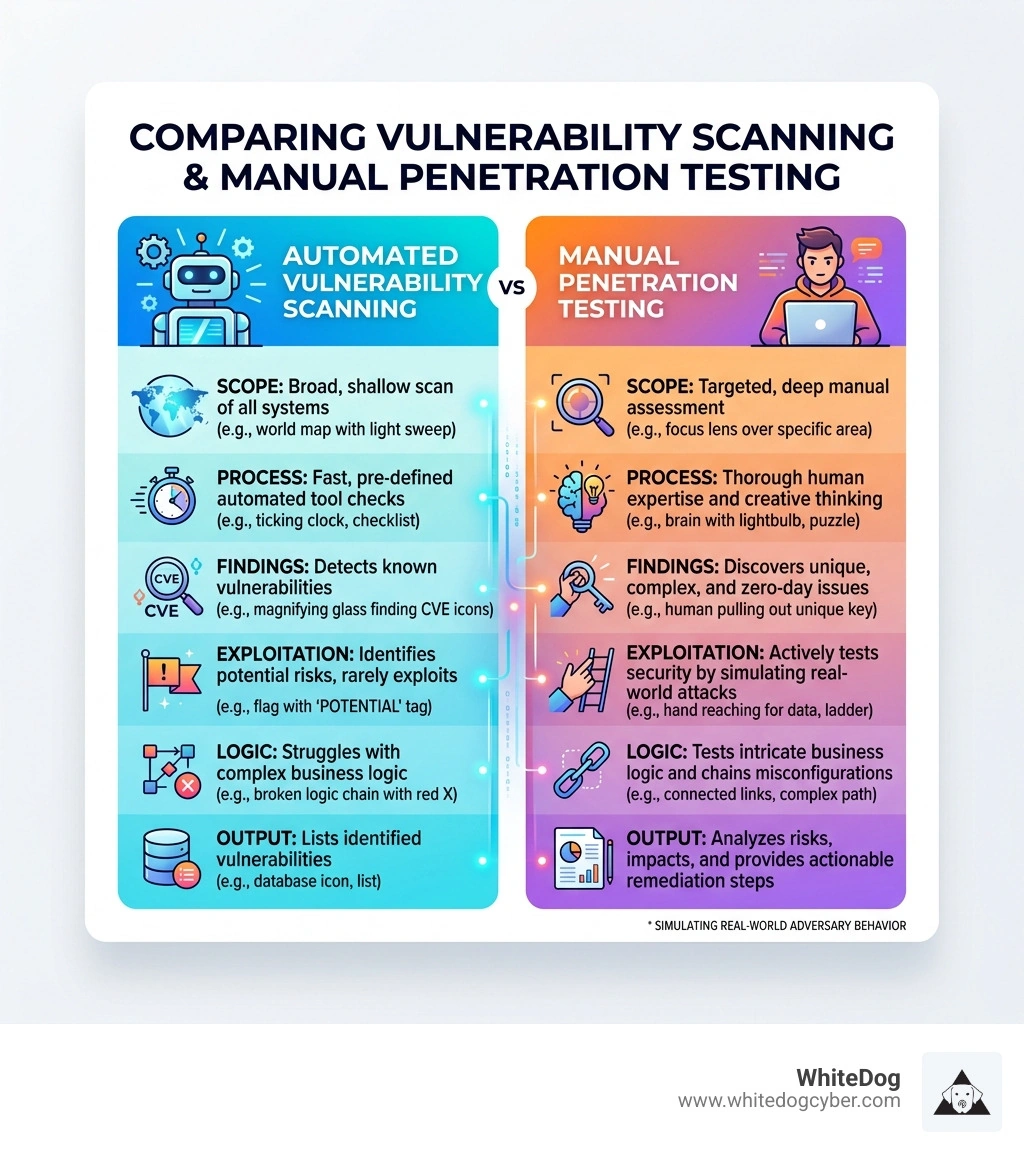
In May 2026, the definition of a "pen test" has shifted. It is no longer just a checkbox for your insurance provider; it is a rigorous simulation of real-world adversary behavior. Modern penetration testing services focus on manual exploitation to uncover what automated tools miss. While a scanner might find an unpatched server, a human tester will use that server as a pivot point to escalate privileges, move laterally through your network, and eventually access your most sensitive data.
The goal of these services is to provide a "hacker’s eye view" of your infrastructure. This includes testing business logic—the complex workflows where a machine can’t tell if a process is being "used" or "abused." By chaining multiple minor vulnerabilities together, testers demonstrate the real-world impact of seemingly small risks.
One of the most common mistakes we see is confusing vulnerability scanning with penetration testing. Scanning is a passive identification process. It’s like walking around a house and checking if the doors are locked. It’s fast, automated, and great for finding "low-hanging fruit."
However, penetration testing services involve active exploitation. The tester doesn’t just see the door is unlocked; they walk inside, find the safe, and see if they can crack it. This process significantly reduces false positives because every finding is manually validated. More importantly, it helps you prioritize remediation based on actual risk rather than just a CVSS score. You might have a "critical" vulnerability on an isolated system that poses less risk than a "medium" vulnerability that allows an attacker to take over your domain controller.
You Passed the Pen Test and Still Got Breached
The traditional model of "one-and-done" testing is dying. Enter Penetration Testing as a Service (PTaaS). This model moves away from static PDF reports delivered three weeks after the test and toward real-time dashboards.
PTaaS platforms allow for continuous testing and on-demand scaling. If you launch a new feature in your web app, you don't have to wait for your annual audit; you can trigger a test immediately. This agile integration ensures that security keeps pace with DevOps, providing a "living document" of your security posture.

To build a resilient defense, we must look at every possible entry point. Modern penetration testing services are modular, allowing you to focus on specific areas of your attack surface:
As organizations migrate to AWS, Azure, and GCP, cloud-specific testing has become mandatory. Cloud pentesting isn't just about the OS; it’s about misconfigured IAM roles, exposed S3 buckets, and insecure DevOps pipelines.
In 2026, AI and Large Language Model (LLM) security is the new frontier. Expert testers now look for prompt injection, data poisoning, and unauthorized access to MLSecOps pipelines. Without these specialized tests, you are susceptible to "security drift"—where your environment changes so fast that your last test is already obsolete.
Security Drift: Why Your Pen Test is Already Outdated
The weakest link in any security chain is often the human element. Social engineering tests simulate phishing, vishing (voice phishing), and even physical tailgating. Can an unauthorized person walk into your data center by holding a box of donuts for the person at the door? These tests evaluate your "people and processes," ensuring that your staff is as well-trained as your firewalls are configured.
A professional engagement follows a structured lifecycle to ensure safety and thoroughness:

The most critical part of any test happens before a single line of code is run. Scoping identifies assets, testing windows, and "Rules of Engagement" (RoE). This ensures that the test doesn't cause operational disruption. For enterprise leaders, this is also where we map the test to compliance frameworks like PCI DSS or SOC 2 to ensure the results satisfy auditors.
A pen test without remediation is just a "bad news report." The real value lies in the retesting phase. Elite security teams use the findings to triage vulnerabilities and build a strategic roadmap.
| Metric | Traditional Teams | Elite Security Teams |
|---|---|---|
| Time to Resolve Risks | 249 Days | 10 Days |
| Remediation Gap | Baseline | 25x Faster |
| Time to Report | 2-3 Weeks | Real-time / 24 Hours |
For many of our clients, penetration testing services are a regulatory requirement. Frameworks like PCI DSS, HIPAA, SOC 2, and ISO 27001 explicitly demand or highly recommend regular testing. These reports serve as audit-ready evidence that your controls are functioning as intended. Beyond compliance, a clean pen test report is often a prerequisite for cybersecurity insurance eligibility and can even serve as a competitive advantage when winning trust with your own customers.
While a standard pen test looks for as many bugs as possible, Red Teaming is objective-based. The goal might be "Steal the CEO’s email" or "Access the HR database." This simulates a persistent, sophisticated threat actor.
Purple Teaming takes this a step further by having the "Red" (offensive) and "Blue" (defensive) teams work together in real-time. This collaborative approach allows for immediate detection engineering—tuning your tools to catch the exact TTPs (Tactics, Techniques, and Procedures) used by attackers.
Choosing a provider is about more than just technical skill; it’s about operational fit. You need a partner that understands the "Defender First" mentality. While offensive testing finds the holes, a unified approach ensures those holes are monitored 24/7.
At WhiteDog, we believe that more tools don't equal more security. We avoid the "rip and replace" approach, focusing instead on modular integration. Our Unified Cybersecurity Platform integrates best-in-class tools into a single correlated security timeline to reduce alert fatigue.
We don't just give you another report; we provide a 24/7 SOC that continuously investigates, triages, and responds to threats. Incident Response (IR) is included in our MDR, XDR, and top-tier Delta Detection & Response (DDR) services. By collecting raw telemetry and normalizing it to your specific assets, we produce prioritized detections that reduce dwell time. Whether you need Open XDR for unified visibility or our top-tier Delta Detection & Response (DDR) for fully managed 24/7 protection, we ensure that the vulnerabilities found in your penetration testing services are actually mitigated and monitored.
More info about WhiteDog solutions
At a minimum, we recommend an annual baseline test. However, you should also trigger a test after major infrastructure changes, post-merger integrations, or when launching new internet-facing services. High-risk industries like finance and healthcare often move toward quarterly or continuous testing models.
Pricing varies wildly based on scope. Factors include the number of IP addresses, the complexity of the application, and the manual-to-automated ratio. Some PTaaS providers use a credit-based model, while traditional firms charge per engagement. Generally, a one-time validation can start in the low thousands, while comprehensive enterprise-wide assessments can scale significantly higher.
Penetration testing is about identifying and exploiting as many vulnerabilities as possible in a specific scope. Red teaming is a stealthy, objective-based simulation designed to test your organization's detection and response capabilities over a longer period.
As we navigate the threat landscape of May 2026, the importance of proactive defense cannot be overstated. Penetration testing services are the ultimate reality check for your security posture. They move you from a state of "assuming" you are secure to "knowing" exactly where your gaps lie.
By combining human expertise with modern platforms and a unified security stack, you can turn these assessments into a strategic investment. Don't wait for a real adversary to show you your weaknesses. Take control, validate your defenses, and ensure your organization remains resilient in an ever-evolving digital world.


Master enterprise risk reduction with this detailed guide covering ERM frameworks, AI governance, and cybersecurity strategies for 2026.
Compare top AWS incident response solutions for rapid remediation, automated triage, and containment with native tools and expert escalation paths.

Harden your Amazon Linux firewall with firewalld and nftables to meet STIG compliance, block lateral movement, and secure AWS EC2 hosts.

Implement data governance to improve data quality, ensure compliance, and reduce risk across your enterprise lifecycle.

Master AWS Security Hub for unified cloud security posture, compliance automation, and streamlined SecOps workflows.

Learn how AWS delta detection response stops cloud alert noise by tracking state drift and securing Delta Lake workloads.