Cybersecurity
September 15, 2026
Navigate security compliance requirements across ISO 27001, SOC 2, and GDPR with a strategic blueprint for sustainable compliance management.
Security compliance is the ongoing work of meeting legal, industry, contractual, and internal security requirements through documented policies, effective controls, evidence, and oversight. Security protects systems, data, and people from harm. Compliance proves that those protections meet the rules that apply to your organization.
For CIOs, CISOs, and IT leaders, compliance is not a once-a-year audit task. It is a practical way to reduce risk, build customer trust, support business growth, and keep security operations aligned with changing requirements. The strongest programs connect risk management, continuous monitoring, incident response, and audit-ready evidence across cloud, endpoint, identity, data, and third-party environments.
I’m Shahin Pirooz, a cybersecurity and cloud services executive with decades of experience building managed security and technology services. In this guide, I will explain how leaders can make security compliance a clear, sustainable part of their wider security strategy.
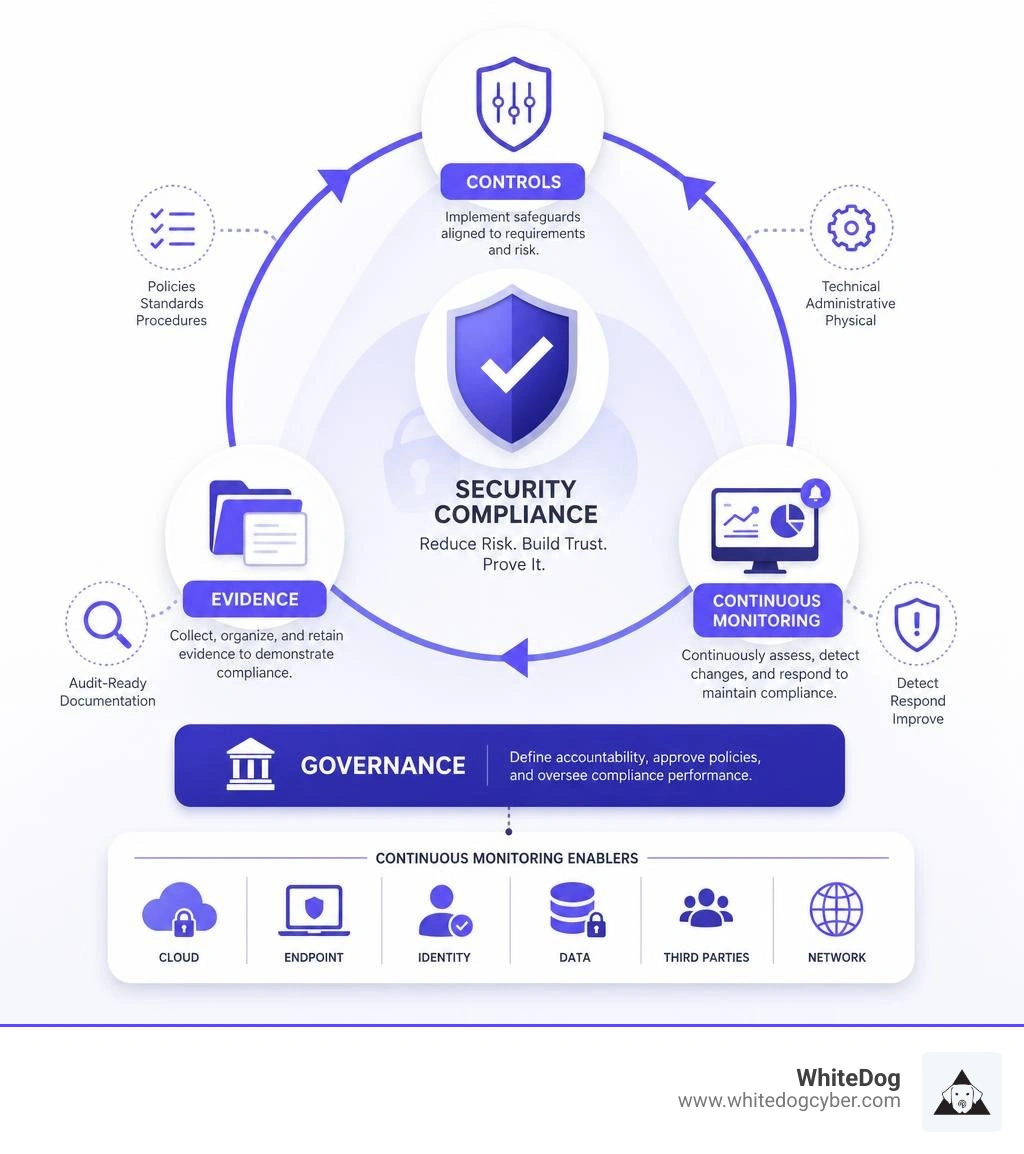
Navigating security compliance requires understanding how technical safeguards intersect with administrative mandates. Too often, organizations treat compliance as a separate tracking exercise while their security engineers focus strictly on stopping threats. In reality, both disciplines rely on the same fundamental objective: mitigating business risk.
Security frameworks provide the blueprint for defensive architectures, while compliance provides the governance structure to ensure those architectures are maintained, tested, and documented. Performing routine cybersecurity health checks allows leadership to validate whether technical implementations satisfy both operational needs and statutory duties.
| Dimension | Technical Security Controls | Compliance Obligations |
|---|---|---|
| Primary Objective | Protect systems, users, and data from active threats | Demonstrate adherence to legal, regulatory, or industry baselines |
| Operational Scope | Firewalls, EDR, MFA, network segmentation, encryption | Documented policies, audit trails, risk registers, access governance |
| Measurement of Success | Zero breaches, minimal dwell time, blocked threat activity | Successful audit completion, zero statutory penalties, valid certifications |
| Frequency | Real-time, continuous detection and operational response | Periodic or continuous attestation, evidence collection, scheduled reviews |
| Primary Stakeholder | SOC analysts, security engineers, IT operations | Compliance officers, internal auditors, legal counsel, external assessors |
Security and compliance are two sides of the same coin, yet they serve distinct operational functions.
Security represents the tangible technical, physical, and administrative controls implemented to safeguard assets. This includes operational safeguards like endpoint detection, multi-factor authentication (MFA), identity and access management (IAM), and physical access cards. Security is dynamic; it adapts constantly to counter novel adversary techniques and unpatched vulnerabilities.
Compliance, by contrast, is the structured process of proving that an organization adheres to established external standards or legal mandates. It dictates what controls must exist and demands verifiable evidence that those controls function effectively over time.
A company can possess extensive security tools yet fail an audit if configurations lack documentation or logs are not retained according to policy. Conversely, an enterprise might achieve a clean compliance report on paper while harboring misconfigured cloud assets that leave it vulnerable to exploitation. True resilience happens when technical security controls directly satisfy compliance objectives without creating redundant operational friction.
Viewing compliance purely as a cost center overlooks the severe financial consequences of falling short. When governance breaks down, the fiscal and operational impact ripples across the enterprise.
Beyond direct financial assessments, non-compliance inflicts severe reputational fallout, contract terminations, customer churn, and operational halts that take years to repair.
Enterprise IT environments rarely answer to a single mandate. Modern enterprises often operate across hybrid clouds, global regions, and regulated verticals, requiring security leaders to cross-map controls across multiple frameworks simultaneously. Leveraging comprehensive public cloud baselines, such as the Azure compliance documentation, helps teams align native infrastructure controls with international data sovereignty and security benchmarks.
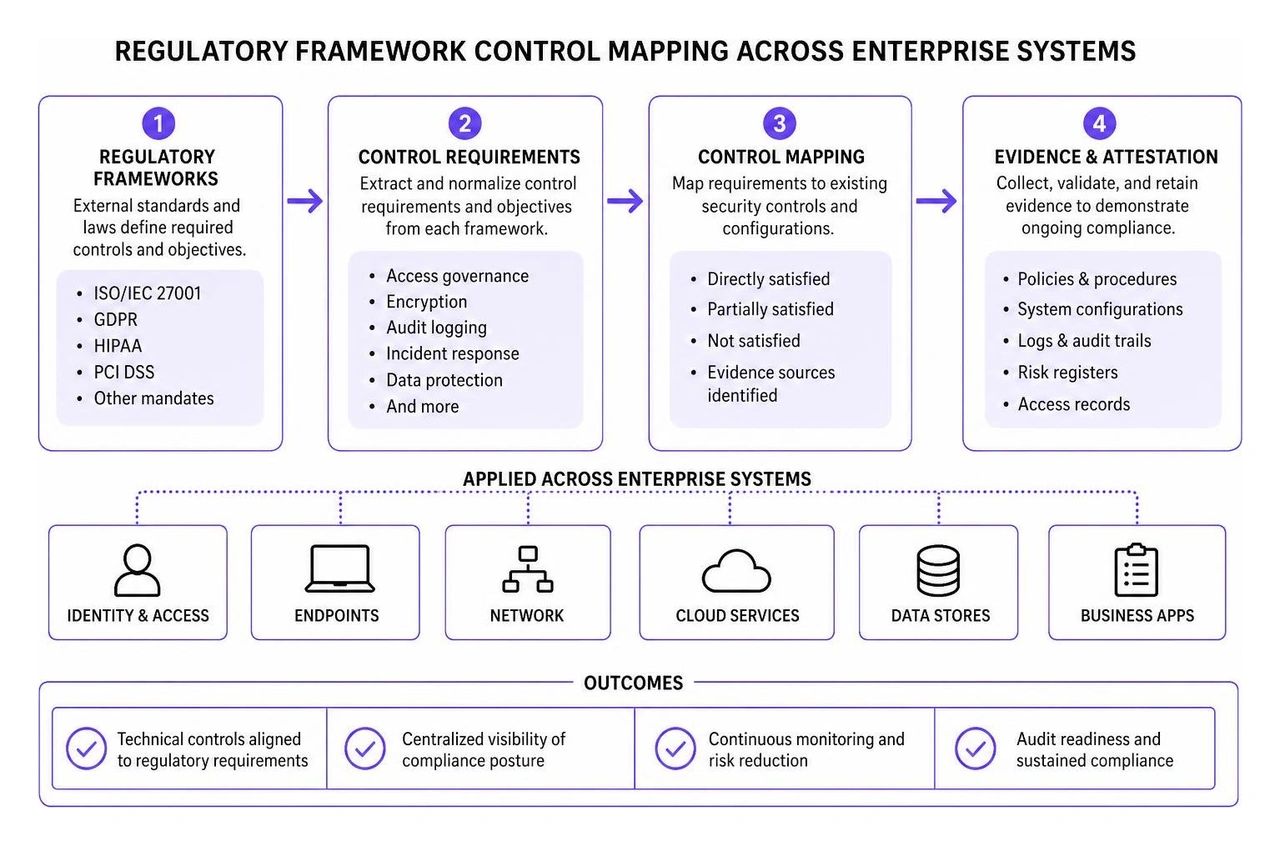
Several foundational frameworks dictate security baselines across the commercial sector and defense industrial base:
Alongside general security frameworks, sector-specific mandates and privacy laws enforce strict operational requirements:
As regulations proliferate, third-party and vendor ecosystems face heightened scrutiny. Service providers increasingly bear the weight of these mandates, a reality explored in our analysis of supply chain compliance risks.
Maintaining a compliant posture across enterprise environments is complex. Security teams juggle disparate tool stacks, evolving legal definitions, and hybrid infrastructures spanning legacy systems, modern microservices, and multi-cloud footprints. Guidance such as the technical reference for Keeping Up With Security and Compliance on IBM Z highlights how enterprises must manage specialized system controls alongside agile cloud platforms.

The proliferation of point solutions often creates disconnected security telemetry. When an enterprise utilizes dozens of standalone tools for endpoint management, identity governance, cloud security, and network monitoring, compliance evidence remains siloed.
This fragmentation fuels compliance drift—the gradual divergence of actual operational configurations from approved compliance baselines over time. Drift occurs when:
Without centralized visibility, compliance officers and security teams struggle to detect drift until an external auditor uncovers the discrepancy.
Historically, security operations (SecOps) and compliance audits operated on different cadences. SecOps works in seconds and minutes, neutralizing threats in real time. Auditors work in retrospective cycles, reviewing logs, tickets, and configurations generated months prior.
Bridging this gap requires embedding compliance validation into daily operational workflows and continuous integration pipelines (DevSecOps). By automating evidence capture when systems are provisioned and logging security interventions within a centralized repository, organizations eliminate the manual scramble associated with audit preparation. Aligning operational telemetry with audit frameworks transforms compliance from a disruptive interruption into a natural byproduct of sound security hygiene.
Building an efficient compliance program requires a systematic approach that unites governance, risk analysis, and operational tooling. Rather than addressing each regulation in isolation, mature enterprises establish unified controls that satisfy multiple standards simultaneously.

Manual evidence collection using static spreadsheets is labor-intensive and prone to human error. Sustainable compliance requires automation across the entire control lifecycle:
Compliance frameworks demand documented risk management and tested incident response capabilities. Regulators do not expect organizations to be impervious to threats; they expect them to understand their exposure and maintain verified plans to contain disruptions.
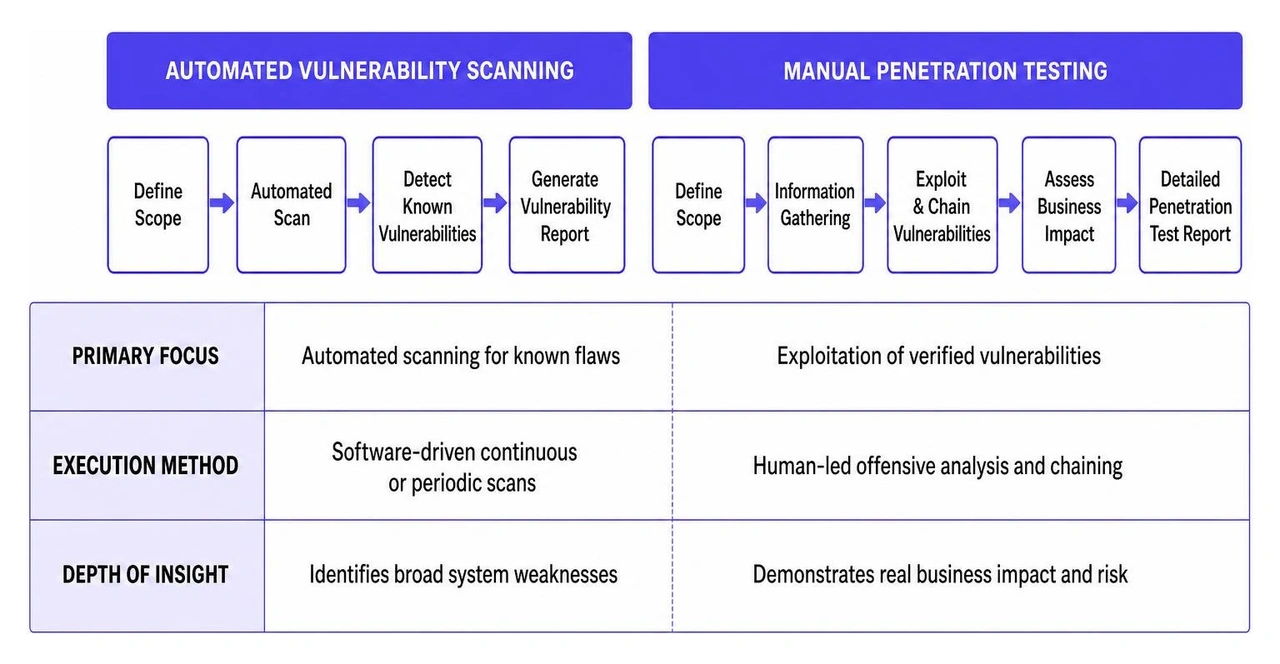
Organizations should maintain an active risk register that evaluates asset criticality, threat vectors, and compensating controls. This posture is continuously validated through automated vulnerability scanning and regular penetration testing.
Furthermore, regulatory standards mandate structured incident response planning with explicit reporting timelines. Under frameworks like GDPR (72 hours), the SEC breach disclosure rules (4 business days), and the EU Cyber Resilience Act (24 hours for actively exploited flaws), having an integrated incident response program is both a defensive necessity and a legal obligation.
Cybersecurity consists of the active technical, operational, and physical protections implemented to protect systems, networks, and data from attacks or unauthorized access. Regulatory compliance is the structured process of proving—through documentation, policies, configurations, and audit trails—that an organization's safeguards adhere to specific legal, industry, or contractual mandates.
Organizations should conduct internal compliance audits continuously through automated telemetry, paired with formal comprehensive reviews at least annually. High-risk areas, access permissions, and systems subject to heavy regulatory oversight (such as payment environments under PCI DSS or health systems under HIPAA) should undergo quarterly or semi-annual evaluations to ensure operational controls remain aligned with baselines.
The most effective way to prevent compliance drift is replacing periodic manual audits with continuous, automated posture monitoring. Implementing automated configuration baselines (such as infrastructure as code), continuous vulnerability scanning, centralized identity and access reviews, and real-time posture alerts ensures that configuration discrepancies or policy violations are surfaced and remediated immediately.
Security compliance is no longer a static, once-a-year checklist exercise. As regulatory scrutiny deepens and infrastructure environments grow increasingly interconnected, enterprises need an operational approach that bridges defensive controls and governance requirements.
WhiteDog Cyber helps organizations simplify cybersecurity operations through a unified platform that connects visibility, detection, response, and risk management. Emphasizing modular integration rather than a rip-and-replace approach, we complement and extend your existing Microsoft Security and Microsoft 365 investments, adding an operational layer that helps teams maximize their current tools.
Our Open XDR framework delivers unified visibility and detection across email, DNS, identity, endpoint, network, cloud, and data environments, eliminating the blind spots where compliance drift occurs. For organizations seeking comprehensive operational coverage, our fully managed 24/7 SOC services—including Managed Detection and Response (MDR), XDR, and our top-tier Delta Detection & Response (DDR) offering, with incident response included across MDR, XDR, and DDR—provide continuous attack surface management and correlated intelligence to identify threats earlier and respond with confidence.
By aligning automated technical telemetry with your compliance objectives, we help you reduce cyber risk, maintain audit readiness, and transform regulatory alignment into a sustainable business advantage.


Navigate security compliance requirements across ISO 27001, SOC 2, and GDPR with a strategic blueprint for sustainable compliance management.

Learn how AI phishing detection stops next-gen attacks that bypass traditional defenses, with practical capabilities to evaluate.

Evaluate your cloud security audit options with this actionable checklist covering multi-cloud frameworks, CSPM, DSPM, and AI-driven automation.

Learn the five pillars of MSP risk reduction to secure operations, manage vendor risk, and build defensible compliance.

Learn how AI based malware detection stops polymorphic threats and zero-day attacks using deep learning, behavioral analysis, and multi-modal pipelines.
Learn penetration testing basics: ethical hacking methods, black-box scoping, and 7-phase workflows to reduce risk before attackers strike.