Cybersecurity
August 22, 2026
Unify your security with an XDR cybersecurity platform that correlates endpoint, network, and cloud threats for faster, managed response.
Zero Trust Architecture is a security model that requires every access request to be authenticated, authorized, and continuously validated against contextual risk signals before access is granted, regardless of whether the request originates inside or outside the corporate network. Modern enterprises require this continuous verification because attackers routinely harvest legitimate credentials through phishing, session hijacking, or identity-based attacks, and a single compromised account can otherwise provide an open highway for lateral movement. For decades, enterprise security relied on the castle-and-moat concept. We assumed that anything outside the corporate network was hostile, but everything inside was trustworthy. Once a user cleared the firewall by entering valid credentials or establishing a remote connection, they received broad network access.
Modern attack techniques have rendered this boundary obsolete. Attackers rarely compromise systems by brute-forcing strong firewalls; instead, they harvest legitimate credentials through sophisticated phishing, session hijacking, or identity-based attacks. In an environment with implicit trust, a compromised standard account provides an open highway for lateral movement. Adversaries can navigate across subnets, discover sensitive databases, elevate their privileges, and establish persistence while remaining undetected for months. In fact, research indicates that the average time for sophisticated attackers to infiltrate deep into a network after establishing their initial foothold is just 18 minutes.
Transitioning to modern security means redefining security in a world with no edge. The foundational mandate of Zero Trust is simple: always assume compromise. Every transaction, access request, and administrative action must be authenticated, authorized, and continuously validated against contextual risk signals before access is granted.
| Security Dimension | Legacy Perimeter Defense | Zero Trust Architecture |
|---|---|---|
| Trust Model | Implicit trust based on network location (inside vs. outside). | Explicit verification required for every request regardless of origin. |
| Access Scope | Broad network-level reachability across whole subnets. | Micro-segmented, per-application, least-privilege access. |
| Authentication Cadence | Single check at initial network login. | Continuous, session-long contextual re-evaluation. |
| Lateral Movement Risk | High; attackers move freely once past the perimeter. | Minimal; resources are cloaked and isolated. |
| Visibility & Telemetry | Siloed perimeter and edge appliance logs. | Unified correlation across identity, endpoint, network, and cloud. |
Static security relies on point-in-time checks. A user logs in at 8:00 AM from an approved office laptop, passes multi-factor authentication (MFA), and retains broad privileges for the rest of the day. But static checks create massive blind spots when conditions change. What happens if that user's session token is stolen thirty minutes later, or their machine becomes infected with infostealer malware?
Understanding static trust vs dynamic risk reveals how modern adversaries bypass traditional defenses. Zero Trust replaces static access with dynamic, risk-adaptive evaluation. Rather than granting broad, persistent authorization, the architecture evaluates contextual attributes in real time for every individual resource request:
By enforcing least privilege and continuously evaluating these dynamic signals, organizations drastically shrink the blast radius of any single compromised credential.
Adopting Zero Trust delivers tangible business value alongside technical defense. By eliminating wide-open network segments and replacing legacy remote-access tools with direct-routed Zero Trust Network Access (ZTNA), organizations realize immediate operational and economic gains.
Exploring the broader benefits of ztna highlights several measurable business outcomes:
Transitioning to Zero Trust is not a one-time product deployment. It is an operational discipline that requires continuous policy refinement, identity governance, telemetry correlation, and rapid incident response. For enterprise IT and security leaders, establishing a mature zero trust architecture is vital to ensure long-term operational resilience and proactive defense.
Academic and industry research, along with guidance from NIST on zero trust architecture, demonstrates that modern security delivery models must incorporate continuous integrity attestation, automated policy enforcement, and real-time container and host verification. When adopting an enterprise framework, decision-makers must assess how cleanly security controls integrate across disparate on-premises, hybrid, and multi-cloud environments.
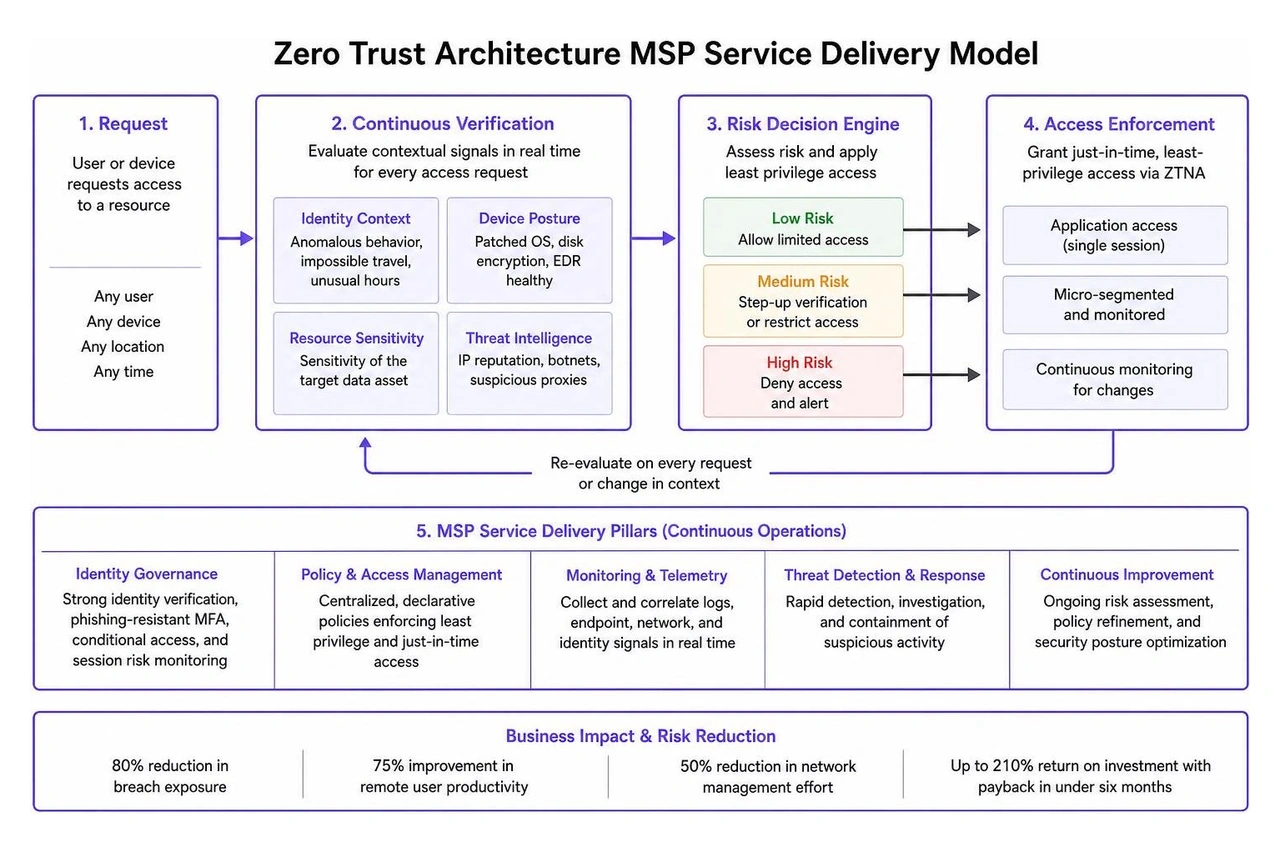
A comprehensive Zero Trust model structures security controls across five interconnected operational pillars:
When evaluating operational frameworks and security solutions to support your Zero Trust strategy, look for these foundational capabilities:
Deploying Zero Trust across an enterprise requires translating strategic tenets into practical controls. Guided by frameworks such as the NIST SP 800-207A cloud-native access control guidelines, organizations can systematically implement identity-based and application-tier controls across hybrid and multi-cloud environments.
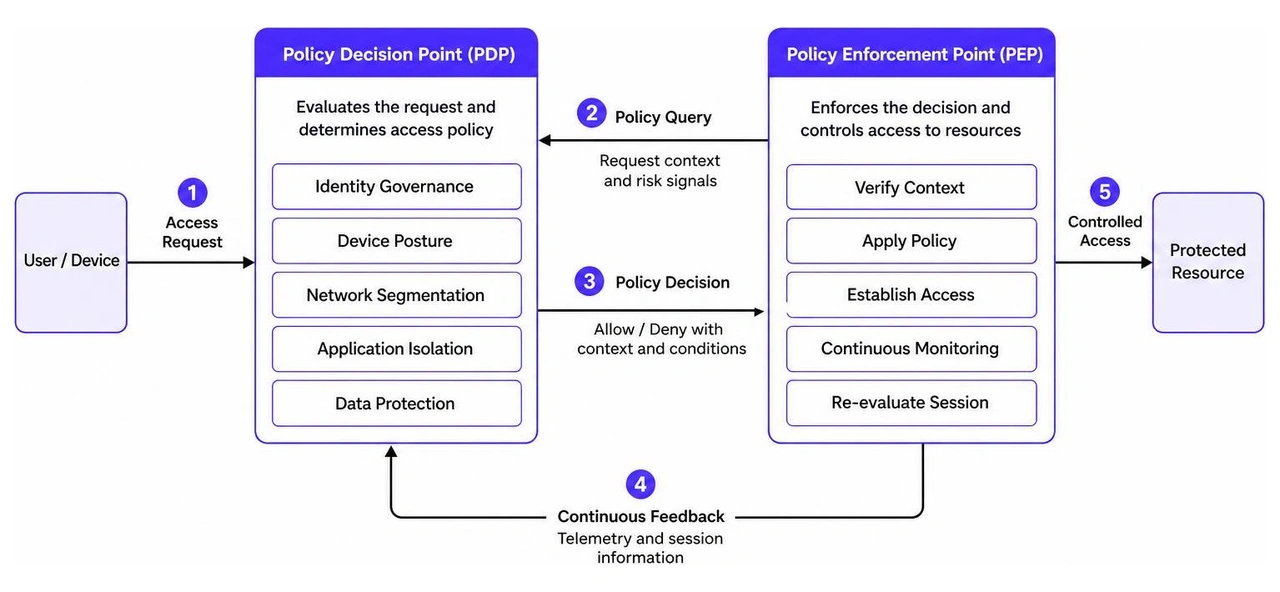
Identity is the foundational control plane in modern security architecture. Every access attempt begins with robust authentication governed by granular Conditional Access rules.
We implement this by enforcing context-driven policies:
Once identity and device posture are validated, network and application layers must restrict access exclusively to authorized resources.
Beyond stopping advanced threat actors, Zero Trust is essential for meeting modern regulatory standards and passing stringent cyber insurance underwriting reviews.
Modern compliance frameworks explicitly mandate the core capabilities of Zero Trust: least privilege, continuous monitoring, robust identity controls, and strict data segmentation.
| Regulatory Standard / Mandate | Key Zero Trust Requirement | Operational Implementation |
|---|---|---|
| NIST SP 800-207 | Core Zero Trust Tenets | Continuous contextual verification, micro-segmentation, and comprehensive telemetry correlation. |
| CMMC 2.0 (Level 2) | Access Control & Identification | Strict separation of Controlled Unclassified Information (CUI), phishing-resistant MFA, and least-privilege access. |
| SOC 2 Type II | Trust Services Criteria (CC6 / CC7) | Enforce logical access boundaries, role-based access control (RBAC), and continuous audit logging. |
| Cyber Insurance Underwriting | Insurability Mandates | Universal MFA enforcement across all users, privileged access management (PAM), endpoint hygiene, and rapid containment capabilities. |
Cyber insurance carriers have significantly raised their underwriting standards. Questionnaires that once took twenty minutes now require exhaustive technical proof of operational controls. Insurers regularly deny coverage or increase premiums for organizations that lack:
Implementing a Zero Trust architecture fulfills these insurance mandates, protecting your organization from liability while stabilizing annual premium costs.
For defense suppliers and regulated contractors, complying with CMMC 2.0 Level 2 and federal guidelines is a non-negotiable requirement for doing business. Zero Trust simplifies this compliance by isolating Controlled Unclassified Information (CUI) within software-defined enclaves.
Instead of subjecting an entire enterprise network to rigorous, expensive federal audits, micro-segmentation isolates compliance boundaries, ensuring that only explicitly authorized users and verified devices can interact with sensitive data repositories.
Zero Trust is not a static configuration that you set once and forget. As cloud workloads scale, permissions expand, and new endpoints connect, security configurations naturally degrade over time.
Relying solely on periodic compliance reviews creates dangerous visibility gaps. Understanding security drift underscores why modern enterprises require real-time posture validation and exposure management.
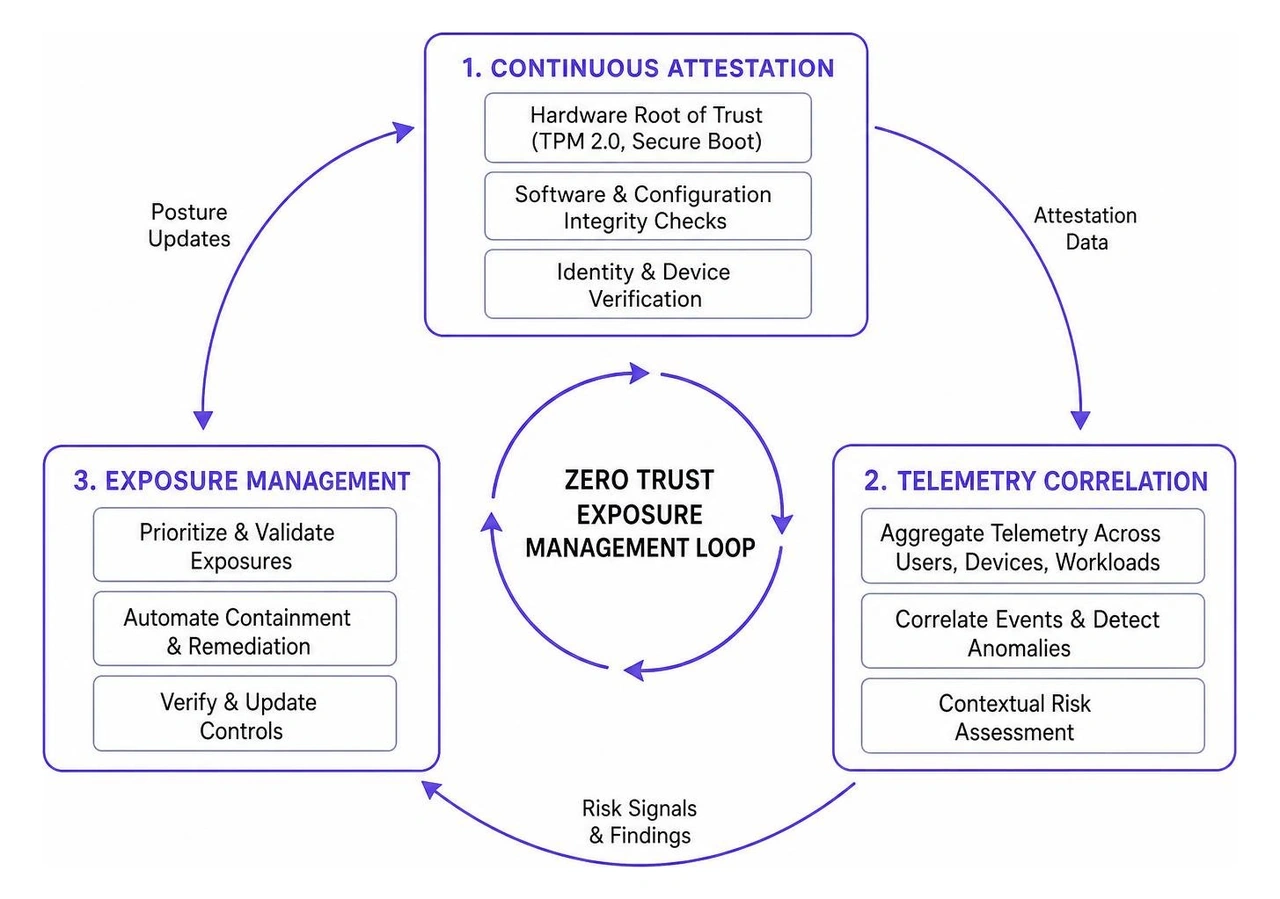
To maintain a resilient Zero Trust architecture, security controls must continuously verify system integrity at both hardware and software layers:
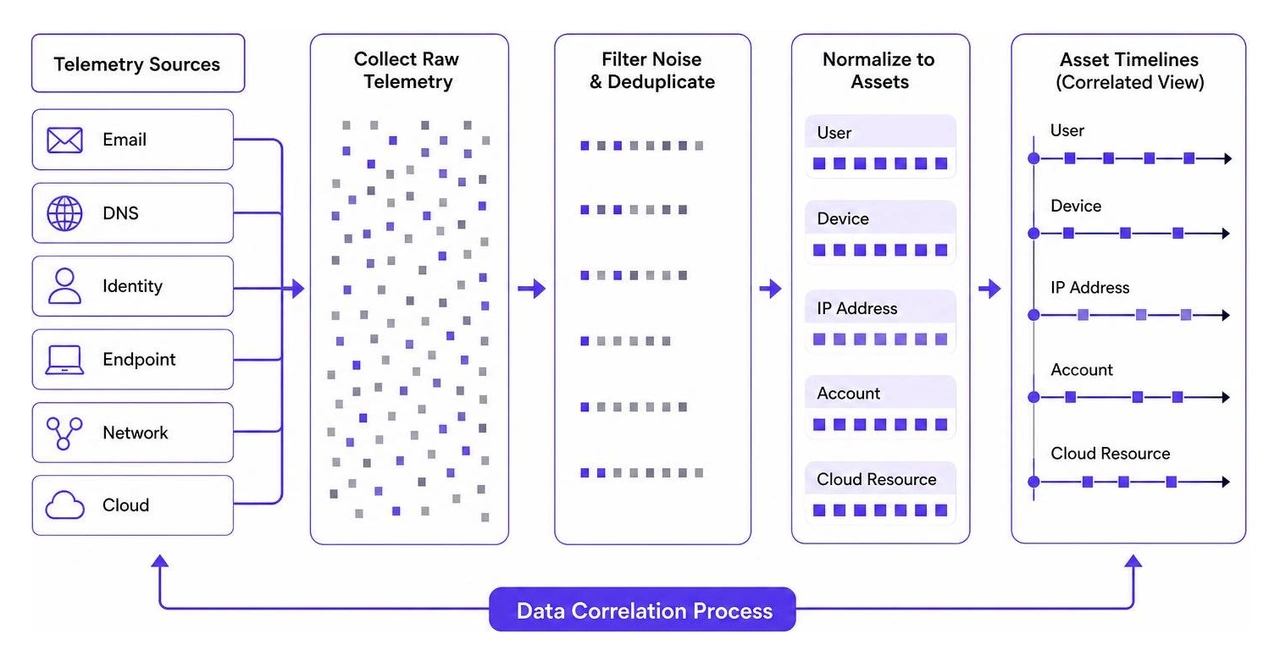
Effective Zero Trust requires complete visibility across your digital footprint. Disconnected security tools generate siloed alerts that overwhelm internal teams with alert fatigue while critical threats slip through unnoticed.
A unified cybersecurity platform eliminates these blind spots by continuously mapping your external attack surface, identifying exposed assets or misconfigurations, and prioritizing high-risk exposures. By correlating signals across email, identity, endpoints, network flows, and cloud environments, security analysts can track threats across the entire attack lifecycle and neutralize risks before adversaries establish persistence.
A traditional virtual private network (VPN) grants broad, network-level reachability to an entire subnet once a user successfully authenticates, allowing potential lateral movement across internal resources. In contrast, Zero Trust Network Access (ZTNA) establishes isolated, encrypted, per-application connections. The user is authenticated and authorized specifically for the individual application requested, while all other network resources remain cloaked and unreachable.
Zero Trust enforces granular access controls, micro-segmentation, and comprehensive audit logging—capabilities that directly map to major regulatory frameworks such as NIST SP 800-207, CMMC 2.0, HIPAA, and SOC 2. By isolating sensitive data enclaves through software-defined boundaries, Zero Trust limits the scope of regulatory audits, simplifies policy enforcement, and provides continuous evidence of compliance.
Yes. Zero Trust is an architectural framework and operational model, not a single standalone product. Modern Zero Trust implementations are composable and designed to integrate with an enterprise's existing infrastructure, identity providers (such as Microsoft Entra ID), endpoint protection agents, and cloud platforms. Organizations can layer Zero Trust policies, telemetry correlation, and continuous verification onto their current security stack without requiring a costly rip-and-replace overhaul.
Building enterprise security resilience in today's threat landscape requires moving beyond static, perimeter-focused defenses. By embracing continuous verification, dynamic risk assessment, and software-defined segmentation, organizations can dramatically minimize their breach exposure, streamline operational overhead, and satisfy rigorous compliance mandates.
Achieving high Zero Trust maturity does not require discarding your existing technology investments. WhiteDog's Unified Cybersecurity Platform brings together MDR, XDR, Delta Detection & Response (DDR), exposure management, and 24/7 SOC expertise to deliver end-to-end visibility across email, DNS, identity, endpoint, network, cloud, and data environments, with incident response included directly within MDR, XDR, and DDR. Through modular integration, our platform avoids any rip-and-replace approach and complements and extends your Microsoft Security and Microsoft 365 investments, helping your organization maximize the value of its existing Microsoft environment. Delta 360 (Δ360), built on WhiteDog’s Open XDR framework, adds a unified operational and security layer across Microsoft and third-party tools to improve correlation, visibility, security hardening, threat detection, exposure management, and response. Combined with our continuous attack surface management and 24/7 security operations, which build on correlated intelligence to identify threats earlier, we help your organization transform disconnected data into actionable intelligence and respond to threats with confidence.
Explore how WhiteDog unified cybersecurity solutions can help your team operationalize Zero Trust architecture and elevate enterprise resilience today.

Unify your security with an XDR cybersecurity platform that correlates endpoint, network, and cloud threats for faster, managed response.
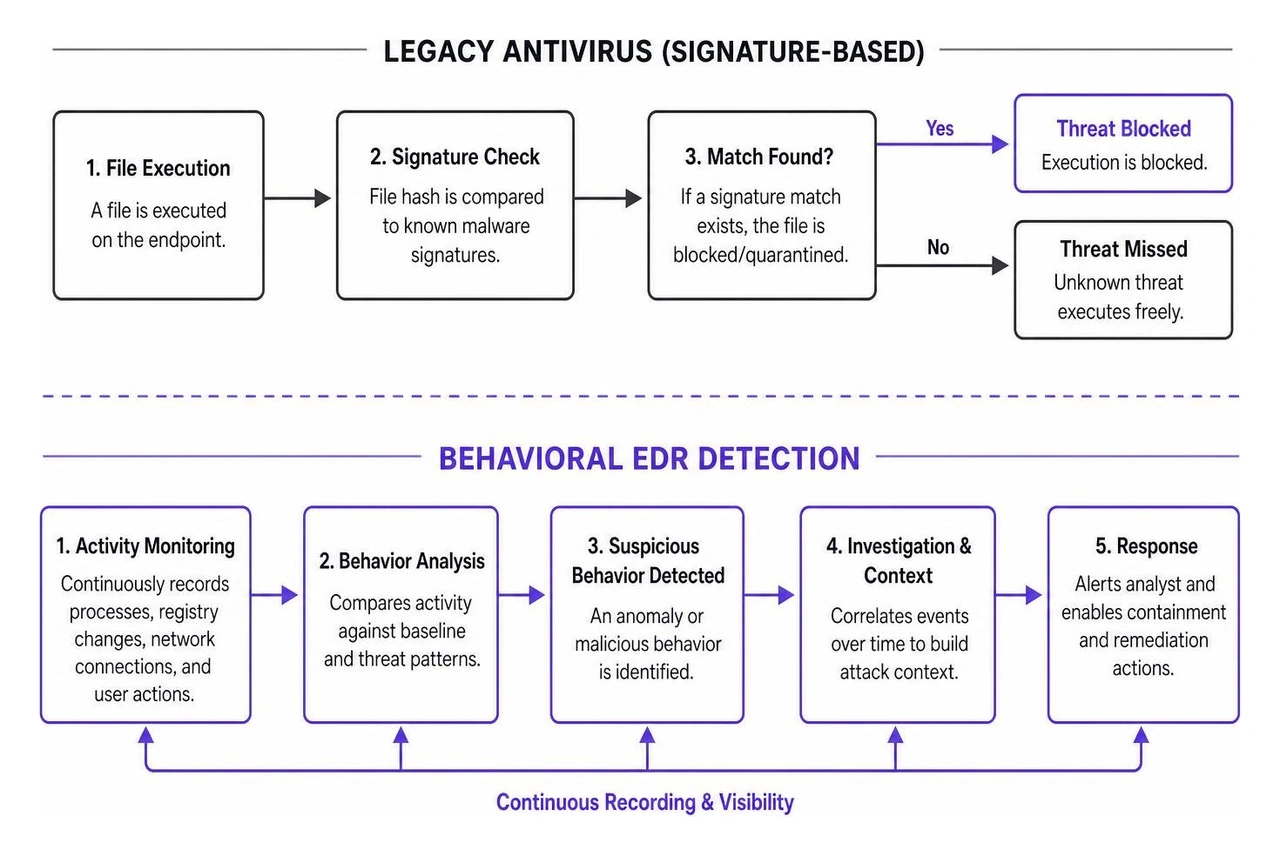
Compare EDR, XDR, and MDR solutions in this guide to endpoint detection & response, featuring WhiteDog's unified platform with 24/7 SOC and incident response.
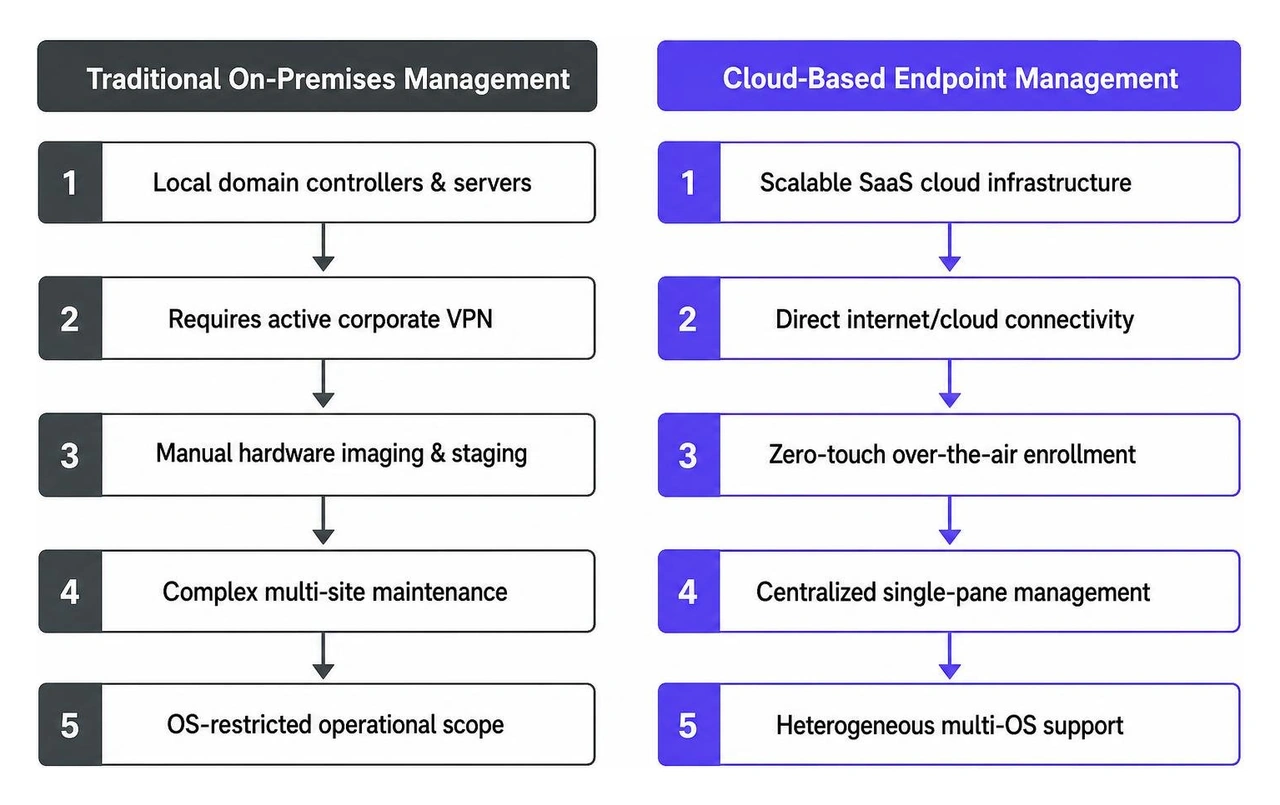
Compare cloud based endpoint management options with this checklist covering security, remote workforce support, and operational efficiency.

Compare MSP MDR detection services to reduce dwell time and boost efficiency with a unified 24/7 SOC platform.

Compare MSP MDR platform architecture vs. tool sprawl to reduce risk, improve detection, and scale your security operations.

The Ultimate Guide to Cybersecurity for Small Business - Learn about cyber security for small business