Cybersecurity
October 10, 2026
Learn how to check DNS security across your infrastructure with a 5-step audit, including DNSSEC, email records, and CAA validation.
XDR risk reduction works by connecting security signals across endpoints, identities, email, networks, cloud workloads, DNS, and data. To evaluate an XDR solution, confirm that it can integrate with your existing tools, correlate activity across those layers, and prioritize the few incidents that need action. The goal is simple: find multi-stage attacks earlier, reduce investigation time, and limit business impact without adding more disconnected dashboards.
EDR can detect endpoint activity, but it may miss the wider story when an attacker uses stolen credentials, moves through cloud services, or begins with a phishing email. MDR adds people and around-the-clock monitoring, but its risk-reduction value depends on the data sources it can access and correlate. XDR brings the data together so teams can see attack paths rather than isolated alerts.
For many organizations, the right choice depends as much on team maturity, after-hours coverage, and integration readiness as on product features. A well-planned XDR deployment can reduce alert fatigue by grouping related signals into a higher-confidence incident and giving analysts the context needed to investigate faster.
I am Shahin Pirooz, a cybersecurity and technology executive with experience building managed security and cloud services for complex IT environments. In this guide, I will help you assess where XDR risk reduction fits alongside your current security investments, staffing model, and operational goals.
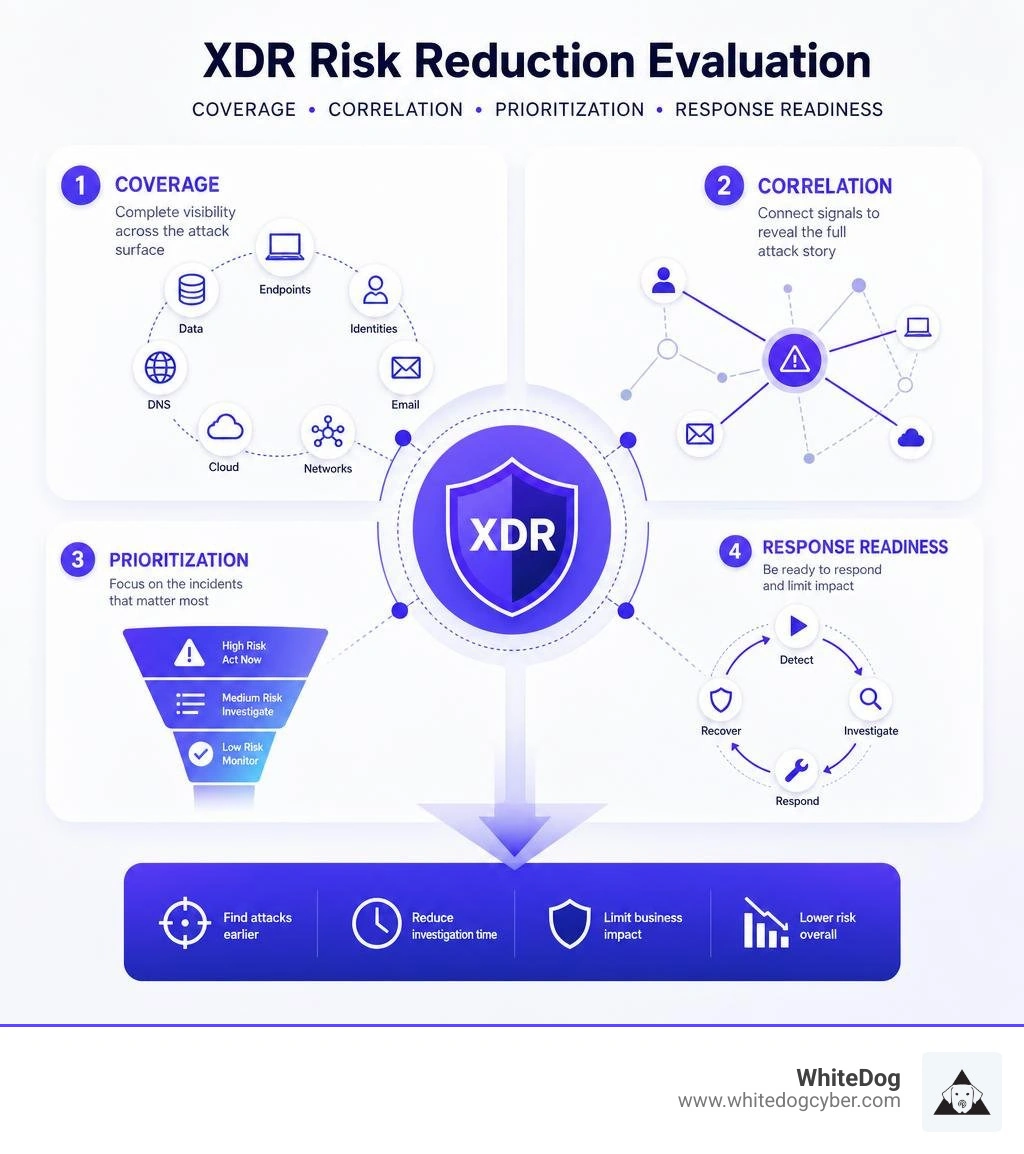
Essential XDR risk reduction terms:
Modern cyber attacks rarely stick to a single lane. An adversary does not merely attack a laptop; they phish a user, harvest credentials, bypass multifactor authentication, access cloud resources, manipulate identity permissions, and move laterally across server workloads.

When security teams rely on disconnected point products, they receive fragments of an attack story. The email gateway flags a suspicious link, the identity provider notes an unusual login from a new IP, and the endpoint agent detects PowerShell executing a script. In isolation, each of these events might appear low-severity or routine. Together, they represent an active enterprise breach.
True XDR risk reduction comes from stitching these disparate telemetry sources into a cohesive narrative. By collecting and synchronizing metadata across the entire ecosystem, Extended Detection and Response (XDR) transforms scattered telemetry into high-confidence detections, dramatically decreasing attacker dwell time.
For years, Endpoint Detection and Response (EDR) served as the cornerstone of enterprise defense. While endpoint visibility remains essential, endpoint security isn't enough on its own to counter modern intrusion techniques.
Attackers routinely operate in the spaces between managed endpoints:
If your monitoring environment stops at the endpoint agent, you are blind to credential misuse inside identity providers and lateral movement through network segmentation boundaries.
To close visibility gaps, XDR platforms ingest and normalize telemetry from multiple domains. This correlation process establishes behavioral baselines for users and entities across systems:
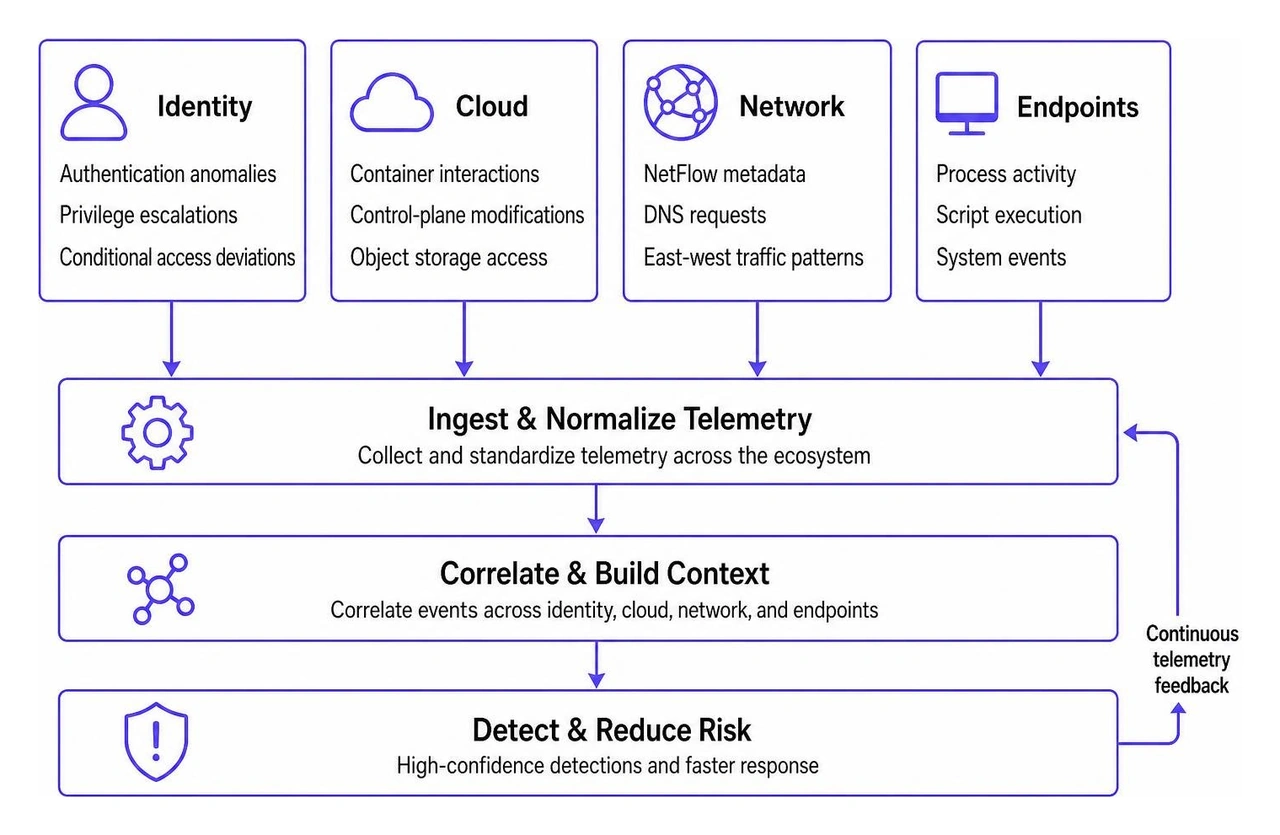
By establishing synchronization across these layers, XDR identifies multi-stage attacks that point solutions miss, significantly reducing organizational risk.
Choosing the right defense architecture requires evaluating visibility breadth, operational overhead, and who handles the work when an alert fires.

| Capability / Factor | Endpoint Detection & Response (EDR) | Managed Detection & Response (MDR) | Extended Detection & Response (XDR) |
|---|---|---|---|
| Primary Telemetry Focus | Endpoints (laptops, servers, VMs) | Primarily endpoints, with select log ingestion | Cross-layered (Endpoint, Identity, Network, Cloud, Email) |
| Data Correlation | Single vector (process/memory/host) | Varies by provider; often host-centric | Multi-vector native correlation across environments |
| Operational Staffing | Requires internal security staff | Managed 24/7 external SOC | Requires internal team or managed overlay |
| Response Scope | Host isolation, process termination | Guided remediation or host containment | Automated or orchestrated multi-system response |
| Blind Spot Mitigation | Low (confined to managed hosts) | Moderate (dependent on integrated feeds) | High (unifies identity, cloud, and network) |
For deeper context on evaluating these models, the EDR vs MDR vs XDR: The Decision Guide -- Redmondmag.com provides practical frameworks for matching architectures to team constraints.
EDR delivers granular inspection of process trees and file executions, but its containment actions are restricted to the endpoint itself. If a compromised account is being used to spin up unauthorized cloud instances, an EDR tool cannot revoke that user's session tokens or lock their active directory profile.
XDR bridges this architectural divide. By unifying telemetry, an XDR engine can automatically correlate a host-level suspicious execution with an identity tenant anomaly, triggering containment workflows that isolate the endpoint, disable the user account, and block malicious network egress simultaneously.
Deploying a powerful tool does not automatically create security outcomes. Many organizations run into security maturity plateaus and tool sprawl, purchasing advanced platforms without having the internal personnel to manage them.
Understanding your team's operational maturity prevents investing in software that ends up generating alerts no one has time to investigate.
The true test of any security investment is its effect on core operational metrics: Mean Time to Detect (MTTD) and Mean Time to Respond (MTTR).
When an adversary breaches a perimeter, speed is your defense. In traditional environments, analysts spend hours pivoting between different consoles: checking firewall logs, reviewing endpoint processes, and pulling authentication records to build an incident timeline.
XDR automates this timeline construction. By presenting the full scope of an incident in a single console, analysts can understand the root cause within minutes rather than days. Automated playbooks can immediately apply targeted mitigations—such as revoking API keys, quarantining devices, and updating firewall drop-lists—shortening both MTTD and MTTR.
Security teams face an overwhelming volume of notifications daily. Alert fatigue leads to analyst burnout and increases the likelihood that critical warnings will be ignored or missed.
XDR addresses this by acting as an intelligent aggregation layer:
While the operational advantages are significant, realizing the benefits of XDR requires practical planning around integration and data management.
Many IT environments suffer from fragmented architecture. When organizations add new standalone solutions without unifying them, too many tools create fragmented protection and drive up management overhead.
Key integration hurdles include:
Adopting Open XDR approaches or leveraging unified security architectures helps organizations bring together their existing tools—including investments in Microsoft 365 security—without requiring a disruptive rip-and-replace overhaul.
Modern regulatory standards—such as HIPAA, PCI-DSS, CMMC, and GDPR—require organizations to demonstrate continuous monitoring, rapid incident response capabilities, and rigorous audit trails across endpoints, networks, and identities.
XDR simplifies compliance by:
To run a standalone XDR platform internally, an organization typically needs a mature IT security team with dedicated analysts who can manage API connectors, customize detection rules, and handle 24/7 triage. Organizations with smaller or developing teams can achieve the same risk-reduction benefits by partnering with a managed service or adopting a unified platform backed by an external 24/7 SOC.
EDR monitors processes running on host machines. If an attacker uses valid credentials to log directly into a cloud console or access SaaS applications, an endpoint agent sees nothing suspicious. XDR correlates identity provider telemetry (such as impossible travel, repeated MFA failures, or abnormal token use) with host and network behavior, surfacing compromised accounts before they can be used for privilege escalation.
The most common challenge is poor data ingestion hygiene and lack of integration planning. If critical systems—such as cloud identity providers or edge network devices—are omitted from the ingestion pipeline, the XDR correlation engine cannot build a complete picture of an attack, recreating the blind spots it was meant to resolve.
Securing modern environments requires moving beyond isolated point products and fragmented alerts. By connecting telemetry across endpoints, identities, networks, cloud workloads, and data, organizations can identify complex attack chains earlier, streamline their operations, and significantly reduce operational risk.
At WhiteDog, we help organizations simplify security operations through our unified cybersecurity platform solutions. By integrating visibility, exposure management, and detection capabilities alongside our 24/7 SOC expertise, we transform disconnected telemetry into correlated intelligence—empowering your team to identify threats faster, eliminate alert fatigue, and protect your digital operations with confidence.


Learn how to check DNS security across your infrastructure with a 5-step audit, including DNSSEC, email records, and CAA validation.

Master enterprise risk reduction with this detailed guide covering ERM frameworks, AI governance, and cybersecurity strategies for 2026.

Compare top AWS incident response solutions for rapid remediation, automated triage, and containment with native tools and expert escalation paths.

Harden your Amazon Linux firewall with firewalld and nftables to meet STIG compliance, block lateral movement, and secure AWS EC2 hosts.

Implement data governance to improve data quality, ensure compliance, and reduce risk across your enterprise lifecycle.

Master AWS Security Hub for unified cloud security posture, compliance automation, and streamlined SecOps workflows.