Cybersecurity
July 9, 2026
Discover how cyber security health checks strengthen your defenses, reduce risk, and support compliance across regulated industries and SMEs.
Effective AI phishing detection combines real-time email and URL analysis with strict human verification. Security leaders should:
Traditional filters still matter, but they cannot reliably catch new, personalized attacks that have no known malicious domain, signature, or wording. AI can identify subtle signals such as a sender's unusual writing style, a lookalike URL, a brand mismatch on a webpage, or a request that breaks normal business behavior.
This matters because generative AI makes convincing scams easier to create at scale. One study found that AI-written phishing emails led 54% of participants to click - a result comparable with expert-written scams and more than three times the rate of generic phishing. The threat also extends beyond the inbox: deepfake voice and video can add false urgency and apparent executive approval to a fraudulent request.
For security teams, the goal is not to trust an AI score without question. It is to use AI as one layer in a defense that combines detection, correlated telemetry, clear analyst context, and non-negotiable verification protocols.
I am Shahin Pirooz, a cybersecurity and technology executive with deep experience building cloud, managed security, and service delivery programs. In this guide, I will explain how practical AI phishing detection can help security leaders reduce risk without adding more disconnected tools.
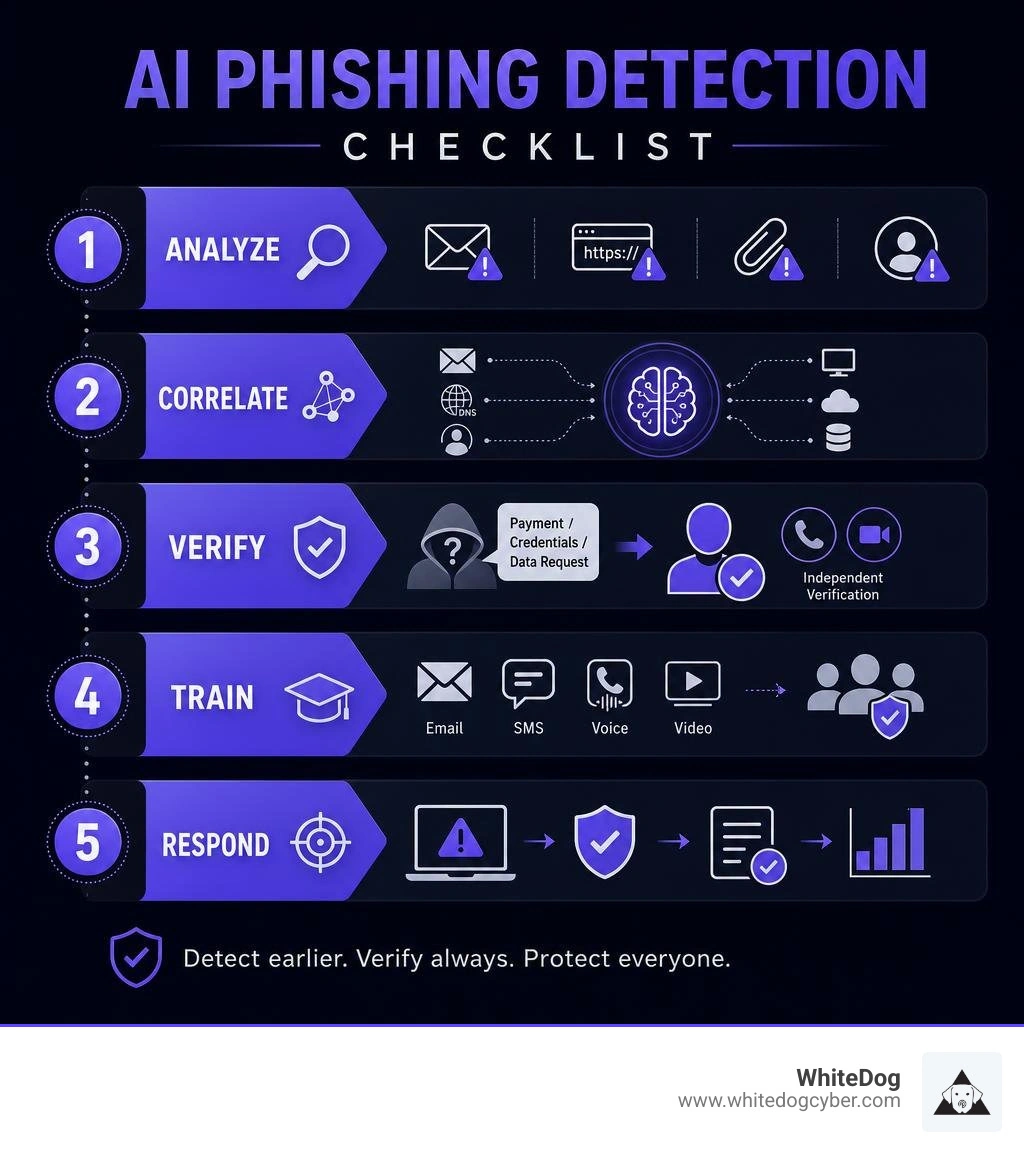
Ai phishing detection terms you need:
Static signature blacklists and legacy secure email gateways were designed for an era when phishing was ungrammatical, blasted in bulk, and sent from suspicious, newly registered domains. Today, 46.8% of email traffic consists of spam messages, and bad actors no longer rely on obvious typos or crude lures. Modern social engineering leverages large language models to generate contextually accurate, conversational prose that matches internal corporate jargon with flawless grammar.
Traditional security measures fall short against modern attacks for several distinct reasons:
When organizations examine why email security is falling behind, the root cause is clear: static rules cannot evaluate dynamic human context. As phishing campaigns shift toward real-time social engineering, standard simulated phishing tests also provide diminishing returns. Security operations need protection that moves beyond phishing simulations: real protection for email attacks through continuous, algorithmic verification of message intent.
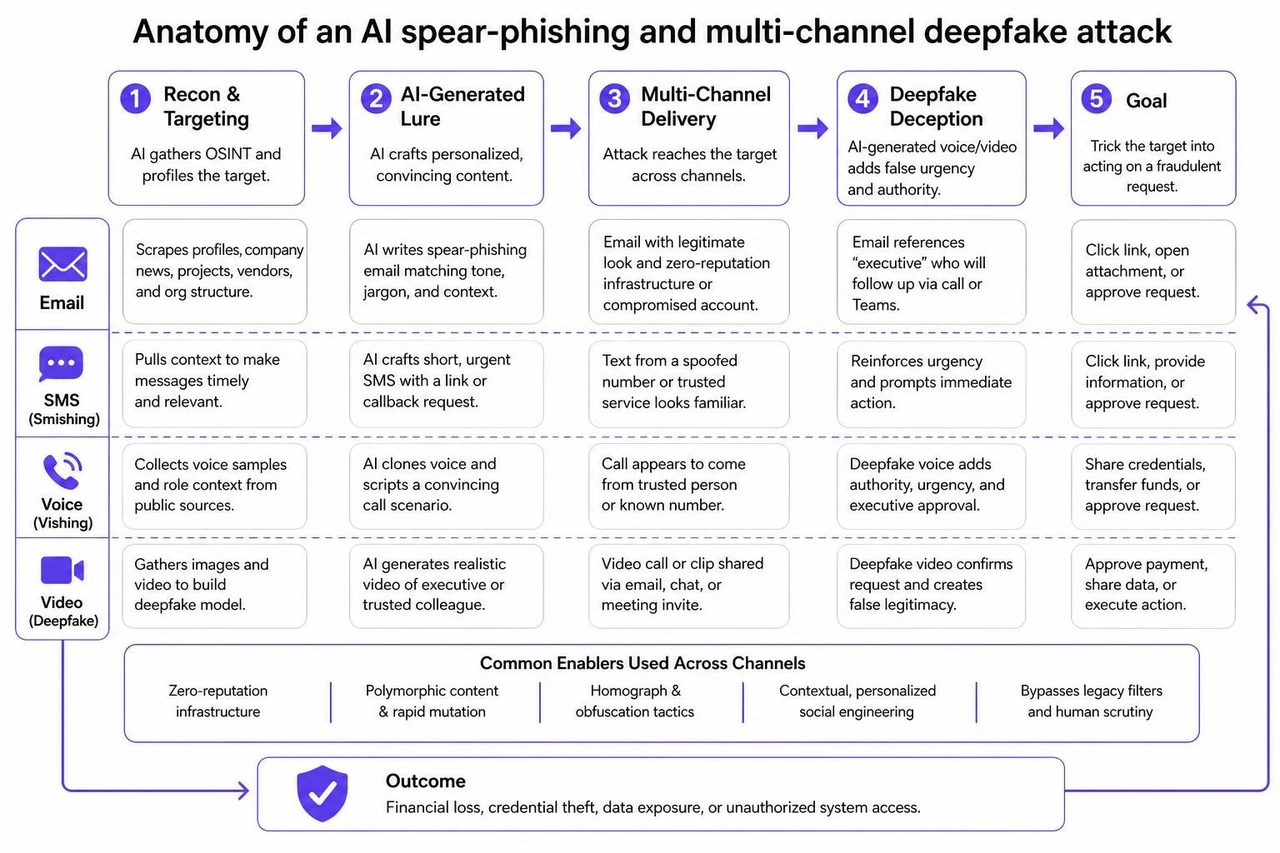

Modern defense platforms do not rely on a single isolated model. Instead, they deploy multi-layered inspection pipelines that analyze textual linguistics, technical email headers, domain routing telemetry, and live webpage rendering. Bibliometric analysis tracking academic literature over recent years demonstrates a 27.51% annual growth rate in research dedicated to machine learning and deep learning for phishing detection, showing how rapidly the field is progressing (Popescul & Radu, 2025).
Modern detection platforms operate across a pipeline that evaluates incoming communications through specialized layers:

By applying AI-driven threat detection, organizations baseline routine communication patterns to flag anomalies that human reviewers and rule sets overlook.
To detect malicious payloads in real time, defense architectures combine classical machine learning with advanced deep learning models:
Open-source and client-side implementations, such as the PhishGuard AI phishing detector, demonstrate how compact BiLSTM and CNN architectures can execute locally inside browser environments via client-side frameworks, ensuring on-device link evaluation without leaking user browsing habits.
Sophisticated phishing pages frequently use clean HTML, evade security crawlers, and obfuscate text using inline images or canvas elements. Defeating these tactics requires multimodal systems capable of analyzing text, computer vision, and live browser behavior concurrently.
Academic innovations such as MemoPhishAgent's memory-augmented multimodal LLM framework highlight how multi-agent architectures outperform static heuristics. In production, these agents coordinate specialized tasks:
Similarly, open-source toolkits like anishalx's Phisgentic framework leverage multi-agent consensus to reduce false positives by requiring independent verification agents to cross-validate findings before raising high-priority incident flags.
When evaluating detection platforms, enterprise security leaders must assess whether a tool genuinely mitigates risk or merely introduces alert noise.
| Capability Area | Classical Signature / Rule Filters | Multi-Agent AI Phishing Detection |
|---|---|---|
| Zero-Day Lure Detection | Fails; requires known malicious IP, domain, or file hash. | High; evaluates semantic intent, brand context, and visual artifacts. |
| Behavioral Profiling | None; treats every message in isolation. | Continuous; maps historical communication graphs and sender tone. |
| Visual Impersonation | Cannot evaluate image payloads or rendered layouts. | Renders pages in headless browsers; matches visual brand markers. |
| Cross-Channel Correlation | Siloed to email inbox scanning only. | Correlates email, DNS, identity, endpoint, and cloud telemetry. |
| Analyst Explainability | Binary rule trigger (e.g., "Matched Blocklist Rule #402"). | Provides natural-language rationale payloads and structured JSON context. |
Organizations providing managed security services or scaling an internal operations center should align detection capabilities with our framework for email threat detection for MSPs. It is also vital to distinguish marketing claims from operational realities, as outlined in our analysis of AI in the SOC: what's real, what's hype, and what's next.
Effective detection requires establishing baseline communication norms for every identity across an organization. Behavioral engines continuously monitor:
If an attacker compromises an executive's mailbox or crafts an undetectable lookalike address, the behavioral engine detects that the message style diverges from historical baselines, or that an out-of-band wire transfer request violates standard workflows.
By integrating these signals into an enterprise defense layer, security teams leverage automation and threat intelligence to scale operations, neutralizing targeted executive impersonation attempts before funds or data leave the organization.
While deep learning and LLMs achieve high detection accuracy, operational adoption often struggles with the "black-box" dilemma. If an AI engine quarantines a critical executive communication without explaining why, security analysts waste valuable time investigating benign alerts.
Explainable AI (XAI) addresses this opacity. Cutting-edge frameworks, including FedPhishLLM's federated learning and LLM detection mechanism, output explainable JSON metadata alongside classification scores:
Structured explainability speeds up triage, mitigates concept drift as attackers alter techniques, and supports unified endpoint defenses alongside AI-based malware detection platforms.
AI-generated phishing emails bypass standard gateways because they lack known malicious signatures, file attachments, or previously flagged domains. Adversaries use large language models to draft pristine, grammatically correct content that avoids spam trigger keywords and mimics genuine corporate communication styles. Furthermore, attacks often stage destination links on legitimate, high-reputation cloud hosting services, passing conventional IP and domain reputation checks.
Multi-modal Large Language Models inspect both the textual structure and visual representation of a target webpage simultaneously. Rather than just checking an HTML document for suspicious code, a multi-modal agent renders the site in an isolated container, evaluates screenshots to verify if logos match the actual domain identity, inspects form elements for credential harvesting indicators, and applies heuristic reasoning to detect zero-day spoofing attempts.
Yes. Modern architectures preserve data privacy by running optimized, lightweight neural networks locally on client devices or utilizing federated learning pipelines. In federated frameworks, raw email text, employee browsing histories, and sensitive company documents remain strictly on local infrastructure. Only encrypted model parameter updates (such as LoRA weights) are shared with central aggregation servers, maintaining regulatory compliance with standards like GDPR while continuously improving detection accuracy.

Defending against modern social engineering requires more than isolated tools. As spear-phishing converges with deepfake voice and video, security resilience depends on combining automated AI detection with strict verification policies and continuous threat exposure management.
WhiteDog Cyber helps organizations simplify cybersecurity operations through a unified platform that connects visibility, detection, response, and risk management. We complement and extend your existing Microsoft Security and Microsoft 365 investments—helping IT leaders maximize the value of tools they have already deployed through modular integration.
Our approach to enterprise resilience aligns capabilities to your operational needs:
By uniting real-time AI phishing detection with correlated cross-vector telemetry and 24/7 security operations, enterprise leaders can reduce cyber risk, simplify operations, and protect critical assets against modern identity and email threats.
Popescul D, Radu LD. "AI in phishing detection: a bibliometric review.." Frontiers in artificial intelligence, 2025. PMCID PMC12589022.


Discover how cyber security health checks strengthen your defenses, reduce risk, and support compliance across regulated industries and SMEs.

Discover co-managed security for MSP: Share responsibilities, boost efficiency, and scale cybersecurity without losing control.

Master your CMMC compliance assessment with this definitive guide covering levels, timelines, and certification requirements for DoD contractors.

Master CMMC compliance certification for DoD contractors. Guide to levels, assessments, timelines & prep for FCI/CUI security.

Master internet threat protection with layered defense strategies that reduce risk and stop modern attacks before they compromise your enterprise.

Compare certified penetration testing certifications, skills, and AI trends to strengthen enterprise security and compliance in 2026.