Cybersecurity
May 6, 2026
Discover proactive incident response services: Slash dwell time, cut costs, boost resilience vs. reactive IR in 2026.
Migrating data and core workloads to the cloud delivers clear operational agility, but it also alters the governance perimeter. In a physical data center, physical security, network boundaries, and server hardware sit entirely under direct administrative control. In dynamic hyperscale environments, infrastructure is decoupled, virtualized, and ephemeral. Proving system integrity and regulatory alignment requires a structured shift from periodic manual checks toward continuous verification.
Meeting regulatory expectations requires organizations to demonstrate data integrity, robust identity boundaries, and comprehensive operational transparency across all storage tiers and compute engines.
| Cloud Model | CSP Audit Scope | Customer Audit Scope | Key Audit Artifacts |
|---|---|---|---|
| IaaS | Physical infrastructure, data centers, core hypervisors | OS patching, network configuration, IAM, encryption, data | CSP SOC 2 Type II, CIS Benchmarks, CSPM reports |
| PaaS | Physical infrastructure, OS maintenance, runtime environment | Application code, database schema, user access, configuration | Provider attestation, CI/CD scan results, IAM policies |
| SaaS | Complete application stack, runtime, hosting, physical security | Identity access management, data classification, tenant settings | SaaS SOC 1/SOC 2, tenant audit logs, CASB/SSPM reports |
To maintain a defensible security baseline, governance teams rely on formal certifications such as ISO/IEC 27001 to govern overarching security management systems, while aligning cloud retention and internal controls to legal frameworks like the Sarbanes-Oxley Act (SOX).
A common pitfall is assuming that achieving compliance guarantees security. In reality, compliance establishes a baseline of documented controls to meet standard regulatory requirements, whereas operational security actively protects workloads from dynamic, evolving threats.
Compliance frameworks outline necessary safeguards—such as requiring multi-factor authentication (MFA) and encryption at rest—to establish regulatory defensibility. However, a fully compliant environment can still fall victim to sophisticated zero-day attacks, targeted phishing, or subtle configuration drift. As organizations mature their governance programs, aligning foundational checks with broader enterprise security compliance allows them to turn passive audit trails into active operational resilience.
Digital archiving in cloud platforms must satisfy strict legal and operational standards to withstand external audits. Archival systems must be designed around ten foundational features:
The shared responsibility model dictates the distribution of security controls between cloud service providers (CSPs) and enterprise customers. In an Infrastructure-as-a-Service (IaaS) model, the cloud provider manages physical security, hypervisor virtualization, and basic infrastructure facilities. The customer retains ownership of the operating systems, network ingress/egress rules, identity boundaries, middleware, and stored data.
As organizations consume Platform-as-a-Service (PaaS) or Software-as-a-Service (SaaS), the provider assumes greater operational control over the underlying stack. However, data governance, user permissions, and configuration integrity remain the customer's legal responsibility. Auditors must review vendor assurance documentation while verifying customer-managed controls against recognized industry benchmarks, such as the ISO/IEC 27017 cloud security standards, which provide clear control taxonomies for shared cloud environments.
Navigating compliance requires structured assessments across financial, technical, and privacy disciplines.
Organizations typically navigate three distinct categories of cloud evaluations:
These assessments often reference provider attestation reports—such as a standardized SAP Enterprise Management SOC 1 Audit Report 2025 H2—to confirm the financial and operational reporting controls of underlying hosting partners. To structure these assessments comprehensively, audit teams consult guidance like the ISO/IEC TR 3445 technical report to establish audit boundaries and streamline evidence collection.
Different jurisdictions and industry sectors require specific compliance frameworks:
With enterprise architectures spanning multiple clouds and SaaS platforms, governance teams face operational complexity, decentralized assets, and rapid configuration drift.
Misconceptions about cloud compliance often lead to operational blind spots:
Multi-cloud operations often suffer from fragmented visibility, inconsistent IAM policies, and disconnected logging systems. When teams configure AWS, Microsoft Azure, and Google Cloud Platform through separate consoles, governance standards quickly diverge.

Overcoming these visibility silos requires centralizing identity governance through a unified Identity Provider (IdP) and enforcing security guardrails across deployment pipelines via automated policy-as-code. Standardizing operational controls across environments simplifies cross-cloud validation, a process detailed in this multicloud compliance governance guide.
Static spreadsheets and manual screenshot collection cannot keep pace with dynamic container instances, serverless microservices, and rapid CI/CD deployments. Modern compliance relies on automated tooling to monitor infrastructure continuously.
Modern governance architectures rely on specialized platforms to assess posture and enforce technical guardrails:
These technologies map technical findings directly against industry governance models like the Cloud Security Alliance Cloud Controls Matrix (CCM), providing structured evidence for external assessors.
Compliance automation software integrates directly with cloud management APIs, continuously querying infrastructure state, parsing identity federations, and logging access policies into a central repository.
When infrastructure shifts unexpectedly—such as a developer opening port 22 on a production instance or modifying an S3 bucket policy—automated detection surfaces the deviation immediately. Using automated AWS delta detection methods allows security teams to identify configuration drift early, gather immutable evidence, and remediate gaps before formal audit engagements begin.
A successful cloud audit requires a structured execution framework spanning discovery, control testing, and remediation.
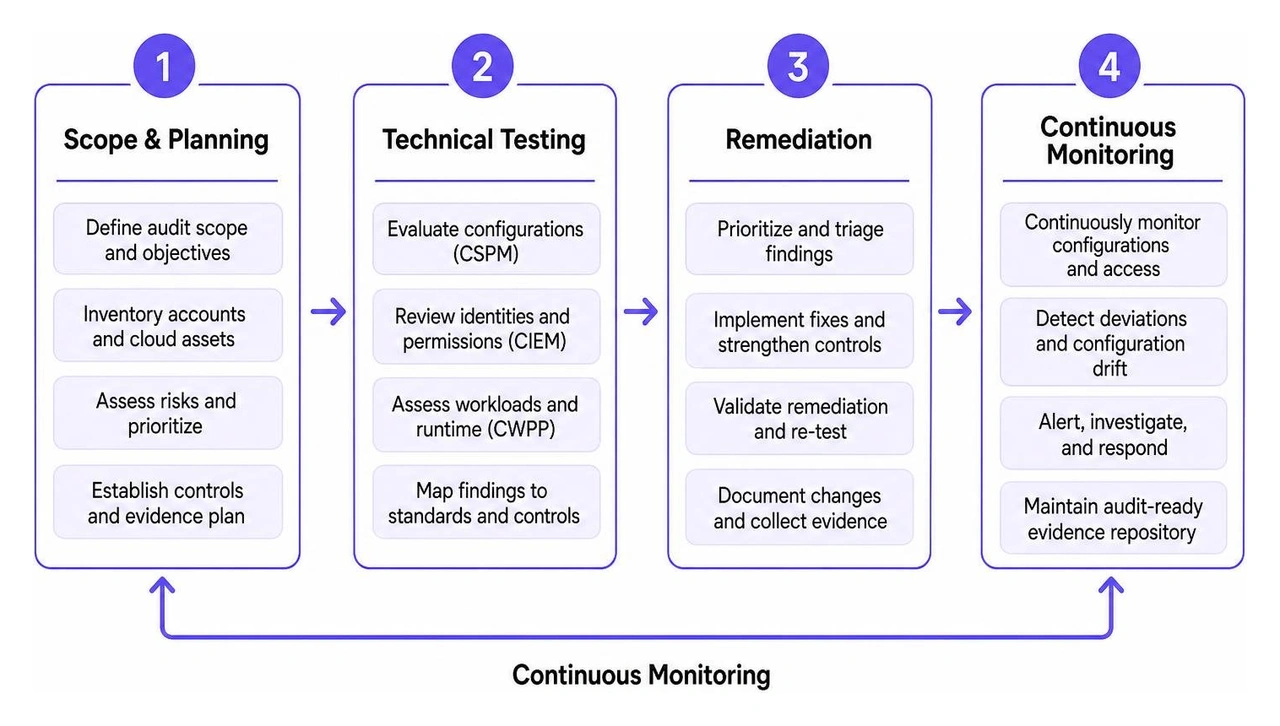
Following this roadmap ensures that governance teams systematically assess risks rather than scrambling to assemble documentation at the end of the year. For a deeper look at aligning these stages with broader cloud architecture, explore this comprehensive cloud security guide.
The initial phase focuses on establishing comprehensive visibility:
Once scoping is complete, technical teams execute systematic verification across critical infrastructure layers:
The final phase transforms raw assessment findings into actionable risk reduction:
The most critical challenge is uncontrolled configuration and policy drift across disparate cloud providers. Because AWS, Azure, and GCP utilize distinct API structures, identity models, and logging formats, organizations often suffer from fragmented visibility. This fragmentation makes it difficult to maintain consistent security guardrails, leading to unmonitored orphan accounts, inconsistent IAM policies, and incomplete audit evidence.
Compliance automation focuses on continuously checking technical configurations against defined regulatory frameworks (such as SOC 2, ISO 27001, or NIST) to generate audit evidence and flag compliance failures. Continuous Threat Exposure Management (CTEM) takes a broader, risk-centric approach. CTEM evaluates whether existing vulnerabilities, misconfigurations, and identity weaknesses can be actively exploited by attackers, prioritizing remediation based on real-world business impact rather than checklist compliance alone.
While traditional external compliance audits occur annually, organizations should perform continuous, automated internal auditing. Deploying tools that evaluate API configurations, network perimeter exposure, and identity hygiene in real time ensures that drift is caught immediately. Additionally, targeted formal reviews should be triggered whenever significant architectural changes occur, such as large-scale cloud migrations, new SaaS platform adoptions, or major application deployments.
Proving compliance across modern cloud environments requires continuous operational discipline, unified visibility, and cross-domain intelligence. Point-in-time checks are no longer sufficient to secure distributed, fast-moving infrastructure against sophisticated threats.
At WhiteDog, we help organizations simplify cybersecurity operations through a unified platform that connects visibility, detection, response, and risk management. Our Delta 360 (Δ360) platform, built on our Open XDR framework, complements and extends your existing Microsoft Security and Microsoft 365 investments. By adding a unified operational layer across Microsoft and third-party tools, Δ360 improves telemetry correlation, security hardening, exposure management, and threat response through modular integration rather than a rip-and-replace approach.
Our technology integrates data across email, DNS, identity, endpoint, network, cloud, and data environments, transforming fragmented security signals into actionable intelligence. WhiteDog’s continuous attack surface management and 24×7 security operations build on correlated intelligence to identify threats earlier and respond with confidence. While our Open XDR offering delivers unified visibility and detection, our managed MDR, XDR, and top-tier Delta Detection & Response (DDR) services provide fully managed 24/7 SOC expertise—with incident response included—to contain active attacks.
Whether you need to streamline multi-cloud governance or validate your environment against stringent regulatory standards, conducting a structured cloud security audit establishes the operational baseline needed to secure your workloads and maintain continuous compliance.


Discover proactive incident response services: Slash dwell time, cut costs, boost resilience vs. reactive IR in 2026.

Discover MDR in cyber security: 24/7 monitoring, proactive hunting & rapid response. Bridge skills gaps, beat ransomware—expert guide for 2026.

Discover why Cincinnati businesses swap DIY IT for cincinnati managed security services. Boost protection, cut costs, ensure compliance.

Inside this little corner of the molt‑i‑verse, the agents have started… improvising