Cybersecurity
November 18, 2026
Learn the fundamentals of AWS security auditing, including IAM reviews, compliance checks, and automation with AWS Config and Security Hub.
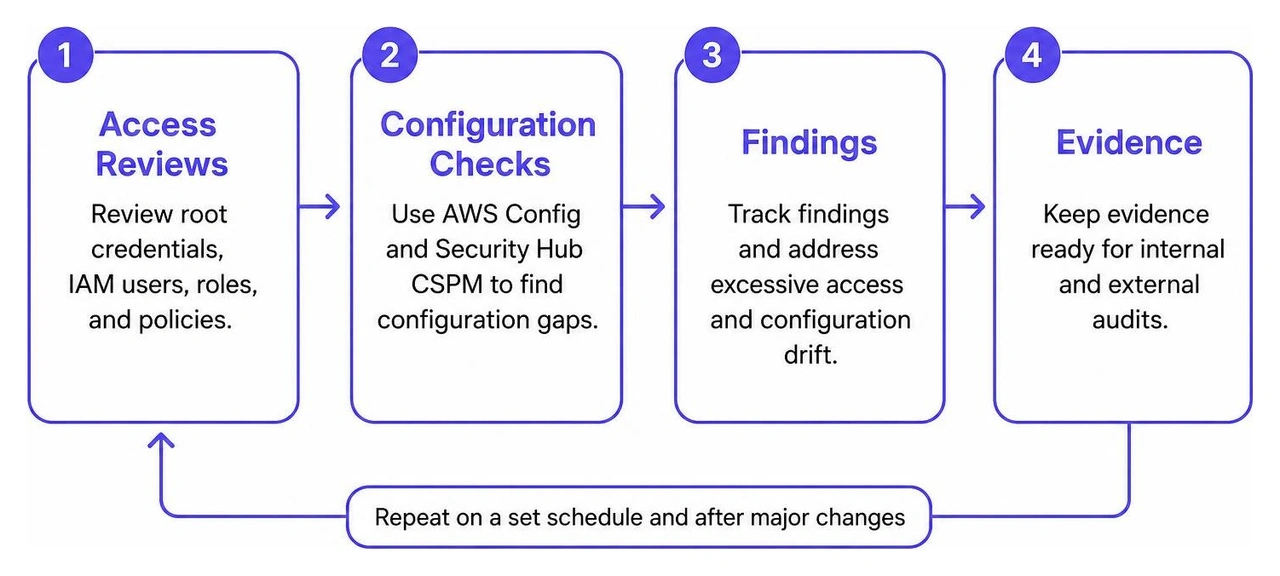
AWS security auditing is the regular review of who can access your AWS accounts, how resources are configured, and whether security activity is recorded. Start with root credentials, IAM users, roles, and policies. Then use AWS Config and Security Hub CSPM to find configuration gaps and track findings. Repeat the review on a set schedule and after major staffing or infrastructure changes.
This approach helps teams catch excessive access and configuration drift before they become larger risks. It also keeps evidence ready for internal and external audits.
Identity and Access Management (IAM) is the primary defensive boundary in any cloud environment. Conducting an effective cloud security audit requires a deep evaluation of all identities, authentication mechanisms, and privilege boundaries. Following official AWS security audit guidelines ensures that organizations systematically eliminate latent access risks across their infrastructure.
The starting point of any audit begins with root credentials. The AWS account root user possesses unrestricted, permanent administrative control over every resource in the account. Root credentials must never be utilized for daily administrative operations. Auditors should ensure that root account access keys do not exist or have been permanently deleted, and that strong, hardware-backed multi-factor authentication (MFA) is strictly enforced on the root login. Day-to-day administrative duties should instead be delegated through identity federation using AWS IAM Identity Center.
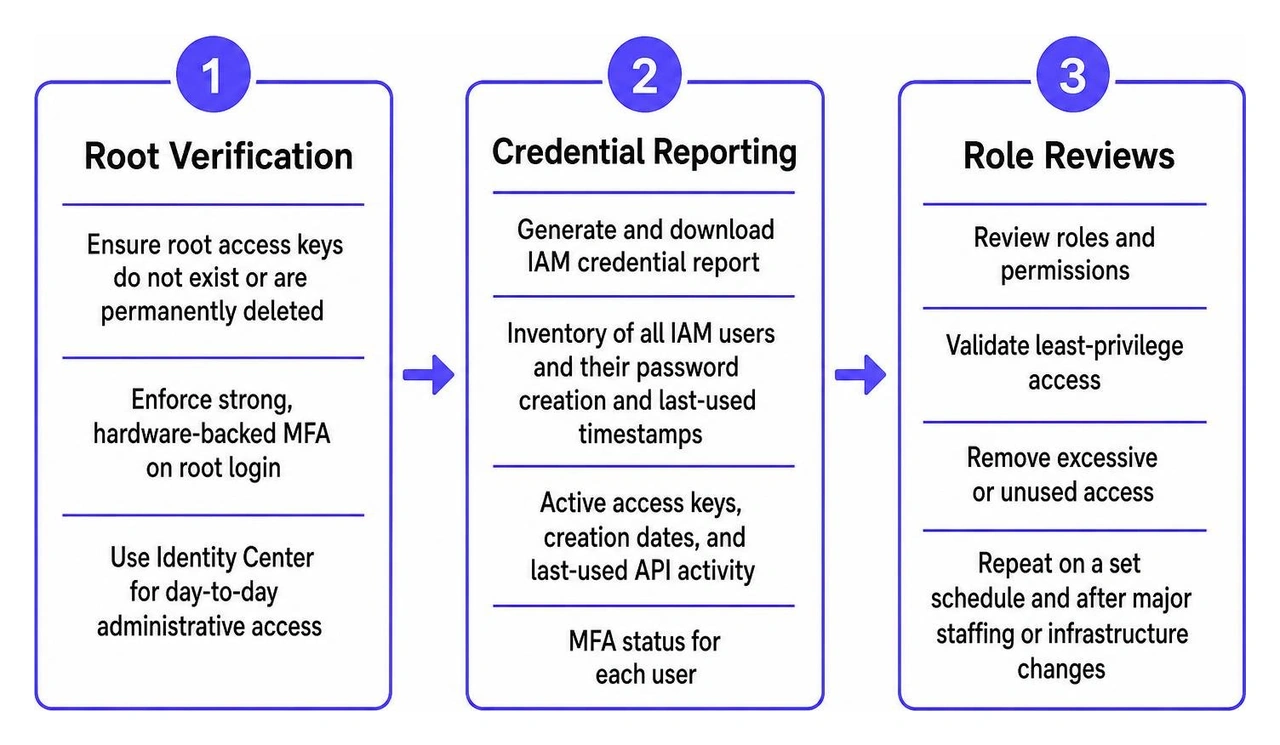
To assess the operational posture of all other IAM identities, administrators must generate and download an IAM credential report. This report delivers an account-wide inventory detailing:
Auditors must review this report to identify and deactivate inactive passwords and long-term static access keys that have not been used for over 90 days. Wherever possible, human users should not have persistent IAM user accounts; organizations should transition workforce authentication to centralized identity providers using temporary credentials.
Preparing for an audit involves defining structured review triggers and assessing auxiliary authentication conduits. A security assessment should not merely occur as an annual checkbox exercise; teams must maintain alignment between audit and compliance in cloud computing.
Standard audit triggers include:
Additionally, auditors must examine third-party identity relationships. Identity providers configured via SAML 2.0 or OpenID Connect (OIDC) metadata must be audited to ensure that trusted external endpoints remain valid and that obsolete IdP integrations are pruned.
Mobile and client-side applications accessing AWS infrastructure require equal scrutiny. Hardcoded access keys embedded directly within application binaries present an extreme risk of credential extraction. Auditors must confirm that all mobile and client applications exchange identity tokens for temporary, short-lived AWS credentials using Amazon Cognito or AWS Security Token Service (STS).
Evaluating IAM policies requires analyzing how permissions interact across identity-based policies, permission boundaries, and resource-based policies. A critical objective during an audit is preventing privilege escalation pathways.

Granting an IAM principal permissions to create, update, or attach policies is functionally equivalent to granting full AdministratorAccess. For example, actions such as iam:PutUserPolicy, iam:CreatePolicyVersion, iam:AttachRolePolicy, and iam:SetDefaultPolicyVersion allow an identity to assign arbitrary privileges to itself or other entities it controls.
Auditors must review IAM policies against specific risk criteria:
"Action": "*", "Resource": "*") permissions. While wildcards can be acceptable for broad discovery actions (such as ec2:Describe*), they must never be coupled with state-changing or administrative APIs.iam:PassRole—frequently used when provisioning EC2 instances, Lambda functions, or ECS tasks—must be strictly constrained to specific, designated role ARNs. Unchecked iam:PassRole access allows users to launch resources assumed by high-privilege roles, effectively bypassing their own permission boundaries.When external auditors, compliance teams, or automated posture assessment tools require visibility into an AWS environment, granting broad administrative or generic read access introduces unnecessary exposure. AWS addresses this challenge through the official SecurityAudit managed policy (arn:aws:iam::aws:policy/SecurityAudit).
The SecurityAudit policy is an AWS-maintained managed policy engineered specifically to provide read-only access to security configuration metadata without exposing sensitive application data. AWS maintains this policy centrally across iterations—it has been edited as recently as September 30, 2026, and is at version v94. As AWS releases new services and governance APIs, the policy is updated to ensure auditing roles inherit necessary metadata visibility.
| Policy Characteristic | SecurityAudit Managed Policy | ReadOnlyAccess Managed Policy |
|---|---|---|
| Primary Scope | Security configuration metadata and governance telemetry | Full account read-only visibility across data and control planes |
| Data Plane Access | Restricted; cannot view S3 object data, DynamoDB records, or database rows | Permitted; allows reading contents of S3 objects, database tables, and secrets metadata |
| Target Audience | Security auditors, compliance assessors, CSPM tools | General developers, operations teams, troubleshooting engineers |
| Privilege Level | Highly constrained least-privilege metadata inspection | Broad read privileges encompassing sensitive business payloads |
To implement read-only auditing across an enterprise, organizations should establish dedicated cross-account IAM roles rather than generating static credentials. In a multi-account structure, each member account hosts an audit role containing the SecurityAudit policy attached alongside targeted trust policies.
This cross-account architecture allows a centralized security account or an external assessor to invoke sts:AssumeRole, gaining temporary, scoped access to evaluate account configurations. Because the policy strictly limits permissions to Describe, List, and Get metadata APIs across services like EC2, IAM, S3, KMS, and GuardDuty, auditors can verify encryption parameters, bucket policies, and logging setups without the risk of viewing sensitive customer payloads or altering system state.
Integrating these auditing roles with an AWS security observability platform ensures that all cross-account role assumptions and audit queries are continuously captured via AWS CloudTrail, providing an immutable record of auditing activity.
Manual audits represent a snapshot in time, quickly becoming obsolete as infrastructure evolves. To maintain continuous audit readiness, organizations deploy AWS Config to continuously record resource relationships, track configuration history, and evaluate infrastructure states against defined baselines.
By utilizing custom AWS Config rules, security engineers can implement compliance checks as code. When cloud resources are provisioned or altered, AWS Config captures the configuration item, evaluates it against custom compliance logic executed by an AWS Lambda function, and records whether the resource is COMPLIANT or NON_COMPLIANT. Incorporating continuous delta evaluations, as outlined in our AWS delta detection guide 2026, allows security teams to identify subtle security posture deviations as soon as they emerge.
A foundational security requirement across regulatory frameworks and the CIS AWS Foundations Benchmark (Control 4.3) is verifying that network flow logging is active across all Virtual Private Clouds (VPCs). While managed rules exist for standard configurations, building a custom AWS Config rule illustrates how policy-as-code operates end-to-end.
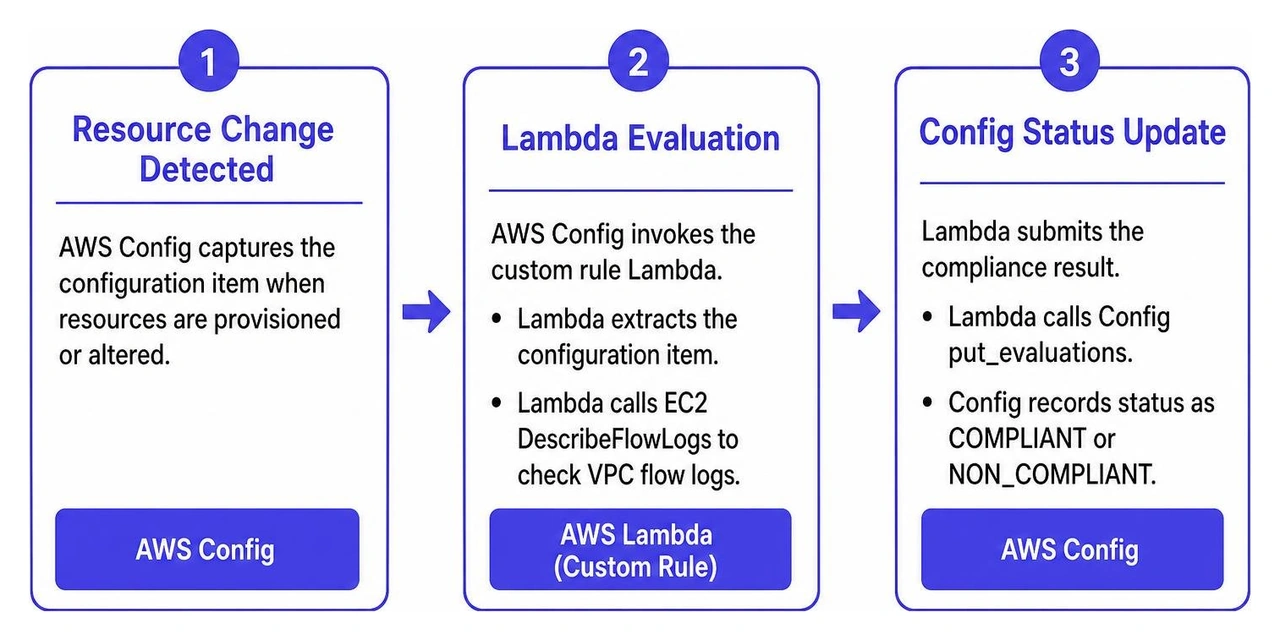
The process for deploying a custom evaluation pipeline follows these steps:
describe_flow_logs API to confirm whether active flow logs exist for the target VPC ID.put_evaluations API, returning a status of COMPLIANT if active flow logs are detected or NON_COMPLIANT if they are missing or inactive.AWSConfigRulesExecutionRole and read-only EC2 permissions (ec2:DescribeFlowLogs, ec2:DescribeVpcs).AWS::EC2::VPC resource type.Continuous configuration tracking relies on decoupling real-time event triggers from periodic compliance reporting:
Operating cloud infrastructure at enterprise scale requires handling massive volumes of operational telemetry. Modern cloud environments generate immense auditing overhead—AWS services record 600 billion auditing API events every day and execute 5 billion resource configuration checks each month. Managing this volume across dozens or hundreds of accounts requires structured multi-account frameworks and centralized evidence aggregation.
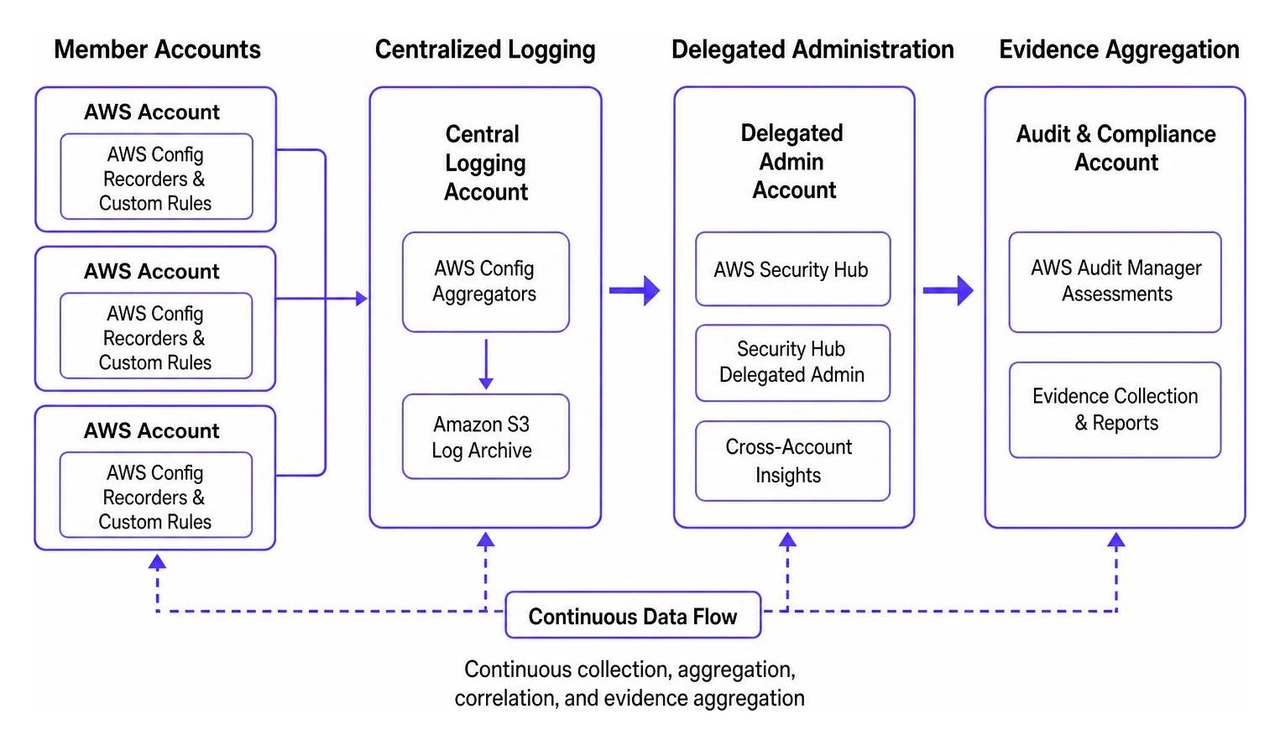
Auditors and security leaders must transition from traditional data center audit mindsets to cloud-native verification procedures. Educational initiatives like the Cloud Audit Academy emphasize modernizing verification methods to handle distributed, highly dynamic cloud workloads. For comprehensive protection across dynamic cloud footprints, organizations rely on comprehensive continuous attack surface management. WhiteDog’s continuous attack surface management and 24×7 security operations, through managed MDR/XDR capabilities, build on correlated intelligence to identify threats earlier and respond with confidence across complex cloud estates.
AWS provides native governance services that aggregate telemetry, detect anomalies, and streamline compliance assessments:
The AWS Security Reference Architecture (AWS SRA) provides prescriptive blueprints and infrastructure-as-code templates for designing a resilient, multi-account security baseline.
Key elements of an SRA-aligned auditing architecture include:
Audits should be executed on a regular, periodic schedule (such as quarterly access reviews and annual architectural validations), as well as dynamically in response to specific operational events. Key triggers include offboarding personnel with administrative access, decommissioning services or third-party integrations, introducing major infrastructure updates, or responding to suspected security incidents or credential leaks.
While both policies are read-only, SecurityAudit is scoped strictly to control-plane security configuration metadata (e.g., viewing IAM policies, encryption configurations, and logging settings). It deliberately blocks access to underlying data plane assets. Conversely, ReadOnlyAccess provides expansive read visibility across both control and data planes, allowing users to view the contents of Amazon S3 objects, read DynamoDB table entries, and access application data payloads.
No. While AWS Audit Manager automates continuous evidence collection across its 146 automated controls and standard frameworks, it does not certify compliance or guarantee that an organization will pass an audit. Compliance operates under the AWS Shared Responsibility Model; Audit Manager streamlines evidence generation, but internal auditors and accredited third-party assessors must independently evaluate whether operational controls satisfy specific regulatory requirements.
Conducting a thorough AWS security audit requires moving beyond point-in-time checklists toward continuous posture management, identity governance, and automated configuration tracking. By eliminating long-term root credentials, applying the principle of least privilege, establishing policy-as-code evaluations through AWS Config, and centralizing findings in AWS Security Hub, organizations can maintain complete visibility across their cloud attack surface.
Protecting complex environments requires integrating cloud signals into a cohesive defensive strategy through modular integration rather than a rip-and-replace approach. WhiteDog’s Unified Cybersecurity Platform bridges the gap between disconnected telemetry streams by correlating intelligence across email, DNS, identity, endpoint, network, cloud, and data environments. Designed to integrate seamlessly with existing enterprise investments—including Microsoft 365 environments via Delta 360 (Δ360) on our Open XDR framework—WhiteDog adds a unified operational and security layer that enhances threat detection, exposure management, and security hardening.
By combining continuous attack surface management with the proactive oversight of 24/7 SOC expertise—including complete incident response embedded directly within managed MDR, XDR, and top-tier Delta Detection & Response (DDR) offerings without separate retainers—we help organizations eliminate alert noise, identify cloud misconfigurations earlier, and respond to threats with confidence.
To learn more about optimizing your cloud posture and centralizing compliance findings, explore our in-depth guide on AWS Security Hub.


Learn the fundamentals of AWS security auditing, including IAM reviews, compliance checks, and automation with AWS Config and Security Hub.

Streamline cloud threat visibility with AWS Security Hub integration, unifying multi-cloud findings for faster detection and response.

Secure ePHI without disrupting clinical workflows. Learn how HIPAA cybersecurity services protect availability, stop threats, and support compliance.

Master your AWS data governance audit to reduce breach exposure, enforce compliance, and automate remediation across multi-account environments.

Master cloud security with this AWS Security Hub guide for enterprise teams, covering architecture, automation, and multi-account governance.

Learn how a rapid security assessment identifies gaps, prioritizes fixes, and strengthens your defense posture.