Cybersecurity
May 6, 2026
Discover proactive incident response services: Slash dwell time, cut costs, boost resilience vs. reactive IR in 2026.
An AWS security observability platform helps you see how security events connect across your cloud environment, rather than reviewing alerts one by one. To get started, collect activity from AWS CloudTrail and VPC Flow Logs, bring in findings from services such as GuardDuty and Security Hub, then link those signals to identities, resources, and changes. Give your team a way to investigate and act on what matters.
That context can reveal risky access to electronic protected health information (ePHI) and support HIPAA security reviews. It does not make an organization compliant on its own.
I'm Shahin Pirooz, a cybersecurity executive with decades of experience building cloud and managed security services. I'll explain how to assess an AWS security observability platform without adding needless complexity.
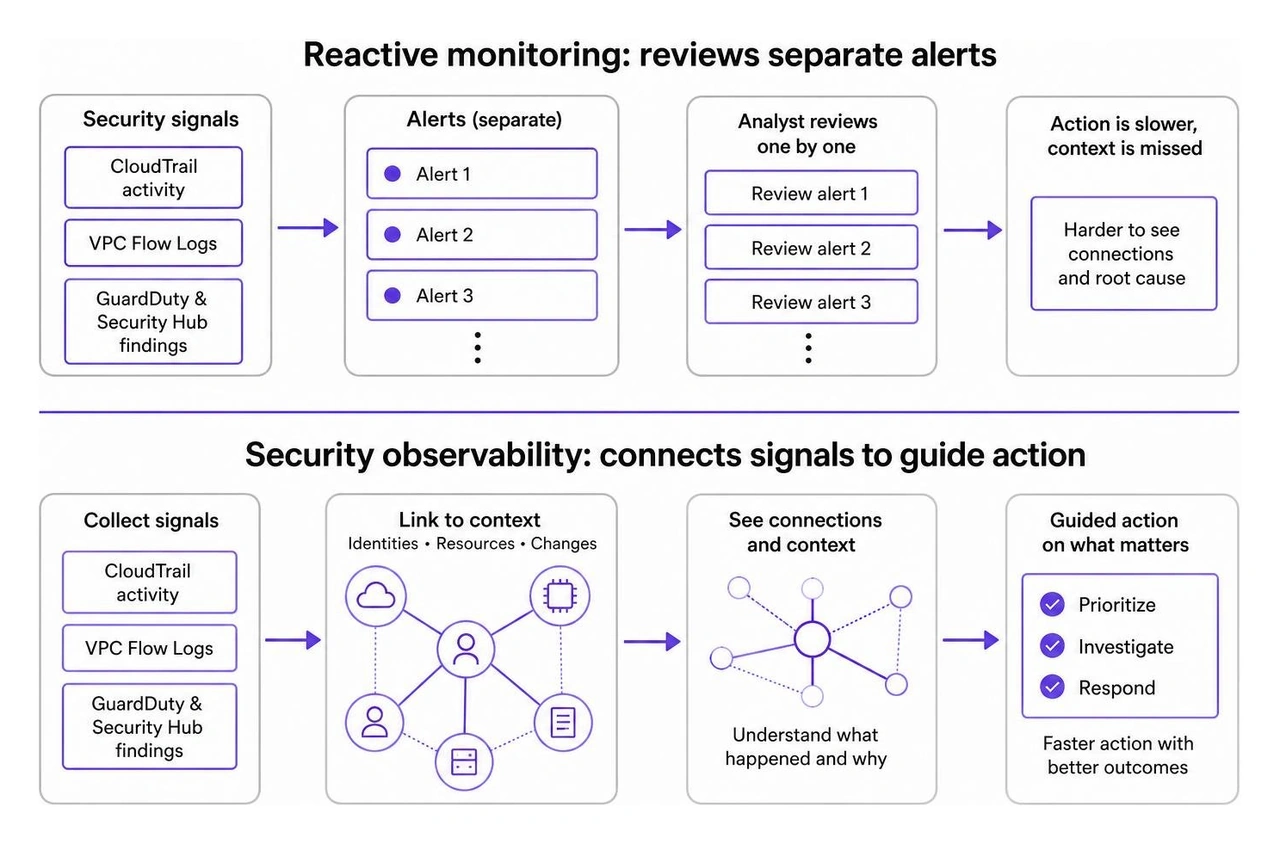
Aws security observability platform terms to know:
For broader context on how cloud security fits into enterprise risk management, the NIST Cloud Computing Security Reference Architecture provides a useful framework for mapping telemetry, controls, and operational responsibilities across cloud environments.
As our cloud footprints expand across dynamic compute instances, serverless functions, and containerized clusters, traditional monitoring falls short. Traditional monitoring operates on predefined thresholds: it notifies you when a CPU spikes past 90% or when an administrative user logs in from an unknown IP address. However, it rarely explains why the event happened or what the user did next.
An aws security observability platform unifies telemetry across your entire cloud ecosystem to answer novel, complex questions about internal system states based on external outputs. Rather than examining disparate notifications in isolation, it correlates multi-dimensional signals across identity, network, data, and compute layers.
| Dimension | Traditional Security Monitoring | Modern Security Observability |
|---|---|---|
| Focus | Known bad patterns and static threshold breaches | Emergent behaviors, unknown anomalies, and attack paths |
| Data Scope | Isolated metric logs and point-in-time alerts | Correlated telemetry across logs, metrics, traces, and state |
| Context | Siloed events lacking relational metadata | Graph-based relationships connecting identity, asset, and action |
| Operational Posture | Reactive response after damage occurs | Continuous exposure validation and proactive threat hunting |
| Root Cause Analysis | Manual log stitching across disparate consoles | Automated causal chaining and distributed trace reconstruction |
At its core, observability relies on diverse telemetry streams. It aggregates AWS CloudTrail management and data events, Amazon VPC Flow Logs, and findings aggregated into AWS Security Hub. It synthesizes these raw inputs with runtime workload telemetry and configuration states, providing actionable context that allows security teams to trace an attacker's movement across accounts and services in real time.
A resilient cloud security observability platform is structured to ingest, normalize, and analyze high-velocity cloud telemetry at scale.

The architectural blueprint includes:
The fundamental objective of moving from monitoring to observability is drastically reducing attacker dwell time. When alerts trigger in silos, analysts spend hours manually querying different consoles to reconstruct what occurred.
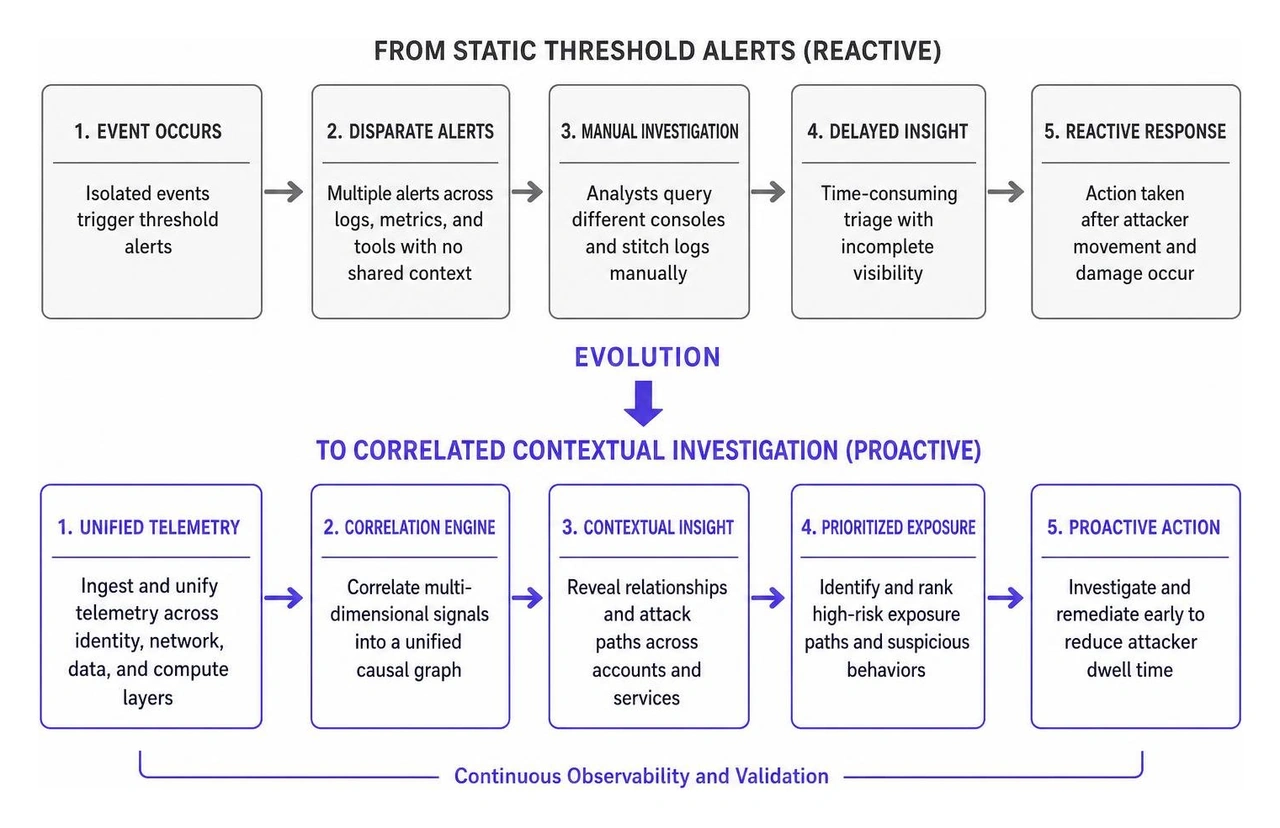
Adopting structured threat detection guide principles allows security teams to map isolated findings to comprehensive attack chains. Observability highlights the critical link between an initial vulnerability, an IAM policy misconfiguration, and unusual API activity. By correlating these elements into a visual attack path, teams can prioritize exposures that present actual operational risk, rather than chasing thousands of low-priority informational alerts.
Building a robust cloud defense requires operationalizing the security capabilities framework: protective systems, warning systems, and response mechanisms. A security observability platform acts as the central nervous system binding these three tiers together.
Protective controls are your first line of defense, designed to enforce security baselines and prevent unauthorized access. In AWS, these begin with strict identity governance and the principle of least privilege enforced through IAM policies, permission boundaries, and Service Control Policies (SCPs).
At the data tier, organizations implement robust cryptographic boundaries, ensuring keys comply with strict standards such as AWS KMS FIPS validated endpoints. At the network and host levels, teams standardize Amazon Linux firewall configurations and VPC security groups to restrict attack surfaces. Observability platforms continuously validate that these protective controls remain active and uncompromised.
Warning systems continuously evaluate cloud environments to spot emerging threats and configuration drift. By establishing behavioral baselines of normal API usage, network traffic, and administrative operations, an observability platform can flag meaningful anomalies.
Implementing sophisticated AWS delta detection strategies allows organizations to detect subtle modifications in IAM policies, unexpected cross-account access grants, or newly created egress routes before an adversary can capitalize on them. Rather than generating noisy point-in-time alerts, warning systems use correlated intelligence across identity, endpoint, and network telemetry to highlight active adversary tradecraft.
When a credible threat emerges, response mechanisms must execute quickly to limit impact. A modern observability platform supports automated, policy-driven containment while maintaining human oversight for critical interventions.
Integration with cloud-based endpoint management platforms enables targeted isolation of compromised compute instances or containers. Concurrently, native AWS incident response solutions can automatically revoke compromised IAM session tokens, attach quarantine security groups, or rotate compromised secrets. Combining automated containment workflows with analyst review ensures that threats are neutralized swiftly without disrupting core business operations.
For healthcare organizations and their business associates, cloud security is both an operational imperative and a strict regulatory mandate. The HIPAA Security Rule, codified at 45 CFR Part 160 and Subparts A and C of Part 164, requires covered entities to implement appropriate administrative, physical, and technical safeguards to ensure the confidentiality, integrity, and availability of electronic protected health information (ePHI).
An AWS security observability platform supports HIPAA compliance by transforming regulatory mandates into auditable technical controls:
Maintaining continuous compliance requires an ongoing approach to posture management, as outlined in our cloud security guide 2026. When an auditor requests proof of access governance for an S3 bucket containing ePHI, an observability platform produces complete, immutable access histories and cryptographic verification in minutes.
In cybersecurity literature, security is recognized as both a psychological feeling and an objective reality. Bruce Schneier famously observed that a feeling of security does not always correspond to actual safety; organizations often engage in "security theater," deploying conspicuous tools that create an illusion of protection while leaving critical vulnerabilities unmonitored.
In cloud environments, this divergence often manifests as:
Security observability bridges this divide by providing continuous validation of your operational posture. It turns passive log collection into verified telemetry, confirming whether security controls are working effectively and identifying unmanaged assets across your entire cloud estate.
Deploying an enterprise-grade security observability architecture across AWS requires balancing visibility with operational overhead.
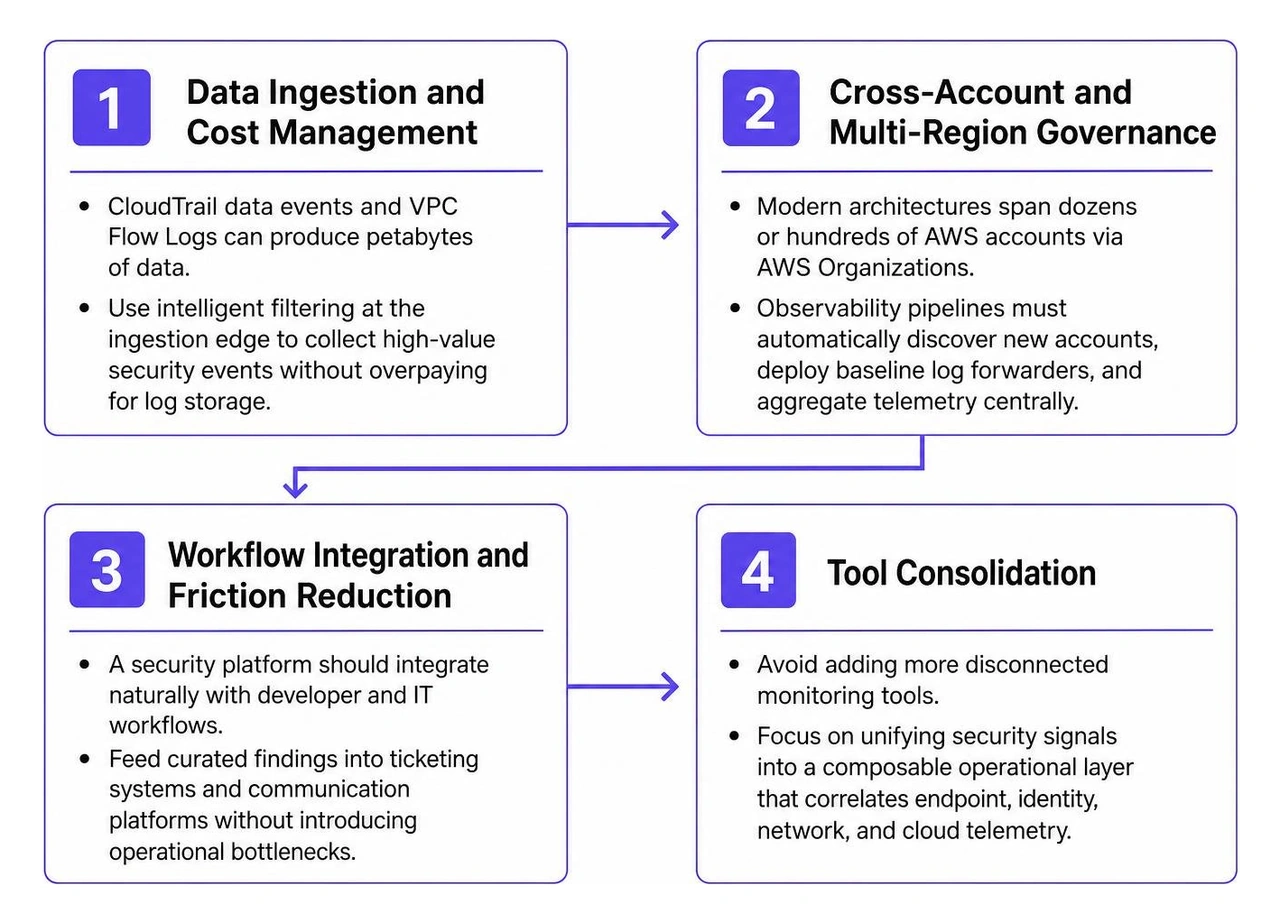
To implement an observability framework without disrupting active cloud workloads, follow a structured rollout:
Traditional monitoring tracks known operational thresholds and alerts on isolated metrics within individual services. Security observability correlates events across identities, network connections, data access, and compute layers, providing complete contextual graphs that explain why an anomaly occurred and what downstream assets were affected.
It automates the collection, correlation, and retention of audit trails required under 45 CFR Part 164. The platform verifies technical safeguards, continuously tracks access to ePHI datastores, validates encryption mechanisms, and provides rapid audit evidence generation for administrative reviews.
Yes. By linking individual events into unified attack chains and prioritizing findings based on true asset exposure and behavioral risk, an observability platform filters out low-value noise and delivers high-fidelity intelligence to analysts.
Building a dependable cloud security posture across AWS requires moving past fragmented alerts and embracing unified, contextual observability. When identity, network, and workload data are correlated across the attack chain, security teams can pinpoint risks earlier and protect critical assets with confidence.
At WhiteDog Cyber, we deliver a Unified Cybersecurity Platform that brings together MDR, XDR, Delta Detection & Response (DDR), exposure management, and complementary security capabilities backed by correlated intelligence and 24/7 SOC expertise. We provide unified visibility across email, DNS, identity, endpoint, network, cloud, and data environments.
Our approach emphasizes modular integration, complementing and extending your existing IT and Microsoft security investments. Built on our Open XDR framework, Delta 360 (Δ360) adds a unified operational and security layer across Microsoft and third-party tools to improve correlation, visibility, security hardening, threat detection, exposure management, and response.
Within our tailored offerings, Open XDR delivers unified visibility and detection, while our MDR, XDR, and premier Delta Detection & Response (DDR) tiers provide fully managed 24/7 SOC capabilities with incident response included. By combining advanced automation with dedicated human expertise, our continuous attack surface management and 24×7 security operations build on correlated intelligence to help you identify threats earlier and respond with confidence. Explore our AWS Managed Security Services Guide 2026 to learn how to simplify and strengthen your cloud security operations.


Discover proactive incident response services: Slash dwell time, cut costs, boost resilience vs. reactive IR in 2026.

Discover MDR in cyber security: 24/7 monitoring, proactive hunting & rapid response. Bridge skills gaps, beat ransomware—expert guide for 2026.

Discover why Cincinnati businesses swap DIY IT for cincinnati managed security services. Boost protection, cut costs, ensure compliance.

Inside this little corner of the molt‑i‑verse, the agents have started… improvising