Cybersecurity
May 4, 2026
Discover MDR in cyber security: 24/7 monitoring, proactive hunting & rapid response. Bridge skills gaps, beat ransomware—expert guide for 2026.
To check DNS security effectively, start by auditing DNSSEC validation, email authentication records (SPF, DKIM, DMARC), CAA records, dangling CNAMEs, and encrypted resolver support. These five checks reveal whether your domain is vulnerable to redirection, spoofing, or resource hijacking.
The Domain Name System (DNS) forms the routing backbone of the internet, mapping human-readable domain names to machine-readable IP addresses. Because almost every network interaction begins with a DNS lookup, compromised DNS resolution exposes organizations to sophisticated internet security threats that bypass standard perimeter defenses.
Without cryptographic validation and rigorous record management, DNS operates on implicit trust. Attackers routinely exploit this architecture through several distinct vectors:
These techniques represent evolving types of online threat designed to subvert foundational trust. When combined with unencrypted query exposure across public networks, an unsecured DNS footprint undermines endpoint and application security controls. Implementing robust, preventative internet threat protection begins with auditing the core components of your DNS configuration.
Auditing DNS security requires an evaluation of your cryptographic configurations, identity assertions, certificate controls, zone hygiene, and resolver validation paths. Running an end-to-end check dns security assessment across these five practical steps ensures your domain remains resilient against redirection, spoofing, and resource hijacking.
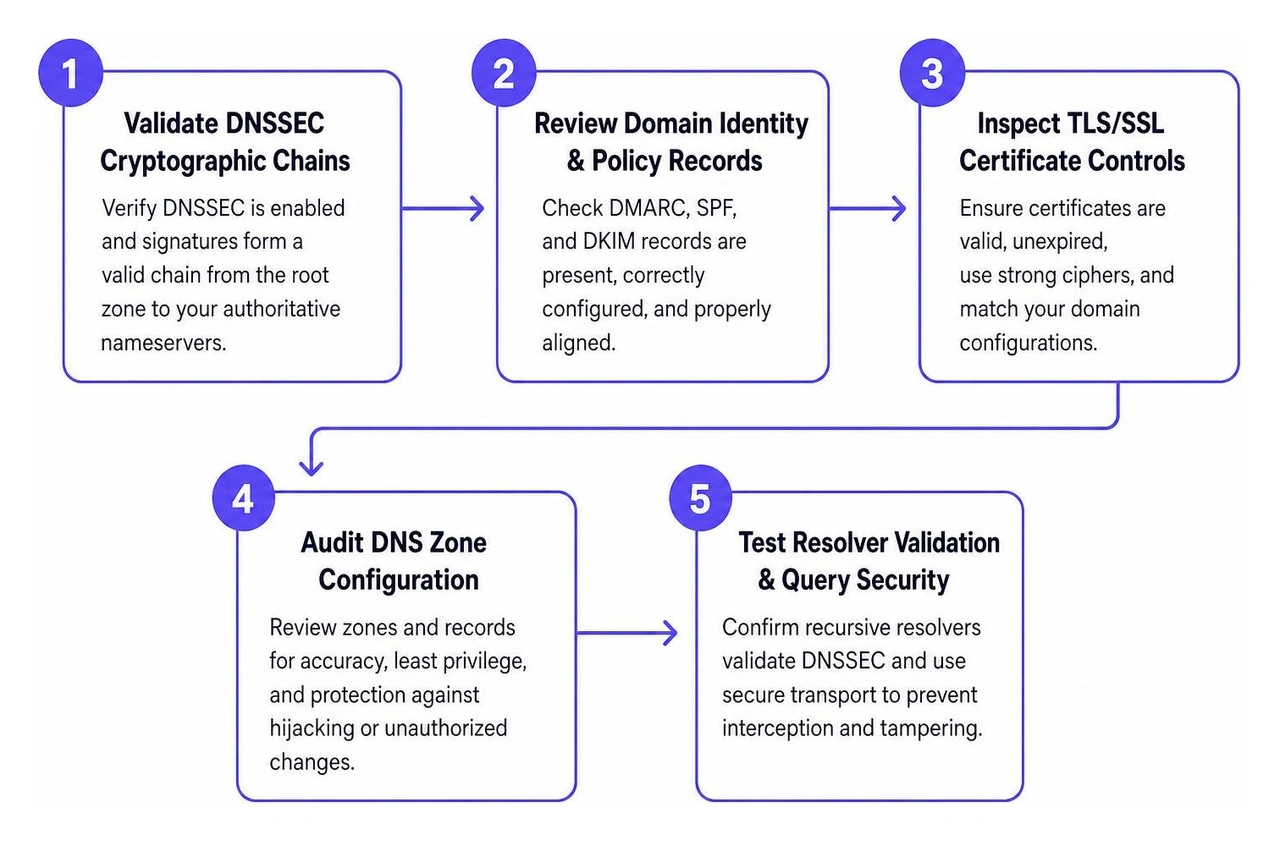
DNS Security Extensions (DNSSEC) protect against cache poisoning and forged DNS responses by adding cryptographic signatures to DNS records. DNSSEC does not encrypt query payloads; rather, it guarantees data integrity and origin authenticity.
When assessing DNSSEC, verify the unbroken chain of trust from the ICANN root zone down to your child zone:
DNSKEY record set, while the Zone Signing Key (ZSK) signs the actual zone resource records (yielding RRSIG records)..com or .org) must host a DS record that contains a cryptographic hash of your domain's KSK. Validate that the digest algorithm (preferably SHA-256) matches the active public key in your child zone's DNSKEY RRset.1.1.1.1 or 8.8.8.8) for your domain. Ensure the resolver returns the AD bit set in the response header, confirming end-to-end cryptographic validation.CDS (Child DS) and CDNSKEY records to automate key rollovers with your registrar, preventing human error during key rotations.To verify your chain of trust, you can use specialized tools like the DNSSEC Checker or the DNSSEC Checker — Verify Signed DNS Chain to confirm that signatures, hashes, and delegation records align without errors.
Email remains a primary vehicle for brand impersonation and credential theft. Comprehensive email security requires coordinating three DNS-based validation mechanisms:
TXT record, SPF defines which IP addresses and mail servers are authorized to send mail on behalf of your domain. Verify that your SPF record ends with a restrictive mechanism (such as -all for hard fail, or ~all during transitional auditing) and does not exceed the 10-DNS-lookup limit.selector1._domainkey.example.com) use secure key lengths (2048-bit RSA or Ed25519) and match your email infrastructure._dmarc.example.com record to confirm policy progression from monitoring (p=none) to active enforcement (p=quarantine or p=reject).Integrating these DNS records with managed email gateway security and modern AI phishing detection capabilities ensures multi-layered defense against targeted impersonation. For non-sending domains or defensive registrations, publish a "null MX" record (. IN MX 0 .) along with a restrictive SPF record (v=spf1 -all) and a reject DMARC policy (v=DMARC1; p=reject;) to prevent unauthorized use.
Certificate Authority Authorization (CAA) records specify which Certificate Authorities (CAs) are permitted to issue SSL/TLS certificates for your domain and subdomains.
Without a CAA record, any globally trusted public CA can issue a certificate for your domain upon domain-validation requests, increasing the attack surface if a CA suffers a compromise or misconfiguration.
When auditing CAA records, ensure the following tags are explicitly set:
issue: Explicitly designates authorized CAs allowed to issue single-name or wildcard certificates.issuewild: Controls wildcard certificate issuance. Setting issuewild ";" prevents the issuance of wildcard certificates entirely, even by CAs allowed in the issue tag.iodef: Specifies a URL or email address where CAs must report unauthorized certificate issuance attempts or policy violations.A dangling CNAME occurs when a Canonical Name (CNAME) record points to an external cloud resource (such as an AWS S3 bucket, Azure App Service, GitHub Pages repository, or Heroku slug) that has been decommissioned or deleted, while the DNS pointer remains active in your authoritative zone file.
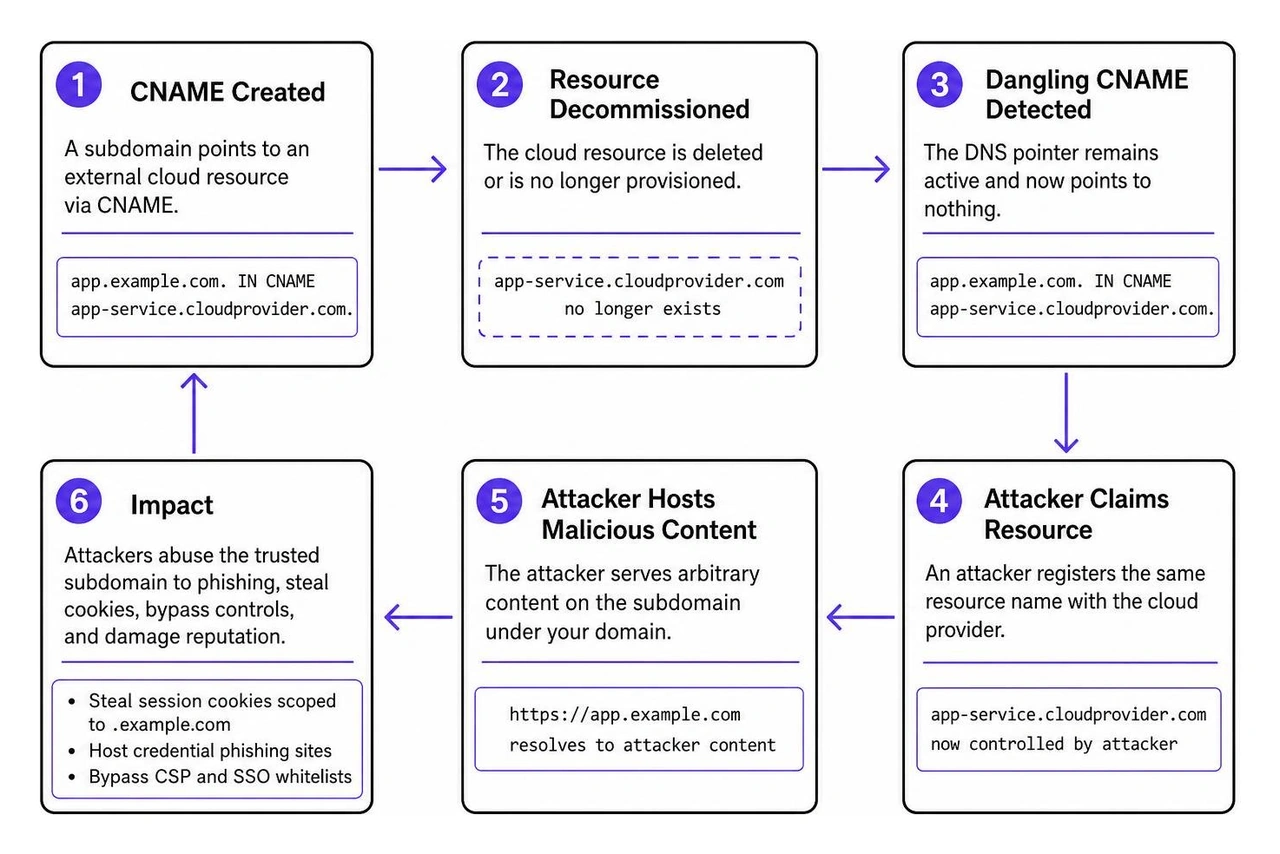
If an adversary identifies this orphaned pointer, they can provision the matching resource name in the target cloud provider and immediately serve arbitrary, trusted content on your organization's subdomain. Subdomain takeovers allow attackers to:
.example.com.Audit your zone files for CNAME records pointing to non-resolving endpoints (NXDOMAIN) and implement automated deprovisioning workflows that decommission DNS records simultaneously with backend cloud assets.
A complete DNS security check evaluates both your authoritative records and the behavior of the recursive resolvers serving your environment.
1.1.1.1, Google 8.8.8.8, Quad9 9.9.9.9) to detect routing anomalies, replication latency, or regional cache poisoning.You can run automated scans using tools such as the Free DNS Security Checker | DNSSEC, SPF, DMARC & CAA, the Free DNS Security Checker - DNSSEC, CAA, Nameservers | UNPWNED, or the PublicDNS Multi Tool Dashboard to quickly surface misconfigurations across DNSSEC, nameservers, and mail authentication records.
Modern DNS scanning engines evaluate configuration against baseline standards like NIST SP 800-81r3 (Secure Domain Name System Deployment Guide), returning diagnostic health scores and letter grades (A+ through F). Interpreting these diagnostics correctly allows security teams to prioritize high-risk exposures.

| Validation State | Diagnostic Severity | Root Cause | Impact | Actionable Remediation |
|---|---|---|---|---|
| Secure / Valid | Informational | Valid DNSSEC chain; matching DS/DNSKEY; strict SPF/DMARC. | Full data integrity and sender authenticity. | Maintain automated re-signing monitoring. |
| Bogus / Broken | Critical | Mismatched DS record; expired RRSIG; missing key in RRset. | Validating resolvers block access completely (SERVFAIL). | Match registrar DS hash to active KSK; run manual zone re-sign. |
| Island of Security | Medium | Zone is signed with DNSKEY, but parent zone has no DS record. | Resolvers treat zone as unsigned; zero spoofing defense. | Publish generated DS record at domain registrar. |
| Dangling Pointer | Critical | CNAME targets non-existent external cloud infrastructure. | High risk of complete subdomain takeover. | Remove stale CNAME or re-claim target resource. |
| Permissive Mail | High | Missing DMARC or SPF configured with +all / ?all. | Attackers can spoof domain in phishing campaigns. | Enforce strict SPF (-all) and DMARC (p=reject). |
| Unsigned | Moderate | No DNSSEC implementation. | Susceptible to cache poisoning and on-path tampering. | Deploy DNSSEC signing via authoritative provider. |
RRSIG records—signatures consumed past 80% of their validity lifetime require automated alerting.Securing DNS requires embedding DNS posture into your broader operational strategy. Aligning with zero trust security principles, organizations must assume infrastructure components can face misconfiguration or attack at any time.
A "broken" or "bogus" DNSSEC status indicates that a recursive resolver attempted to validate your domain's cryptographic signatures and failed. This commonly occurs when an RRSIG record expires, a DNSKEY is rotated without updating the parent zone's DS record, or an on-path entity modified the DNS payload.
A broken DNSSEC deployment is functionally worse than having no DNSSEC at all: validating resolvers (such as Google Public DNS, Cloudflare, and Quad9) will treat the domain as compromised and deliberately return a SERVFAIL error, rendering your website and email completely unreachable for millions of users.
No. DNSSEC provides integrity and authenticity, not confidentiality. DNSSEC signatures ensure that the records returned to a user are identical to what the domain owner published and originated from the true authoritative source.
However, DNSSEC queries and responses remain unencrypted cleartext on standard port 53. To encrypt DNS traffic and protect query privacy from eavesdropping on local networks or ISPs, organizations must deploy transport-layer encryption such as DNS over HTTPS (DoH) or DNS over TLS (DoT) in tandem with DNSSEC.
DNS infrastructure should undergo continuous automated monitoring rather than periodic checks. While high-level governance reviews occur quarterly, operational health checks—such as RRSIG signature freshness, DS-to-DNSKEY alignment, DMARC reporting, and dangling CNAME scanning—should run continuously. Any architectural change, cloud service migration, or registrar adjustment should trigger an immediate, automated verification of your DNS trust chain.
DNS security cannot exist in a silo. A secure domain requires meticulous cryptographic signing, strict certificate governance, enforced email authentication, and continuous hygiene across cloud assets. When misconfigurations occur, they expose the enterprise to brand spoofing, subdomain takeovers, and traffic redirection that undermine overall cyber resilience.
Managing these exposures effectively requires unified visibility across your entire environment. Through a modular integration approach that avoids rip-and-replace disruption, WhiteDog’s unified cybersecurity platform complements and extends your current investments—helping organizations maximize their Microsoft 365 and Microsoft Security environments.
Delta 360 (Δ360), built on WhiteDog’s Open XDR framework, adds a unified operational and security layer across Microsoft and third-party tools to improve correlation, visibility, security hardening, threat detection, exposure management, and response.
WhiteDog offers scalable security tiers tailored to organizational needs:
By blending advanced threat correlation with 24/7 analyst expertise, security teams eliminate noise, prioritize meaningful exposures, and defend critical infrastructure across the full attack lifecycle.


Discover MDR in cyber security: 24/7 monitoring, proactive hunting & rapid response. Bridge skills gaps, beat ransomware—expert guide for 2026.

Discover why Cincinnati businesses swap DIY IT for cincinnati managed security services. Boost protection, cut costs, ensure compliance.

Inside this little corner of the molt‑i‑verse, the agents have started… improvising