Cybersecurity
July 9, 2026
Discover how cyber security health checks strengthen your defenses, reduce risk, and support compliance across regulated industries and SMEs.
Cyber security for small business is one of the most urgent operational challenges facing business owners today. Here is what you need to know right now:
The stakes could not be higher. Cybercrime damage is projected to hit $10.5 trillion globally by 2025. Small businesses are not too small to be targeted. In fact, they are often specifically chosen because they have fewer defenses than large enterprises.
Once considered a back-office IT problem, cybersecurity has moved into the boardroom. Forty percent of C-suite leaders reported suffering a recent cyberattack. The question is no longer if your business will face a threat — it is when, and how ready you will be.
This guide gives you a clear, actionable blueprint to protect your business. It draws on government-backed standards like the NIST Cybersecurity Framework 2.0 and covers everything from phishing defense to vendor risk to cyber insurance.
I'm Shahin Pirooz, technology executive and cybersecurity visionary at WhiteDog Cyber, with over 20 years of experience building managed security and cloud services — and I've spent my career helping businesses of every size navigate cyber security for small business challenges before they become crises. Let's start with the foundation.
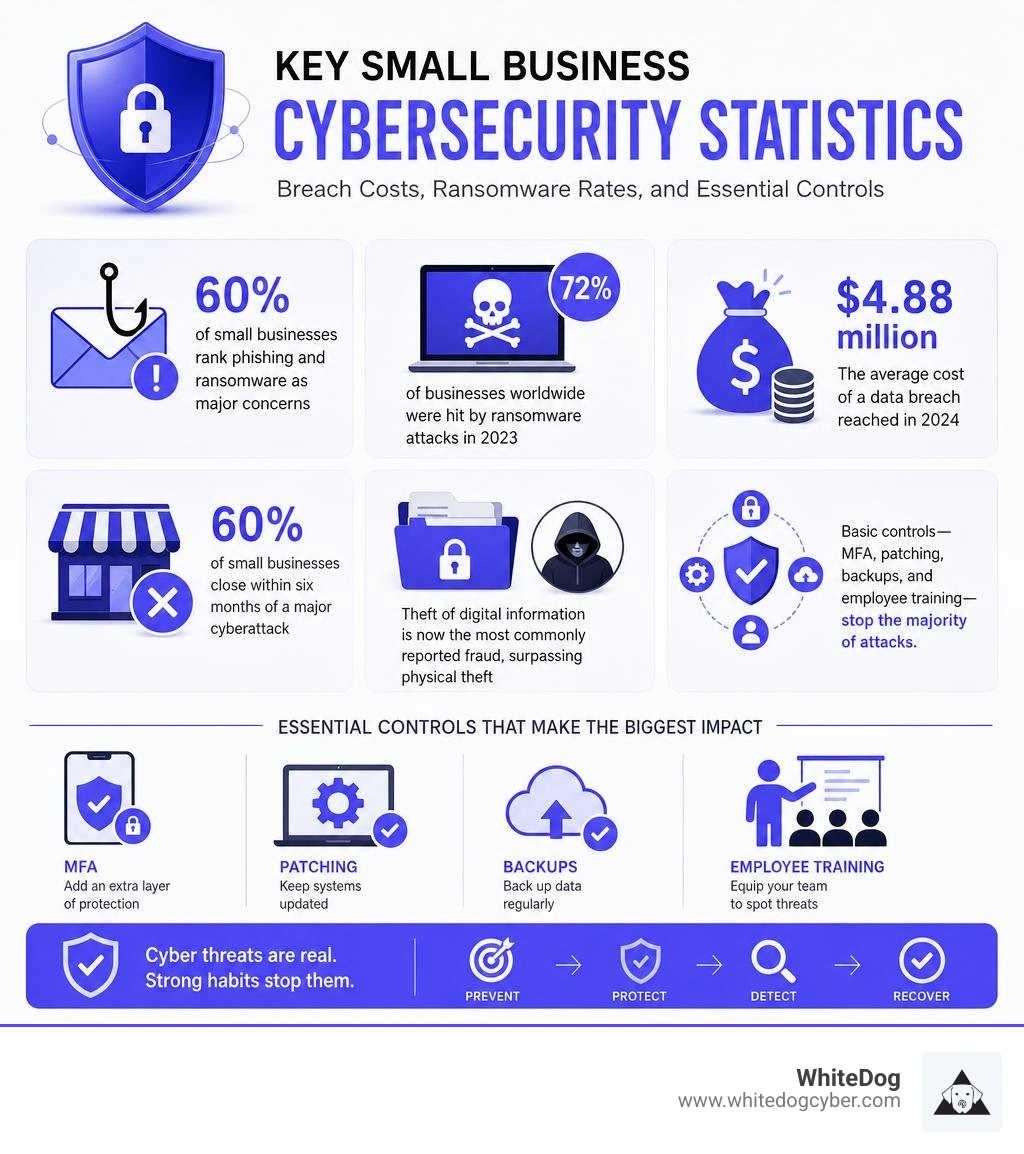
Handy cyber security for small business terms:
For years, many small-to-medium businesses (SMBs) operated under the radar, assuming hackers only targeted Fortune 500 companies with massive financial reserves. But in July 2026, the reality is starkly different. Cybercriminals actively target small businesses because they are viewed as soft entry points into larger supply chains, or because their lack of dedicated security staff makes them easy prey for opportunistic attacks.
Prioritizing cyber security for small business is not just about avoiding a temporary IT headache; it is a fundamental requirement for business continuity and financial survival. When a breach occurs, the immediate costs—forensic investigations, legal fees, and customer notification—can easily spiral.
Furthermore, regulatory compliance requirements have tightened significantly. Depending on your industry, failing to secure sensitive customer data could result in severe fines or the loss of your business license. Building a robust cybersecurity posture is a competitive advantage that builds deep customer trust.
The methods attackers use to infiltrate networks have grown increasingly sophisticated, often accelerated by generative AI. Today, small businesses must defend against a wide array of types of online threat that target both human and technical vulnerabilities.
Navigating these internet security threats requires moving past legacy "firewall-and-antivirus" mindsets toward a more proactive, layered approach.
Before investing in complex security tools, you must establish foundational hygiene. You cannot protect what you do not know exists.
First, compile an accurate asset inventory. You need a documented list of every hardware device, software application, cloud service, and data repository used across your company. Pair this with a basic network diagram so you understand how data flows through your business.
Second, implement network segmentation. Do not allow guest Wi-Fi users or employee personal devices to sit on the same primary network that processes credit card transactions or stores proprietary financial records.
Third, enforce strict patch management. Set a rigid schedule to apply security updates to all operating systems, web browsers, and applications. Whenever possible, turn on automatic updates to minimize the window of vulnerability.
Fourth, utilize data encryption for all sensitive information, both at rest on local hard drives and in transit across the web.
Understanding why a layered defense is critical begins with evaluating your infrastructure model. Many small businesses are migrating away from on-premises servers to secure cloud alternatives because cloud ecosystems are maintained by world-class security teams, drastically reducing your local attack surface.
| Security Control | On-Premises Implementation | Cloud-Native Implementation |
|---|---|---|
| Physical Security | Requires locked server rooms, keycards, and physical climate controls. | Managed entirely by the cloud provider's secure data centers. |
| Patching & Maintenance | Requires manual IT intervention, testing, and downtime scheduling. | Automated and managed continuously by the cloud provider. |
| Access Control | Harder to scale; relies heavily on local active directory configurations. | Built-in Identity and Access Management (IAM) with native MFA integrations. |
| Data Backups | Often relies on local NAS drives or physical tapes that can be lost or encrypted by ransomware. | Automated, geographically redundant, and isolated from the local network. |
Defending your business against modern email threats requires a combination of robust technical controls and sharp human awareness. Phishing remains the single most cost-effective way for cybercriminals to gain a foothold in small business networks. Once inside, they can deploy ransomware, steal intellectual property, or quietly monitor communications to execute business email compromise scams.
Relying on a single password to protect your business accounts is no longer sufficient. If an employee falls victim to a credential-harvesting phishing site, an attacker can log in instantly and begin moving laterally through your systems.
This is why Multi-Factor Authentication (MFA) is non-negotiable. However, not all MFA is created equal. Legacy MFA—such as SMS text messages or basic push notifications—can be bypassed via SIM-swapping or push-fatigue attacks.
The gold standard is FIDO-based, phishing-resistant authentication. FIDO protocols are built directly into modern web browsers and smartphones. They use cryptographic keys tied to specific domains, meaning that even if an employee is tricked into entering credentials on an imposter login page, the hardware token or device authenticator will refuse to pass the secure token to the fraudulent site.
By adopting a model of zero trust explained always assume compromise, you ensure that every access request is continuously verified, authorized, and validated before granting access to sensitive business resources.
Scammers frequently spoof small business domains to send highly convincing phishing emails to your customers, partners, and vendors. This can ruin your brand's reputation overnight. To prevent this, you must configure three essential email authentication protocols on your business domain:
For detailed steps on securing your communication infrastructure, refer to the Cyber Guidance for Small Businesses | CISA portal.
Even the most advanced technical defenses can be bypassed if an employee willingly hands over access. This is why every business using the internet is responsible for creating a top-down culture of security.
Security training should not be a once-a-year boring slideshow. It must be an ongoing, engaging conversation. Incorporate cybersecurity into your new hire onboarding process and run brief, regular training sessions that cover:
To drive accountability, treat "near misses" (like an employee almost falling for a scam but catching it in time) as valuable learning opportunities to refine your internal defenses.
The rise of hybrid work has expanded the traditional business perimeter far beyond the physical office. Today, securing remote employees and managing third-party vendor risks are critical components of any cyber security for small business strategy.
Traditional Virtual Private Networks (VPNs) are increasingly outdated. If an attacker compromises a remote worker's legacy VPN credentials, they often gain unrestricted access to the entire corporate network.
Zero Trust Network Access (ZTNA) solves this issue. ZTNA operates on the principle of least privilege: it verifies the user's identity, evaluates the security posture of the device (ensuring disk encryption is active and antivirus software is running), and then grants secure access only to the specific applications the user needs to perform their job—never the broader network.

Understanding the benefits of ZTNA allows small businesses to confidently support a remote workforce while keeping primary business assets completely isolated from unauthorized lateral movement.
Your security is only as strong as the weakest link in your supply chain. If a vendor with direct access to your network suffers a breach, the hackers can easily pivot into your systems.
To manage third-party risk:
Your website is often the digital front door of your business. If it is compromised, visitors could be infected with malware, or your customer database could be leaked. When selecting or auditing a web host, ask the following questions:
Rather than guessing which security controls to implement, small businesses should align their efforts with a globally recognized standard. The National Institute of Standards and Technology (NIST) Cybersecurity Framework (CSF) 2.0 is a free, flexible, and voluntary tool designed to help organizations of all sizes manage and reduce their cyber risks.
The NIST CSF 2.0 organizes cybersecurity activities into six core functions: Govern, Identify, Protect, Detect, Respond, and Recover. This structured approach helps businesses create a clear, multi-year cybersecurity roadmap.
To help you get started, read the Take A Tour! NIST Cybersecurity Framework 2.0: Small Business Quick Start Guide | NIST blog for an accessible, step-by-step introduction to applying these principles.
Even with the best security posture, absolute protection is impossible. This is where cyber insurance plays a critical role in your risk management strategy, acting as a financial safety net to help your business recover from a successful attack.
When evaluating policies, it is vital to understand the difference between the two primary types of coverage:
When a cyber incident occurs, every second counts. Reducing your "dwell time"—the amount of time an attacker remains undetected inside your network—is crucial to minimizing financial and reputational damage.
You should never try to figure out what to do during an active breach. Your business must have a written, approved Incident Response Plan (IRP) that outlines exact step-by-step containment procedures.
To ensure your team is ready, conduct quarterly tabletop exercises. These are simulated scenarios (like a ransomware attack or a compromised executive email account) where key staff members walk through the response plan to identify gaps in communication, technical controls, or decision-making.
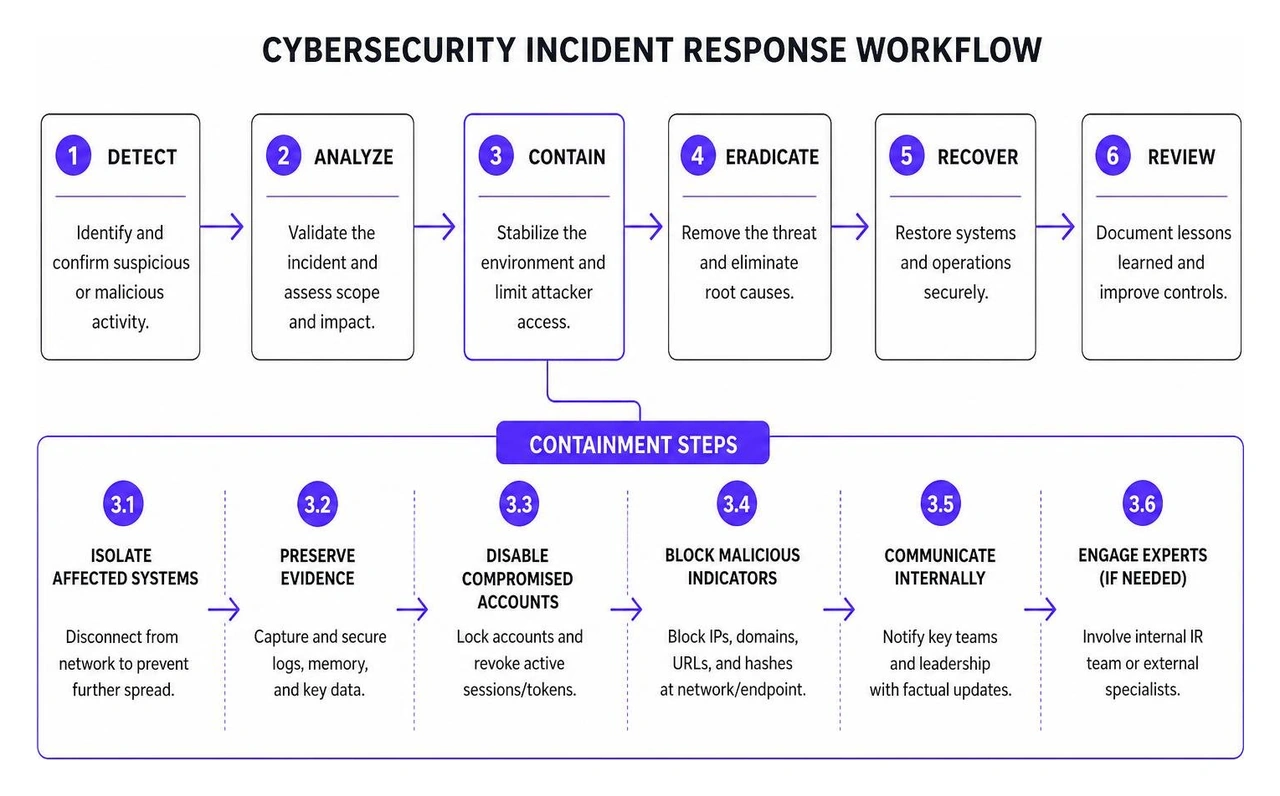
For a comprehensive template on building your defense plan, check out our cybersecurity incident response guide 2026.
Many small businesses fall into the trap of "tool sprawl"—buying dozens of disconnected security software products. However, addressing this does not require a disruptive "rip and replace" of your existing technology. Instead, a modular integration approach allows you to connect and elevate your current systems.
This is where a modern Managed Detection and Response (MDR) approach changes the game. WhiteDog’s Unified Cybersecurity Platform seamlessly integrates with your existing tools through correlation, operating them via a 24/7 Security Operations Center (SOC) to maximize your current security investments without starting from scratch.
Unlike legacy, SIEM-centric approaches that simply collect and dump raw logs, our platform utilizes a highly efficient mechanism:
This process condenses millions of daily events into a single, correlated security timeline, allowing our 24/7 SOC to instantly investigate, triage, and respond to threats before they can cause damage. By focusing on proactive MDR in cyber security, small businesses can drastically reduce dwell time and achieve enterprise-grade resilience without the burden of managing complex tools in-house.
First-party cyber insurance covers the direct costs your business incurs to recover from an attack, such as forensic investigations, legal fees, data restoration, business interruption losses, and customer notification. Third-party cyber insurance protects your business from liability if a third party (like a customer or partner) sues you for failing to protect their data, covering legal defense costs, settlements, and regulatory fines.
While your first instinct might be to pull the power plug on a ransomware-infected computer, doing so can destroy critical forensic evidence. Powering down a device wipes the Random Access Memory (RAM), which contains volatile data that security investigators use to identify the specific strain of ransomware, find decryption keys, and trace how the attacker entered your network. Instead, immediately disconnect the device from the local network (unplug the ethernet cable and disable Wi-Fi) but leave the power on.
The three essential tools are SPF (Sender Policy Framework), which lists authorized mail servers; DKIM (DomainKeys Identified Mail), which adds a cryptographic signature to verify email integrity; and DMARC (Domain-based Message Authentication, Reporting, and Conformance), which uses SPF and DKIM to tell receiving servers how to handle unauthorized emails and provides reporting on domain usage.
Protecting your company in today's threat landscape requires moving away from fragmented, reactive tools. At WhiteDog Cyber, we provide a co-managed, white-label cybersecurity platform built to deliver true operational resilience. Our curated, actively managed security stack integrates modularly with your existing tools, avoiding the need for a costly "rip and replace" approach, and is backed by a 24/7 SOC that continuously hunts, triages, and responds to threats on your behalf.
Whether you need foundational visibility with our Open XDR offering (providing unified visibility and detection) or fully managed protection with our comprehensive MDR/XDR/DDR suites—with incident response (IR) fully included across our MDR, XDR, and DDR offerings—we have a path designed for your business. Our top-tier Delta Detection & Response (DDR) offering provides the ultimate level of protection, focusing on rapid dwell-time reduction and operational efficiency.
Ready to find your security gaps before attackers do? Explore our curated cybersecurity solutions today, and let's secure your business together.


Discover how cyber security health checks strengthen your defenses, reduce risk, and support compliance across regulated industries and SMEs.

Discover co-managed security for MSP: Share responsibilities, boost efficiency, and scale cybersecurity without losing control.

Master your CMMC compliance assessment with this definitive guide covering levels, timelines, and certification requirements for DoD contractors.

Master CMMC compliance certification for DoD contractors. Guide to levels, assessments, timelines & prep for FCI/CUI security.

Master internet threat protection with layered defense strategies that reduce risk and stop modern attacks before they compromise your enterprise.

Compare certified penetration testing certifications, skills, and AI trends to strengthen enterprise security and compliance in 2026.