Cybersecurity
October 15, 2026
Learn how Cylance BlackBerry Protect uses AI-driven MTD to secure mobile endpoints, integrate with Microsoft Intune, and strengthen your SecOps.
Certified penetration testing is the practice of using credentialed security professionals to simulate real-world attacks against an organization's systems — with proper authorization, defined scope, and documented results. Unlike a basic vulnerability scan, certified testing proves whether weaknesses can actually be exploited and what the business impact would be.
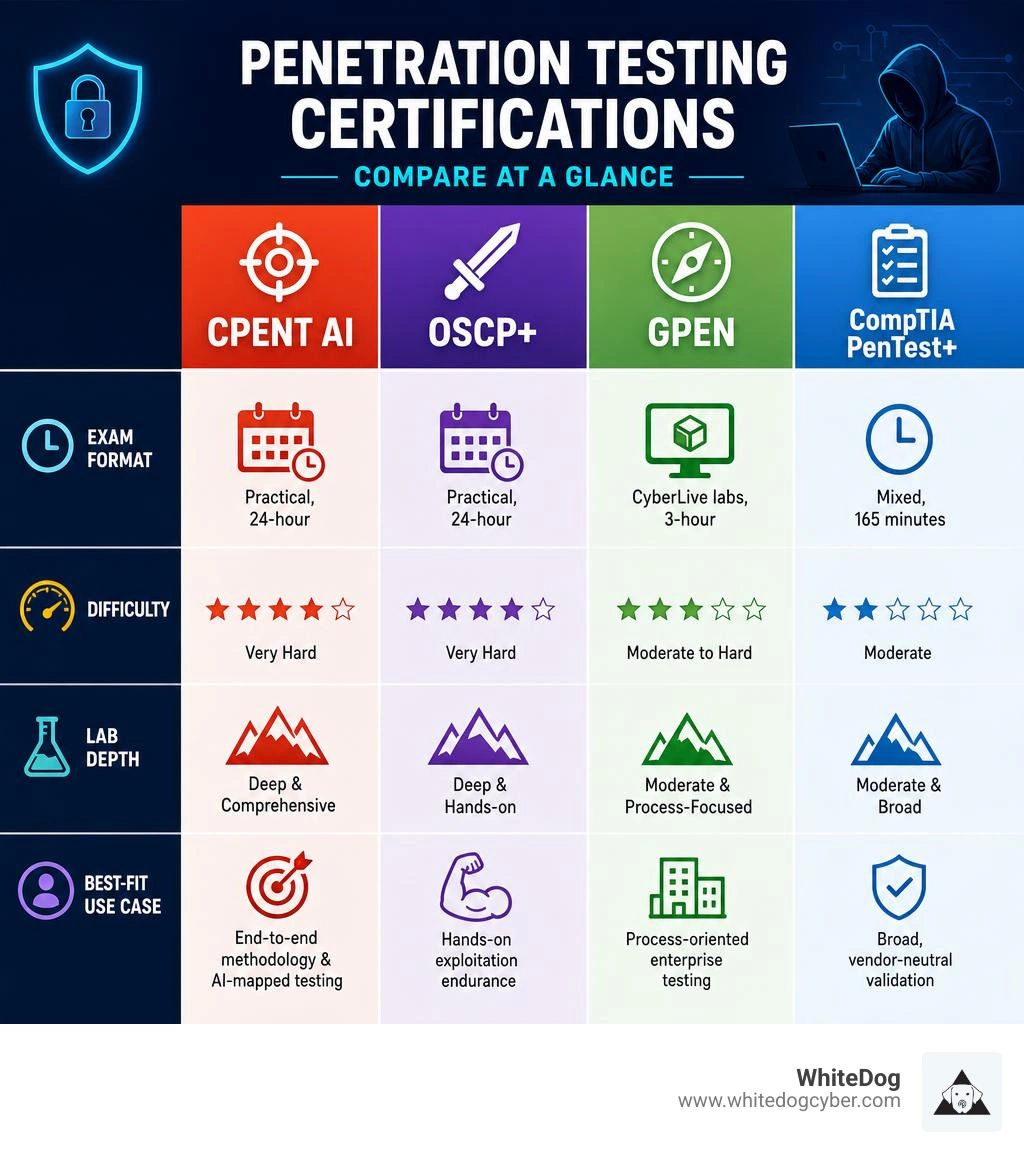
Here is a quick comparison of the top certified penetration testing credentials available in 2026:
| Certification | Issuing Body | Exam Format | Best For |
|---|---|---|---|
| CPENT AI | EC-Council | Practical, 24-hour | End-to-end methodology, AI-mapped testing |
| OSCP+ | OffSec | Practical, 24-hour | Hands-on exploitation endurance |
| GPEN | GIAC | CyberLive labs, 3-hour | Process-oriented enterprise testing |
| CompTIA PenTest+ V3 | CompTIA | Mixed, 165 minutes | Broad, vendor-neutral validation |
The demand for qualified testers has never been higher. A full 99% of security professionals say penetration testing has grown more critical as technology evolves. Yet 39% of organizations report talent shortages in pen testing, and 57% say demand for AI security skills already exceeds what their current teams can deliver.
This matters for every IT and security leader making decisions about how to validate controls, meet compliance requirements, and reduce real risk — not just check a box.
I'm Shahin Pirooz, a senior cybersecurity executive with over two decades of experience building managed security and cloud services, and certified penetration testing has been a cornerstone of the offensive security programs I've designed and advised on throughout my career. In the sections below, I'll break down what each major certification actually tests, how they compare, and how to put certified skills to work inside a modern security program.
In May 2026, enterprise networks are more complex than ever. Between hybrid cloud architectures, API-driven microservices, and IoT devices on the factory floor, the attack surface is constantly shifting. This is why automated tools alone are no longer enough to keep attackers out.
Certified penetration testing provides authorized, offensive validation of your digital perimeter and internal controls. Instead of simply generating a list of potential bugs, a certified penetration tester safely emulates actual attacker behavior. They chain minor vulnerabilities together, bypass firewalls, move laterally through networks, and attempt to access sensitive databases.
The ultimate goal of a certified engagement is to prove exploitability, demonstrate real business impact, and deliver prioritized remediation guidance. With a detailed executive report in hand, leadership can focus their security investments where they will actually reduce risk. This thorough, human-driven validation is exactly what we outline in our detailed breakdown of Penetration Testing Services.
It is common for IT leaders to confuse vulnerability scanning with penetration testing, but treating them as the same thing creates dangerous security blind spots.
Vulnerability scanning is an automated, high-level sweep designed to find known missing patches or configuration errors across your network. It provides breadth.
In contrast, a penetration test provides proof. A certified tester takes those scanner results and manually verifies if the vulnerability is actually exploitable in your specific environment. They look for logical flaws, weak credentials, and system misconfigurations that automated scanners miss entirely.
While a scanner might flag fifty "medium-severity" vulnerabilities, a certified tester can show how chaining just two of those minor flaws allows them to take over your entire Active Directory domain. Balancing these two approaches is the key to proactive security, helping you Find Your Gaps Before Attackers Do.
When you hire a penetration tester, you are essentially handing someone the keys to attempt a break-in of your most critical business systems. That requires an immense amount of trust.
Organizations insist on certified professionals because certifications guarantee a baseline of legal, ethical, and technical competence. Certified testers operate under strict Rules of Engagement (ROE) and legal authorizations, ensuring they do not disrupt operations. They use repeatable, industry-standard methodologies to produce defensible results that can be shared with board members, auditors, and cyber insurance underwriters.
With a 39% talent shortage in penetration testing and a massive 57% gap in AI-focused security skills, holding a recognized certification is the strongest signal that a practitioner can safely and effectively protect an enterprise.
A point-in-time penetration test is highly valuable, but its shelf life is short. The moment a new software update is pushed or a firewall rule is modified, new vulnerabilities can emerge.
In a mature, proactive security program, certified penetration testing serves as the ultimate validation step. It tests your attack surface management, validates your detection engineering rules, and exercises your incident response playbooks.
If your penetration tester can compromise a critical database without triggering a single alert in your Security Operations Center (SOC), you have found a gap in your monitoring—not just your patching. This continuous drift in security posture is why we emphasize understanding Security Drift: Why Your Pen Test Is Already Outdated.
Building an offensive security team or hiring an external firm requires knowing which certifications actually carry weight. Let's look closely at the four industry leaders.
The Certified Penetration Testing Professional (CPENT AI) by EC-Council is widely regarded as one of the most comprehensive programs for mastering modern offensive security. What sets it apart in 2026 is its complete integration of artificial intelligence techniques across every single phase of the penetration testing lifecycle.
Rather than treating AI as an afterthought, the CPENT AI curriculum explicitly maps AI-driven automation to scoping, open-source intelligence (OSINT), web API testing, and Active Directory exploitation. Candidates must navigate five multidisciplinary live cyber ranges containing segmented enterprise networks, IoT zones, and OT/SCADA systems.
To earn the certification, students must pass a grueling, practical 24-hour exam. Those who score above 90% earn the elite Licensed Penetration Tester (LPT) Master designation. For more details on this modern curriculum, check out the Certified Penetration Testing | CPENT Certification | EC-Council page.
OffSec’s OSCP+ (formerly OSCP) remains a legendary rite of passage for hands-on penetration testers. The exam is a 24-hour, proctored practical challenge where students must compromise multiple standalone machines and a fully simulated Active Directory forest.
The OSCP+ curriculum (PEN-200) focuses heavily on the "Try Harder" mindset, requiring deep persistence, custom scripting, and manual exploitation. The exam grading is split, with 60% of the points focused on initial access and privilege escalation on standalone systems, and 40% dedicated to simulating a multi-machine Active Directory breach scenario. It is highly valued by technical hiring managers because it proves a candidate can find and exploit vulnerabilities under intense time pressure.
The GIAC Penetration Tester (GPEN) certification is the gold standard for practitioners who need to conduct structured, process-oriented penetration tests for large enterprises. GPEN focuses heavily on real-world methodologies, planning, scoping, and professional executive reporting.
The exam uses GIAC's proprietary CyberLive testing format, which puts candidates into realistic virtual machine environments to solve performance-based challenges using authentic security tools. Key areas tested include Active Directory domain escalation, password attacks, pivoting, and cloud security testing within Azure and Entra ID environments. Learn more about the exam structure directly from the GIAC Penetration Tester Certification (GPEN)| Cybersecurity Certification page.
For those establishing a solid foundational baseline in offensive security, CompTIA's PenTest+ V3 (PT0-003) is an excellent choice. It is a vendor-neutral certification that covers the entire lifecycle of a penetration testing engagement, from initial planning and scoping to compliance-focused reporting.
The exam is a 165-minute mix of multiple-choice and performance-based questions. It is highly valued for its broad coverage of modern attack surfaces, including cloud environments, hybrid networks, APIs, IoT devices, and even modern AI attacks like prompt injection. For complete objectives, visit the PenTest+ Certification V3 (New Version) | CompTIA Global page.

To be successful, a certified penetration tester must possess a unique blend of deep technical capabilities, business acumen, and strict ethical standards.
On the technical side, a modern tester must be a jack-of-all-trades and a master of several. Core competencies include:
Technical wizardry is useless if the tester cannot translate their findings into business terms. Certified testers must be skilled in:
A professional tester must know how to select and customize the right tool for the job. They regularly use industry-standard tools like:
Certified penetration testers are highly sought after across heavily regulated sectors like financial services, healthcare, SaaS providers, and defense contracting. Common job roles that require these credentials include:
Earning a top-tier offensive certification requires intense preparation, hands-on experience, and a clear understanding of the exam environments.
Modern offensive exams are moving away from simple multiple-choice questions. Top-tier credentials like CPENT AI and OSCP+ use practical, hands-on exam formats.
Candidates are given access to a secure, simulated corporate network via a VPN. Over a 24-hour period, they must discover vulnerabilities, exploit systems, gain administrative access, and document their steps.
Once the practical portion is complete, candidates typically have another 24 hours to submit a professional, client-ready penetration testing report detailing their findings and remediation steps.
These are not entry-level certifications. Most organizations and certifying bodies recommend that candidates have:
You cannot learn how to swim by reading a book, and you cannot learn how to secure a network by memorizing multiple-choice questions. Hands-on labs are where real offensive skills are forged.
Modern cyber ranges simulate complex, multi-layered enterprise environments. To prepare for real-world engagements, candidates should practice scenarios such as:
For experienced professionals looking to push their skills to the absolute limit, advanced certifications focus on exploit development and advanced threat simulation.
The GIAC Exploit Researcher and Advanced Penetration Tester (GXPN) certification validates a practitioner's ability to analyze source code, write custom shellcode, bypass advanced stack protections, and perform deep memory analysis. Learn more about these advanced concepts on the GIAC Exploit Researcher and Advanced Penetration Tester (GXPN) | Cybersecurity Certification page.
Additionally, the Certified Advanced Penetration Tester | PECB training course is designed to prepare senior consultants to simulate advanced persistent threat (APT) scenarios within hardened enterprise networks.

Offensive security is undergoing a massive transformation driven by artificial intelligence, evolving regulatory landscapes, and the shift toward continuous monitoring.
Artificial intelligence is not replacing human penetration testers; it is supercharging them. By using AI-assisted OSINT tools, testers can map out an organization's external attack surface in a fraction of the time it used to take.
AI models can generate custom exploit scripts, vary payloads to bypass modern endpoint detection systems, and help draft highly detailed remediation reports. This automation allows testers to focus their brainpower on complex logical flaws and custom attack paths, leading to reported productivity gains of up to 2X.
With great power comes new risks. Certified testers must now understand how to attack and secure AI systems themselves. This includes testing for prompt injection vulnerabilities in enterprise LLMs, identifying model manipulation risks, and ensuring that sensitive corporate data is not leaked to public training sets.
Regular penetration testing is no longer just a "nice-to-have" security practice—it is a strict requirement under major frameworks like PCI DSS, HIPAA, SOC 2, and ISO 27001.
However, simply passing a point-in-time test does not make you immune to attacks. In fact, many companies have learned the hard way that You Passed the Pen Test and Still Got Breached. Real security requires taking those certified findings and turning them into continuous, validated operational controls.
A penetration test is a snapshot of your security posture at a specific moment in time. But in modern IT, environments change daily.
To bridge this gap, organizations are moving toward continuous exposure management. Instead of requiring a "rip and replace" of your existing security stack, WhiteDog Cyber emphasizes modular integration that works seamlessly with your current tools.
This is where our top-tier offering, Delta Detection & Response (DDR), changes the game. Whether you utilize our MDR, XDR, or DDR solutions, comprehensive incident response is fully included. Our platform operates by collecting raw telemetry across your entire environment, filtering, deduplicating, and correlating this data, normalizing it to your specific assets and enriching it with threat intelligence. This raw telemetry is processed by our 24/7 SOC to create a single, correlated security timeline—greatly reducing dwell time and accelerating threat response.
This continuous visibility ensures that your security controls remain strong long after the penetration testers have packed up and gone home, providing a Comprehensive Continuous Attack Surface Management strategy.
For teams focused on broad, foundational skills and compliance reporting, CompTIA PenTest+ is an excellent entry point. If your team needs to validate deep, hands-on exploitation capabilities, OSCP+ is the industry standard. For organizations looking to leverage cutting-edge AI automation and end-to-end testing methodologies across modern IT/OT environments, CPENT AI is the premier choice.
At a minimum, organizations should conduct a certified penetration test annually. However, you should also schedule targeted testing after any major infrastructure change, cloud migration, new application launch, or significant firewall modification.
Your pen test results should serve as a direct feedback loop for your incident response team. With WhiteDog Cyber, incident response is fully included in our MDR, XDR, and top-tier Delta Detection & Response (DDR) offerings. If your tester successfully executed a lateral movement technique, your SOC should use that data to tune their detection rules. Integrating these findings into your playbooks is a core component of Proactive Incident Response Services and helps refine your overall Cybersecurity Incident Response Workflow.
Certified penetration testing is an invaluable tool for identifying weaknesses, but finding a vulnerability is only half the battle. The real value lies in how quickly and effectively your organization can detect, contain, and remediate those threats.
Instead of requiring a "rip and replace" of your existing security investments, WhiteDog Cyber focuses on modular integration to enhance your current setup. We offer robust MDR and XDR solutions alongside our top-tier Delta Detection & Response (DDR) offering, with incident response fully included across all tiers. We collect raw telemetry from your entire stack, filter out the noise, correlate events, and deliver prioritized detections to our active SOC.
By replacing tool sprawl with a single, correlated security timeline, we help you reduce risk, improve operational efficiency, and dramatically lower attacker dwell time. Because in modern security, Attackers Will Get In: Speed Is Your Defense.
Ready to elevate your security posture with continuous, actively managed protection? Connect with WhiteDog Solutions today to see how we can secure your enterprise.


Learn how Cylance BlackBerry Protect uses AI-driven MTD to secure mobile endpoints, integrate with Microsoft Intune, and strengthen your SecOps.

Learn how an AWS security observability platform reduces alert fatigue, improves threat detection, and supports HIPAA compliance with proactive visibility.

Learn how to check DNS security across your infrastructure with a 5-step audit, including DNSSEC, email records, and CAA validation.

Master enterprise risk reduction with this detailed guide covering ERM frameworks, AI governance, and cybersecurity strategies for 2026.

Compare top AWS incident response solutions for rapid remediation, automated triage, and containment with native tools and expert escalation paths.

Harden your Amazon Linux firewall with firewalld and nftables to meet STIG compliance, block lateral movement, and secure AWS EC2 hosts.