Cybersecurity
September 22, 2026
Learn how cloud security protects your data in 2026, covering shared responsibility, zero trust, and posture management to prevent breaches.
Cyber security health checks give organizations a clear, structured snapshot of where their defenses stand — and where they don't.
If you're evaluating security assessment services, here's what you need to know at a glance:
| What You Want to Know | Quick Answer |
|---|---|
| What is a cyber security health check? | A structured assessment that identifies security gaps, technology weaknesses, and policy deficiencies across your IT environment |
| Who needs one? | SMEs, regulated industries, local government agencies, and any organization without a clear view of their security posture |
| How long does it take? | Anywhere from a single day (lightweight self-assessment) to 4-6 weeks (full managed assessment) |
| What frameworks are used? | NIST CSF, ISO 27001, CIS Controls, DORA, and Cyber Essentials are the most common |
| What do you get at the end? | A risk-ranked gap report, prioritized remediation roadmap, and an executive summary |
| Is it the same as a pen test? | No — a health check is a posture review, not an active exploit exercise |
| Can results support compliance or insurance? | Yes — findings map to regulatory frameworks and cyber insurance requirements |
The numbers make the case for urgency. Eight in ten organizations have experienced a cybersecurity incident within a single 12-month period. One in two encounter incidents multiple times per year. The average cost of a ransomware attack in Singapore alone runs around $1.5 million. And globally, the average data breach costs organizations approximately $4.35 million. Yet many businesses still have no formal, documented view of where their defenses are weak.
That gap — between the threat landscape and organizational awareness — is exactly what a cyber security health check is designed to close.
I'm Shahin Pirooz, WhiteDog Cyber's technology executive with over two decades of experience building Managed Security and Cloud Services, and cyber security health checks have long been central to how I help organizations understand their true risk exposure before committing to a broader security strategy. In this guide, I'll walk you through everything you need to evaluate, commission, and act on a health check — so your next step is informed, not reactive.
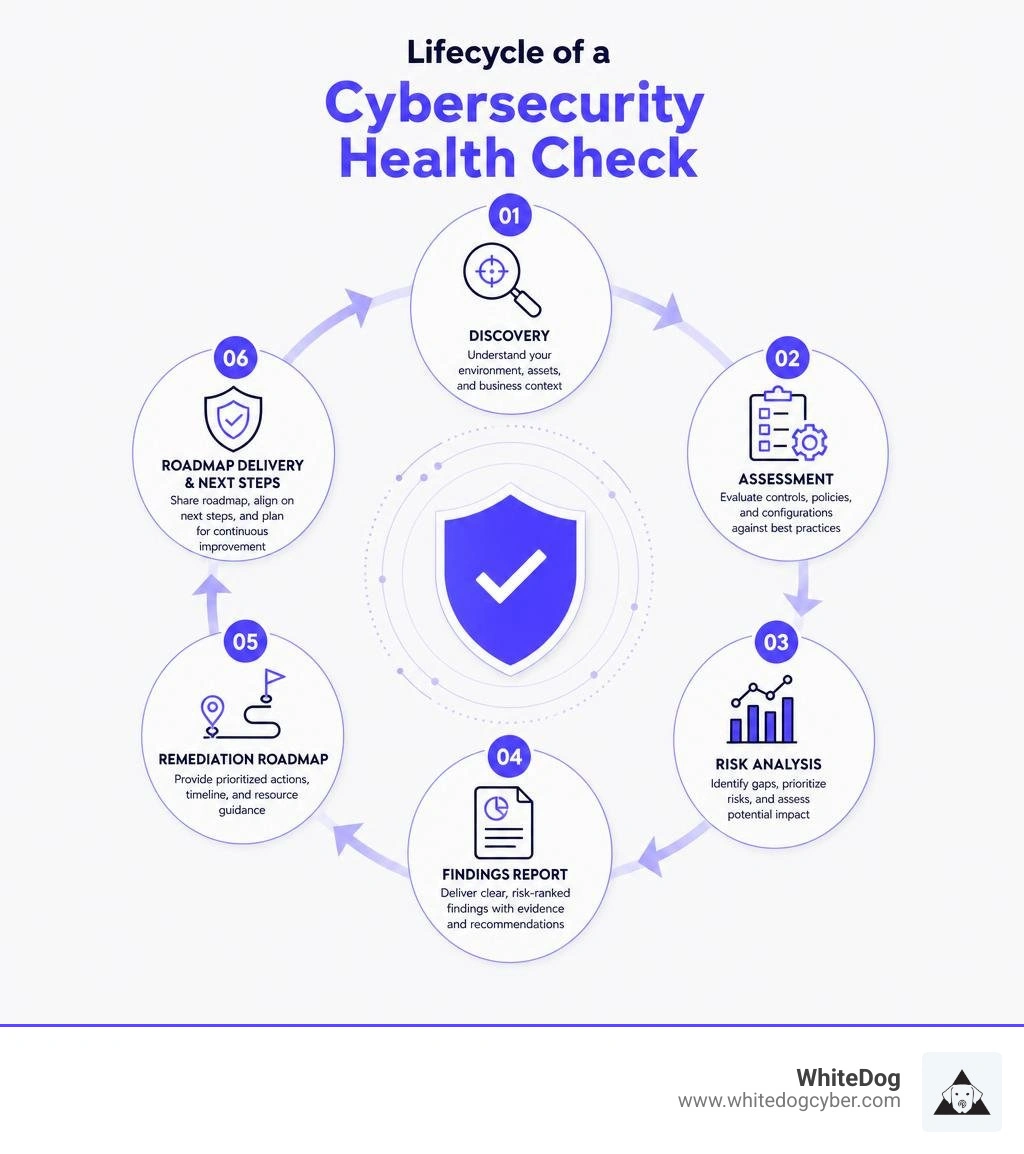
A point-in-time assessment is more than a checklist; it is a diagnostic tool that aligns your technical reality with your business risk. For enterprise decision-makers, a cyber security health check serves as the baseline for all strategic security planning. It exposes hidden security deficiencies and technology gaps before malicious actors exploit them, and it translates technical vulnerabilities into clear operational risk.
One of the greatest hurdles in modern enterprise security is a lack of transparency. Complex, hybrid IT infrastructures often obscure where critical data resides, who has access to it, and how easily a perimeter can be breached. By systematically evaluating your entire ecosystem, a health check builds the foundation for long-term risk mitigation. It ensures that security is treated as a strategic business enabler rather than an isolated IT headache.
Importantly, these assessments elevate board-level awareness. Board members and executive leaders do not need to understand raw packet captures or firewall configurations; they need to understand how security gaps impact business continuity, financial stability, and brand trust. A structured health check translates complex technical risks into business metrics, giving leadership the exact context they need to make informed decisions. Furthermore, it helps organizations evaluate their supply chain risk—an essential focus in an era where partners and third-party vendors are frequently used as entry points for sophisticated attacks.

It is common to confuse cyber security health checks with penetration testing or ongoing security monitoring, but they serve fundamentally different purposes. Think of a health check as a comprehensive physical exam that checks your vitals, habits, and genetic risks, while a penetration test is a stress test designed to see exactly when and where your heart rate redlines under pressure.
If you rely solely on point-in-time assessments, you run into the challenge of "security drift." Security drift is the natural degradation of your security posture over time due to configuration changes, new software installations, and evolving threat methods. To understand why a static test can leave you exposed, it is helpful to look at Security Drift: Why Your Pen Test is Already Outdated.
A health check establishes your baseline, helping you Find Your Gaps Before Attackers Do, so you can build a more resilient foundation before bringing in active testers or deploying continuous monitoring tools.
The operational benefits of a health check depend heavily on your organization's size, industry, and regulatory landscape:
To see how national bodies support these efforts, organizations can leverage the Cybersecurity Health Check for Organisations | Cyber Security Agency of Singapore , which provides structured self-assessment tools aligned with national standards.
Additionally, if you are preparing to apply for or renew a cyber liability policy, using an Assessment Tool - Cybersecurity Insurance Compliance can help you identify gaps that might otherwise lead to denied coverage or skyrocketing premiums.
To ensure that a cyber security health check delivers objective, actionable value, it must be mapped to established industry frameworks. Relying on an assessor's subjective opinion is a recipe for blind spots. By anchoring the assessment in recognized global standards, you ensure consistency, repeatability, and regulatory alignment.
| Framework | Core Focus | Best Suited For | Key Strength |
|---|---|---|---|
| NIST CSF (Cybersecurity Framework) | Five core functions: Identify, Protect, Detect, Respond, Recover. | All enterprise sizes, particularly US-based or infrastructure-critical firms. | Highly flexible, risk-based approach with clear operational outcomes. |
| ISO 27001 | Information Security Management System (ISMS) governance and administrative controls. | Global enterprises and organizations requiring formal, third-party certification. | Strong focus on management commitment, continuous improvement, and policy. |
| CIS Controls | 18 prioritized, highly technical security actions (Basic, Foundational, Organizational). | Technical teams looking for a prescriptive, action-oriented implementation guide. | Pragmatic, defensive focus designed to stop the most common real-world attacks. |
A comprehensive health check does not look at your network in isolation. It evaluates several interconnected domains to ensure your defenses are integrated and resilient.
To understand why all of these domains must work together seamlessly, read our insights on Why a Layered Defense is Critical.
When you look at the Anatomy of a Cyber Attack: Why Layered Protection Matters, it becomes clear that a failure in even one of these assessed areas can compromise your entire environment.
The quality of your health check depends entirely on the expertise of the people performing it. When selecting a third-party provider or evaluating the team conducting your assessment, look for recognized industry certifications such as:
In addition to technical certifications, look for providers who follow structured, government-backed methodologies. For example, the UK's National Cyber Security Centre provides excellent resources to Check your cyber security | National Cyber Security Centre , offering fast, remote, non-intrusive checks that help smaller organizations find exposed vulnerabilities using the same public data that attackers exploit.
Understanding the logistics of a cyber security health check helps you prepare your team, set realistic expectations, and ensure minimal disruption to daily business operations.
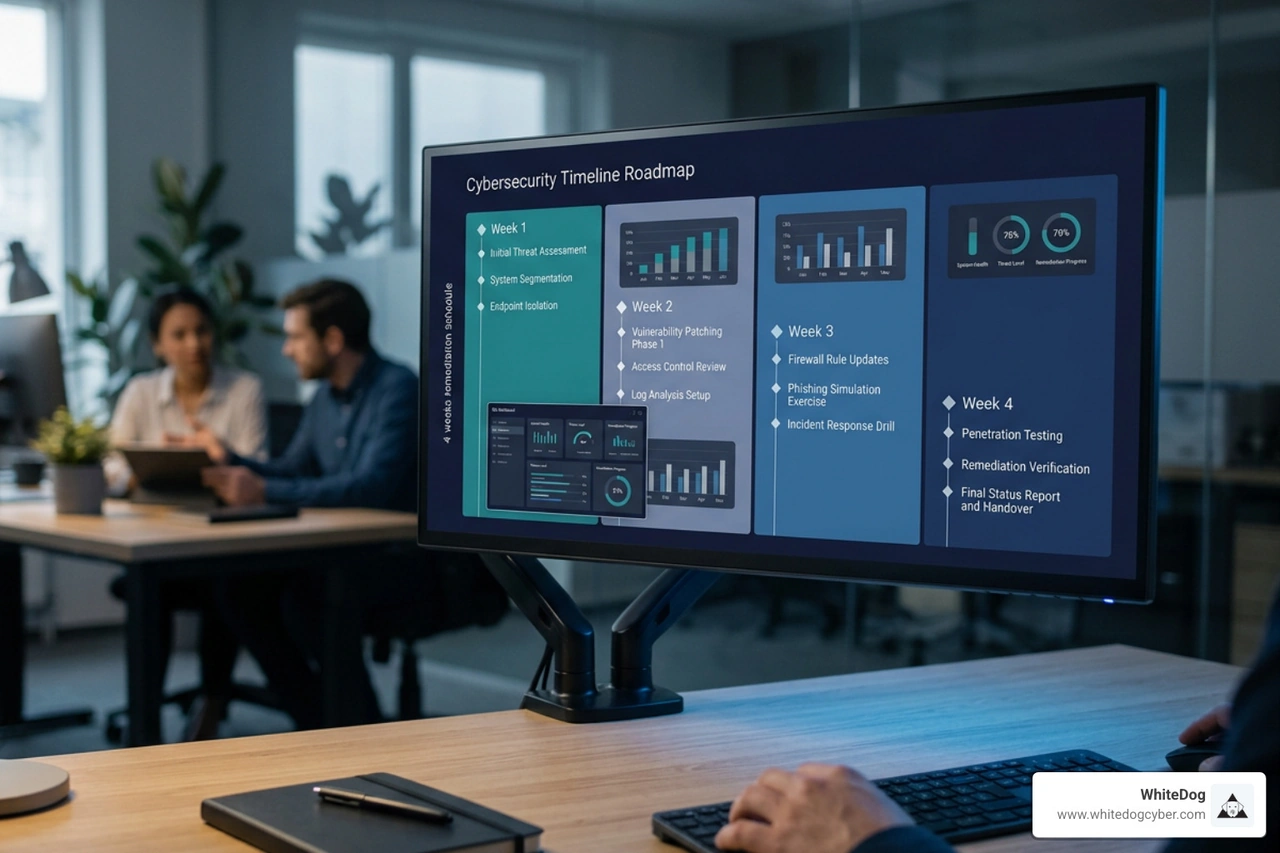
While lightweight self-assessments can be completed quickly online, a professional, managed health check typically follows a structured, multi-week process:
For organizations seeking a streamlined, browser-based approach to kickstart this process, the Cyber Health Check for Australian Businesses | CyberAssure provides an excellent model of how guided, plain-English questionnaires can quickly produce risk-ranked gap lists without requiring complex software installations.
The cost of a health check varies based on the size of your network, the complexity of your infrastructure, and whether you require a lightweight self-assessment or a comprehensive, manual consultant-led audit. Most commercial providers offer these assessments on a fixed-price basis, ensuring there are no hidden fees.
Fortunately, there are numerous free or subsidized programs available, particularly for small businesses, public schools, and local government agencies:
A point-in-time cyber security health check is an essential starting point, but it is not a permanent shield. The day after your assessment is completed, a user might disable MFA on an admin account, a new critical vulnerability might be disclosed, or an employee might click on a sophisticated phishing link.
If you treat security as an annual event, you remain highly vulnerable to the gaps that open up between assessments.
To truly protect your organization, you must transition from point-in-time assessments to a continuous security posture. This is where many enterprise decision-makers struggle with "tool sprawl"—the accumulation of disconnected security tools that generate thousands of uncoordinated alerts.
Instead of adding more disconnected software, organizations need a unified security timeline that correlates data across endpoints, networks, and cloud environments. This approach dramatically reduces dwell time—the period an attacker spends undetected inside your network before launching a payload.
While average industry statistics show that attackers often linger for weeks, a correlated platform can identify anomalous behavior in a fraction of that time. To understand this dynamic, explore how Attackers Linger for Months, We Find Them in Minutes.
Maintaining this level of visibility requires Comprehensive Continuous Attack Surface Management to ensure that your external-facing assets are constantly monitored for new exposures.
To move from a passive, reactive posture to an active defense, you must understand the different tiers of modern security operations:
In today's threat landscape, point-in-time checks are simply the diagnostic step. The ultimate goal is to build an active, resilient infrastructure because, as we advise our partners, you must always Prepare to be Hacked.
If you don't transition to a continuous, actively managed defense, you risk falling into a dangerous cycle of being Breached and Vulnerable: The Cycle of Repeat Attacks.
At a minimum, organizations should conduct a formal health check annually. However, we highly recommend quarterly reviews for organizations handling sensitive customer data or operating in regulated environments. Additionally, a health check should be triggered immediately following any major infrastructure changes, such as migrating to a new cloud environment, acquiring another company, or transitioning to a fully remote workforce.
No assessment can guarantee 100% protection against ransomware or any other cyber threat. A health check is a diagnostic tool designed to identify security deficiencies and technology gaps. Its value lies in the remediation actions you take after receiving the report. By implementing the recommended controls—such as robust backup procedures, multi-factor authentication, and employee security awareness training—you significantly reduce your attack surface and minimize the potential operational and financial impact of an attack.
Cyber insurance underwriters have grown highly sophisticated, and applications now require detailed validation of your security controls. A completed health check report serves as documented evidence of your security posture. By presenting a clean health check along with a prioritized remediation roadmap, you demonstrate to insurers that you are a lower-risk client. This validation can be the difference between getting approved or denied for a policy, and it directly influences the cost of your premiums.
A cyber security health check is your organization's diagnostic baseline. It exposes the gaps, validates your controls, and provides the strategic roadmap you need to protect your business. But once you have that baseline, the real work begins.
At WhiteDog Cyber, we provide a co-managed, white-label cybersecurity platform with integrated tools, 24/7 security operations, threat hunting, and incident response designed specifically for MSPs and the enterprises they support. Our modularly integrated platform bypasses the complexity of tool sprawl by collecting raw telemetry from your existing systems, filtering and correlating the data, and normalizing it to your assets to produce prioritized, actionable detections without requiring a 'rip and replace' approach. Backed by our 30-day onboarding guarantee and a fully managed SOC, we help you reduce risk, improve operational efficiency, and dramatically lower attacker dwell time.
Ready to transition from point-in-time checks to an active, continuous defense? Explore WhiteDog's Unified Cybersecurity Solutions today.


Learn how cloud security protects your data in 2026, covering shared responsibility, zero trust, and posture management to prevent breaches.

Verify AWS KMS FIPS compliance with this step-by-step guide covering FIPS 140-3 HSMs, endpoints, and auditing for regulatory alignment.

Navigate security compliance requirements across ISO 27001, SOC 2, and GDPR with a strategic blueprint for sustainable compliance management.

Learn how AI phishing detection stops next-gen attacks that bypass traditional defenses, with practical capabilities to evaluate.

Evaluate your cloud security audit options with this actionable checklist covering multi-cloud frameworks, CSPM, DSPM, and AI-driven automation.

Learn the five pillars of MSP risk reduction to secure operations, manage vendor risk, and build defensible compliance.