Cybersecurity
October 17, 2026
Strengthen your DNS security with this guide to threats, DNSSEC, encryption, and enterprise defense best practices.
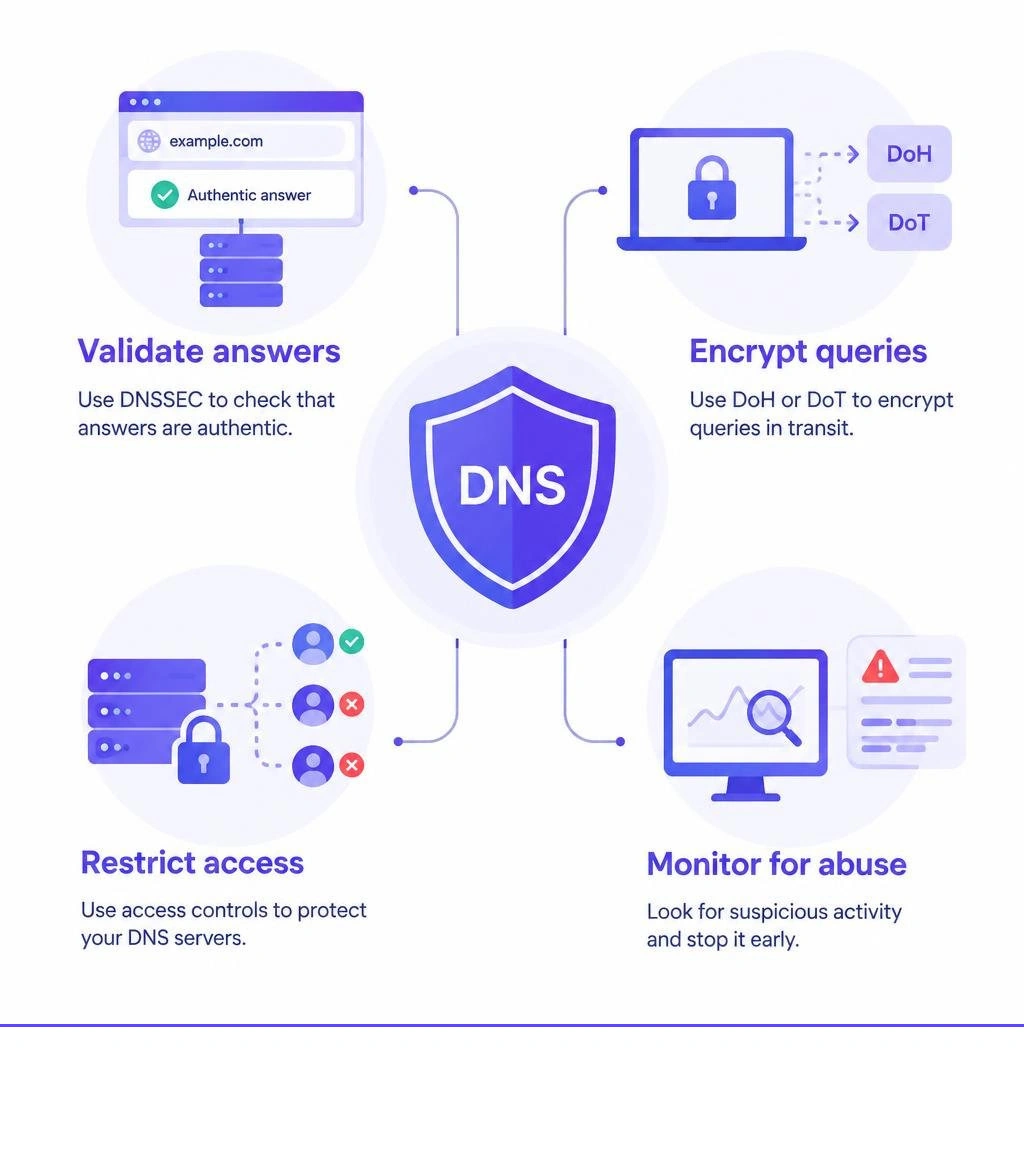
DNS security protects the system that helps devices find websites and services. Start by using DNSSEC to check that answers are authentic, DoH or DoT to encrypt queries in transit, and access controls and monitoring to protect your DNS servers. These controls work together: DNSSEC does not hide queries, and encrypted DNS does not prove an answer is correct.
Without those safeguards, a forged DNS answer can send staff to a fake site. Malware can also use DNS to receive commands or move data out of a network. Both risks can affect business operations.
I'm Shahin Pirooz, a technology executive at WhiteDog Cyber with more than 20 years of experience building cloud and managed security services. I'll use that experience to explain the DNS security risks that matter most and the practical steps organizations can take to reduce them.
The Domain Name System serves as the fundamental address book of the Internet. Invented in 1983 by Paul Mockapetris and deployed across ARPANET by 1985, DNS replaced static host files with a distributed, hierarchical naming database. Operating primarily over UDP and TCP port 53, it translates human-friendly hostnames into machine-routable IP addresses.
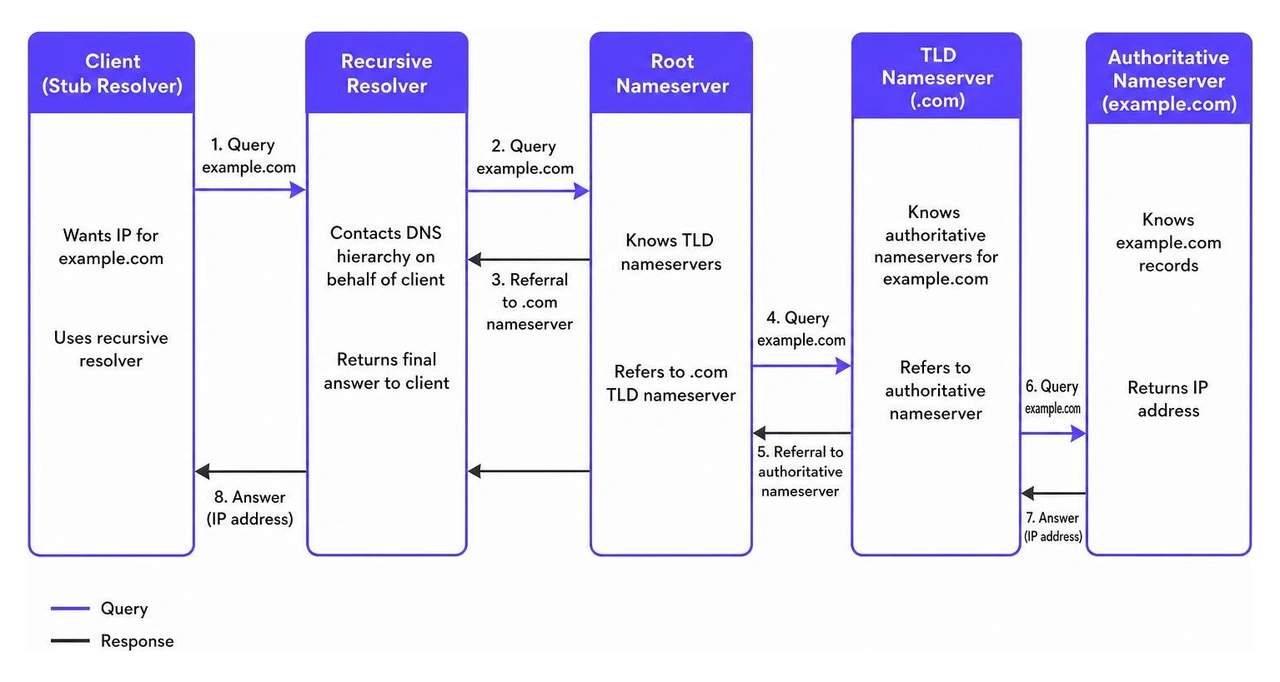
When Mockapetris designed DNS, the early internet relied on mutual institutional trust. As a result, standard DNS transport lacks native confidentiality controls and cryptographic authentication. Queries and answers travel across networks in cleartext. This fundamental architecture leaves plain DNS lookups vulnerable to inspection, eavesdropping, and alteration by intermediaries.
Understanding these design limits helps security teams recognize why modern attackers target DNS records, resolvers, and transport paths.
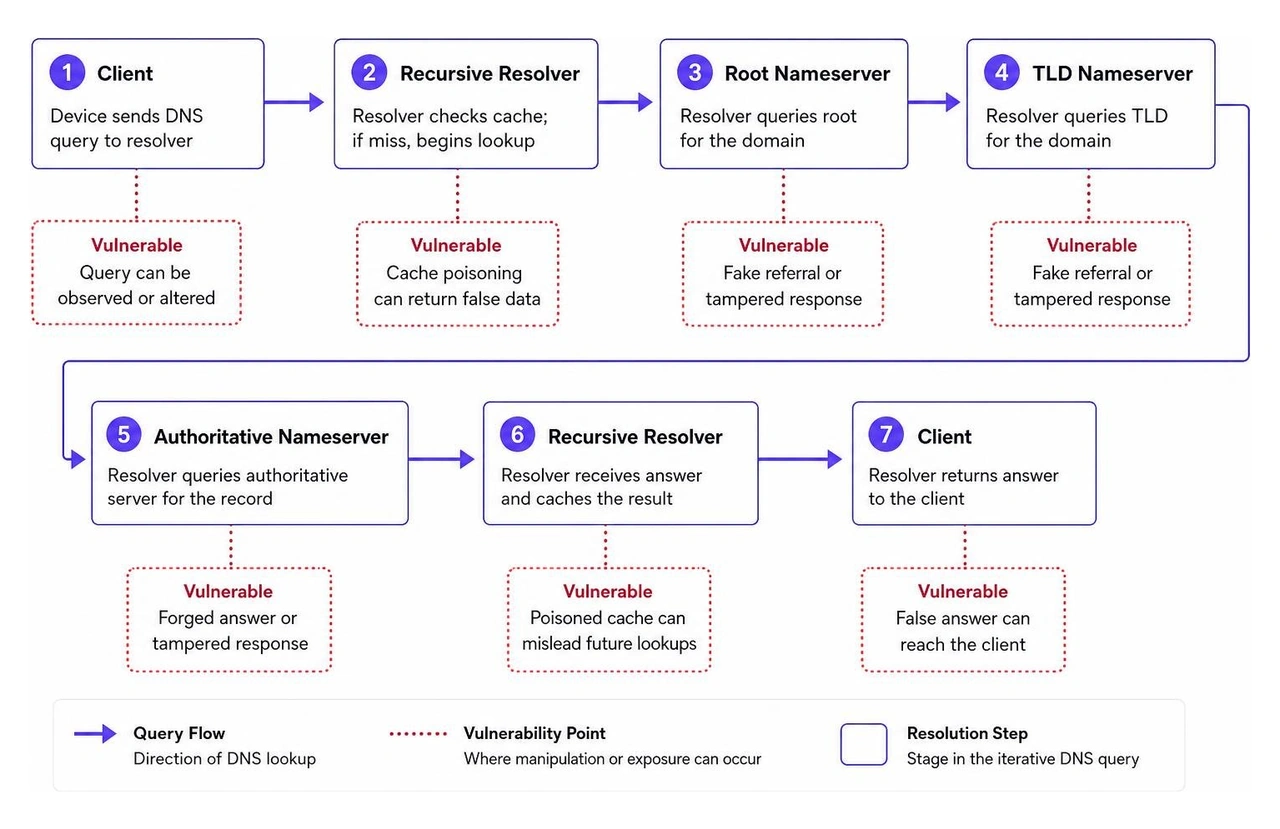
Modern threat actors exploit the inherent trust of traditional DNS through various attack techniques. Because DNS is necessary for standard network connectivity, perimeter firewalls frequently allow outbound port 53 traffic without inspection. This turns DNS into an appealing vector for both redirection and stealthy communications.

DNS cache poisoning targets recursive resolvers. Under normal operation, a recursive resolver queries upstream authoritative nameservers when an uncached domain is requested, matching answers to queries using a 16-bit Transaction ID (TXID) alongside the source UDP port.
Historically, predictable TXIDs and static source ports allowed attackers to execute race conditions, famously documented in the Kaminsky attack. An adversary floods a resolver with forged responses containing targeted mapping data while requesting random subdomains. If a forged response matches the TXID and source port before the legitimate authoritative server responds, the resolver accepts the fraudulent record.
The corrupted resolver then caches the forged mapping for the duration of the Time to Live (TTL). Every client relying on that resolver is directed to the attacker's malicious IP address without receiving browser certificate warnings—unless strict HTTPS protections like HSTS are enforced.
Misconfigured infrastructure, including lame delegations where parent zones point to expired or decommissioned nameservers, presents an additional risk. Attackers can register those abandoned nameserver domains to take control of legitimate query pathways.
Because security teams often monitor HTTP/S web traffic closely while leaving DNS uninspected, malware developers routinely use DNS as a covert transport channel. Advanced threats encode data within DNS requests and responses, bypassing conventional egress filtering.
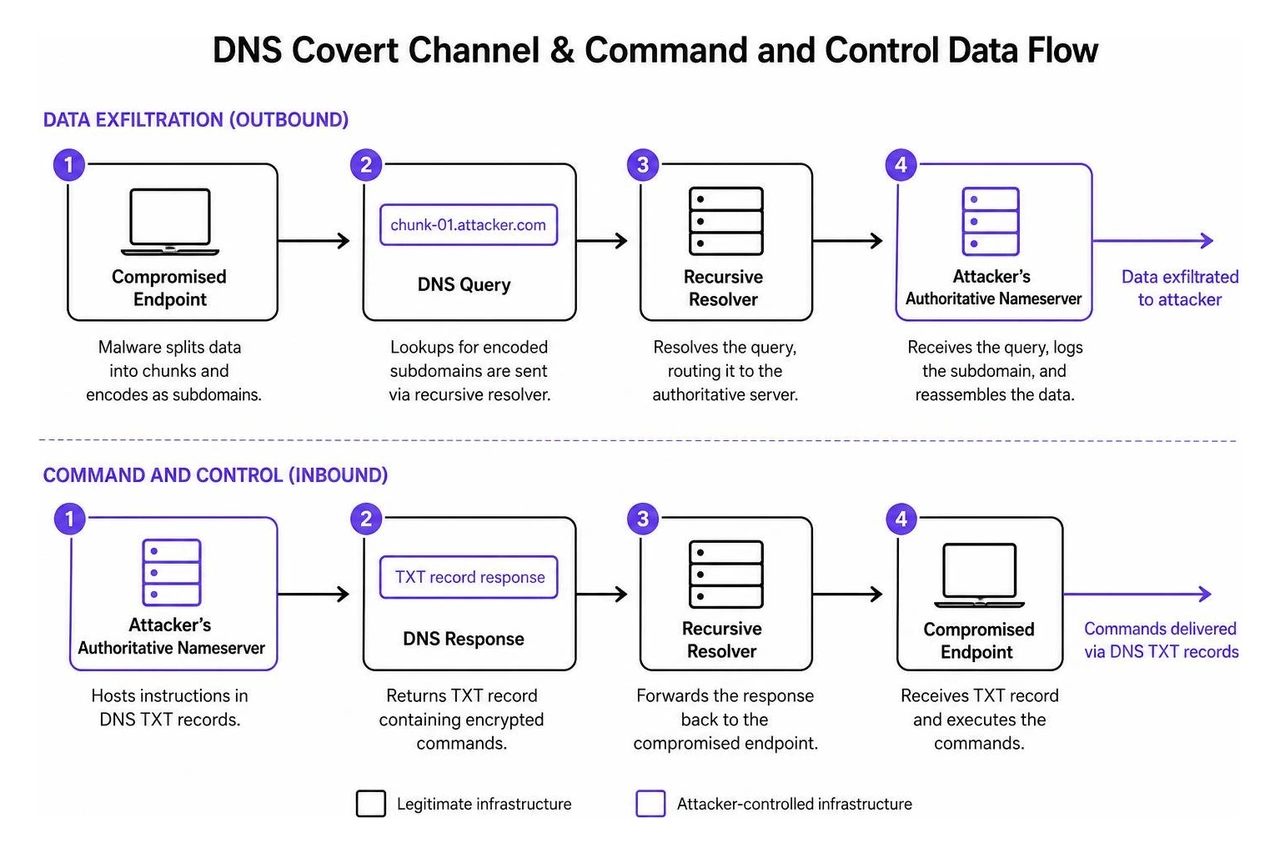
Threat actors break sensitive data into smaller alphanumeric chunks, append them as subdomains to a domain they control, and issue lookups (such as data-chunk-01.attackerdomain.com). The recursive resolution tree routes the request directly to the attacker’s authoritative nameserver, which logs the query and reassembles the payload.
Command and Control (C2) frameworks use DNS TXT records to deliver encrypted instructions back to compromised endpoints. A prominent example is DNSMessenger, a multi-stage malware strain that executes commands delivered entirely within TXT record payloads.
Detecting these covert channels requires continuous analysis of query patterns:
To resolve the lack of authentication in original DNS specifications, the Internet Engineering Task Force (IETF) developed the Domain Name System Security Extensions (DNSSEC). DNSSEC adds cryptographic signatures to resource records, creating a verifiable chain of trust from the root zone down to individual domain records.
DNSSEC provides three core security properties:
DNSSEC does not provide confidentiality. DNSSEC signatures validate the authenticity of the records, but queries and responses remain readable to any intermediary monitoring cleartext transport.
The fundamental requirements for DNSSEC are outlined in RFC 4033 - DNS Security Introduction and Requirements and consolidated in updated specifications like the DNS Security Extensions (DNSSEC) framework.
DNSSEC establishes integrity through several dedicated resource records:
Zone administration splits operational trust between a Key Signing Key (KSK) and a Zone Signing Key (ZSK). The ZSK signs the zone’s resource record sets frequently, while the KSK signs only the DNSKEY record set. The corresponding DS record in the parent zone references the KSK, minimizing coordination overhead with parent registries during routine key updates.
If a zone is signed but the parent zone lacks a corresponding DS record, the domain functions as an "island of security." In this state, resolvers cannot construct an unbroken chain of trust back to the global root trust anchor, leaving responses unvalidated.
As quantum computing architectures advance, traditional public-key algorithms based on RSA and elliptic curve cryptography face eventual obsolescence. The cybersecurity community is actively testing post-quantum signature algorithms like ML-DSA-44 to protect the DNS infrastructure against future cryptanalytic threats.
However, post-quantum signatures introduce operational challenges for standard DNS transports. An ML-DSA-44 signature requires approximately 2,420 bytes—significantly larger than standard 64-byte ECDSA signatures.
Because standard DNS over UDP limits payloads to avoid fragmentation (typically constrained to 1,232 or 1,400 bytes via EDNS0), post-quantum responses routinely trigger truncation (the TC bit), forcing resolvers to fall back to TCP. Network engineers and security leaders must account for increased latency, connection overhead, and fallback requirements when preparing DNS infrastructure for quantum-resilient algorithms.
While DNSSEC confirms data integrity, it does not stop unauthorized parties from reading user lookups. Internet Service Providers, network intermediaries, and local eavesdroppers can log DNS activity to profile user behavior or harvest intelligence.
To address transport privacy, modern encrypted DNS protocols wrap port 53 traffic in established encryption standards.
| Protocol | Standard Port | Transport Layer | Privacy / Encryption Level | Enterprise Visibility | Latency Impact |
|---|---|---|---|---|---|
| Do53 (Traditional) | UDP/TCP 53 | Cleartext UDP/TCP | None (Cleartext) | High (Easily logged/filtered) | Baseline (Lowest) |
| DoT (DNS over TLS) | TCP 853 | TLS Tunnel | Full Transport Encryption | Medium (Dedicated port filtering) | Low to Medium (TLS handshake) |
| DoH (DNS over HTTPS) | TCP 443 | HTTPS (HTTP/2 or HTTP/3) | Full Transport Encryption | Low (Blends with web traffic) | Medium (HTTPS overhead) |
| DoQ (DNS over QUIC) | UDP 853 | QUIC (TLS 1.3 + UDP) | Full Transport Encryption | Medium (Port specific, stream-based) | Low (0-RTT capabilities) |
The deployment of encrypted DNS protocols changes the balance between user privacy and enterprise network visibility.
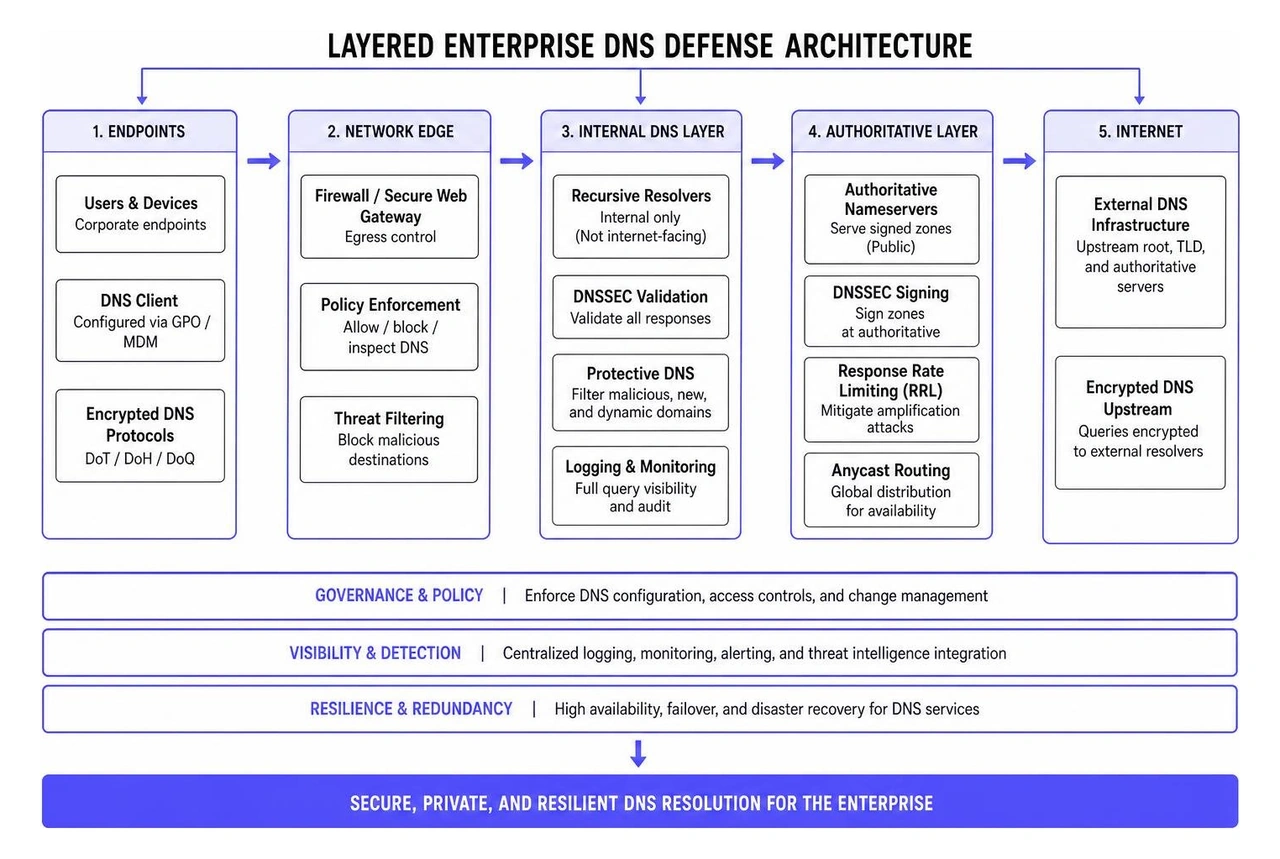
For enterprise environments, blindly enabling public DoH resolvers on managed endpoints introduces significant operational blind spots. Attackers can also use DoH to bypass perimeter controls and communicate with external infrastructure. Organizations should configure corporate endpoints via group policies or mobile device management (MDM) to use internal validating recursive resolvers, retaining full audit capabilities while encrypting upstream queries.
Security teams looking to baseline their infrastructure configurations can thoroughly evaluate and check DNS security posture across internal endpoints and exposed nameservers.
Securing DNS requires a defense-in-depth model that addresses authoritative zones, internal recursive resolvers, and egress network boundaries.
DNS spoofing is a broad term that describes any technique used to return fraudulent address records to a client, including local hosts file modifications, rogue DHCP configurations, or man-in-the-middle attacks. DNS cache poisoning specifically refers to corrupting the lookup cache of an intermediate recursive resolver, which subsequently serves that falsified record to all downstream clients querying that server.
No. DNSSEC provides data origin authentication, record integrity, and authenticated denial of existence using cryptographic signatures, but the query and response payloads remain cleartext. To ensure confidentiality and prevent network eavesdropping, DNSSEC must be paired with transport encryption protocols such as DoT, DoH, or DoQ.
Detecting covert DNS communication requires analyzing both traffic volume and packet characteristics. Key indicators include high character entropy in subdomains, elevated volumes of TXT or unusual record requests, uniform query intervals indicative of automated beaconing, and lookups targeting unfamiliar or newly registered second-level domains.
Securing the Domain Name System requires an approach that balances cryptographic integrity, transport privacy, and operational network visibility. Because DNS underpins nearly all network communication, attackers continue to exploit its fundamental trust mechanics through cache poisoning, domain spoofing, amplification abuse, and covert exfiltration channels. Securing this layer requires validating records with DNSSEC, encrypting endpoint transport through managed pathways, and continuously auditing query logs for anomalous behavior.
However, DNS security cannot operate in isolation. Threat actors execute complex attack paths that combine DNS manipulation with compromised identities, malicious email links, cloud infrastructure misconfigurations, and endpoint executions. Detecting and mitigating these threats requires correlating telemetry across every stage of the attack chain.
WhiteDog Cyber helps organizations simplify cybersecurity operations through a Unified Cybersecurity Platform that connects visibility, detection, response, and risk management. Emphasizing modular integration across existing security investments, WhiteDog seamlessly ingests and correlates telemetry across email, DNS, identity, endpoint, network, cloud, and data environments.
To help organizations maximize their existing Microsoft investments, Delta 360 (Δ360), built on WhiteDog’s Open XDR framework, adds a unified operational and security layer across Microsoft and third-party tools to improve correlation, visibility, security hardening, threat detection, exposure management, and response. Our continuous attack surface management and 24/7 security operations build on correlated intelligence to identify threats earlier and respond with confidence. Depending on your operational needs, WhiteDog provides flexible delivery tiers ranging from Open XDR for unified visibility and detection to fully managed MDR, XDR, and our top-tier Delta Detection & Response (DDR) backed by 24/7 SOC expertise, with incident response included in MDR, XDR, and DDR. By combining advanced analytics with experienced human analysts, WhiteDog eliminates operational noise and empowers teams to defend their critical infrastructure against emerging threats.


Strengthen your DNS security with this guide to threats, DNSSEC, encryption, and enterprise defense best practices.

Learn how Cylance BlackBerry Protect uses AI-driven MTD to secure mobile endpoints, integrate with Microsoft Intune, and strengthen your SecOps.

Learn how an AWS security observability platform reduces alert fatigue, improves threat detection, and supports HIPAA compliance with proactive visibility.

Learn how to check DNS security across your infrastructure with a 5-step audit, including DNSSEC, email records, and CAA validation.

Master enterprise risk reduction with this detailed guide covering ERM frameworks, AI governance, and cybersecurity strategies for 2026.

Compare top AWS incident response solutions for rapid remediation, automated triage, and containment with native tools and expert escalation paths.