Cybersecurity
September 22, 2026
Learn how cloud security protects your data in 2026, covering shared responsibility, zero trust, and posture management to prevent breaches.
The edr solution meaning is straightforward: EDR stands for Endpoint Detection and Response, a cybersecurity technology that continuously monitors devices like laptops, desktops, servers, and mobile phones to detect threats and take action — in real time.
Here is a quick breakdown:
| Term | What It Means |
|---|---|
| Endpoint | Any device connected to your network (laptop, phone, server, IoT) |
| Detection | Continuous monitoring and analysis to identify suspicious behavior |
| Response | Automated or manual actions taken to contain and eliminate threats |
In plain terms: EDR watches what is happening on every device, spots unusual activity, and helps your security team stop threats before they cause serious damage.
Unlike traditional antivirus — which only checks for known threats — EDR uses behavioral analytics and AI to catch threats that have never been seen before. It records everything happening on an endpoint, so your team can investigate exactly what happened, how it got in, and where it went.
This matters because endpoints are where most attacks begin. Studies estimate that up to 90% of successful cyberattacks originate at endpoint devices. And threat actors often go undetected for weeks or even months once inside a network.
For MSPs managing security across multiple clients, that visibility gap is a serious operational risk.
I am Shahin Pirooz, a senior cybersecurity and technology executive with over 20 years of experience building Managed Security and Cloud Services — and understanding the full edr solution meaning has been central to how I help organizations cut through tool sprawl and build security stacks that actually work. In this guide, I will break down exactly how EDR functions, how it fits into a modern security architecture, and what it means for the clients you protect.
To fully grasp the edr solution meaning, we have to look at its roots. The term Endpoint detection and response was originally coined by Anton Chuvakin at Gartner in 2013. Back then, he called it "endpoint threat detection and response" (ETDR).
At its core, EDR is a category of tools that focus on the "post-compromise" phase of an attack. While other tools try to keep the bad guys out, EDR assumes that, eventually, someone might get in. It acts like a digital flight data recorder (or a DVR) for your laptops, servers, and mobile devices, capturing every process execution, registry change, and network connection.
In the "old days" (which in tech terms was only about a decade ago), we relied almost exclusively on signature-based antivirus. These tools worked like a digital "Most Wanted" poster; if a file’s signature matched a known piece of malware in the database, it was blocked.
The problem? Cybercriminals got smart. They started creating polymorphic malware that changes its signature every time it replicates. They began using "fileless" attacks that live only in the computer's memory, leaving no file for a traditional antivirus to scan. This shift necessitated a move from looking at what a file is to what a file does—the birth of behavioral analysis.
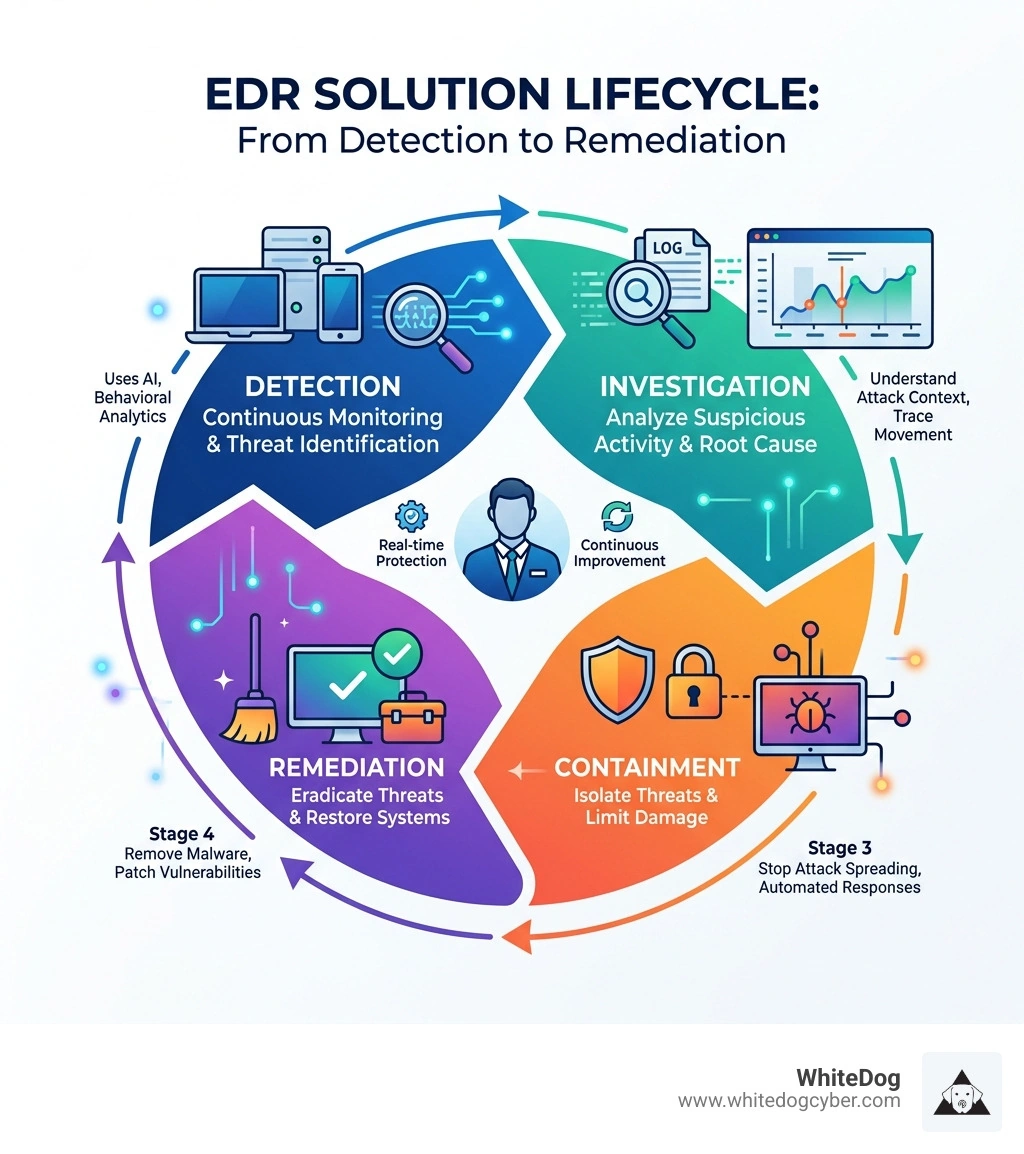
For a CISO or IT leader in May 2026, the edr solution meaning translates to four essential capabilities:
However, as we often tell our partners, Endpoint Security Isn't Enough on its own. It is the foundation, but it requires a managed layer to be truly effective.
How does an edr solution meaning move from "just data" to "saving the day"? It starts with raw telemetry. Every time a user opens an email, a script runs, or a laptop connects to a new IP address, the EDR agent logs it.
This is where the "magic" happens. Modern EDR uses AI and machine learning to establish a "baseline" of normal behavior. When a process suddenly starts encrypting files or trying to "phone home" to a known malicious server in a foreign country, the AI flags it as an Indicator of Attack (IOA).
By mapping these behaviors to the MITRE ATT&CK framework—a global knowledge base of adversary tactics—we can identify exactly what stage an attacker is in. Is it initial access? Lateral movement? Exfiltration? EDR tells us the story.
When a threat is detected, the workflow follows a precise path:
This level of detail is vital for Comprehensive Continuous Attack Surface Management, ensuring that no corner of your digital estate is left unmonitored.
Cybersecurity loves its alphabet soup. To understand the edr solution meaning, you have to know how it sits alongside its cousins.
| Technology | Focus | Primary Goal |
|---|---|---|
| EPP (Endpoint Protection Platform) | Prevention (Antivirus, Firewall) | Stop threats at the perimeter |
| EDR (Endpoint Detection & Response) | Detection & Investigation | Find threats that bypassed EPP |
| MDR (Managed Detection & Response) | Human-led Service | 24/7 SOC management of EDR/XDR |
| XDR (Extended Detection & Response) | Cross-layer Integration | Correlate endpoint, network, and cloud |
| SIEM (Security Information & Event Management) | Log Aggregation | Compliance and broad log storage |
The Extended detection and response (XDR) category is particularly important because it solves "tool sprawl." In 2021, studies showed 32% of organizations used between 21 and 30 separate security tools per threat. That is a recipe for fatigue.
At WhiteDog, we focus on XDR vs Open XDR vs Whitedog What's the Real Difference by providing a single correlated security timeline rather than a mountain of disconnected alerts.
EDR allows for proactive threat hunting. Instead of waiting for a "red light" to flash, security professionals can search through historical telemetry to find "low and slow" attackers who might be lurking. This retrospective analysis is the only way to catch advanced persistent threats (APTs).
In our current era of hybrid work, the "perimeter" is gone. Your employees are working from coffee shops, home offices, and airports. An EDR solution ensures that the security travels with the device. This is a core component of our One Comprehensive XDR Platform strategy.
For those needing the highest level of protection, we introduced Introducing Delta Detection Response (DDR), which closes the gaps that standard XDR often leaves behind by focusing on the actual assets and their vulnerabilities.
The biggest hurdle in the edr solution meaning isn't the technology—it's the noise. EDR tools can be incredibly "chatty," leading to alert fatigue. When a security team receives 500 alerts a day, they start missing the important ones.
The key is prioritization. A modern platform should collect raw telemetry, deduplicate it, and correlate it into a single story. Instead of 50 alerts for one infected machine, you should see one prioritized incident.
This is exactly why we argue that DR: A New Cybersecurity Category Built to Close the Gaps XDR Leaves Behind is necessary. By using a 24/7 SOC to triage these alerts, we reduce the burden on your internal IT staff, allowing them to focus on business growth rather than chasing ghosts in the logs.

Most modern EDR is cloud-based (SaaS), which allows for rapid deployment and zero impact on endpoint performance. However, for many MSPs and SMBs, "buying the tool" is only half the battle. You also need the people to run it.
Managed EDR (mEDR) or fully managed XDR provides the software plus the experts. This is often the most cost-effective route for organizations that don't want to build a million-dollar SOC in-house. Check out how we define A New Cybersecurity Category Built to Close the Gaps XDR Leaves Behind to see how managed services change the ROI equation.
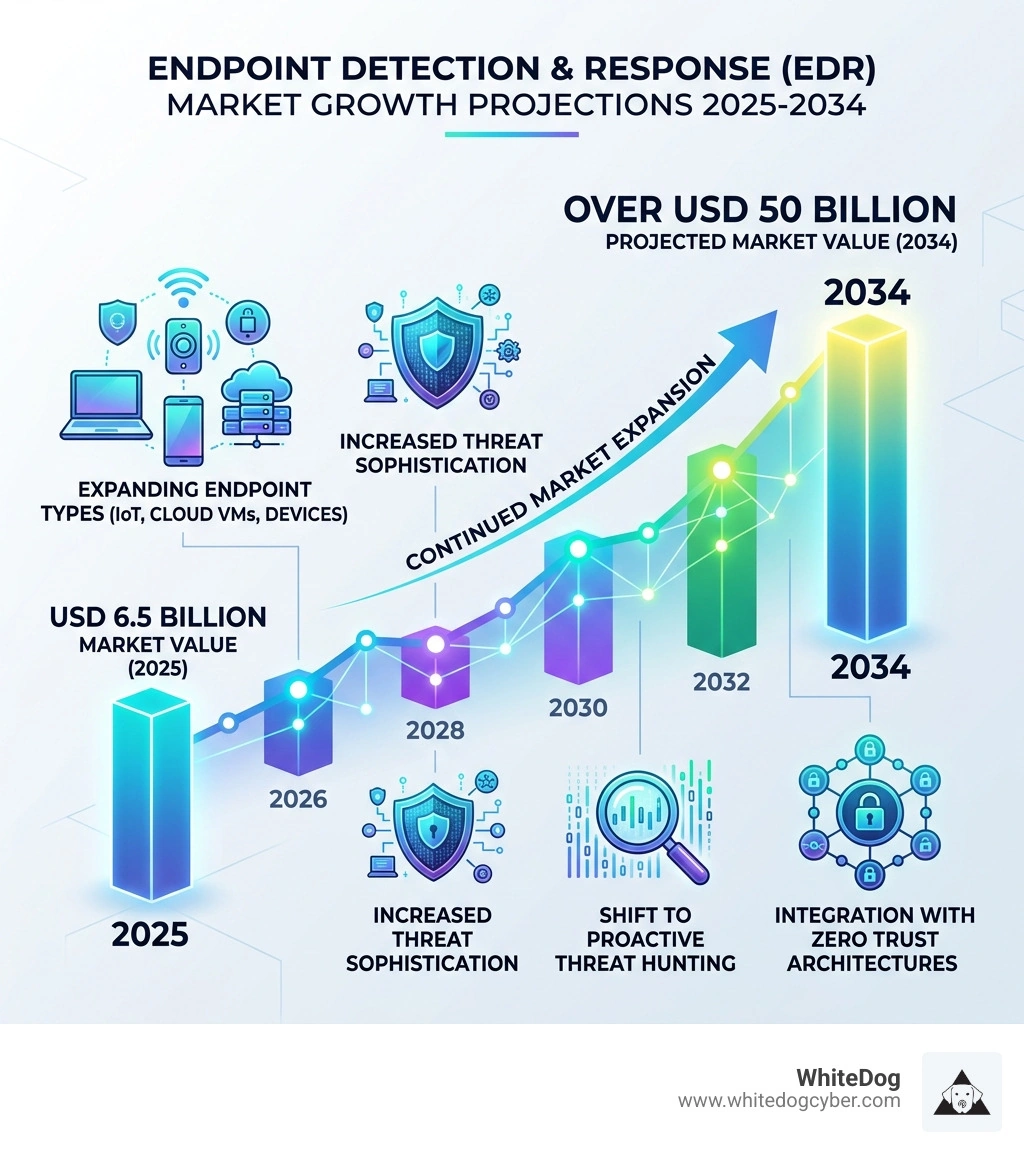
As of May 2026, the EDR market is exploding. While it was valued at approximately USD 6.5 billion in 2025, it is projected to skyrocket to over USD 50 billion by 2034. Why? Because the "endpoint" is expanding. It’s no longer just laptops; it’s IoT sensors, smart medical devices, and virtual machines in the cloud.
The future of the edr solution meaning lies in automated remediation and Zero Trust integration. We are moving toward a world where the EDR doesn't just "alert" us to a problem; it "heals" the endpoint by rolling it back to a known good state automatically.
Not exactly. Think of it as an upgrade. While EDR can perform many antivirus functions (like blocking known bad files), its real value is in detecting unknown threats through behavioral analysis. Most modern "Next-Gen Antivirus" (NGAV) products actually combine EPP and EDR into a single agent.
For SMBs, EDR is becoming a "must-have" for insurance and regulatory compliance. Many cyber insurance providers now require EDR as a condition of coverage because it significantly reduces the likelihood of a catastrophic ransomware payout. It provides the "forensic proof" required by auditors to show that you are actively monitoring your data.
EDR provides the granular, "ground-level" data that a SIEM needs to see the full picture. While a SIEM might see that a user logged in at 3 AM, the EDR shows exactly what that user did on their laptop after logging in. Integration with SOAR (Security Orchestration, Automation, and Response) allows for lightning-fast playbooks, such as "If EDR detects ransomware, automatically disable the user's Active Directory account."
Understanding the edr solution meaning is about more than just knowing an acronym—it's about gaining the visibility needed to defend a modern, decentralized workforce. At WhiteDog, we believe that security shouldn't be a collection of disconnected tools that keep you up at night with endless alerts.
We provide a Unified Cybersecurity Platform—a curated, actively managed stack where the best EDR and XDR tools are integrated, correlated, and operated by our 24/7 SOC. Our goal is simple: to reduce your risk, increase your operational efficiency, and ensure that when your endpoints try to tell you something, you have the team and the technology ready to listen and act.
Ready to close the gaps in your defense? Explore our managed security solutions and see how we can transform your endpoint telemetry into true business resilience.


Learn how cloud security protects your data in 2026, covering shared responsibility, zero trust, and posture management to prevent breaches.

Verify AWS KMS FIPS compliance with this step-by-step guide covering FIPS 140-3 HSMs, endpoints, and auditing for regulatory alignment.

Navigate security compliance requirements across ISO 27001, SOC 2, and GDPR with a strategic blueprint for sustainable compliance management.

Learn how AI phishing detection stops next-gen attacks that bypass traditional defenses, with practical capabilities to evaluate.

Evaluate your cloud security audit options with this actionable checklist covering multi-cloud frameworks, CSPM, DSPM, and AI-driven automation.

Learn the five pillars of MSP risk reduction to secure operations, manage vendor risk, and build defensible compliance.