Cybersecurity
September 17, 2026
Verify AWS KMS FIPS compliance with this step-by-step guide covering FIPS 140-3 HSMs, endpoints, and auditing for regulatory alignment.
Email threat detection for MSPs is the practice of identifying, blocking, and remediating malicious emails across multiple client environments — before they cause financial or operational damage.
Here is what MSPs need to know right now:
Every day, roughly 3.4 billion fraudulent emails hit inboxes worldwide. For an MSP managing dozens or hundreds of SMB clients, that is not an abstract statistic — it is a daily operational reality. A single successful phishing attack on one client can trigger a ransomware outbreak, a business email compromise, or an account takeover that quietly spreads before anyone notices. The average recovery cost from a ransomware attack reached $2.73 million in 2023, not counting the ransom itself. And because human error still accounts for 68% of data breaches, no amount of user training alone closes the gap.
The threat landscape has shifted. Attackers now use generative AI to craft highly personalized, grammatically perfect phishing emails at scale. They hijack legitimate email threads — a tactic known as zombie phishing or conversation hijacking — so that malicious messages arrive from trusted contacts inside ongoing conversations. Traditional filters were not built for this. Neither were the native security tools bundled into Microsoft 365.
For MSPs, the stakes are uniquely high. You are not just protecting one organization. You are the shared gateway to every client you serve.
I'm Shahin Pirooz, a senior cybersecurity and technology executive with over two decades of experience building managed security and cloud services — and email threat detection for MSPs has been at the core of the security architectures I have designed throughout my career. In this guide, I will walk you through exactly what the modern email threat landscape looks like, where current defenses fall short, and what a purpose-built MSP solution should actually do.
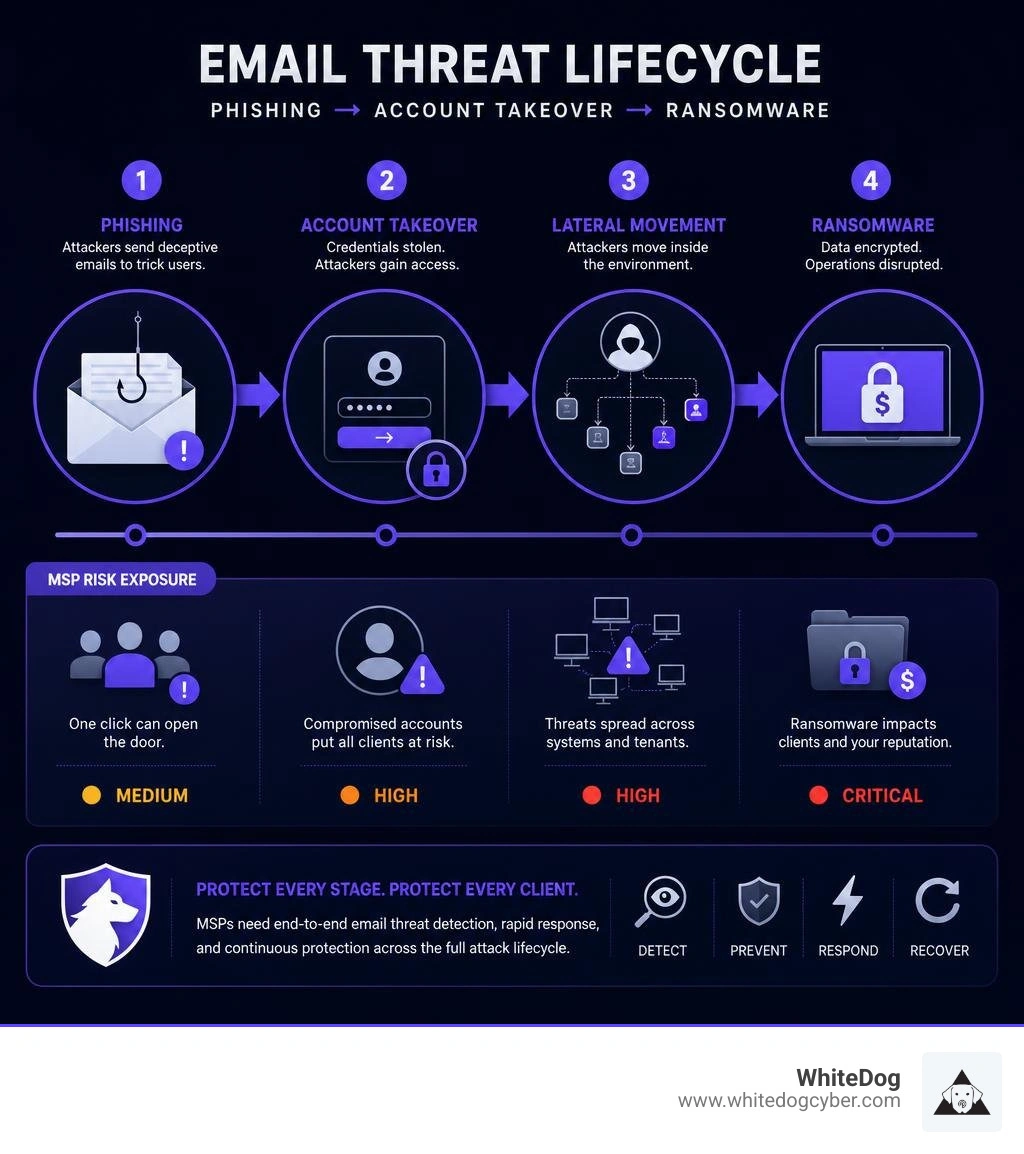

In cybersecurity, we often talk about the "perimeter." But in a cloud-first, hybrid world, the perimeter isn't a firewall at the office door; it's the corporate inbox.
With 90% of cyber attacks starting with email and 94% of malware delivered via this same channel, the inbox is where the battle is won or lost. For MSPs, managing this risk is complicated by the sheer diversity of your client base. You are securing accountants, medical offices, manufacturing firms, and retail brands. Each has different levels of security awareness, yet they all face the same highly coordinated, industrial-scale threat operations.
The reality is that traditional email security mechanisms are structurally unequipped for today's threats. To understand why, we have to look at how email threats have evolved from basic spam into highly complex, multi-stage campaigns. For a deeper look into this structural shift, read our analysis on Why Email Security is Falling Behind.
Phishing has evolved far beyond the classic "Nigerian Prince" emails of the early 2000s. Today's campaigns are highly targeted, socially engineered, and often completely devoid of malicious links or file payloads.
Business Email Compromise (BEC) is the perfect example. In a BEC attack, an adversary impersonates a high-value individual-such as a CEO, CFO, or trusted external vendor-to manipulate employees into executing unauthorized wire transfers, changing vendor payment details, or exposing sensitive credentials. Because these emails are purely text-based and rely entirely on human manipulation and trust, traditional signature-based spam filters let them pass right through.
The financial damage is staggering:
Relying solely on employee training is a losing strategy when attacks are this convincing. While educating users is important, we must move Beyond Phishing Simulations: Real Protection for Email Attacks to stop these threats programmatically.
Email remains the primary delivery vehicle for ransomware, with 40% of businesses reporting an average ransomware payout of $1.2 million per year. When you factor in downtime, legal fees, and reputational damage, the average cost to recover from a ransomware attack was $2.73 million in 2023 (excluding ransoms paid).
These devastating attacks often begin with Account Takeover (ATO). Once an attacker harvests an employee's credentials through a targeted phishing page, they log in as a legitimate user. From there, they don't immediately launch an attack. Instead, they "lurk" inside the mailbox, analyzing historical communication patterns, setting up silent forwarding rules, and inserting themselves into active financial discussions.
This brings us to zombie phishing (or conversation hijacking). An attacker takes over a legitimate internal account and replies to an existing, trusted email thread with a malicious payload or link. Because the recipient is already in a trusted conversation with their colleague, their guard is down. They click, and the ransomware is deployed.
To combat these multi-stage attacks, MSPs need a layered technical defense that can monitor internal email traffic, spot anomalous behavior, and intervene in real time. Learn how we handle these advanced scenarios with our Advanced Threat Protection | Combat Cyberattacks solutions.

Almost every SMB client your MSP manages is hosted on Microsoft 365 or Google Workspace. It is tempting for clients—and sometimes even MSPs—to assume that the built-in, native security features of these platforms are sufficient. After all, Microsoft is a multi-billion-dollar security company.
However, native security features are designed as broad, baseline protections. They are highly effective at blocking known, high-volume spam and signature-matched malware, but they struggle against sophisticated, AI-driven, and highly localized attacks. Furthermore, because Microsoft 365 is the most widely used business platform on earth, attackers can simply buy a tenant, test their malicious emails against Microsoft's filters until they pass undetected, and then launch their campaign.
Another emerging threat vector within these environments is the rise of unauthorized AI integrations. For an in-depth look at this risk, see our guide on Shadow AI Agents in Microsoft 365: An IT Blind Spot.
One of the greatest liabilities of native and legacy email security systems is the speed of analysis. Traditional Secure Email Gateways (SEGs) route emails through a sandbox to detonate and analyze suspicious attachments. This process can take anywhere from 5 to 20 minutes per email.
In a business environment, delaying email delivery by 15 minutes is unacceptable to users. To keep mail flowing, traditional filters often make compromises, allowing emails to land in the inbox while the scan completes in the background. This creates a dangerous "dwell time" window where a user can click a malicious link before the system realizes it's threat-laden.
Modern attackers exploit this speed gap. They use techniques like "stalling mechanisms" in their code to delay sandbox execution, or they employ "time-of-click" URL redirection, where a link is completely clean when the email is scanned but redirects to a credential harvesting site the moment the user clicks it.
We must accept a fundamental truth: Attackers Will Get In. Speed is Your Defense. True security requires real-time, CPU-level analysis that inspects threats at the exploit stage in under 30 seconds, combined with immediate post-delivery remediation.
Traditional email security relies on static signatures, blacklists, and reputation scores. If an email originates from a newly registered domain, has no historical reputation, or contains zero-day malware with no known signature, static filters fail.
Today's cybercriminals use generative AI to write perfectly tailored, contextually relevant emails that bypass natural language processing (NLP) models designed for basic keyword spotting. Furthermore, because these attacks often come from compromised legitimate accounts (such as a compromised vendor's Microsoft 365 tenant), the sender's IP, SPF, DKIM, and DMARC records are perfectly valid.
To the native Microsoft 365 filter, the email looks 100% authentic. Without behavioral AI that understands the relationship and typical communication patterns between the sender and recipient, detecting these anomalies is impossible. We dive deep into how to separate marketing hype from operational reality in our article, AI in the SOC: What's Real, What's Hype, and What's Next.
To protect your clients effectively without drowning your technicians in tickets, your email threat detection MSP solution must combine advanced detection capabilities with streamlined MSP operations.
| Feature / Capability | Legacy Secure Email Gateway (SEG) | Integrated Cloud Email Security (ICES) |
|---|---|---|
| MX Record Changes | Required (disrupts mail flow, reveals security stack) | None (deploys in minutes via API) |
| Internal Email Scanning | None (only inspects inbound/outbound) | 100% scanning of internal, inbound, and outbound |
| Deployment Time | Hours to days per tenant | Under 5 minutes via cloud API |
| Spear Phishing & BEC | Weak (relies on signatures/IP reputation) | Strong (uses behavioral AI & NLP) |
| Post-Delivery Remediation | Manual or complex scripting | Automated, instant retraction across all tenants |
| User Experience | External quarantine portals, delivery delays | Native inbox experience, zero delivery lag |
For years, the standard deployment model for email security was the Secure Email Gateway (SEG). This required changing the client's MX records to route all inbound mail through the gateway before delivering it to Microsoft 365 or Google Workspace.
While SEGs served their purpose in the on-premises Exchange era, they are highly problematic for modern MSPs:
In contrast, Integrated Cloud Email Security (ICES) solutions deploy via native APIs. There are no MX records to change. The solution connects directly to the Microsoft 365 or Google Workspace tenant in minutes, allowing you to onboard new clients with zero downtime. Because it integrates directly into the cloud environment, it scans inbound, outbound, and internal emails simultaneously, providing comprehensive visibility.
An enterprise-grade solution must utilize Adaptive AI that combines Natural Language Processing (NLP), image recognition (to catch credential harvesting pages disguised as screenshots), and relationship mapping. By analyzing historical email metadata, the system learns what "normal" looks like for each user, allowing it to spot subtle anomalies in sender behavior, writing style, and login locations.
But detection is only half the battle. What happens when a sophisticated threat slips through?
This is where automated post-delivery remediation becomes critical. If a malicious email lands in an inbox, the system must have the capability to automatically claw it back. More importantly, if that same email was sent to multiple users across different tenants, a centralized system should automatically identify and retract that threat from every affected inbox instantly.
To explore how tailored email security partnerships can transform your managed service offering, check out the insights on Email Security for MSPs: Why Specialization Matters.
As an MSP, your most valuable — and expensive — resource is your technicians' time. If your security stack requires your team to log into twenty different consoles, manually review hundreds of false positives, and write custom PowerShell scripts to delete phishing emails from client inboxes, your business cannot scale.
To build a profitable managed security service, you must operationalize your email threat detection.
A true MSP-focused email security solution must offer a centralized, multi-tenant management console. From a single pane of glass, your team should be able to:
At WhiteDog, we go a step further. We believe that tools alone do not solve the operational challenge. MSPs do not need another dashboard to stare at; they need answers. That is why WhiteDog operates as a Unified Cybersecurity Platform that pairs a curated, actively managed security stack with our 24/7 Security Operations Center (SOC).
Our platform collects raw telemetry from your clients' email, endpoint, and cloud environments. It filters, deduplicates, and correlates this data, normalizing it to specific assets and enriching it with threat intelligence. Instead of sending your team a flood of disjointed alerts, our 24/7 SOC continuously investigates, triages, and responds to threats. Incident response is fully included in our MDR, XDR, and DDR offerings, eliminating the need for complex incident response retainers.
If a malicious email slips through, our SOC acts immediately — validating the threat, retracting the email, disabling compromised accounts, and documenting the entire incident. We turn tool sprawl into a single, correlated security timeline, significantly reducing your team's operational overhead and dwell time. Learn how we deliver this operational peace of mind by exploring our Explore WhiteDog Solutions page.
While advanced technology and SOC operations do the heavy lifting, establishing strong baseline security policies for your clients is essential. We recommend implementing the following best practices across your entire client base:
Implementing these best practices ensures that your clients have a strong foundational defense, allowing your advanced threat detection tools and SOC operations to focus on neutralizing sophisticated, targeted attacks.
SMBs are highly attractive targets for cybercriminals because they possess valuable financial assets and intellectual property but often lack the specialized internal security resources to defend them. Because 90% of attacks start via email, a successful compromise can quickly escalate into a business-ending ransomware event.
Furthermore, MSPs face cascading risk: if an attacker compromises one of your client environments, they can use that trusted access to launch targeted attacks against your other clients or your own MSP infrastructure. A specialized, managed email security solution provides enterprise-grade protection tailored to SMB budgets and operational constraints.
Traditional email security alerts your team after a threat is detected, leaving your technicians to manually log into the client's tenant, find the malicious email, and delete it. If a phishing campaign hits fifty users across five different clients, this manual process can take hours.
Post-delivery remediation automates this entire workflow. The moment a threat is identified, the system automatically claws back and quarantines the email from all affected inboxes across all managed tenants in seconds. This prevents users from clicking the link, eliminates support tickets, and frees your team to focus on strategic initiatives.
Secure Email Gateways (SEGs) act as an external mail filter, requiring you to reroute your client's mail flow by changing their MX records. This can cause delivery delays, is blind to internal-to-internal email threats, and is easily bypassed by modern, text-based BEC attacks.
Integrated Cloud Email Security (ICES) solutions connect directly to the email provider (like Microsoft 365) via secure APIs. This allows for zero-touch onboarding with no MX record changes, provides 100% visibility into internal email traffic, and leverages advanced AI to analyze the behavior and context of every message in real time.
Email remains the most heavily targeted, rapidly evolving attack vector facing your clients. As cybercriminals leverage generative AI to craft sophisticated phishing, BEC, and conversation hijacking campaigns, relying on native cloud filters or legacy gateways is no longer an option.
For growing MSPs, the challenge is not just finding a tool that can detect these threats—it is finding the operational capacity to manage those tools, investigate alerts, and respond to incidents 24/7 without burning out your staff.
At WhiteDog, we solve this equation. We provide a co-managed, white-label cybersecurity platform with integrated, best-in-class tools operated by our 24/7 SOC. Rather than suggesting a disruptive "rip and replace" approach, we emphasize modular integration that seamlessly layers into your existing environment. Through our top-tier Delta Detection & Response (DDR) offering, we collect raw email and endpoint telemetry, correlate it into a single security timeline, and handle the entire detection, triage, and incident response process for you—with incident response fully included in our MDR, XDR, and DDR services. All of this comes with a 30-day onboarding guarantee and no hidden fees.
By partnering with us, you dramatically reduce your clients' risk and dwell time while maximizing your team's operational efficiency and profitability.
Ready to scale your security services and protect your clients' inboxes with confidence? Explore WhiteDog Solutions today.


Verify AWS KMS FIPS compliance with this step-by-step guide covering FIPS 140-3 HSMs, endpoints, and auditing for regulatory alignment.

Navigate security compliance requirements across ISO 27001, SOC 2, and GDPR with a strategic blueprint for sustainable compliance management.

Learn how AI phishing detection stops next-gen attacks that bypass traditional defenses, with practical capabilities to evaluate.

Evaluate your cloud security audit options with this actionable checklist covering multi-cloud frameworks, CSPM, DSPM, and AI-driven automation.

Learn the five pillars of MSP risk reduction to secure operations, manage vendor risk, and build defensible compliance.

Learn how AI based malware detection stops polymorphic threats and zero-day attacks using deep learning, behavioral analysis, and multi-modal pipelines.