Cybersecurity
April 30, 2026
Discover why Cincinnati businesses swap DIY IT for cincinnati managed security services. Boost protection, cut costs, ensure compliance.
Enterprise risk reduction works when leaders treat risk as part of strategy, not as a separate compliance task. Start by identifying risks across the business, assigning accountable owners, scoring likelihood and impact, choosing a response, and reviewing results as conditions change.
A practical enterprise-wide approach should:
Enterprise risk management (ERM) goes beyond traditional, siloed risk management. It helps leadership see how one event, such as a cyber incident, supplier failure, regulatory shift, or AI governance gap, can affect revenue, operations, reputation, and growth at the same time.
This matters in 2026. Cybersecurity investment is a top-three strategic priority for 60% of business and technology leaders, while AI governance and third-party risk are rising priorities. An effective ERM program gives leaders a consistent way to make trade-offs, fund the most valuable controls, and find opportunities worth pursuing within acceptable risk limits.
For security leaders, cyber risk must feed the enterprise risk register rather than sit in a separate dashboard. WhiteDog's Open XDR can provide unified visibility and detection across Microsoft and third-party environments, while MDR, XDR, and Delta Detection & Response (DDR) add fully managed 24/7 SOC capabilities with incident response included. These services build on correlated intelligence, continuous attack surface management, and 24/7 security operations to identify threats earlier and support confident response. They complement, rather than replace, existing Microsoft Security and Microsoft 365 investments.
I am Shahin Pirooz, a cybersecurity and technology executive with more than two decades of experience in cloud, managed services, and security leadership. My work in enterprise risk reduction focuses on helping organizations connect security operations, technology decisions, and business resilience without adding unnecessary operational complexity.
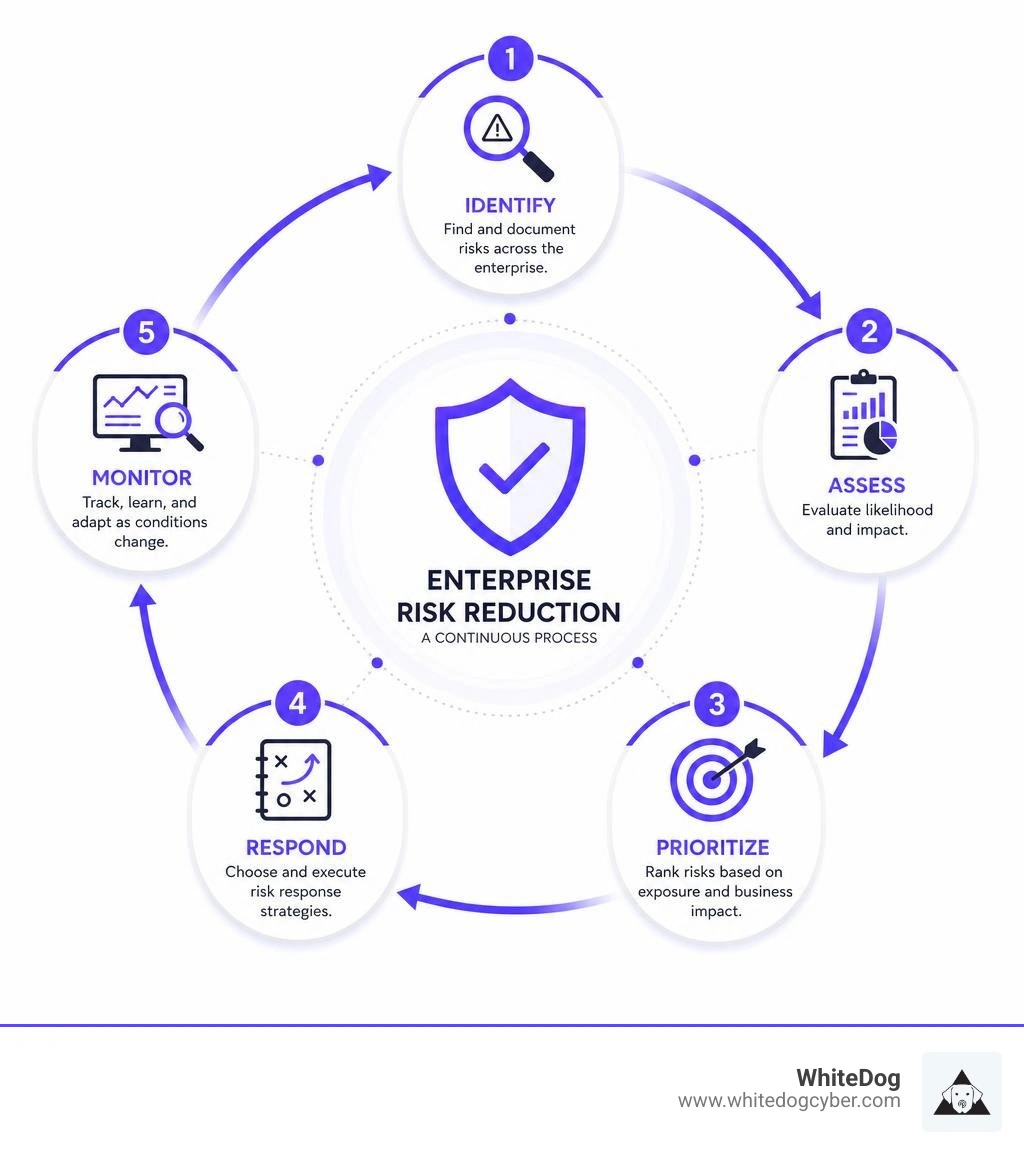
Important enterprise risk reduction terms:
Traditional risk management operates in departmental silos. The finance team monitors liquidity, legal manages contractual exposure, operations mitigates supply bottlenecks, and IT defends against technical failures. Each team works with its own definitions, tools, and reporting formats. This fractured approach creates critical blind spots.
Enterprise risk management treats uncertainty as an interconnected ecosystem. Rather than viewing risk merely as a negative event to avoid, ERM evaluates both downside risks and upside strategic opportunities.
| Dimension | Traditional Risk Management (TRM) | Enterprise Risk Management (ERM) |
|---|---|---|
| Scope | Departmental, fragmented, siloed | Enterprise-wide, portfolio view |
| Focus | Loss prevention and compliance | Value preservation and creation |
| Governance | Disconnected unit-level oversight | Board and executive committee integration |
| Perspective | Reactive, backward-looking | Proactive, forward-looking, continuous |
| Risk Language | Variable across departments | Standardized taxonomy and shared criteria |
| Strategic Alignment | Isolated from corporate planning | Embedded into budgeting, KPIs, and strategy |
A mature program relies on establishing an explicit risk appetite—the aggregate amount and type of risk an organization is willing to pursue or accept in search of its strategic goals. From this baseline, leaders establish risk tolerance, which defines the acceptable operational variance around specific performance metrics.
Risk governance functions effectively only when executive boards and senior leaders possess clear visibility into the organization's risk profile. When ERM is decoupled from strategic planning, organizations waste capital protecting non-critical assets while leaving key revenue drivers exposed.
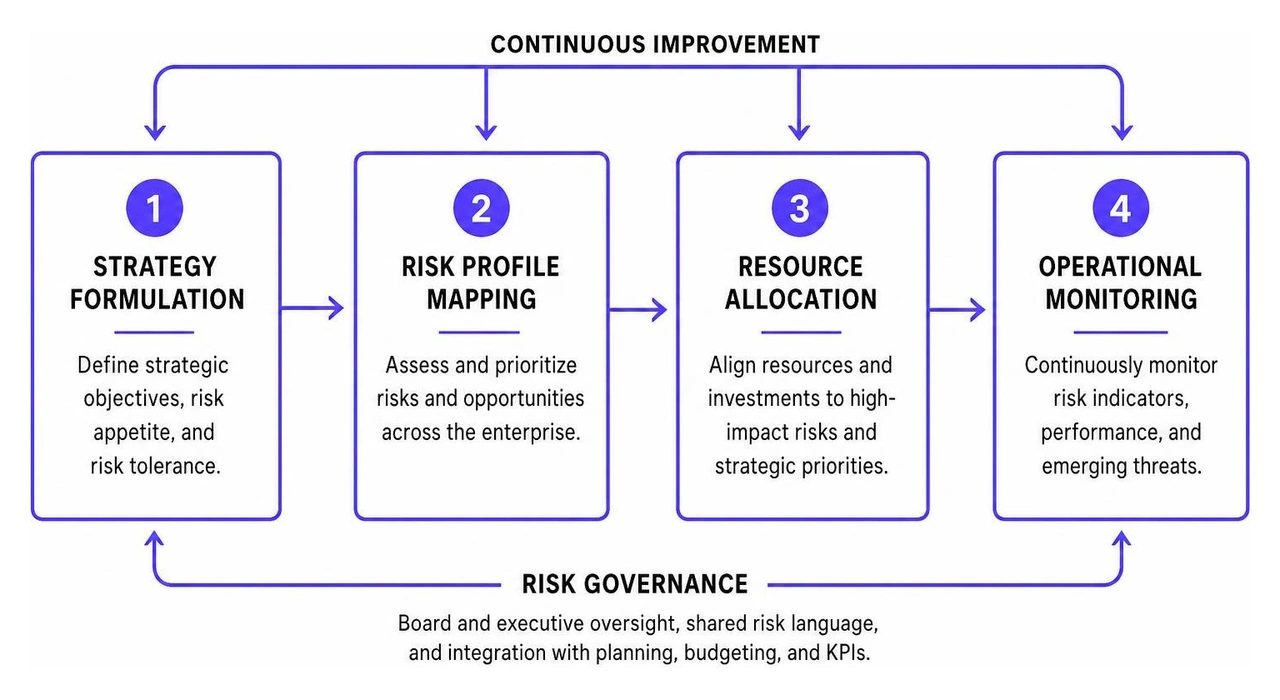
A comprehensive academic study on embedded risk management highlights that incorporating risk assumptions directly into corporate planning creates a decision-oriented risk-value contribution. When risk metrics inform capital expenditure and operational budgets, organizations can deploy resources toward high-impact mitigations while trimming expenditure on low-probability, low-impact threats.
Organizations select from four primary risk response strategies based on their defined risk appetite and operational goals:
Leaders evaluate these responses using three uncertainty lenses: downside protection (preventing severe losses), upside exploration (taking calculated risks to capture market share), and agility (maintaining operational flexibility to pivot when macro conditions change).
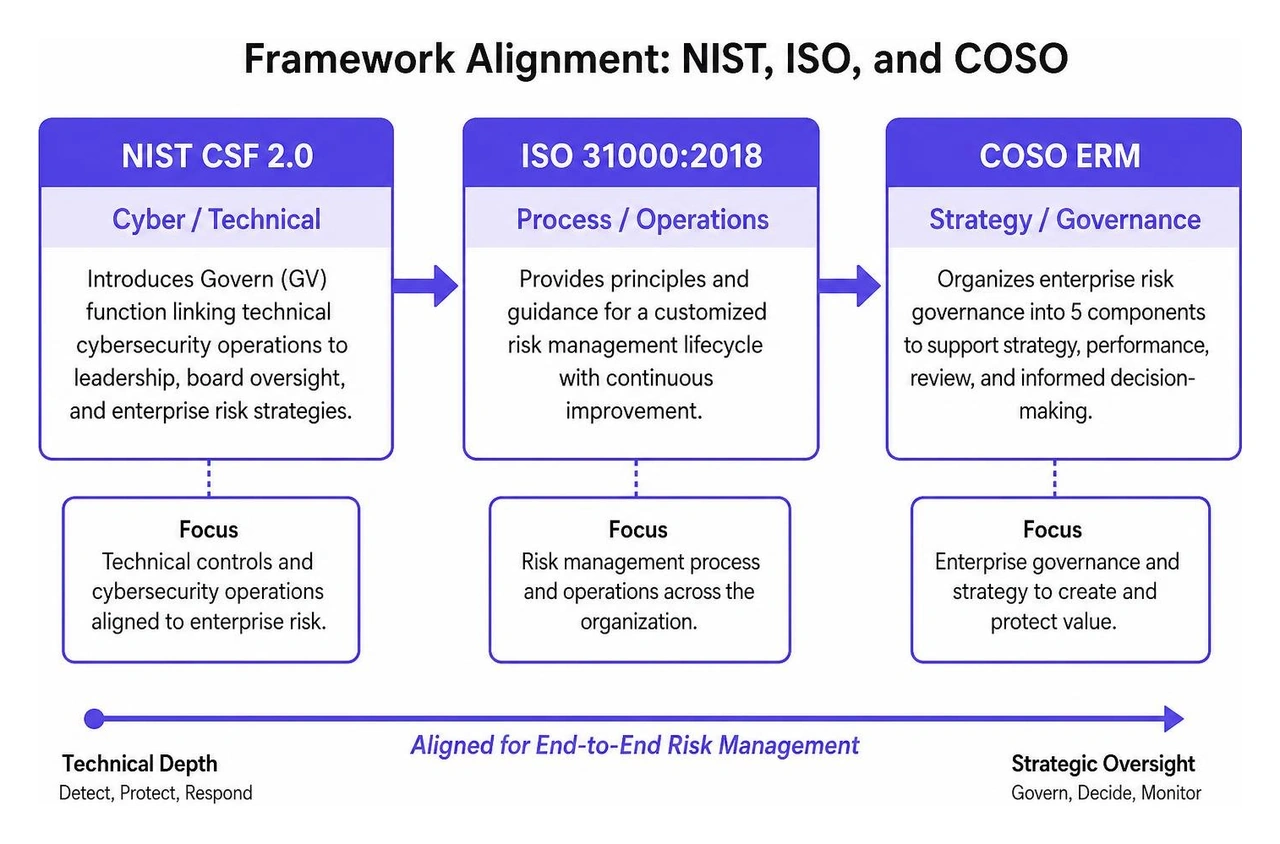
A standardized framework provides the structure, common taxonomy, and assessment cadences required for comprehensive enterprise risk reduction. Integrating Cybersecurity and ERM Guidance from federal and industry bodies ensures operational controls align directly with enterprise-level governance.
Rather than adopting a single standard in isolation, organizations frequently blend leading frameworks:
Modern frameworks increasingly rely on quantitative modeling, such as Monte Carlo simulations, to run thousands of potential loss scenarios. This aggregation translates qualitative risk assessments (High, Medium, Low) into probabilistic financial exposures that executive teams can evaluate during budget planning.
A modern risk architecture centers on a dynamic Enterprise Risk Register (ERR) supported by specialized sub-registers, such as a Cybersecurity Risk Register (CSRR).
Effective architectures incorporate:
For service providers and partner ecosystems, adopting structured evaluation models outlined in the MSP Risk Reduction Guide 2026 helps maintain risk visibility across shared operational boundaries.
Modern risk managers navigate a "polycrisis" environment—a reality where geopolitical volatility, macroeconomic swings, accelerated cyber attacks, and regulatory mandates converge simultaneously.
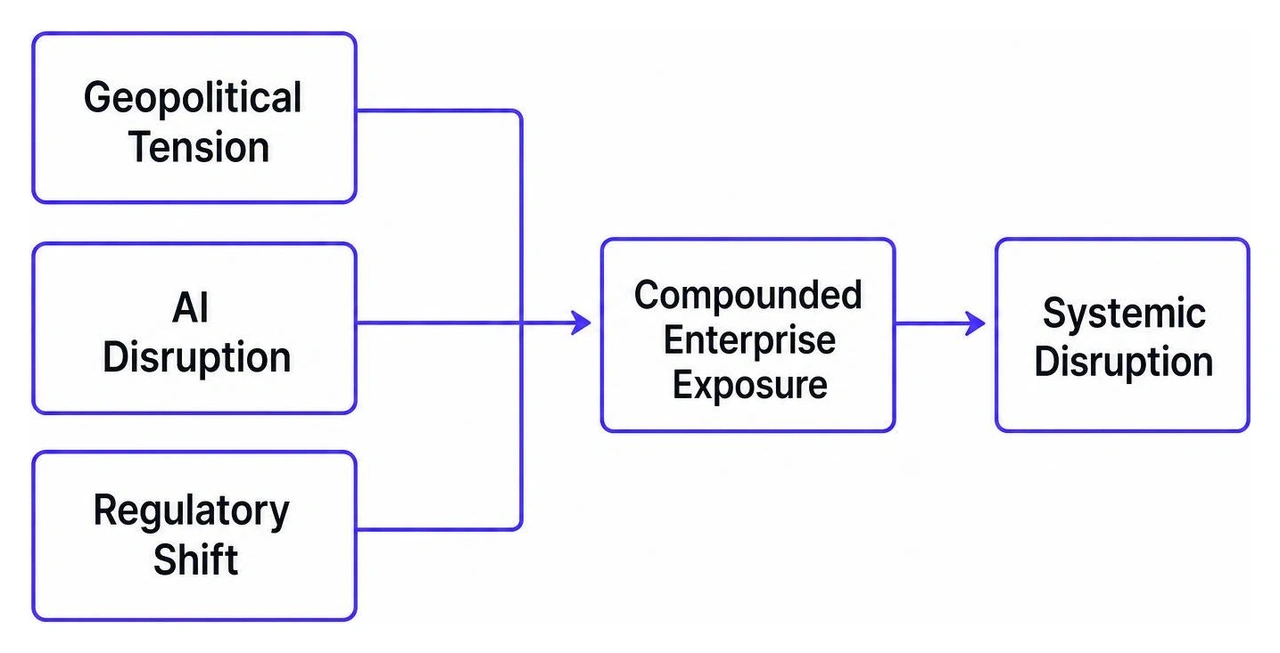
Cybersecurity risk can no longer be treated as an isolated IT problem. Attackers actively exploit interconnected supply chains, identity infrastructure, and unmanaged external surfaces. Understanding the stages of compromise—as detailed in our analysis of the Anatomy of a Cyber Attack: Why Layered Protection Matters—helps security teams implement defenses that disrupt adversary progression before material damage occurs.
To maintain continuous threat exposure management, organizations require holistic visibility across endpoints, networks, identities, and cloud assets. Modern visibility frameworks, such as Security Without Limits: Open XDR That Works for You, allow enterprises to aggregate telemetry through modular integration across disparate environments to maximize existing defensive tools.
Artificial intelligence introduces operational opportunities alongside novel attack surfaces, data privacy liabilities, and model integrity challenges. According to PwC's 2026 executive findings, 37% of leaders now rank AI governance and third-party risk as top operational priorities.
Key regulatory considerations include:
Securing autonomous enterprise workloads requires structured validation frameworks. Security teams can review A Simple Checklist for Securing AI Agents to evaluate operational models, while monitoring threat developments outlined in AI and Polymorphic Attacks: A Growing Cybersecurity Threat to safeguard critical infrastructure.
Enterprise risk reduction requires measurable, continuous validation rather than static annual assessments.
Organizations balance operational metrics with predictive indicators to track resilience trends over time:
Implementing continuous telemetry and progressive security postures—as outlined in The Cyber Resilience Playbook: Achieving Evergreen Protection—ensures that KRI thresholds trigger real-time mitigations before an exposure manifests as a business interruption.
While baseline enterprise assessments occur annually, dynamic risk environments demand clearly defined triggers for off-cycle evaluations:
When an unexpected incident does occur, structured incident workflows detailed in our Cybersecurity Incident Response Guide 2026 ensure teams contain damage swiftly. Regular defensive validation through active testing—supported by our Penetration Testing Complete Guide 2026—validates that existing controls function as intended against real-world adversarial tactics.
Traditional risk management manages threats within separate operational silos, treating risk as a localized compliance or loss-prevention issue. Enterprise risk management uses an integrated, top-down approach that aligns all risk categories across the organization with overarching strategic goals, treating risk as both an exposure to mitigate and an opportunity to optimize.
Off-cycle reviews are typically triggered by major organizational or environmental changes, including material security breaches, critical third-party failures, significant regulatory changes, major acquisitions or divestitures, or rapid rollouts of disruptive technologies like enterprise AI.
Organizations establish clear risk tolerance boundaries that define acceptable operational variance. By deploying continuous risk sensing and monitoring leading indicators, leadership teams can explore innovative opportunities—such as deploying new software platforms or entering new markets—with confidence that risks exceeding defined limits will be identified and mitigated promptly.
Enterprise risk reduction requires a shift from static, reactive checklists to a continuous culture of operational resilience. By integrating risk management directly into corporate strategy, establishing clear appetite boundaries, and adopting unified frameworks, organizations can turn risk visibility into a distinct competitive advantage.
At WhiteDog Cyber, we help organizations simplify cybersecurity operations through a unified platform that connects visibility, detection, response, and risk management. We offer distinct capability tiers to match organizational needs: our Open XDR framework provides unified visibility and detection across Microsoft and third-party tools, while our MDR, XDR, and top-tier Delta Detection & Response (DDR) solutions deliver fully managed 24/7 SOC capabilities with incident response included.
Our continuous attack surface management and 24/7 security operations build on correlated intelligence to help security teams identify threats earlier and respond with confidence. Rather than replacing your existing technology, WhiteDog complements and extends Microsoft environments to maximize your Microsoft Security and Microsoft 365 investments.
Explore our enterprise cybersecurity solutions to build a proactive risk posture and strengthen your operational resilience.


Discover why Cincinnati businesses swap DIY IT for cincinnati managed security services. Boost protection, cut costs, ensure compliance.

Inside this little corner of the molt‑i‑verse, the agents have started… improvising