Cybersecurity
July 16, 2026
Explore types of online threat in this guide covering malware, phishing, network attacks, and strategies to strengthen enterprise cyber resilience.
Internet of Things DDoS attacks have become one of the most urgent security challenges for any organization running connected devices. Here is a quick summary of what you need to know:
The scale of the threat is staggering. Back in 2016, the Mirai botnet took down a major security blog with over 620 Gbps of traffic — and that was considered record-breaking at the time. A decade later, attacks have grown more than 40 times larger. Today, poorly secured smart devices are not just a convenience risk — they are a liability that can be weaponized against your clients, your infrastructure, and the broader internet.
I'm Shahin Pirooz, WhiteDog Cyber's technology executive, and I've spent over two decades building managed security and cloud services at the intersection of where internet of things DDoS threats and enterprise infrastructure collide. In this guide, I'll walk you through how these attacks work, what the research says about detecting them, and what a modern defense actually looks like.
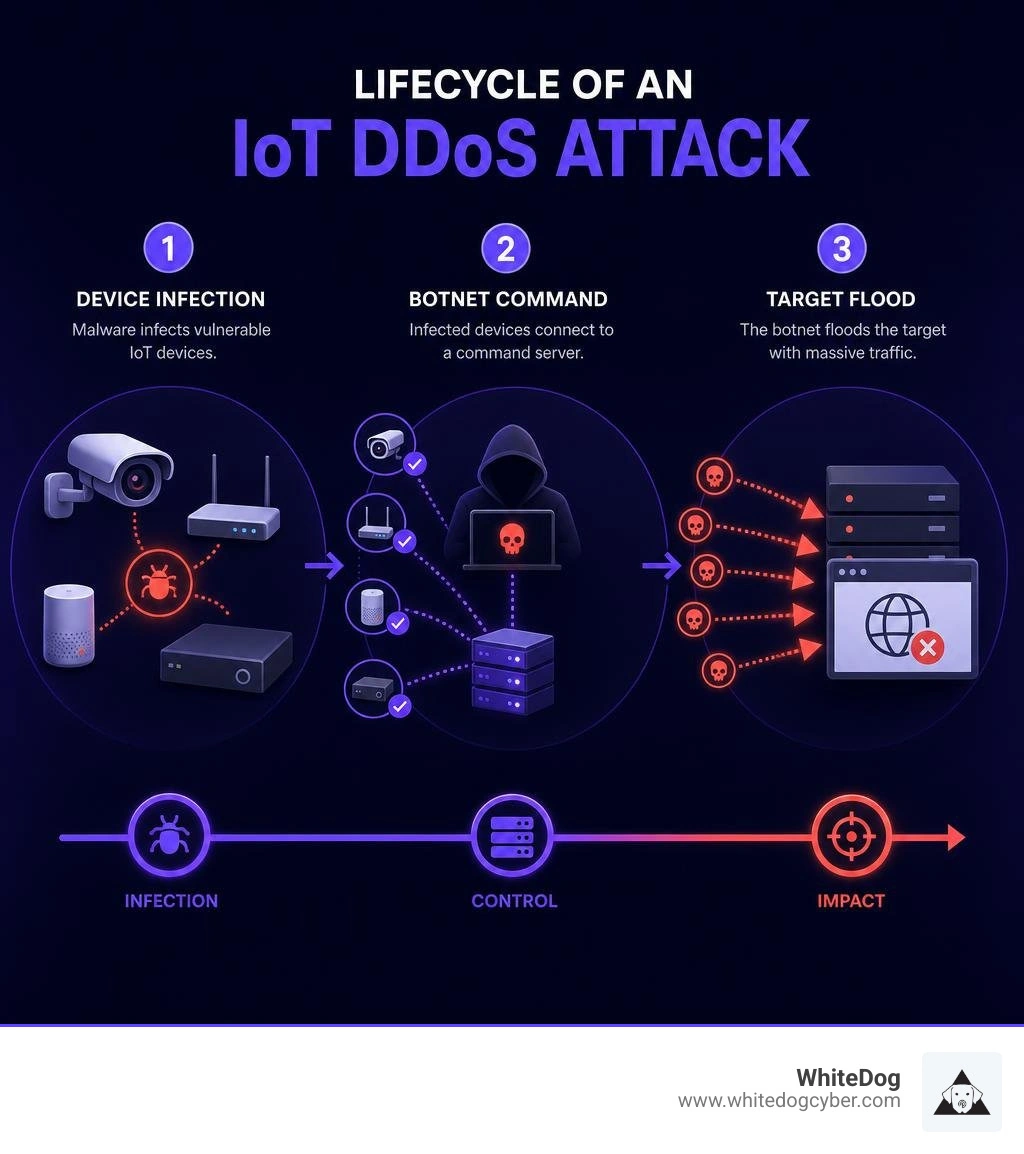
Simple guide to internet of things ddos terms:

To understand how to protect your enterprise network, we first need to define the threat. A Distributed Denial-of-Service (DDoS) attack is a malicious attempt to disrupt the normal traffic of a targeted server, service, or network. It accomplishes this by overwhelming the target—or its surrounding infrastructure—with a massive flood of internet traffic.
When we look at an internet of things DDoS attack, the mechanics are uniquely dangerous. Instead of relying only on compromised traditional computers, attackers hijack thousands or even millions of smart, connected devices. Think of digital video recorders (DVRs), smart IP cameras, and office Wi-Fi routers. These devices are continuously connected to high-speed internet, making them the perfect engines for generating massive, distributed traffic spikes.
This vulnerability stems from a fundamental design truth: The Internet Was Never Meant to Be Secure. Early protocols prioritized open connectivity and ease of communication over robust verification. When billions of low-cost, low-resource smart devices were introduced to this open architecture, security was often treated as an afterthought.
Why do cybercriminals target smart lightbulbs and network routers instead of corporate laptops? The answer lies in three critical vulnerabilities that define the types of online threat we face today:
When an attacker decides to leverage an IoT botnet, they typically execute one of three types of attacks, targeting different layers of the network protocol stack:
To understand why traditional, single-point defenses fail against these multi-layered exploits, we must look at how attacks unfold step-by-step. Our guide on Anatomy of a Cyber Attack: Why Layered Protection Matters highlights why relying on a single firewall near the victim is no longer enough to stop modern, distributed threats.

The threat landscape has evolved from simple, centralized scripts to highly complex, decentralized peer-to-peer (P2P) malware architectures. To help security professionals understand this shift, academic surveys like the Systematic Literature Review of IoT Botnet DDOS Attacks and Evaluation of Detection Techniques - PMC track how botnets have adapted over time to resist traditional takedown efforts.
The modern era of IoT botnets began in September 2016 when the Mirai botnet launched a devastating DDoS attack on a prominent security blog, exceeding 620 gigabits per second (Gbps). Shortly after, another Mirai-powered attack targeted French webhost OVH, reaching peak volumes between 1.1 and 1.5 terabits per second (Tbps). The author of Mirai later claimed that over 380,000 IoT devices were enslaved during the initial campaign.
Mirai achieved this scale using a remarkably simple technique: it continuously scanned the internet for open Telnet ports (ports 23 and 2323) and attempted to log in using a dictionary of just 62 common default factory credentials. Around the same time, the Bashlite botnet emerged, eventually enlisting an estimated one million compromised devices.
Fast forward to July 2026, and the scale of these internet security threats has exploded. Modern botnets like Aisuru, KimWolf, JackSkid, and Mossad have collectively infected more than 3 million devices worldwide. Instead of gigabit-scale attacks, these next-generation botnets have launched record-breaking DDoS attacks measuring approximately 30 Terabits per second (Tbps).
The operational frequency of these modern threats is equally staggering:
Early botnets relied on a centralized "star" topology, where infected bots communicated directly with a single Command and Control (C2) server. While simple to build, this structure had a major flaw: if law enforcement seized the C2 server, the entire botnet collapsed.
Modern botnets have adapted. Many now use peer-to-peer (P2P) topologies, where every infected device can act as a C2 server, passing commands down the line. This makes the infrastructure incredibly resilient to traditional domain and server takedowns.
Furthermore, botnets like KimWolf and JackSkid have proven capable of targeting and infecting IoT devices that reside within traditionally "firewalled" corporate networks. They do this by:
As IoT botnets become more complex, traditional rule-based Intrusion Detection Systems (IDS) are struggling to keep up. These older systems rely on static signatures—matching incoming traffic against a database of known threats. When a botnet changes its packet structure or uses a zero-day exploit, signature-based tools fail.
To solve this, security research has shifted toward anomaly-based detection powered by machine learning (ML) and deep learning (DL). By analyzing traffic flows and building a baseline of "normal" behavior, these models can flag suspicious activity even if they have never seen the specific malware strain before.
A landmark study published in MDPI, A Machine-Learning-Based Approach for the Detection and Mitigation of Distributed Denial-of-Service Attacks in Internet of Things Environments, demonstrates how optimized ML models can achieve near-perfect detection rates.
While complex deep learning models work well in cloud environments with virtually unlimited computing power, deploying them directly on IoT gateways or edge routers is a major challenge. These edge devices simply do not have the RAM or CPU capacity to run heavy algorithms.
To deploy ML at the edge, we have to optimize the models using three key techniques:
When designing an enterprise detection system, we must balance accuracy against computational overhead. A model that is 100% accurate but takes 10 seconds to process a packet is useless for real-time mitigation.
Below is a comparison of how different machine learning models perform in IoT/Cloud environments, using standard benchmark datasets like CIC-DDoS2019, N-BaIoT, and WUSTL-IIoT-2021:
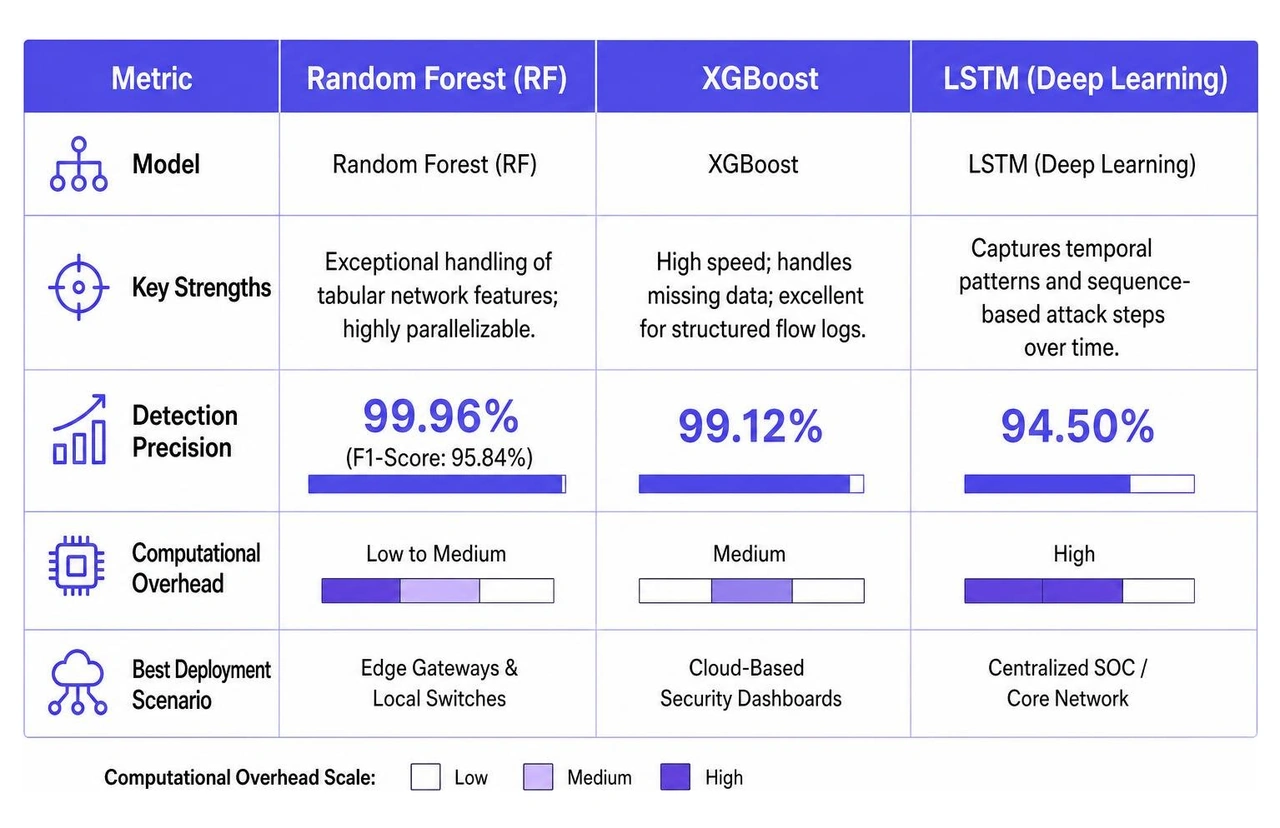
| Machine Learning Model | Key Strengths | Detection Precision | Computational Overhead | Best Deployment Scenario |
|---|---|---|---|---|
| Random Forest (RF) | Exceptional handling of tabular network features; highly parallelizable. | 99.96% (F1-Score: 95.84%) | Low to Medium | Edge Gateways & Local Switches |
| XGBoost | High speed; handles missing data; excellent for structured flow logs. | 99.12% | Medium | Cloud-Based Security Dashboards |
| LSTM (Deep Learning) | Captures temporal patterns and sequence-based attack steps over time. | 94.50% | High | Centralized SOC / Core Network |
| ChebyKANRes (KAN) | Extremely compact parameter size (~123k parameters / 0.47 MB). | 99.83% | Very Low | Resource-Constrained Edge Routers |
As the data shows, simpler ensemble models like Random Forest can actually outperform complex deep learning networks like LSTM in detection precision while requiring a fraction of the computational power. For a deeper look at how these technologies integrate into Software-Defined Networking (SDN) to dynamically adjust routing rules, see the A comprehensive survey on DDoS attacks detection & mitigation in SDN-IoT network - ScienceDirect survey.
Detecting an internet of things DDoS attack is only half the battle; you must also be able to mitigate it before it takes your critical business systems offline. Enterprise mitigation requires a combination of local technical controls and global coordinated action.
To protect your cloud infrastructure and connected devices, we recommend a multi-layered technical defense stack:
Integrating these controls into a unified internet threat protection strategy ensures that if one layer is bypassed, secondary defenses are immediately available to absorb the impact.
While technical defenses protect individual networks, stopping global botnets entirely requires dismantling their digital and physical infrastructure. This is where international law enforcement collaborations play a vital role.
In March 2026, a coordinated operation involving the U.S. Department of Justice (DOJ), the FBI, the Royal Canadian Mounted Police (RCMP), and Europol successfully disrupted the C2 infrastructure of the Aisuru, KimWolf, JackSkid, and Mossad botnets. By seizing physical and virtual servers, taking over malicious domains, and prosecuting the physical operators in Canada and Germany, authorities severed the connection between the administrators and their 3 million enslaved IoT devices.
These botnets frequently operate on a "cybercrime-as-a-service" model, where access to hijacked devices is leased to other criminals for a fee. Dismantling these networks requires a persistent, multi-agency approach. To understand why relying on simple perimeter defenses is no longer enough to protect against these global syndicates, read our breakdown on Why a Layered Defense Is Critical.
As we look toward the future, securing billions of connected devices requires moving away from centralized, reactive security models toward decentralized, proactive intelligence.
Several emerging technologies are shaping the future of IoT security:
IoT devices are highly vulnerable because they are resource-constrained, meaning they often lack the processing power to run traditional endpoint security software. Additionally, many are deployed with unchanged default factory credentials, run unpatched firmware, and lack active traffic monitoring, making them easy targets for automated brute-force scanning.
Machine learning models analyze network traffic flow statistics (such as packet sizes, flow duration, and connection rates) to establish a baseline of normal behavior. By using optimized algorithms like Random Forest or lightweight Chebyshev KANs, these systems can identify anomalous traffic patterns and flag potential DDoS attacks within milliseconds, without needing to match a specific malware signature.
International law enforcement agencies (such as the FBI, DOJ, RCMP, and Europol) collaborate to locate and seize the physical and virtual servers used as Command and Control (C2) infrastructure. By taking over these domains and prosecuting the cybercriminals who run them, authorities can disable the botnets and prevent them from executing coordinated attacks.
Securing your organization against internet of things DDoS threats requires moving past old, SIEM-centric approaches that simply collect mountains of unorganized logs. Tool sprawl often leaves IT teams staring at a chaotic mess of alerts, making it incredibly difficult to spot a coordinated botnet propagation before it's too late.
At WhiteDog Cyber, we approach security differently. We provide a Unified Cybersecurity Platform designed for modular integration with your existing infrastructure, consolidating tool sprawl into a single, correlated security timeline without requiring a disruptive 'rip and replace' of your current investments. Our curated, actively managed security stack collects raw telemetry from across your entire environment, filters out the noise, deduplicates and correlates the data, normalizes it to your actual assets, and enriches it with global threat intelligence.
The result? Prioritized, actionable detections that are investigated, triaged, and responded to 24/7 by our dedicated Security Operations Center (SOC). Whether you choose foundational visibility through Open XDR, fully managed response with MDR, or our top-tier Delta Detection & Response (DDR) offering, comprehensive incident response is fully included in our Open XDR, MDR, and DDR offerings, eliminating the need for separate incident response retainers. We provide complete risk reduction, operational efficiency, and rapid incident containment with no added fees and a 30-day onboarding guarantee.
Don't let your connected devices become a liability. Partner with WhiteDog Cyber today to secure your network with a curated defense stack backed by a 24x7 SOC.


Explore types of online threat in this guide covering malware, phishing, network attacks, and strategies to strengthen enterprise cyber resilience.

Discover how 24/7 threat response services deliver rapid detection, containment, and recovery to reduce risk and strengthen your security posture.

Upgrade your MSP email gateway security in 2026. Ditch legacy failures, embrace AI-driven ICES, Zero Trust, and unified protection against phishing & BEC.

Run better cyber security health checks with MSPs: Boost resilience, cut risks, and ensure compliance via continuous monitoring and NIST-aligned audits.

Discover how cyber security health checks strengthen your defenses, reduce risk, and support compliance across regulated industries and SMEs.

Discover co-managed security for MSP: Share responsibilities, boost efficiency, and scale cybersecurity without losing control.