Cybersecurity
April 30, 2026
Discover why Cincinnati businesses swap DIY IT for cincinnati managed security services. Boost protection, cut costs, ensure compliance.
MSP SOC as a service gives organizations access to a managed security operations team instead of requiring them to staff every monitoring shift in-house. To decide if it fits, compare 24/7 coverage, detection and response duties, integration with your existing tools, and who has authority to act during an incident.
An outsourced SOC can ease staffing pressure and help teams make sense of high alert volumes. An in-house SOC offers more direct control, while a co-managed model shares the work. The right choice depends on your team’s capacity and the level of control you need.
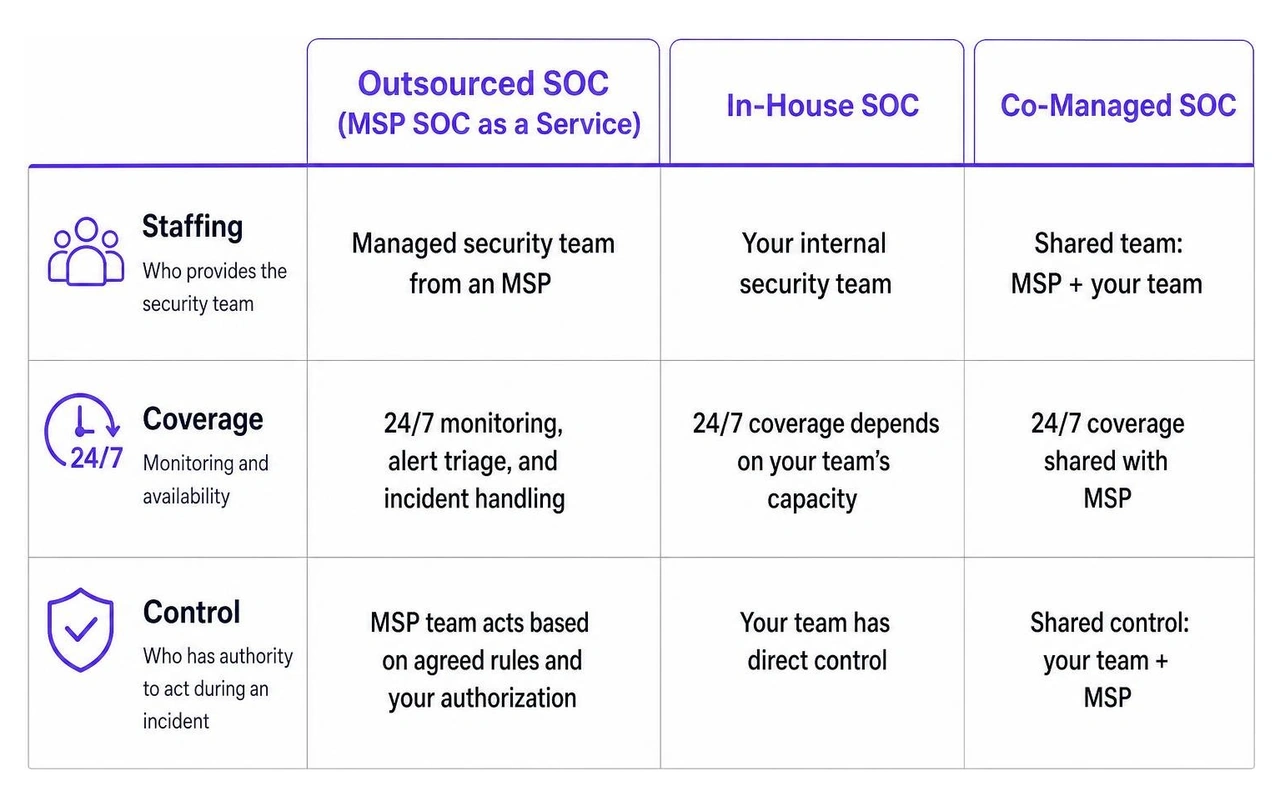
Security Operations Center as a Service (SOCaaS) delivered through a Managed Service Provider (MSP) or Managed Security Service Provider (MSSP) shifts the burden of continuous monitoring, alert triage, and incident handling to an external team of security specialists. Rather than procuring separate analytics platforms, engineering custom detection rules, and hiring dedicated shift analysts, organizations subscribe to shared operational infrastructure and expertise.
Building an internal SOC requires capital expenditure across software, compute, and personnel. In contrast, SOC as a Service converts these fixed overheads into predictable operational expenses.
| Operating Dimension | In-House SOC | Outsourced MSP SOCaaS | Co-Managed SOC |
|---|---|---|---|
| Staffing Requirements | 8–12 full-time employees minimum for true 24/7 coverage | Zero internal headcount additions required | Shared workload; internal leads partner with external analysts |
| Operational Coverage | Often limited to business hours unless heavily funded | Continuous 24/7/365 active monitoring and response | Continuous 24/7 monitoring with tiered escalation |
| Cost Profile | High fixed capital and recurring operational expense | Predictable, subscription-based operational expense | Balanced shared operational cost |
| Direct Control | Total control over engineering, playbooks, and data | Governed by Service Level Agreements (SLAs) and contracts | Collaborative governance and custom playbook execution |
| Scalability | Slow; constrained by recruitment and licensing ramps | Immediate; scales dynamically with asset count | High; flexible workload distribution |
Transitioning from an internal security posture to a managed service alters daily operations. In an internal model, the entire operational lifecycle—from ingesting raw telemetry to executing containment playbooks—rests on in-house staff.
Under an outsourced or co-managed model, security ownership follows a structured shared responsibility framework. The provider's analysts manage continuous alert triage, false-positive reduction, and threat hunting, while escalating validated threats through predefined response paths. Clear service-level agreements (SLAs) govern response windows for critical incidents. Establishing comprehensive 24x7 SOC coverage for MSPs ensures that tier-1 and tier-2 triage occurs immediately, preventing overnight visibility gaps.
The cybersecurity talent shortage remains a persistent operational bottleneck. Operating a resilient 24/7 security center requires multiple shifts of tier-1 triage analysts, tier-2 incident responders, detection engineers, and SOC managers to account for rotation, time off, and turnover.
Industry benchmarks indicate that outsourcing security operations can reduce operational expenses by up to 50% compared to building and maintaining an equivalent in-house facility. Furthermore, over 70% of small and mid-sized organizations leverage external service providers for security operations to bridge internal technical deficits. By aggregating telemetry across diverse customer bases, managed providers achieve economies of scale, enabling them to invest in specialized threat analysts, continuous engineering, and advanced automation platforms that individual organizations cannot cost-effectively replicate.

A modern managed SOC must provide more than passive log archiving or automated alert forwarding. True operational value lies in turning raw telemetry into high-fidelity context that enables decisive action across the entire attack chain.
Key baseline capabilities include:
Effective security operations depend on a unified technology architecture. Typical deployments integrate Security Information and Event Management (SIEM), Endpoint Detection and Response (EDR), and Extended Detection and Response (XDR) capabilities into a centralized telemetry pipeline.

Rather than simply providing software tools, providers deliver comprehensive 24/7 threat response that pairs log normalization and detection engineering with proactive containment. This operational discipline ensures alerts are fully investigated before escalations reach internal IT teams.
Evaluating operational effectiveness requires tracking standard performance metrics:
Deploying a dedicated managed SOC service can reduce MTTD by up to 60% and MTTR by up to 40%. Furthermore, organizations maintaining mature operational oversight experience 30% fewer successful security breaches. From a financial perspective, research indicates the average data breach cost drops from $4.45 million for organizations without structured SOC oversight to $3.15 million for those backed by active detection and response operations.
Selecting an operational partner requires examining architectural depth, analyst competency, and contractual clarity rather than relying on high-level feature checklists.
Use this operational scorecard when vetting prospective providers:
Pricing structures for managed SOC services generally fall into four commercial models:
Aligning security operations with regulatory frameworks is critical. A qualified provider must supply structured audit trails, log retention policies, and continuous mapping against standards such as NIST Cybersecurity Framework 2.0, HIPAA, PCI DSS, SOC 2, and CMMC. Audit evidence should be accessible without complex data extraction requests.
Outsourcing security operations introduces specific risks that IT leaders must address upfront:
Modular integration is essential when partnering with a provider, so established endpoint, firewall, and identity tools can work together rather than in isolation. Modern security teams require flexible architectures that ingest, parse, and normalize data from diverse systems—spanning endpoints, identity directories, cloud infrastructure, email gateways, and DNS layers.

Leveraging Open XDR integration allows organizations to consolidate fragmented security signals while preserving the value of previous technology purchases through modular integration. When combined with a co-managed security framework, internal teams retain administrative control while external analysts handle alert correlation and telemetry analysis across the entire attack surface.
The strategic shift toward managed operations is reflected in broader industry trends. The global managed security services market is expanding rapidly, projected to grow from $43.1 billion in 2023 to $77.5 billion by 2028, reflecting a compound annual growth rate (CAGR) of 12.5%. Additionally, by 2025, 60% of organizations will rely on managed detection and response as their primary operational security model.
Modern security architectures handle massive operational throughput. Advanced SOC environments routinely process more than 10,000 security signals daily, utilizing machine learning and correlation engines to suppress benign noise and achieve false-positive rates below 1%.
Real-world deployments demonstrate the practical impact of this approach. In the BACS partner case study, migrating from disconnected security point products to a unified detection platform backed by 24/7 operational experts eliminated alert silos, shortened response cycles, and delivered comprehensive visibility across multi-tenant environments without requiring additional internal headcount.
Determining whether an outsourced SOC model outpaces an in-house build comes down to operational velocity, economic sustainability, and response confidence. Maintaining continuous 24/7 security oversight internally requires significant recruitment, engineering, and infrastructure overhead. A dedicated managed service provider delivers mature, scalable security operations from day one.
WhiteDog Cyber helps organizations simplify cybersecurity operations through a Unified Cybersecurity Platform that connects visibility, detection, response, and exposure management. Backed by 24x7 security operations and expert analysts, WhiteDog transforms disconnected security signals across email, DNS, identity, endpoint, network, cloud, and data into correlated, actionable intelligence.
Through modular integration, WhiteDog complements and extends current investments—including Microsoft Security and Microsoft 365 environments—to help organizations maximize their existing Microsoft investment. Delta 360 (Δ360), built on WhiteDog’s Open XDR framework, adds a unified operational and security layer across Microsoft and third-party tools to improve correlation, visibility, security hardening, threat detection, exposure management, and response.
Incident response is included in MDR, XDR, and DDR.
WhiteDog structures its capabilities to meet diverse operational needs:
To evaluate your operational readiness and select the right coverage model, explore our complete MSP SOC as a Service guide.
Managed Detection and Response (MDR) is a core component of a broader SOC as a Service offering. While MDR focuses specifically on monitoring endpoints, networks, and cloud telemetry to detect and contain active cyber threats, SOC as a Service encompasses a broader operational scope. A full SOCaaS model typically includes continuous log management, compliance auditing, attack surface exposure management, vulnerability context integration, and comprehensive security infrastructure health monitoring alongside threat response.
Yes, depending on the agreed-upon rules of engagement and service tier. In a fully managed response model, providers can execute pre-authorized containment actions—such as isolating compromised hosts, terminating malicious processes, revoking session tokens, or modifying firewall access rules—within minutes of identifying a confirmed threat. In advisory models, the provider alerts internal teams with step-by-step remediation instructions. Most organizations adopt a hybrid approach: granting automated containment authority for high-confidence threats while requiring manual approval for operational disruptions.
Onboarding timelines depend on environment complexity and architectural flexibility. Deployments leveraging unified Open XDR frameworks and cloud-native API connectors can establish telemetry ingestion, log normalization, and active baseline monitoring within one to two weeks. Complex enterprise environments with legacy infrastructure, customized compliance reporting needs, or distributed network topologies typically require four to six weeks to complete asset mapping, playbook tuning, and false-positive suppression.


Discover why Cincinnati businesses swap DIY IT for cincinnati managed security services. Boost protection, cut costs, ensure compliance.

Inside this little corner of the molt‑i‑verse, the agents have started… improvising