Cybersecurity
May 19, 2026
Demand a SOC onboarding guarantee: Achieve 30-day deployment, 24/7 monitoring, and risk reduction with proven SLAs.
AWS delta detection response means baselining what a workload, policy, or Delta Lake table should look like, then investigating meaningful changes. Start by collecting AWS CloudTrail, S3 data events, AWS Glue activity, Lake Formation audit logs, and VPC Flow Logs. Correlate those signals to alert on high-risk differences, such as a new IAM permission, an unexpected Delta Lake schema change, a large delete operation, or an overwrite of an unusual partition. Then contain the affected role or job, preserve logs and table history, and validate recovery before restarting pipelines.
This approach helps security teams move beyond raw alert volume. Rather than treating every API call as equally important, they can prioritize changes that break an approved baseline or occur in an unusual context.
For Delta Lake workloads in AWS Glue, that includes watching the _delta_log transaction history alongside access and configuration events. A valid change may be part of a scheduled ETL job; the same change made by an unfamiliar role, from a new network path, or outside the normal window deserves immediate review.
WhiteDog's Delta 360 (Δ360), built on its Open XDR framework, adds a unified operational and security layer across Microsoft and third-party tools to improve correlation, visibility, security hardening, threat detection, exposure management, and response. Open XDR provides unified visibility and detection only, while fully managed 24/7 SOC capabilities and integrated incident response are available through MDR, XDR, and Delta Detection & Response (DDR), WhiteDog's top-tier offering.
I am Shahin Pirooz, a cybersecurity and cloud-services executive with decades of experience helping organizations operate and secure complex cloud environments. My work in aws delta detection response draws on that experience to connect cloud telemetry, operational context, and practical incident response.
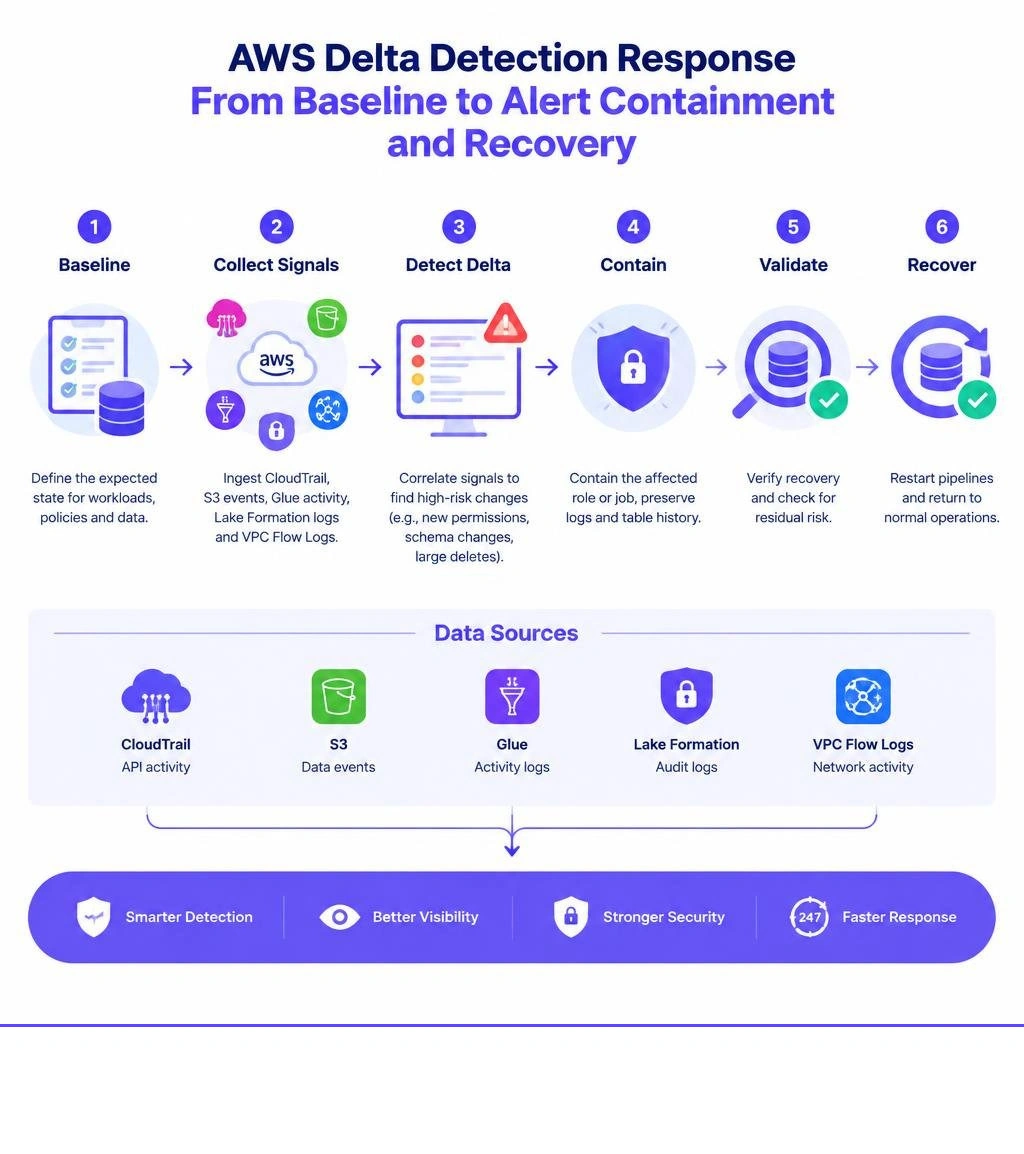
Modern enterprise environments generate millions of events each day across compute, storage, and identity layers. When security operations centers (SOCs) attempt to analyze every individual event in isolation, alert fatigue sets in rapidly. Instead of sifting through massive event streams, teams achieve clearer visibility by monitoring state deltas—the precise differences between an established, authorized baseline and the current operational reality.
In cloud security architectures, state drift represents the gradual, unauthorized, or accidental modification of configurations and data structures away from secure states. Detecting this drift requires understanding how cloud components evolve over time. For example, AWS IoT architectures maintain persistent state tracking where device shadow mechanisms continuously reconcile differences between desired and reported states, as detailed in the AWS documentation on shadow data flows. Applying this same delta-centric concept across cloud infrastructure allows defenders to spot unauthorized modifications immediately.
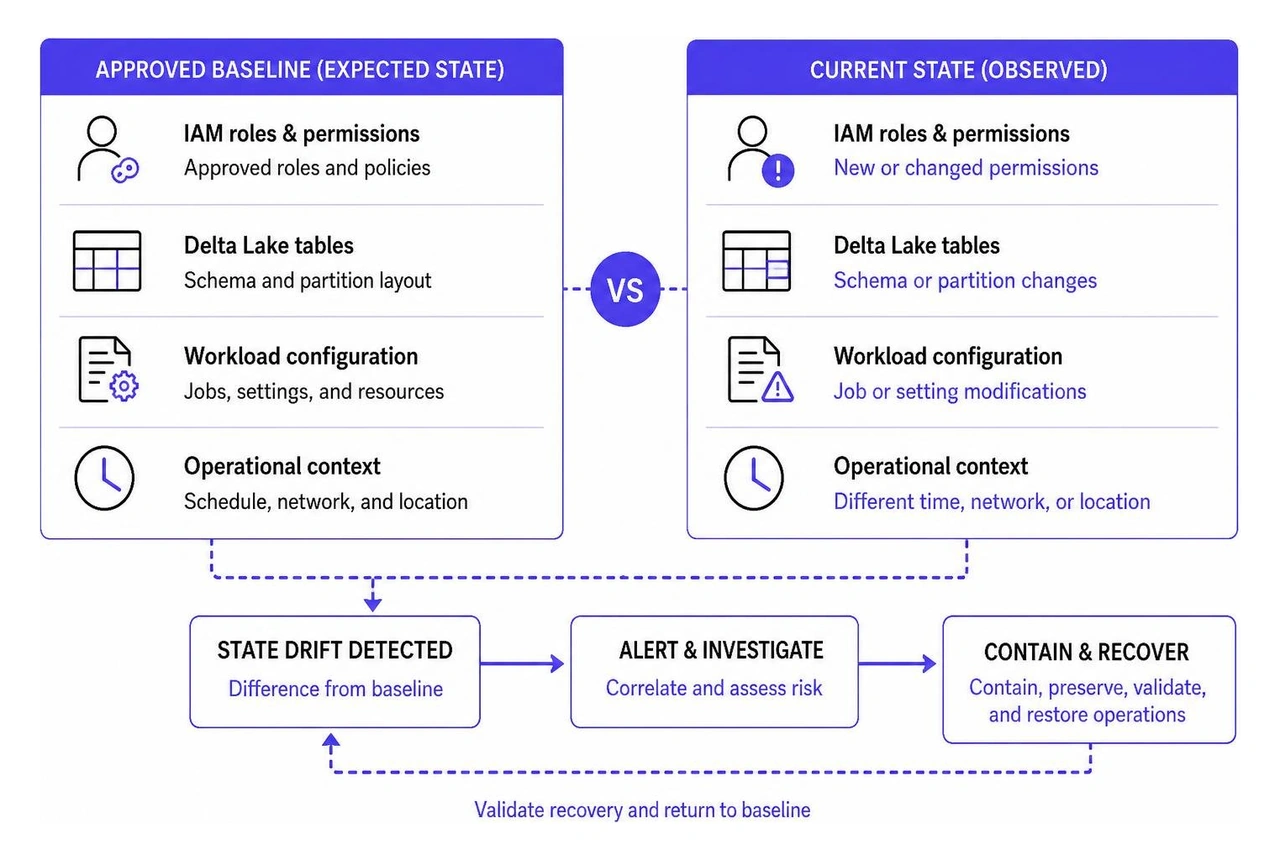
Under the AWS shared responsibility model, AWS manages the security of the cloud, including the underlying hardware, physical facilities, virtualization layers, and managed service runtimes. The customer remains responsible for security in the cloud. When operating transactional data layers such as Delta Lake alongside orchestration engines like AWS Glue, customers own:
According to the AWS Security Incident Response User Guide on Detection, detection depends on spotting deviations from baselines, matching known threat actor tactics, techniques, and procedures (TTPs), and processing external intelligence. By coupling baseline tracking with comprehensive continuous attack surface management, organizations identify vulnerabilities and indicators of compromise (IoCs) before threat actors can exploit unmonitored infrastructure changes.
Tracking control plane evolution requires deep visibility into configuration item modifications. AWS Config continuously records changes across infrastructure resources, publishing notification payloads containing structural differences.
Within these notifications, the configurationItemDiff payload highlights exact property modifications, relationships, and metadata updates. When inspecting resource drift, you will encounter distinct changeType classifications:
CREATE: Indicates that a new resource property, tag, or associated relationship was established.UPDATE: Indicates an existing setting or configuration value was modified.DELETE: Indicates a property, inline policy, or relationship was stripped away.These classifications often appear in combinations. For instance, an UPDATE-CREATE event occurs when a role configuration is updated to introduce a brand-new policy relationship, whereas an UPDATE-UPDATE event signals modifications to existing permissions. Security engineers can inspect structural details by reviewing guidance on troubleshooting configuration item diff notifications to build automated parsing pipelines. Detecting an unexpected IAM policy attachment or an escalation in role attachment counts allows security platforms to trigger alerts before an attacker moves laterally.
Delta Lake introduces ACID transactional integrity to Amazon S3 data lakes using structured JSON-based transaction logs stored in the _delta_log/ directory. While this architecture brings database-level consistency to analytical pipelines, it introduces specialized attack vectors and operational failure modes that traditional storage monitoring misses.
Security teams must monitor for several critical anomalies:
_delta_log directory records sequential JSON commits (000000.json, 000001.json). Direct modifications, manual deletion of commit files, or attempts to overwrite checkpoint Parquet files represent high-severity indicators of compromise.VACUUM commands with zero-retention parameters, purging historic versions and blinding forensic investigators.remove actions in a single commit, or widespread overwrite jobs running outside scheduled batch windows indicate data wiping or ransomware behavior.A resilient cloud security architecture correlates telemetry across control planes, data stores, and serverless compute engines.

To deliver effective protection across complex environments, Delta 360 (Δ360), built on WhiteDog’s Open XDR framework, adds a unified operational and security layer across Microsoft and third-party tools to improve correlation, visibility, security hardening, threat detection, exposure management, and response. Open XDR provides unified visibility and detection across disparate data streams, allowing teams to consolidate alerts from AWS native tools alongside broader enterprise signals without creating operational silos or requiring a rip-and-replace approach.
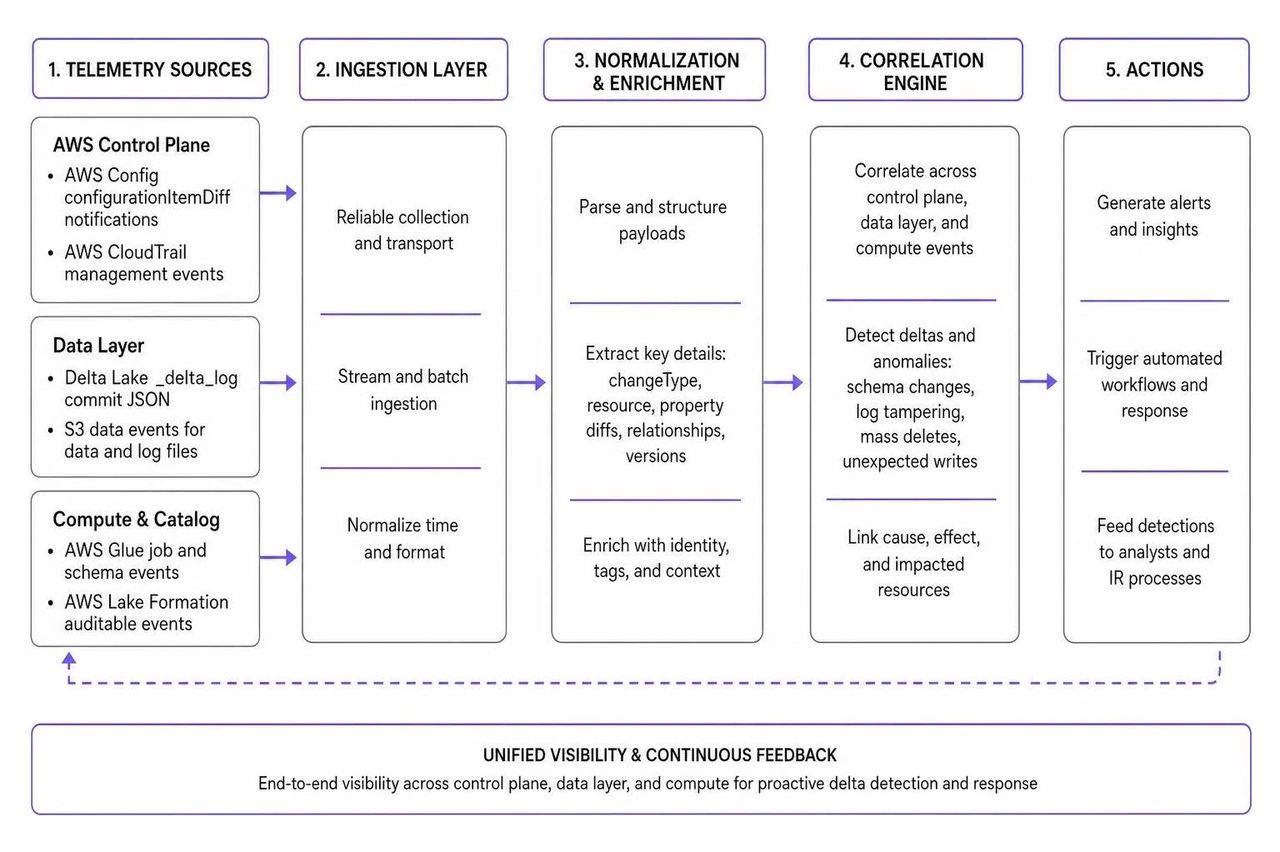
Emphasizing modular integration to maximize existing cloud investments, security teams pair these architectures with proactive incident response services—which are included directly within MDR, XDR, and DDR—to maintain strict least-privilege enforcement, govern catalog objects via AWS Lake Formation, and link control plane auditable events directly to data modifications.
Building comprehensive delta detection requires ingesting and correlating multiple high-fidelity telemetry streams across the environment:
CreateJob, UpdateTable, PutObject) and granular S3 object-level operations, logging caller identity, source IP, user agent, and timestamps.Transforming these raw event feeds into actionable security intelligence enables analysts to focus on true behavioral shifts rather than routine data processing spikes.
Securing Delta Lake tables registered within the AWS Glue Data Catalog requires strict authorization boundaries configured across IAM and AWS Lake Formation:
IAM execution roles granted to AWS Glue ETL jobs must be restricted to minimal S3 bucket paths. Rather than granting broad wildcard permissions, use condition keys (aws:PrincipalArn, aws:SourceVpc) and enforce least privilege.
Within AWS Lake Formation:
SELECT permissions for read-only consumer roles and grant SUPER permissions strictly to authorized data ingestion pipelines.S3SingleDriverLogStore) to ensure atomic commits and reject out-of-order or conflicted write transactions.These guardrails align with foundational zero trust security principles, ensuring that access is continuously validated across every analytical transaction.
Effective cloud detection strategies move beyond static metric thresholds. The table below illustrates the operational shift from traditional threshold alerting to state-based delta detection:
| Detection Metric | Traditional Threshold Alerting | Delta-Driven State Detection |
|---|---|---|
| IAM Permission Changes | Alerts only when high-privilege policies (e.g., AdministratorAccess) are attached. | Evaluates configurationItemDiff payloads for any unapproved policy modification or baseline drift. |
| S3 Data Ingestion | Triggers alarms when daily data volume exceeds a hard gigabyte limit. | Detects structural deviations in _delta_log commits, unauthorized schema shifts, or anomalous deletion rates. |
| Pipeline Modifications | Alerts if a job fails or exits with an error status code. | Evaluates changes in job execution scripts, VPC connection paths, or runtime parameters before execution. |
| Infrastructure State | Periodic audits scan configurations on a weekly or monthly schedule. | Continuous real-time diff evaluation via EventBridge, preventing non-compliant stack deployments. |
Integrating automated drift checks into CI/CD deployment workflows catches risky modifications early. Organizations can implement pre-deployment validation using serverless constructs, as shown in AWS architectural guidance on building automated drift detection pipelines with EventBridge.
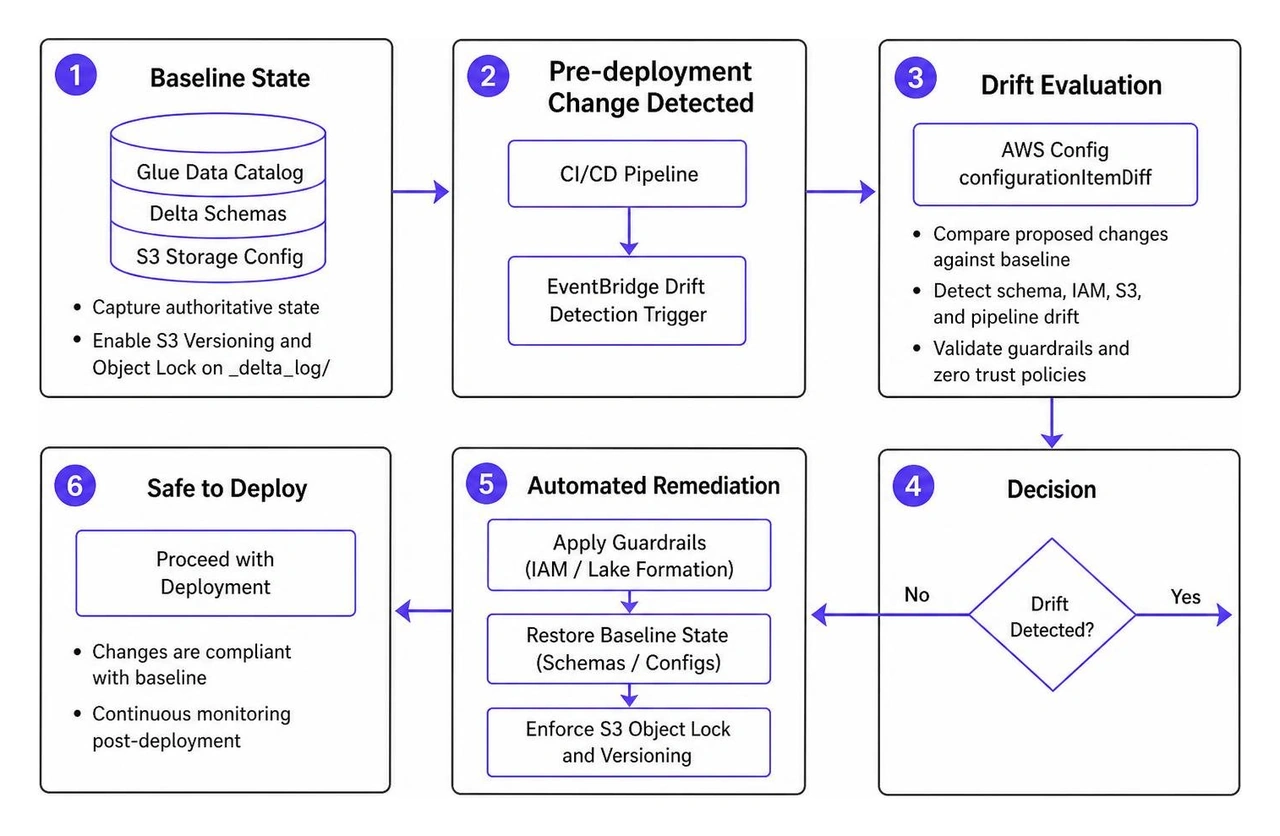
Begin by establishing an authoritative baseline of all AWS Glue Data Catalog table definitions, schema versions, and S3 storage configurations.
_delta_log/ directories to prevent retroactive tampering or unauthorized log file deletion.engineInfo, clientVersion, operation, operationParameters, and isolationLevel. Validate these properties against authorized pipeline templates.mergeSchema=false) by default, requiring administrative review before any structural schema evolution is permitted.Configure automated services to evaluate infrastructure and security configurations continuously against approved golden baselines.
ConfigurationItemChangeNotification events.configurationItemDiff object. Automatically alert if the changeType reveals unauthorized permission additions or modified security group bindings.Organizations that proactively manage configuration drift eliminate security gaps before attackers exploit them, reversing the risks outlined in our analysis of security drift and outdated validation.
When high-risk deltas appear in audit streams, automated response mechanics minimize threat actor dwell time.
A comprehensive incident handling pipeline follows a structured sequence:
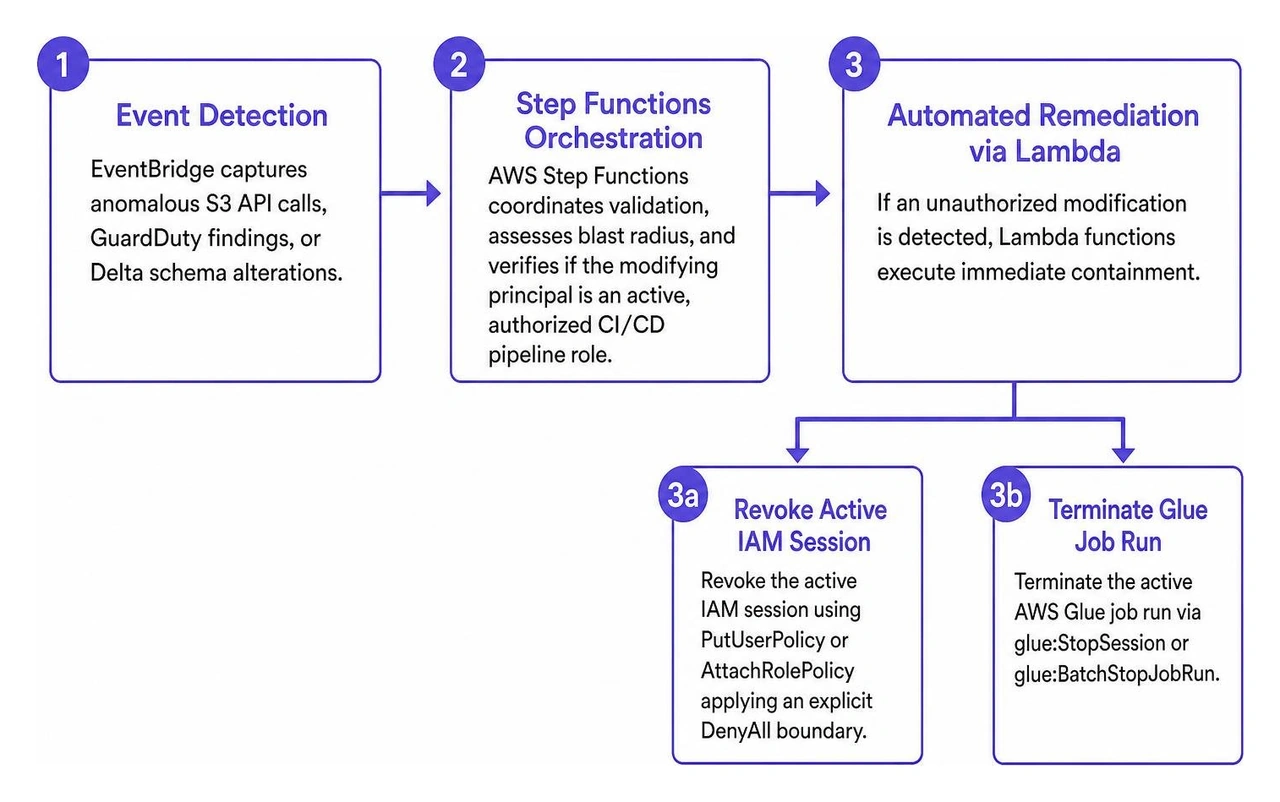
PutUserPolicy or AttachRolePolicy applying an explicit DenyAll boundary.glue:StopSession or glue:BatchStopJobRun.When suspicious activity is detected within analytical data stores, security teams must execute structured forensic containment and investigation playbooks, following established standards outlined in our cybersecurity incident response guide for modern environments.
Forensic examiners must reconstruct the precise timeline of unauthorized read, write, or delete actions across data lake environments:
_delta_log/ prefix. Locate the specific commit introducing malicious changes and inspect the readVersion, isolationLevel, and operationMetrics (e.g., numTargetFilesRemoved, numTargetRowsDeleted).Delta Lake's built-in transaction history enables precise recovery workflows following an attack or accidental data corruption:
Time-Travel Table Restoration: Leverage Delta Lake's RESTORE command to return the table state to the last known trusted commit version or timestamp:
RESTORE TABLE customer_data TO VERSION AS OF 142;
or
RESTORE TABLE customer_data TO TIMESTAMP AS OF '2026-09-15 08:30:00';
S3 Version Recovery: If commit files or underlying Parquet objects were deleted directly through S3 APIs, use S3 Versioning to restore deleted object versions by removing the associated delete markers.
Monitoring Delta Lake tables in AWS Glue requires correlating AWS Glue Data Catalog audit logs, AWS CloudTrail S3 data events, and Delta Lake transaction files. CloudTrail captures API calls to glue:UpdateTable and S3 PutObject events within the _delta_log/ prefix. By parsing commit JSON files, security platforms track changes in transaction operations, committed file counts, and principal identities, triggering alerts when writes originate from unauthorized IAM roles or unapproved IP addresses.
Under the AWS shared responsibility model, AWS manages the underlying hardware, physical facilities, managed service infrastructure, and virtualization platforms supporting Amazon S3, AWS Glue, and AWS Lake Formation. Customers are responsible for configuring identity and access management (IAM) policies, managing Lake Formation data permissions, securing Glue job parameters, auditing _delta_log transaction commits, and maintaining incident response playbooks for data-layer anomalies.
Security teams prevent time-travel manipulation by restricting access to the VACUUM command, enforcing minimum retention periods (e.g., preventing spark.databricks.delta.vacuum.parallelDelete.enabled overrides that allow zero-retention purges), and placing S3 Object Lock controls on storage buckets. Detection involves monitoring CloudTrail for unauthorized DeleteObject calls within _delta_log/ paths and evaluating commit metadata for sudden version rollbacks or anomalous retention configuration modifications.
Managing modern cloud environments requires moving past unmanageable alert volumes and adopting intelligent, state-driven detection architectures. By focusing on configuration diffs, structural transaction log modifications, and policy drift across AWS Glue and Delta Lake, security teams identify genuine risks faster while reducing operational noise.
WhiteDog’s Unified Cybersecurity Platform brings together MDR, XDR, Delta Detection & Response (DDR), exposure management, and complementary security capabilities with correlated intelligence and 24/7 SOC expertise, with incident response included across MDR, XDR, and DDR. By providing unified visibility across email, DNS, identity, endpoint, network, cloud, and data environments through modular integration rather than a rip-and-replace overhaul, WhiteDog turns complex security telemetry into prioritized, actionable operations.
For organizations seeking to maximize their cloud defenses without adding operational overhead, Delta Detection & Response (DDR) delivers our top-tier offering, backed by fully managed 24/7 SOC capabilities and continuous threat exposure management. Explore our 24/7 security operations guidance to see how correlated multi-domain intelligence helps security teams stay resilient against evolving threats.


Demand a SOC onboarding guarantee: Achieve 30-day deployment, 24/7 monitoring, and risk reduction with proven SLAs.
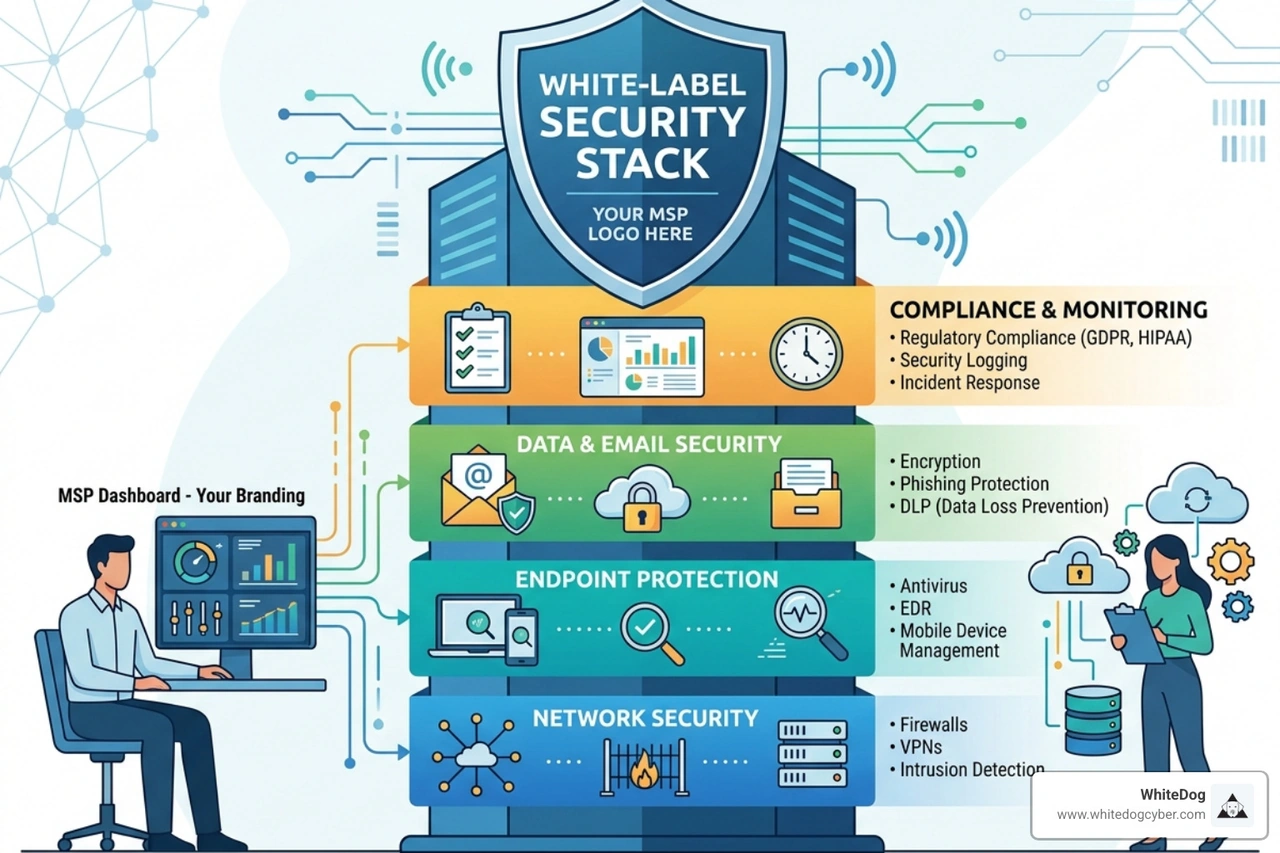
Discover how an MSP white-label security stack solves talent gaps, scales profitability, and delivers 24/7 protection in 2026.

Discover MSP SOC as service: Scale revenue, cut costs vs in-house SOC, leverage AI XDR, and boost compliance for MSPs.

Discover why 24x7 SOC for MSPs eliminates alert fatigue, scales security, and lets you sleep at night with 24/7 protection.
Master your cybersecurity incident response workflow with NIST, SANS, and DDR strategies for rapid detection, containment, and recovery.

Discover proactive incident response services: Slash dwell time, cut costs, boost resilience vs. reactive IR in 2026.