Cybersecurity
September 26, 2026
Learn how AWS delta detection response stops cloud alert noise by tracking state drift and securing Delta Lake workloads.
An msp white-label security stack is a fully managed cybersecurity platform that MSPs deliver to clients under their own brand — with a specialist provider operating the technology and SOC behind the scenes. Here are the core tools typically included:
Running a growing MSP in 2026 means your clients expect enterprise-grade security. But building that capability from scratch is expensive, slow, and increasingly unrealistic. There are over 700,000 unfilled cybersecurity positions in the US alone. Hiring even a small team of certified SOC analysts can exceed $500,000 per year — before tooling, training, or infrastructure. And the average MSP is already managing 18 or more security tools across their client base, a situation that quietly destroys margins and buries technicians in alert noise.
The result? Most MSPs are stuck in a reactive cycle — spending more time cleaning up incidents than strengthening defenses.
A white-label security stack changes that equation. Instead of building, staffing, and stitching together a security practice yourself, you partner with a specialist provider who operates the full stack under your brand. Your clients see your logo. You keep the relationship. The provider handles the 24/7 detection, triage, and response.
This guide walks through the specific tools that make up a high-performance MSP white-label security stack, so you can choose the right components for your clients and your business model.
I'm Shahin Pirooz, technology executive and visionary at WhiteDog Cyber, with over two decades of experience building managed security and cloud services for the MSP ecosystem — including helping define the subscription computing and MSP models that underpin today's msp white-label security stack. The sections ahead draw on that operational experience to help you cut through the noise and build a stack that actually works.
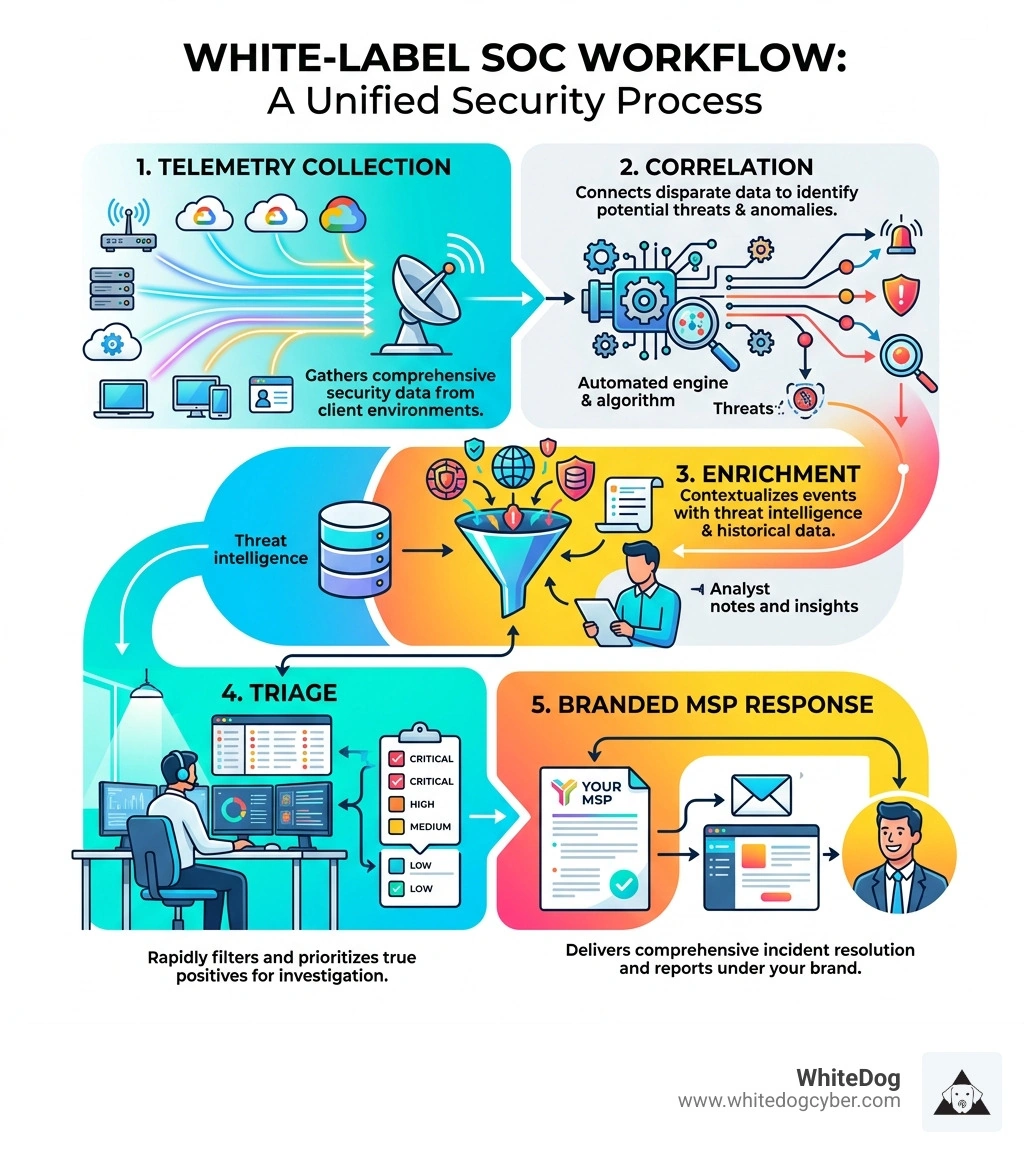
In 2026, the cybersecurity landscape has shifted from "nice-to-have" add-ons to the very foundation of the MSP business model. Clients are no longer asking if you provide security; they are asking how your Security Operations Center (SOC) handles a ransomware attempt at 2:00 AM on a holiday weekend.
For most MSPs, the traditional "outsourced" model—where you simply resell a third-party tool—is no longer enough. You need a unified msp white-label security stack that protects your margins while keeping your brand at the forefront of the client relationship. By adopting a white-label approach, you transition from being a "vulnerable" generalist to a specialized security authority. This shift is essential for Scaling Your Msp Security Offerings With Whitedog without the overhead that typically kills profitability.

The math of hiring in-house security talent simply doesn't work for the average MSP in 2026. With over 700,000 vacancies in the US cybersecurity workforce, competition for talent is fierce. According to Research on the US cybersecurity workforce gap, a single certified SOC analyst can command a salary between $90,000 and $120,000. To provide true 24/7/365 coverage, you need a minimum of four to six analysts to cover shifts, weekends, and vacations.
That is a $500,000+ annual commitment before you’ve even purchased your first SIEM license. Beyond the cost, there is the "burnout" factor. Internal technicians often suffer from alert fatigue, spending 82% of their time reacting to incidents rather than improving client defenses. A white-label stack offloads this burden to a dedicated team, ensuring your internal stars can focus on high-value client strategy rather than triaging endless low-level alerts.
Speed is a competitive advantage. Building an in-house SOC typically takes 6 to 18 months of planning, hiring, and tool integration. In contrast, a white-label security stack can be deployed in days or weeks. At WhiteDog, we offer a 30-day onboarding guarantee, allowing you to go from "zero" to "enterprise-grade" almost instantly.
This rapid entry doesn't just help you win new business; it anchors your current clients. Security services generate contract values 2-3x higher than traditional IT management. By delivering branded portals and reports, you reinforce your value every month, making your services "stickier" and significantly improving client retention. You are Built For Service Providers Ready To Scale because your backend grows automatically with your client list.
A modern security stack is more than just a collection of logos; it is an integrated ecosystem. When we talk about an msp white-label security stack, we are looking at a platform that correlates data across every possible attack vector. This includes everything from the endpoint to the cloud, identity, and the network.

Email remains the primary entry point for attackers due to its reach and the human element. A robust white-label stack must include advanced email authentication standards like SPF, DKIM, and DMARC. According to the Latest research on email authentication standards, enforcing these protocols is no longer optional—it is a baseline requirement for protecting brand reputation and ensuring deliverability.
White-label email security allows you to offer DMARC enforcement and phishing defense without needing a resident email expert. You provide the protection that stops spoofing and business email compromise (BEC), while the platform handles the technical heavy lifting of record generation and monitoring. To see how this fits into a broader strategy, explore our One Comprehensive Xdr Platform.
Most MSPs are familiar with MDR—24/7 monitoring and response. However, as threats evolve, so must the defense. At WhiteDog, we advocate for Delta Detection and Response (DDR). While standard MDR focuses on known threats and basic response, DDR represents the top tier of protection, incorporating advanced threat hunting and integrated incident response without the need for expensive external retainers.
The difference lies in the depth of the investigation. While some providers just pass alerts back to your team, a true white-label partner resolves the vast majority of alerts (up to 97%) without escalation. This allows you to offer Xdr Vs Open Xdr Vs Whitedog Whats The Real Difference: a service that actually reduces your workload instead of just adding to your ticket queue.
For years, the SIEM (Security Information and Event Management) was the gold standard. But in 2026, SIEMs often become "data graveyards" where logs go to die. Modern white-label stacks have moved toward a platform-centric approach that emphasizes correlation over simple collection.
The WhiteDog platform mechanism is designed for operational efficiency. We don't just collect raw telemetry; we filter, deduplicate, and correlate it. We normalize data to specific assets and enrich it with global threat intelligence. This process turns thousands of noisy signals into a single, prioritized detection.
This "noise reduction" is why we can resolve 97% of alerts without needing to bother your technicians. It’s about moving from a "Frankenstein stack" of disconnected tools to a unified system. You can Never Buy Another Security Tool An Evergreen Solution For Msps when your platform is built to evolve with the threat landscape. For more on how we simplify this, check out Taming The Frankenstein Stack How Whitedog Simplifies Cybersecurity For Msps.
The average MSP manages 18+ security tools. This leads to "tool sprawl," where margins are eroded by multiple vendor bills and technicians are forced to master dozens of disparate interfaces. This fragmentation creates security gaps and operational nightmares.
By consolidating these controls into a single correlated security timeline, you gain "single pane of glass" visibility. This doesn't just make your team faster; it makes them more accurate. You can finally Simplified Security For Msps Escape Contract Chaos And Tool Overload and focus on what really matters: growing your business.
The business case for a white-label security stack is rooted in the "Build vs. Rent" math. When you build in-house, your costs are front-loaded and fixed. When you "rent" a white-label bench, your costs are variable and scale directly with your revenue.
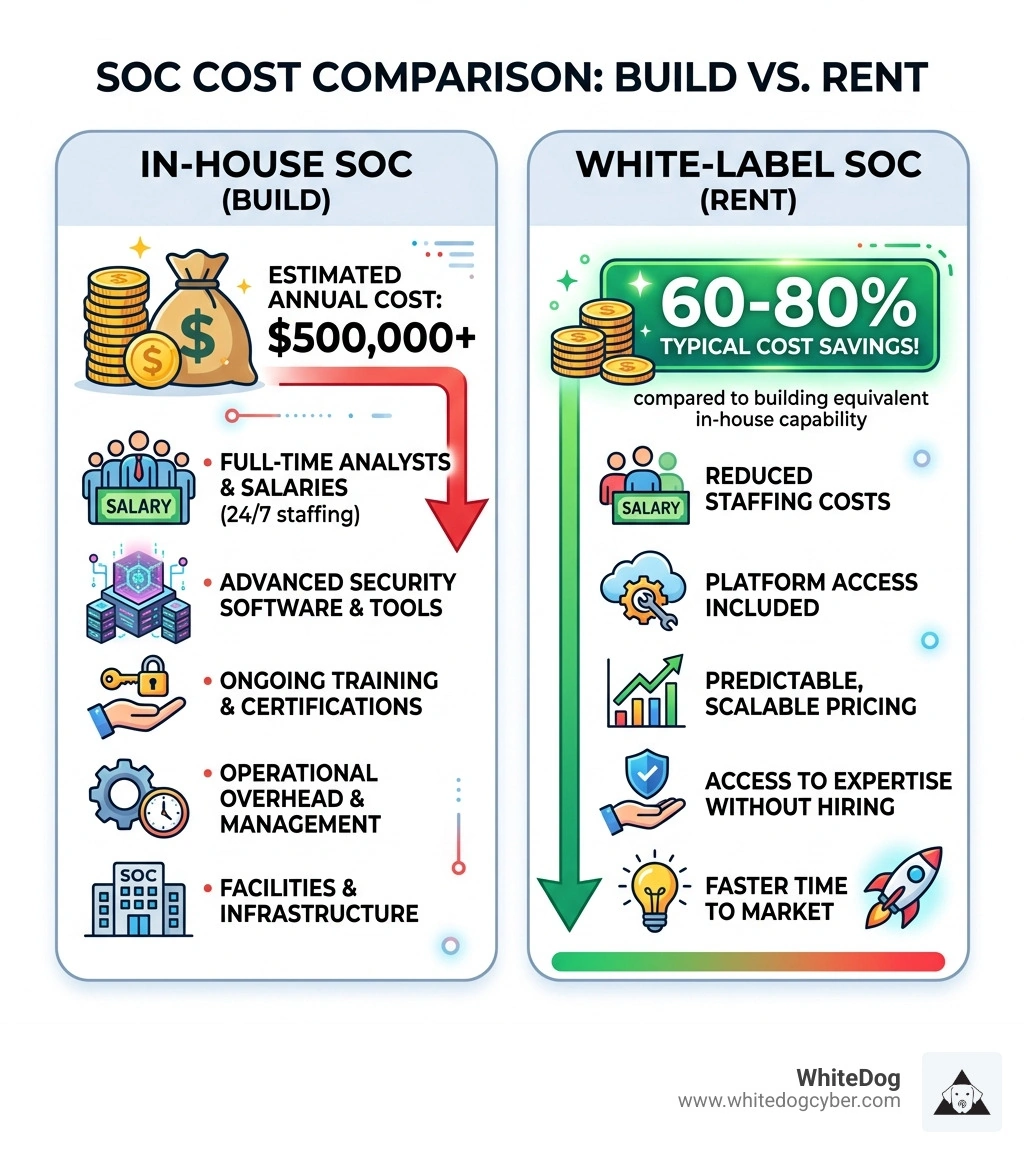
MSPs using a white-label SOC typically see 60–80% cost savings compared to building an in-house equivalent. More importantly, security services command higher margins. While traditional managed services might be a race to the bottom on price, specialized security and Compliance Made Simple A Growth Path For Msps allow you to charge a premium.
A white-label stack transforms your sales conversations. Instead of selling "uptime," you are selling "risk reduction." You can assist clients with cyber insurance readiness, provide vCISO advisory services, and handle complex compliance mandates like CMMC or HIPAA. These are high-value, high-margin services that internal teams often struggle to deliver.
Predictable, wholesale pricing allows you to maintain healthy margins while offering competitive rates to your clients. This financial stability is a key reason How Msps Are Expanding With Whitedog so successfully in today's market.
Modern white-label platforms are built for the MSP ecosystem. They feature native integrations with major tools like ConnectWise, Kaseya, Datto, and NinjaRMM. This allows for automated ticket creation, asset synchronization, and seamless workflows. You don't have to change how you work; the security telemetry simply flows into the tools you already use.
Open XDR provides unified visibility and detection across your entire environment, but it typically requires your team to handle the response. Fully managed MDR (and our higher-tier DDR) includes a 24/7 SOC that actively investigates and remediates threats on your behalf. Open XDR is great for visibility, but MDR/DDR is what gives you your weekends back.
Yes. A professional white-label stack includes the logging, monitoring, and reporting required by major frameworks. Because the provider maintains audit-ready evidence and follows strict security protocols (like SOC 2 Type II), you can pass that compliance "pedigree" down to your clients, making it much easier for them to meet regulatory requirements.
The era of the "patchwork" security stack is over. To thrive in 2026, MSPs must move toward a unified, white-label model that offers enterprise-grade protection without the enterprise-grade price tag.
WhiteDog Cyber provides the ultimate msp white-label security stack—a co-managed platform that combines best-in-class tools with a 24/7 SOC that never sleeps. We don't just give you more tools; we give you a single, correlated security timeline that reduces noise, eliminates tool sprawl, and protects your margins. With our 30-day onboarding guarantee and "never buy another tool" philosophy, we are the engine that helps you scale your revenue without scaling your headcount.
Ready to stop reacting and start growing? Explore White-Label Security Solutions today and see how WhiteDog can help you stack the deck in your favor.


Learn how AWS delta detection response stops cloud alert noise by tracking state drift and securing Delta Lake workloads.

Master modern threat detection with unified visibility across cloud, identity, and AI agents for faster response.

Learn how cloud security protects your data in 2026, covering shared responsibility, zero trust, and posture management to prevent breaches.

Verify AWS KMS FIPS compliance with this step-by-step guide covering FIPS 140-3 HSMs, endpoints, and auditing for regulatory alignment.

Navigate security compliance requirements across ISO 27001, SOC 2, and GDPR with a strategic blueprint for sustainable compliance management.

Learn how AI phishing detection stops next-gen attacks that bypass traditional defenses, with practical capabilities to evaluate.