Cybersecurity
September 24, 2026
Master modern threat detection with unified visibility across cloud, identity, and AI agents for faster response.
A CMMC compliance assessment is the formal process DoD contractors use to verify they are protecting Federal Contract Information (FCI) and Controlled Unclassified Information (CUI) at the level required by their contracts. Here is a quick breakdown of what that means in practice:
What you need to know at a glance:
If your organization holds or is pursuing DoD contracts, CMMC compliance is not optional. It is a contract eligibility requirement codified in 32 CFR Part 170.
The defense industrial base is under constant pressure from sophisticated cyber threats targeting FCI and CUI. The CMMC program exists precisely because voluntary compliance was not enough. Contractors of every size — from large primes to small subcontractors — must now demonstrate that their cybersecurity controls actually work, not just that they have policies on paper.
That gap between documentation and real implementation is where most organizations struggle. A gap analysis that looked fine on a spreadsheet can fall apart quickly when a C3PAO assessor starts asking questions and testing controls.
I'm Shahin Pirooz, a senior cybersecurity executive with over 20 years of experience building managed security and cloud services, and I've guided organizations through the full lifecycle of CMMC compliance assessment — from initial scoping to certification. In the sections below, I'll walk you through exactly what to expect and how to prepare.
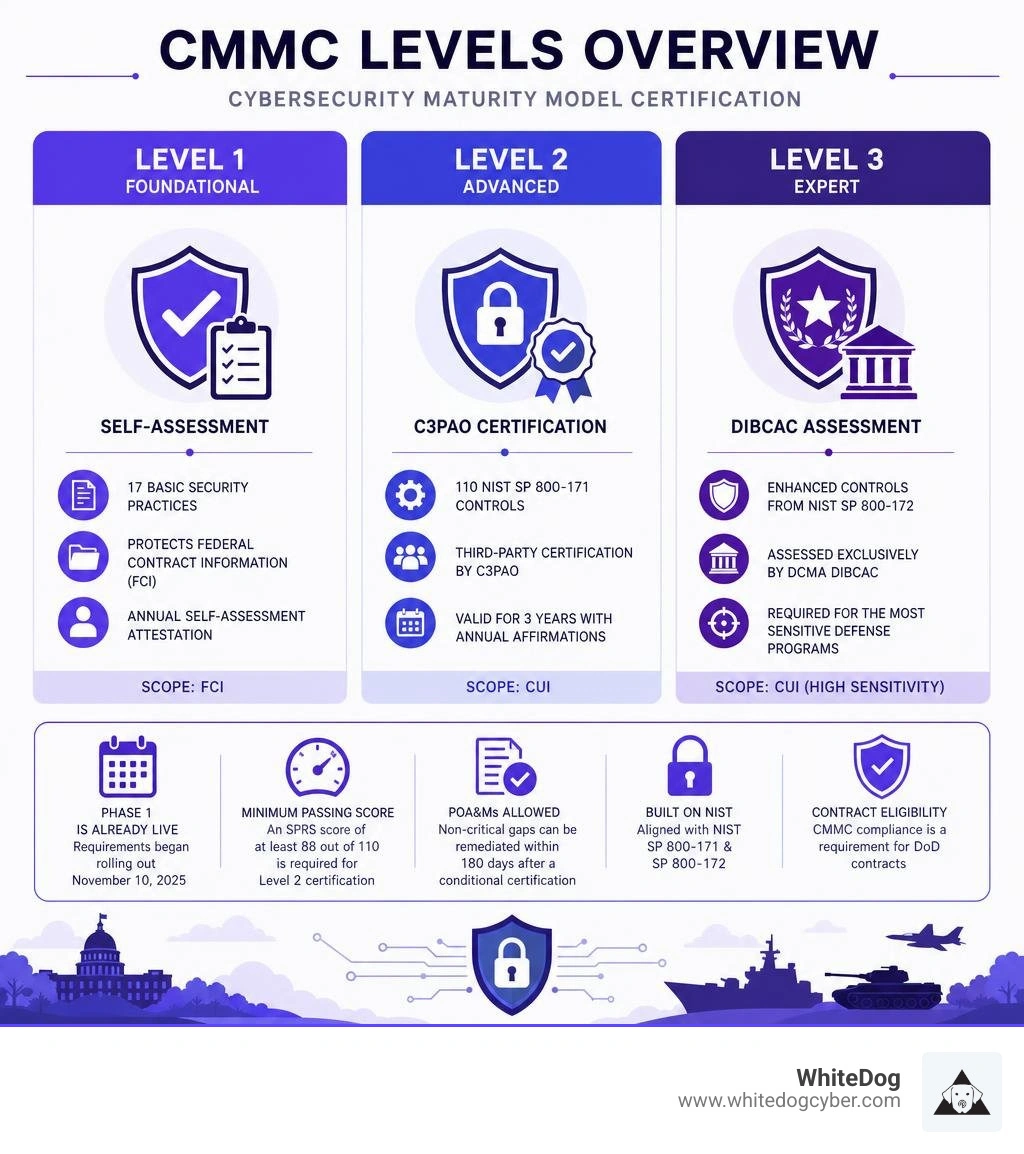
At its core, a CMMC compliance assessment is a structured verification process. It ensures that defense contractors have implemented the specific cybersecurity requirements necessary to safeguard sensitive government data. The program bridges two key types of information:
The regulatory framework relies on distinct legal clauses. For FCI, the baseline is FAR 52.204-21 (Basic Safeguarding of Covered Contractor Information Systems). For CUI, the mandate is DFARS 252.204-7012 (Safeguarding Covered Defense Information and Cyber Incident Reporting), which directs contractors to implement NIST SP 800-171.
To help you visualize how these requirements scale, we have compiled a comparison of the three CMMC levels:
| Feature | CMMC Level 1 | CMMC Level 2 | CMMC Level 3 |
|---|---|---|---|
| Data Protected | Federal Contract Information (FCI) | Controlled Unclassified Information (CUI) | CUI associated with high-value assets / Advanced Persistent Threats (APTs) |
| Security Standard | 15 FAR 52.204-21 clauses (mapped to 17 practices) | 110 NIST SP 800-171 Rev. 2 controls | 110 Level 2 controls + subset of NIST SP 800-172 enhanced controls |
| Assessment Type | Annual Self-Assessment | Triennial C3PAO Assessment (or Self-Assessment for select contracts) | Triennial Government Assessment (DCMA DIBCAC) |
| SPRS Submission | Required annually | Required triennially (with annual affirmations) | Required triennially (with annual affirmations) |
| POA&M Allowed? | No | Yes (conditional, limited to 180 days for non-critical controls) | Yes (conditional, limited to 180 days) |
Contractors do not get to choose their CMMC level; it is determined by the Department of Defense based on the sensitivity of the information associated with a given program. When a solicitation is issued, the DoD specifies the required CMMC level directly in the contract.
To determine your required level ahead of a formal bid, you must analyze the data you will handle. If you only touch FCI, Level 1 is your target. If you handle CUI, you will need to meet Level 2 requirements.
Furthermore, you must check if the CUI falls under the National Archives CUI Registry's Defense Organizational Index Grouping. If it does, you will almost certainly require a third-party C3PAO certification rather than a self-assessment.
For highly sensitive programs involving breakthrough technologies, significant aggregation of CUI, or critical systems, the DoD will mandate Level 3. This level introduces enhanced security requirements from NIST SP 800-172. To understand these advanced expectations, you can refer to the official CMMC Level 3 Assessment Guide.
The CMMC rollout is structured over a multi-year phased timeline to give the defense industrial base and the assessment ecosystem time to scale. Because we are currently in June 2026, we are actively operating within Phase 1, with Phase 2 quickly approaching.
The implementation phases are structured as follows:

Preparing for a cmmc compliance assessment requires a rigorous, systematic approach. You cannot simply buy a tool or sign a policy and declare your organization "compliant." True readiness is built on active management, comprehensive documentation, and continuous validation.
The preparation process generally follows these steps:
Scoping is perhaps the most critical step in your entire compliance journey. An overly broad scope leads to unnecessary complexity, massive implementation costs, and a higher risk of assessment failure. Conversely, an incomplete scope will result in immediate non-compliance.
To scope effectively, you must map your entire CUI Boundary. This involves documenting the exact data flows of how FCI and CUI enter, travel through, are stored within, and exit your organization. You must identify all:
For organizations handling FCI, the scoping process is detailed in the official CMMC Level 1 Self-Assessment Guide. For a deeper look at the broader certification requirements and how they impact your overall business strategy, explore our resource on CMMC Compliance Certification.
CMMC Level 1 consists of 17 basic safeguarding practices spread across 5 primary domains. These controls represent fundamental cyber hygiene. To pass a Level 1 assessment, every single practice must be fully implemented with no active POA&Ms.
Key practices include:
While Level 1 relies on annual self-assessments, Level 2 and Level 3 certifications introduce independent validation. For Level 2, this validation is performed by a Certified Third-Party Assessment Organization (C3PAO). For Level 3, the assessment is conducted directly by the Defense Contract Management Agency's Defense Industrial Base Cybersecurity Assessment Center (DCMA DIBCAC).
To navigate this process successfully, organizations must familiarize themselves with the official CMMC Assessment Process. This document outlines the explicit phases of a C3PAO engagement, from the initial scoping call to the final submission of results.
During the assessment, assessors will not take your word for it. They will use three specific methods to evaluate your controls:
To understand the exact objectives assessors will use to evaluate your system, consult the Level 2 Assessment Guide and review the procedural steps outlined in the CMMC Assessment Process - CMMC Toolkit Wiki.
The Supplier Performance Risk System (SPRS) is the DoD's central database for tracking contractor compliance. For CMMC Level 2, your assessment results are calculated using a weighted scoring system based on the 110 controls (which encompass 320 distinct assessment objectives).
The scoring mechanism is binary but weighted:
If you score at least 88 points but have minor, non-critical deficiencies, you can still achieve a Conditional Level 2 status. To do this, you must document the remaining gaps in a Plan of Action and Milestones (POA&M). You then have exactly 180 days to remediate these gaps and undergo a closeout assessment to achieve a Final Level 2 certification. If you fail to close out the POA&M within 180 days, your conditional status is revoked.
CMMC is not just a headache for prime contractors; it flows down the entire supply chain. If a prime contractor wins a contract that requires CMMC Level 2 because it involves CUI, and they subcontract a portion of that work to your organization, they must flow down those exact requirements to you.
Primes are legally responsible for verifying that their subcontractors hold the appropriate CMMC status before sharing sensitive data. This flowdown requirement has massive implications for Managed Service Providers (MSPs) who manage IT and security for subcontractors. To learn more about how these expectations impact the service provider ecosystem, read our analysis on How Supply Chain Compliance Lands on MSPs and review our guide on Compliance Made Simple: A Growth Path for MSPs.
Even well-prepared organizations can stumble during a formal cmmc compliance assessment. Understanding where others fail can help you avoid the same mistakes.

Here are the most common pitfalls we see in the field:
To avoid these pitfalls, we recommend conducting a complete "dry run" pre-assessment with an external partner. Testing your team, your documentation, and your technical controls under audit conditions is the only way to guarantee success when the C3PAO arrives.
To pass a CMMC Level 2 assessment and achieve a conditional certification, you must score a minimum of 88 points out of 110. This score is calculated by subtracting weighted points (1, 3, or 5 points depending on the control's criticality) from a starting perfect score of 110. Any critical 5-point controls (such as Multi-Factor Authentication or Access Control boundaries) must be fully implemented; they cannot be placed on a POA&M.
A CMMC Level 2 or Level 3 certification is valid for three years. However, achieving certification is not a "set-and-forget" milestone. To maintain your active compliance status, your organization must submit an annual compliance affirmation signed by a designated senior executive (the Affirming Official) in SPRS, verifying that the security controls have been continuously monitored and remain fully implemented.
Yes, but only under strict conditions. A Plan of Action and Milestones (POA&M) is allowed for CMMC Level 2 and Level 3 assessments, provided you achieve the minimum passing score of 88 points. Additionally, no critical 5-point controls can be on the POA&M. Any documented deficiencies must be fully remediated and verified through a closeout assessment within 180 days of the initial assessment.
Navigating a cmmc compliance assessment requires a fundamental shift in how your organization approaches cybersecurity. Moving away from siloed tools and static checklists is no longer just a best practice; it is a requirement for doing business with the Department of Defense.
We understand that managing this complexity while running your core business is a massive undertaking. That is why WhiteDog Cyber provides a curated, actively managed security stack designed to eliminate tool sprawl and simplify compliance.
Rather than forcing a "rip and replace" of your existing investments, our Unified Cybersecurity Platform integrates modularly with your current tools to collect raw telemetry from across your environment, filter and correlate the data, normalize it to your assets, and enrich it with threat intelligence. This process produces a single, correlated security timeline that our 24/7 Security Operations Center (SOC) continuously monitors, triages, and responds to.
Whether you need foundational visibility through our Open XDR offering, Managed Detection and Response (MDR), or fully managed detection and response with our top-tier Delta Detection & Response (DDR) suite, we provide the enterprise-grade security operations you need to reduce risk, lower dwell times, and confidently pass your next audit. Additionally, Incident Response (IR) is fully included in our MDR, XDR, and DDR offerings to ensure you are protected at every stage.
Ready to secure your supply chain and streamline your path to compliance? Explore our WhiteDog Solutions today.


Master modern threat detection with unified visibility across cloud, identity, and AI agents for faster response.

Learn how cloud security protects your data in 2026, covering shared responsibility, zero trust, and posture management to prevent breaches.

Verify AWS KMS FIPS compliance with this step-by-step guide covering FIPS 140-3 HSMs, endpoints, and auditing for regulatory alignment.

Navigate security compliance requirements across ISO 27001, SOC 2, and GDPR with a strategic blueprint for sustainable compliance management.

Learn how AI phishing detection stops next-gen attacks that bypass traditional defenses, with practical capabilities to evaluate.

Evaluate your cloud security audit options with this actionable checklist covering multi-cloud frameworks, CSPM, DSPM, and AI-driven automation.