Cybersecurity
September 17, 2026
Verify AWS KMS FIPS compliance with this step-by-step guide covering FIPS 140-3 HSMs, endpoints, and auditing for regulatory alignment.
CMMC compliance certification is the Department of Defense's mandatory cybersecurity verification program for contractors and subcontractors in the Defense Industrial Base (DIB). Here's what you need to know at a glance:
| CMMC Level | Who It Applies To | Assessment Type | Key Standard |
|---|---|---|---|
| Level 1 | Contractors handling FCI | Self-assessment | FAR 52.204-21 (15 requirements) |
| Level 2 | Contractors handling CUI | Self-assessment or C3PAO | NIST SP 800-171 (110 requirements) |
| Level 3 | High-value CUI / advanced threats | DIBCAC (government-led) | NIST SP 800-172 (+24 requirements) |
If you hold — or want to hold — a DoD contract, this is no longer optional. Cybersecurity used to be largely self-reported across the Defense Industrial Base. Contractors would attest to their own compliance, and the DoD had limited ability to verify it. That model left serious gaps. Adversaries exploited those gaps repeatedly, targeting defense contractors to steal sensitive research, engineering data, and military technology.
CMMC changes that equation entirely. It replaces self-attestation with verified, structured assessments tied directly to contract eligibility. No certification, no contract — it's that straightforward.
Whether you're a large prime contractor, a small subcontractor, or a university research institution working with DoD-funded projects, CMMC applies to you if you handle Federal Contract Information (FCI) or Controlled Unclassified Information (CUI). The rules flow down through the supply chain, meaning primes are responsible for ensuring their subs comply too.
This guide walks you through every layer of the CMMC framework — the levels, the assessment process, the timelines, and how to prepare — so you can move forward with clarity and confidence.
I'm Shahin Pirooz, a senior cybersecurity executive with over 20 years of experience building managed security and cloud services — and I've spent considerable time helping organizations navigate the evolving landscape of CMMC compliance certification as it reshapes how the defense supply chain approaches cyber risk. As the technology executive and visionary at WhiteDog Cyber, I'll guide you through what this program actually requires and what it takes to get — and stay — compliant.
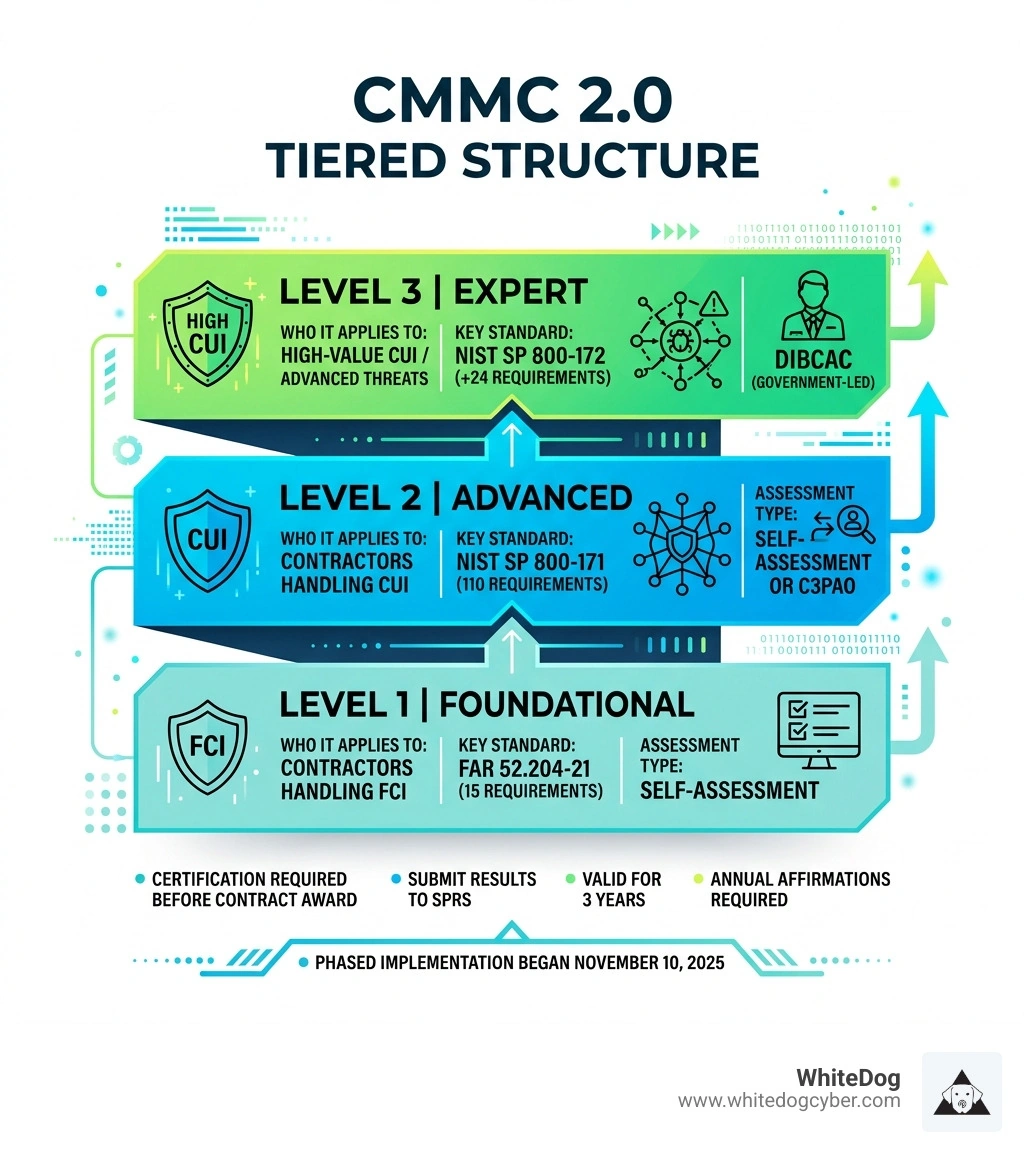
The Cybersecurity Maturity Model Certification (CMMC) isn't just a new set of rules; it’s a verification mechanism. For years, the Department of Defense (DoD) relied on DFARS 252.204-7012, which required contractors to protect Controlled Unclassified Information (CUI). However, the "trust but don't verify" approach led to inconsistent security postures across the Defense Industrial Base (DIB).
CMMC 2.0 streamlines the previous five-level model into three distinct tiers. This framework ensures that every organization in the supply chain—from the massive aerospace primes to the small machine shops—has a baseline of security that matches the sensitivity of the data they handle. To stay current with official updates, it’s always wise to monitor the CIO - Cybersecurity Maturity Model Certification page.
To understand which cmmc compliance certification level you need, you first have to understand what data you are touching. The program protects two primary categories of information:
The standard for protecting CUI is NIST SP 800-171. If your contract involves CUI, you must implement all 110 security controls outlined in that document.
The "why" is simple: the supply chain is the soft underbelly of national defense. While the DoD's internal networks are heavily fortified, subcontractors often represent an easier path for state-sponsored hackers. By stealing unclassified but sensitive data, adversaries can piece together a "mosaic" of intelligence that compromises our military advantage.
The Cybersecurity Maturity Model Certification 2.0 Program | CISA emphasizes that this program solves the problem of accountability. By making certification a condition of contract award, the DoD ensures that cybersecurity is no longer an afterthought or a "best effort" activity—it is a cost of doing business.
CMMC is designed to be tiered. Not everyone needs the highest level of security, but everyone needs a foundation.
Level 1 is the entry point. It applies to contractors who handle FCI but not CUI.
This is where the majority of DIB contractors will land. If you handle CUI, you are at Level 2.
Level 3 is reserved for the most sensitive unclassified programs—those targeted by Advanced Persistent Threats (APTs).

Getting certified isn't a one-and-done event; it’s a rigorous process of evidence collection. You can't just say you have a firewall; you have to show the policy, the logs, and the maintenance records.
The distinction between self-assessment and third-party certification is critical.
Assessors within these organizations hold specific credentials like Certified CMMC Professional (CCP) or Certified CMMC Assessor (CCA). These individuals are trained by the CAICO (CMMC AB/Cyber AB International Certification Organization) to ensure assessments are consistent across the board.
We often see that How Supply Chain Compliance Lands On Msps is a major hurdle for subcontractors who lack the internal expertise to manage these audits.
Before an assessor walks through your door, you must define your "scope." Scoping involves identifying every asset that touches CUI—people, laptops, servers, and even cloud providers.
The DoD is rolling out CMMC in four phases over three years to avoid overwhelming the C3PAO ecosystem.
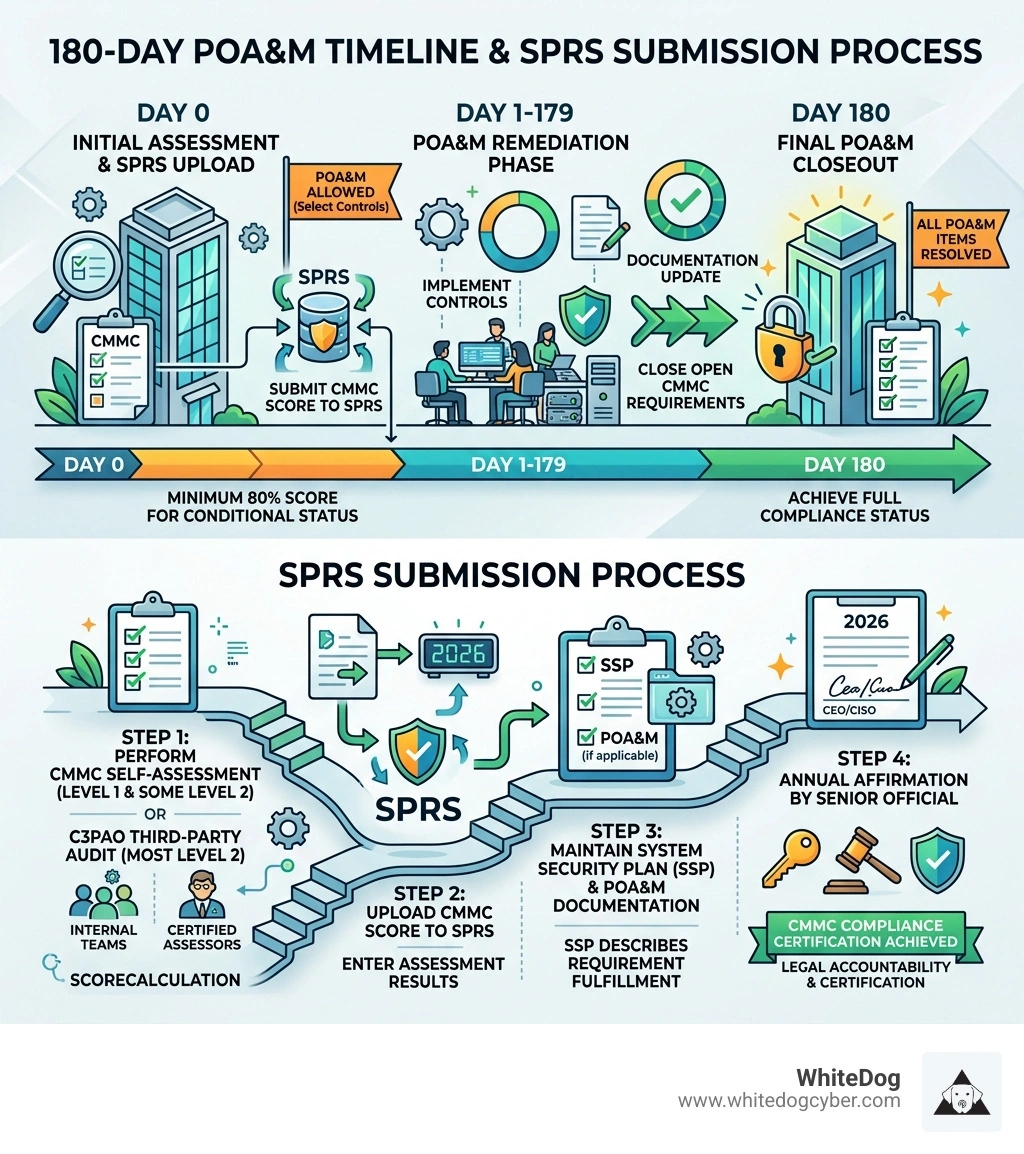
In the past, you could have a "Plan of Action and Milestones" (POA&M) that lasted forever. Not anymore.
Once your assessment is complete, the results are entered into the Supplier Performance Risk System (SPRS). For Level 3, the data might also flow through eMASS (Enterprise Mission Assurance Support Service).
Crucially, an annual affirmation is required. A senior official (like a CEO or CISO) must sign off, stating that the organization has maintained the required security standards. This creates legal accountability under the False Claims Act. As we note in Compliance Made Simple A Growth Path For Msps, this move from "IT problem" to "legal/executive problem" is the biggest shift in CMMC.
Preparation should start at least 6 to 12 months before you expect to bid on a contract requiring cmmc compliance certification.
If you are a Prime contractor, you are the "enforcer." You cannot award a subcontract to a company that doesn't meet the CMMC level required by the contract. This applies to universities and small businesses alike. The only major exemption is for companies providing Commercial Off-The-Shelf (COTS) items—if you sell the DoD the same pens you sell to the general public, CMMC likely doesn't apply to those specific transactions.
Compliance is a state, not a destination. You must move from "check-the-box" compliance to continuous monitoring.
At WhiteDog, we focus on risk reduction by providing a curated, actively managed security stack that emphasizes modular integration with your existing environment rather than a "rip and replace" approach. Instead of "tool sprawl," we offer a single correlated timeline of events, managed by our 24/7 SOC, to ensure that when a threat appears, it is caught and neutralized before it can touch CUI.
Any company doing business with the DoD as a prime or subcontractor that handles FCI or CUI. This includes small businesses, large defense contractors, and research universities.
If you fail to achieve the required level or fail to close a POA&M within 180 days, you are ineligible for contract award. Existing contracts may also be at risk if compliance is not maintained.
Costs vary wildly based on your starting point and the level required. Level 1 is relatively inexpensive (self-assessment), but Level 2 requires paying for a C3PAO audit, which can cost thousands of dollars, plus the cost of technical remediation.
The road to cmmc compliance certification can feel overwhelming, but it is a necessary evolution to protect our national security. By moving away from fragmented, "SIEM-centric" approaches that produce too much noise and not enough action, contractors can achieve a more robust defense.
At WhiteDog Cyber, we believe in a Unified Cybersecurity Platform. We don't just give you tools; we provide an integrated stack—from Open XDR for unified visibility to our top-tier Delta Detection & Response (DDR)—where incident response is included in every level of service. Our approach focuses on modular integration with your current infrastructure rather than a "rip and replace" strategy, all backed by a 24/7 SOC that investigates and responds to threats in real-time. Our goal is to reduce your dwell time and operational burden, letting you focus on what you do best: supporting the mission of the DoD.


Verify AWS KMS FIPS compliance with this step-by-step guide covering FIPS 140-3 HSMs, endpoints, and auditing for regulatory alignment.

Navigate security compliance requirements across ISO 27001, SOC 2, and GDPR with a strategic blueprint for sustainable compliance management.

Learn how AI phishing detection stops next-gen attacks that bypass traditional defenses, with practical capabilities to evaluate.

Evaluate your cloud security audit options with this actionable checklist covering multi-cloud frameworks, CSPM, DSPM, and AI-driven automation.

Learn the five pillars of MSP risk reduction to secure operations, manage vendor risk, and build defensible compliance.

Learn how AI based malware detection stops polymorphic threats and zero-day attacks using deep learning, behavioral analysis, and multi-modal pipelines.