Cybersecurity
October 8, 2026
Master enterprise risk reduction with this detailed guide covering ERM frameworks, AI governance, and cybersecurity strategies for 2026.
Co-managed security for MSP engagements is a shared-responsibility model where an internal IT team and an external security provider split ownership of specific security functions — so neither side is doing everything alone.
Here is a quick breakdown of what that looks like in practice:
| Question | Quick Answer |
|---|---|
| What is it? | A model where your team and an MSP share defined security responsibilities |
| Who controls strategy? | Your internal team retains strategic and architectural control |
| What does the MSP handle? | 24/7 monitoring, threat detection, incident response, and specialist functions |
| Who is it best for? | MSPs and mid-market businesses with internal IT staff but critical security gaps |
| How is it different from fully managed? | You stay in the driver's seat — the provider adds capacity and depth, not replacement |
| What is the biggest risk? | Unclear ownership, which creates gaps or duplicated effort |
| What is the biggest benefit? | Access to enterprise-grade security coverage without building a full in-house SOC |
Most internal IT teams are good at what they do. The problem is that modern security demands more than any one team can realistically cover — 24/7 monitoring, threat hunting, vulnerability management, compliance reporting, and incident response all at once. Something always slips. Over 63% of businesses that have adopted co-managed services did so specifically to strengthen security without overloading their staff. That stat is not surprising. Routine support requests alone can consume most of an internal team's capacity, leaving almost no room to respond to an actual threat.
This is exactly the gap co-managed security is designed to fill. Not to replace your team — but to back them up where it counts most.
I am Shahin Pirooz, technology executive and visionary at WhiteDog Cyber, and I have spent more than two decades building managed security and cloud services — including helping shape the early subscription computing and MSP models that co-managed security for MSP practices are built on today. In the sections below, I will walk you through everything you need to evaluate a co-managed security partnership clearly and confidently.
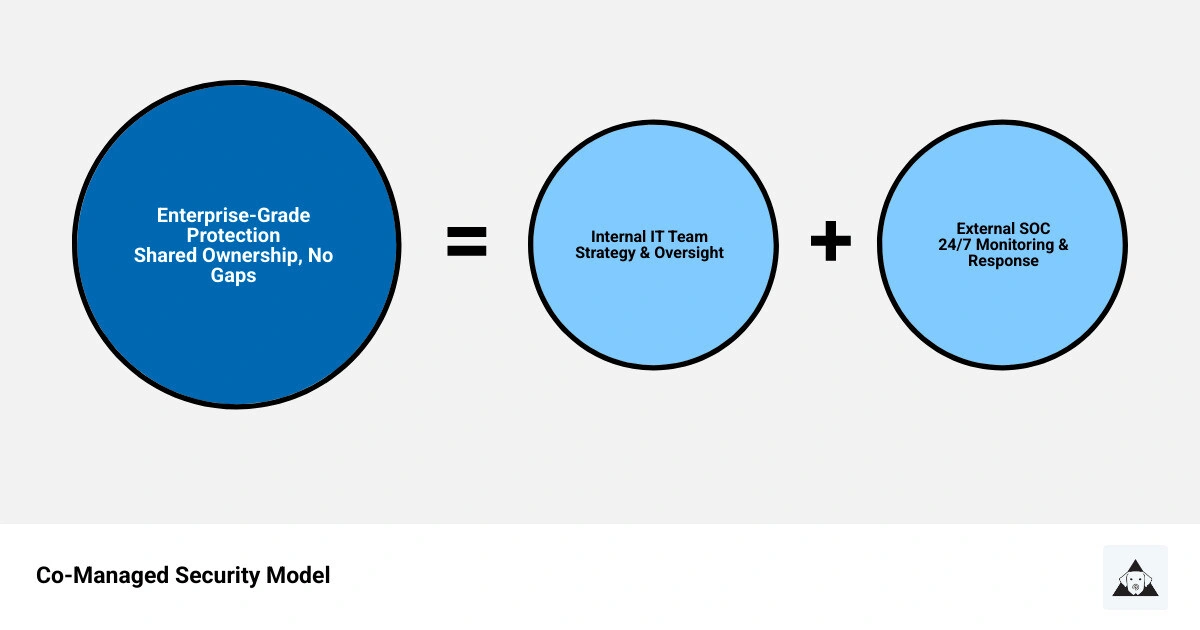
In the simplest terms, co-managed security is an augmentation model. We don't come in and tell you how to run your business; instead, we provide the heavy-duty machinery—the 24/7 Security Operations Center (SOC), the threat intelligence, and the automated response tools—that allows your internal team to focus on high-level strategy. It is a partnership built on shared ownership. You keep the keys to the castle, while we provide the guards on the ramparts who never sleep.
This modular delivery means you can pick and choose where you need help. Perhaps your team is excellent at desktop support but hasn't had the time to master Comprehensive Continuous Attack Surface Management. In a co-managed setup, we handle the complex telemetry while you handle the final business decisions.
The primary difference between these two models comes down to control and strategic oversight. In a fully managed model, the provider typically owns the entire stack and the decision-making process. In co-managed security for MSP, the execution is split.
| Feature | Co-Managed Security | Fully Managed Security |
|---|---|---|
| Strategic Ownership | Internal IT / Client | MSP / Provider |
| Tool Visibility | Shared access to dashboards | Limited / "Black Box" |
| Incident Response | Collaborative (Joint effort) | Provider-led |
| Day-to-Day Tasks | Split by RACI matrix | Handled entirely by MSP |
| Governance | Internal team sets the rules | Provider follows their own standards |
As we move through May 2026, the landscape has shifted. Clients are more tech-savvy than ever. They don't just want a "ticket slayer"; they want a strategic partner who understands their business. Younger, tech-literate business owners are pushing for more self-service and transparency. They want to see the "why" behind a security alert, not just a monthly report saying everything is fine.
Furthermore, AI-driven threats have made manual monitoring nearly impossible. With 3.5 million cybersecurity roles unfilled worldwide, finding and keeping talent is a nightmare. Co-managed security solves this bandwidth gap by giving you an "elastic" team that scales instantly.
Co-managed security is a perfect fit for mid-market and enterprise teams that have reached a "maturity ceiling." If you have a single IT admin who is overwhelmed by a project surge or if you are worried about the "single point of failure" risk (what happens if your one security guy goes on vacation?), co-management is your relief valve.
However, it might not be the right fit for a very small shop with zero internal technical expertise. If there is no one on the inside to coordinate with, a fully managed "MSP-in-a-box" approach is usually more efficient.
Not every security task should be outsourced. The most successful co-managed security for MSP partnerships focus on offloading "high-noise, high-specialization" tasks while keeping "high-context" tasks in-house.
We recommend starting with services that require 24/7 eyes-on-glass. This includes:
Your internal team knows your business better than any outsider. You should retain control over:
One of the biggest mistakes we see is "tool sprawl." Adding more point tools doesn't make you safer; it just makes you busier. At WhiteDog, we believe in Taming the Frankenstein Stack: How WhiteDog Simplifies Cybersecurity for MSPs.
Instead of buying twenty different products, you need a unified security timeline. Our platform collects raw telemetry, deduplicates the noise, correlates events across your entire network, and produces a single, prioritized detection. This is the "evergreen" approach we discuss in Never Buy Another Security Tool: An Evergreen Solution for MSPs.
The biggest risk in co-managed security for MSP is the "I thought you were doing that" syndrome. To avoid this, governance is not an afterthought—it is the foundation.
We use a RACI (Responsible, Accountable, Consulted, Informed) chart to define exactly who does what.
Communication shouldn't only happen when there is a fire. We recommend:
To work as one team, you need shared visibility. This means a shared PSA (Professional Services Automation) or ticketing system where both teams can see the same data in real-time. We focus on Simplified Security for MSPs: Escape Contract Chaos and Tool Overload by providing a single-pane-of-glass dashboard. By integrating Automation and Threat Intelligence: Scaling MSP Security, we ensure that both teams are working from the same playbook.
Why do this? Because it works. Using an MSP’s expertise in a co-managed IT model can reduce overall IT costs by up to 30%. But the benefits go far beyond the balance sheet.
The most common hurdle is "Bring Your Own Tool" (BYOT) friction. If an internal team insists on using a non-standard tool that the MSP doesn't know, it creates "exploratory time debt"—meaning it takes longer to fix things because the technician is learning on the fly. We overcome this by providing a Built for Service Providers Ready to Scale platform that integrates with existing stacks while maintaining high standards.
Contracts for co-managed security for MSP are usually structured around outcomes rather than just hours. You aren't paying for a "body in a chair"; you are paying for a 60-minute response time or a 99.9% uptime guarantee. This makes budgeting predictable and turns IT into a steady monthly expense rather than a series of expensive surprises.
Success should be measurable. We track:
Transitioning doesn't have to be a "rip and replace" event. It should be a phased evolution.
If you have clients who are currently fully managed but are growing their own internal IT teams, you can transition them by mapping their new internal roles to a RACI matrix. Start with a pilot phase—perhaps we keep handling the SOC while they take over Tier 1 help desk support. This allows the client to feel the Scaling Your MSP Security Offerings with WhiteDog benefits without losing the safety net.
Internal staff often fear that an MSP is there to replace them. We address this by positioning ourselves as "Support, Not Replacement." We handle the "grunt work" (patching, log monitoring) so they can handle the "cool work" (digital transformation, AI implementation). When internal teams realize they can finally take a vacation without checking their email, the resistance usually vanishes.
The future is Open XDR and curated stacks. We help MSPs escape the "Frankenstein Stack" by providing a platform that was WhiteDog Founder: This is an MSP Platform Built for MSPs by MSPs. Our goal is to ensure you Never Buy Another Security Tool because our integrated platform evolves as threats change.
Building an in-house SOC that operates 24/7 requires at least 8 to 12 full-time analysts to cover shifts, vacations, and sick days. For most mid-market companies, the cost of salary and enterprise-grade tools exceeds $300,000 annually. Co-managed security for MSP gives you that same 24/7 coverage for a fraction of the cost.
Strategic decisions always stay with you. This includes risk acceptance (deciding what level of risk the business is willing to take), policy creation, and final approval on major architectural changes.
Ask about tool access (will you have a dashboard?), incident roles (who is the "incident commander"?), and how the provider handles Compliance Made Simple: A Growth Path for MSPs. You can also find great general frameworks in this Co-Managed IT services overview and this Co-managed IT partnership guide.
The goal of co-managed security for MSP is simple: risk reduction and operational efficiency. By sharing the load, you get faster detection, reduced dwell time, and the strategic control you need to grow your business. You don't have to choose between "doing it all" and "giving it all away." There is a middle road that leads to a more secure, more profitable, and much more sane IT department.
Whether you are looking for How AI & Automation Are Reshaping Cybersecurity for MSPs or need to get a handle on your Comprehensive Continuous Attack Surface Management, the right partnership makes all the difference.
We are here to be your best friend in the fight against cyber threats. Let's build something secure together.

Master enterprise risk reduction with this detailed guide covering ERM frameworks, AI governance, and cybersecurity strategies for 2026.
Compare top AWS incident response solutions for rapid remediation, automated triage, and containment with native tools and expert escalation paths.

Harden your Amazon Linux firewall with firewalld and nftables to meet STIG compliance, block lateral movement, and secure AWS EC2 hosts.

Implement data governance to improve data quality, ensure compliance, and reduce risk across your enterprise lifecycle.

Master AWS Security Hub for unified cloud security posture, compliance automation, and streamlined SecOps workflows.

Learn how AWS delta detection response stops cloud alert noise by tracking state drift and securing Delta Lake workloads.