Cybersecurity
July 11, 2026
Upgrade your MSP email gateway security in 2026. Ditch legacy failures, embrace AI-driven ICES, Zero Trust, and unified protection against phishing & BEC.
MSP MDR detection services represent a fundamental shift in how managed service providers protect their clients — moving from reactive, tool-heavy approaches to a unified, continuously managed security operation.
Here is a quick overview of what MSP MDR detection services deliver:
If you manage security for multiple clients, you already know the pressure. Threats are getting more sophisticated. Tool stacks are getting more complex. And your team is stretched thin trying to keep up with alerts that may or may not be real.
Traditional antivirus and even standalone EDR tools were not built for this environment. They generate noise. They work in silos. And they leave gaps that attackers are happy to exploit.
MDR changes that equation. Organizations using MDR services see a 50% reduction in mean time to detect and a 40% reduction in mean time to respond. MSPs that offer MDR report 30% higher client retention and 25% more recurring revenue. These are not marginal gains — they are business-defining outcomes.
This guide is built to help you cut through the noise and evaluate MDR service providers with confidence. You will learn what separates modern MDR from legacy security, how the underlying platform architecture works, and what to look for when choosing a partner.
I am Shahin Pirooz, a cybersecurity and technology executive with over two decades of experience building managed security and cloud services, and I have spent much of that time specifically helping MSPs operationalize MSP MDR detection services that scale without adding complexity. This guide draws on that hands-on experience to give you a clear, practical framework for evaluating your options and making the right call for your business and your clients.
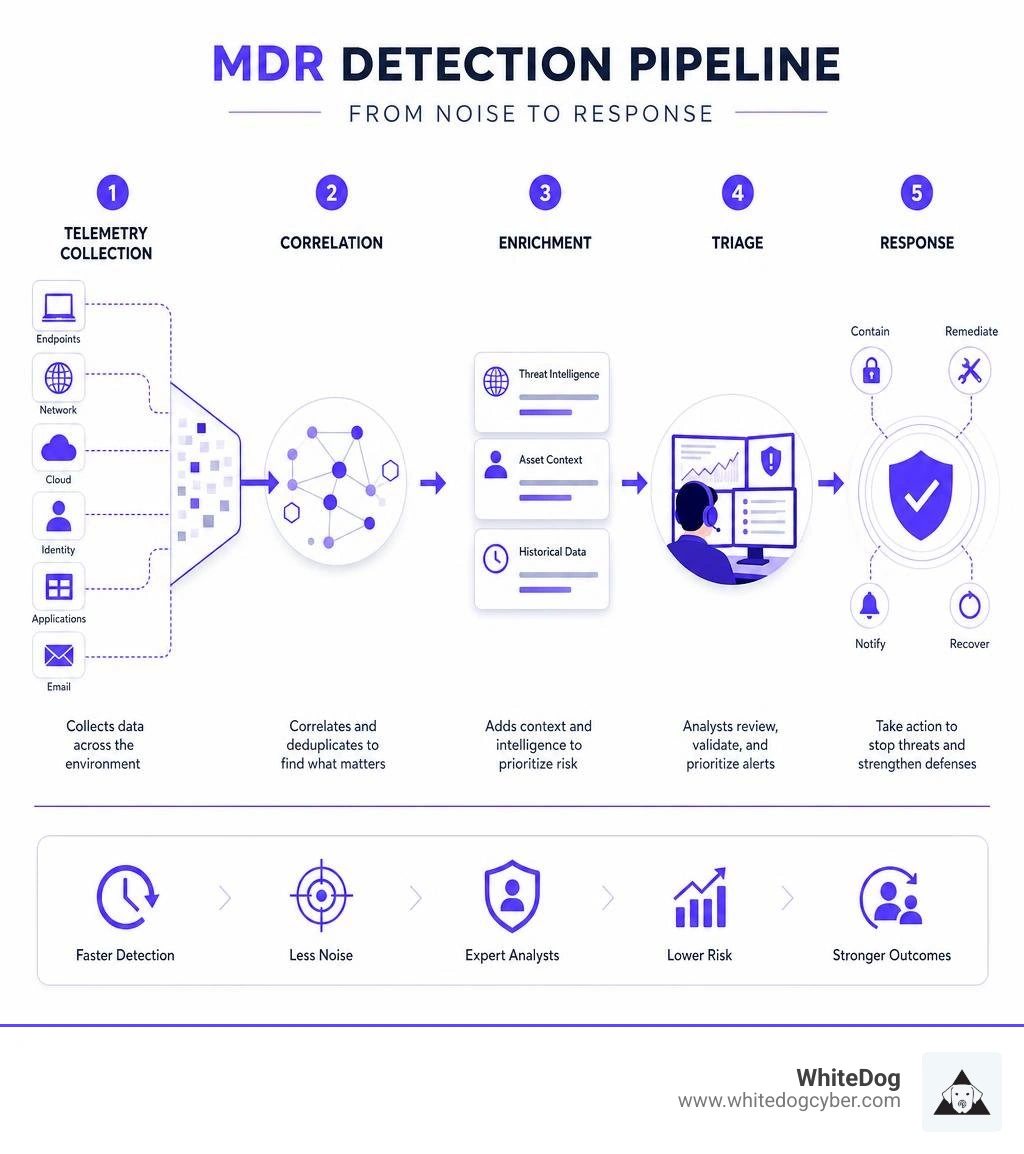
To understand why modern security leaders are shifting to managed detection and response, we must look at how legacy security models fall short in today's threat landscape. Traditional managed security service providers (MSSPs) historically focused on log collection, perimeter monitoring, and forwarding alerts to the client to investigate.
This model leaves the heavy lifting—analysis, validation, and active mitigation—on your shoulders. Modern MSP MDR detection services turn this model on its head by delivering active, human-led response alongside detection.
| Security Capability | Legacy Point Solutions & Traditional MSSPs | Modern MSP MDR Detection Services |
|---|---|---|
| Operational Focus | Log collection, alert forwarding, and perimeter defense | Live detection, threat correlation, and active incident response |
| Dwell Time | Often ranges from weeks to months before detection | Reduced to minutes through proactive correlation and 24/7 monitoring |
| Response Ownership | Alerts are passed to the MSP or client to investigate | Fully managed containment and mitigation by a dedicated 24/7 SOC |
| Technology Integration | Siloed tools operating independently with limited visibility | Unified platform correlating telemetry across endpoints, network, and cloud |
| Analysis Quality | Rule-based signatures and basic alert forwarding | Behavioral analysis, threat intelligence, and human analyst validation |
Understanding the difference between these approaches is crucial. For a deeper dive into how these paradigms differ, read our analysis on Mdr In Cyber Security.
Traditional security relies heavily on static rules. If an event doesn't trigger a specific rule, it goes unnoticed. Meanwhile, Managed Detection Response focuses on behavioral telemetry, identifying anomalous patterns that indicate an active adversary.
This approach aligns with the industry-standard NIST Computer Security Incident Handling Guide, which emphasizes the necessity of continuous monitoring, rapid detection, and coordinated containment to minimize organizational risk.
A modern MDR service is not just a collection of software licenses. It is an operational ecosystem built on three core pillars:
By utilizing these capabilities, the right Managed Detection And Response Tools transform raw data into actionable context, enabling rapid, precise decision-making.
Dwell time—the duration an attacker remains undetected inside an environment—is one of the most critical metrics in cybersecurity. When adversaries gain access, they don't immediately deploy ransomware. They spend days or weeks mapping the network, escalating privileges, and locating sensitive data.
Traditional point solutions are often blind to these low-and-slow tactics. Because each tool only sees a small slice of the environment, the attacker's lateral movement looks like normal administrative activity.
Modern MDR services solve this by monitoring behavior continuously. When an analyst can see that a user account logged in from an unusual location, immediately ran a PowerShell script, and attempted to access an uncommon database, they can intervene before damage occurs.
Speed is the ultimate defense. While Attackers Linger For Months We Find Them In Minutes by looking at the entire environment through a single, correlated pane of glass. When you operate with the mindset that Attackers Will Get In Speed Is Your Defense, your focus shifts from trying to build an impenetrable wall to ensuring you can detect and contain threats in minutes, not days.
Many security organizations struggle with "tool sprawl"—the accumulation of disconnected security products that generate independent alert streams. This disjointed approach forces analysts to manually pivot between consoles to reconstruct an attack timeline, wasting precious minutes when a fast response is critical.
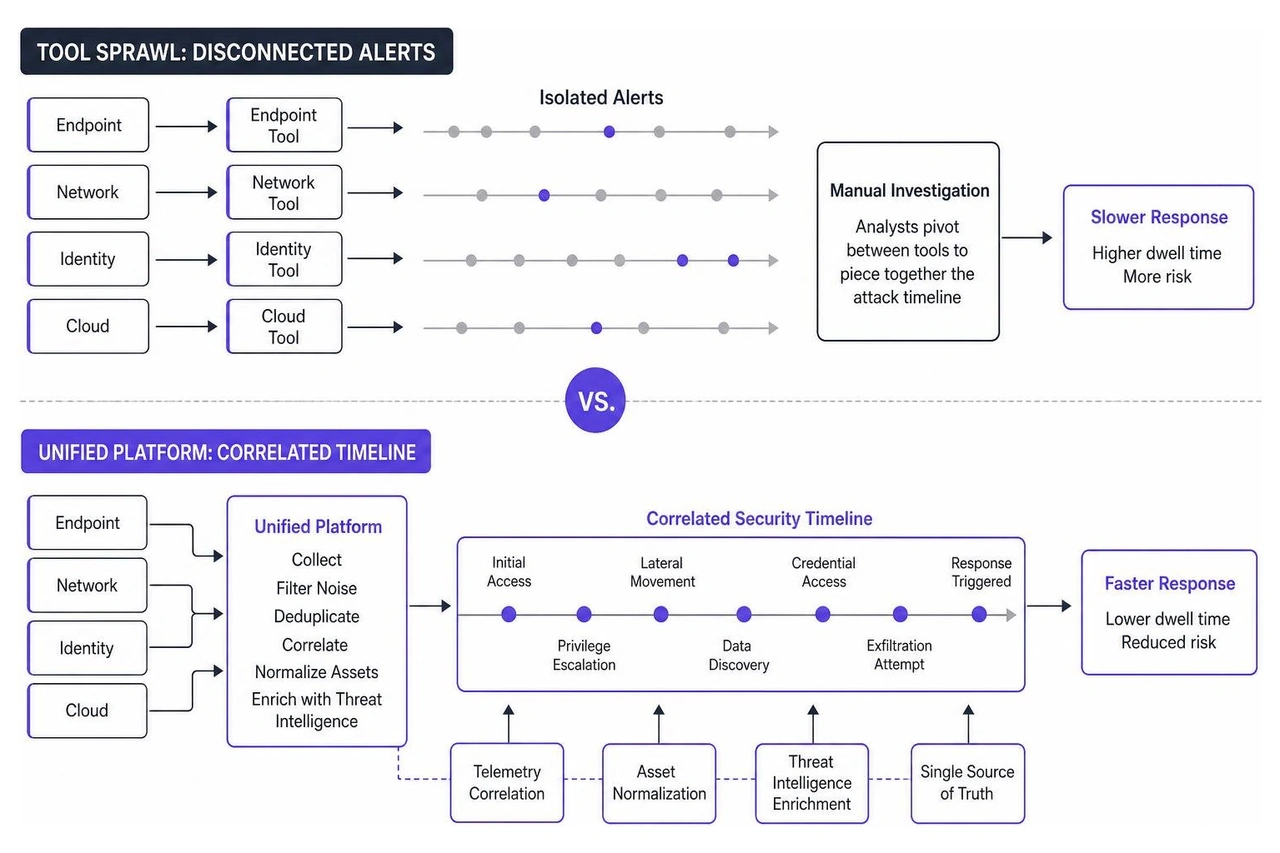
A unified cybersecurity platform eliminates this friction by collecting raw telemetry across your entire estate, filtering out the noise, deduplicating repetitive alerts, and correlating the remaining signals. This process normalizes data to specific assets and enriches it with real-time threat intelligence.
The result is a single, chronological security timeline that shows exactly how an attack started, what assets were affected, and where the threat is attempting to spread.
This architecture is fundamentally different from traditional SIEM-centric approaches. Legacy SIEMs simply collect and store massive volumes of log data, leaving the difficult work of correlation and rule-writing to your team.
Furthermore, simply adding context to an alert isn't enough; we must understand Why Alert Enrichment Isnt Enough if the underlying system still forces analysts to manually triage thousands of independent alerts. True security operations require One Comprehensive Xdr Platform that automatically correlates telemetry into unified incidents before they ever reach a human analyst.
When evaluating security platforms, it is important to distinguish between Open XDR and fully managed services:
For service providers looking to scale, partnering with an Msp Soc As Service delivers the complete MDR experience, allowing your team to offload the burden of round-the-clock monitoring and specialized threat analysis.
While standard MDR provides continuous monitoring, Delta Detection & Response (DDR) represents the highest tier of security operations. DDR goes beyond passive monitoring by continuously validating your security posture against real-world attack simulations.
Security posture is not static. Configurations change, new vulnerabilities are discovered, and users make mistakes. Relying on annual or quarterly assessments leaves you blind to these changes.
By adopting an Always On Or Always Exposed Rethinking Point In Time Security approach, DDR continuously tests your defenses to identify security drift.
Because configurations change daily, understanding Security Drift Why Your Pen Test Is Already Outdated highlights the necessity of continuous, automated validation. DDR ensures that your detection rules, access controls, and security policies are actively working exactly when you need them most.
For managed service providers, offering MDR is not just about improving security—it is a powerful lever for business growth. Historically, MSPs have struggled to scale their security offerings because of the immense capital and operational costs associated with building and staffing an in-house SOC.
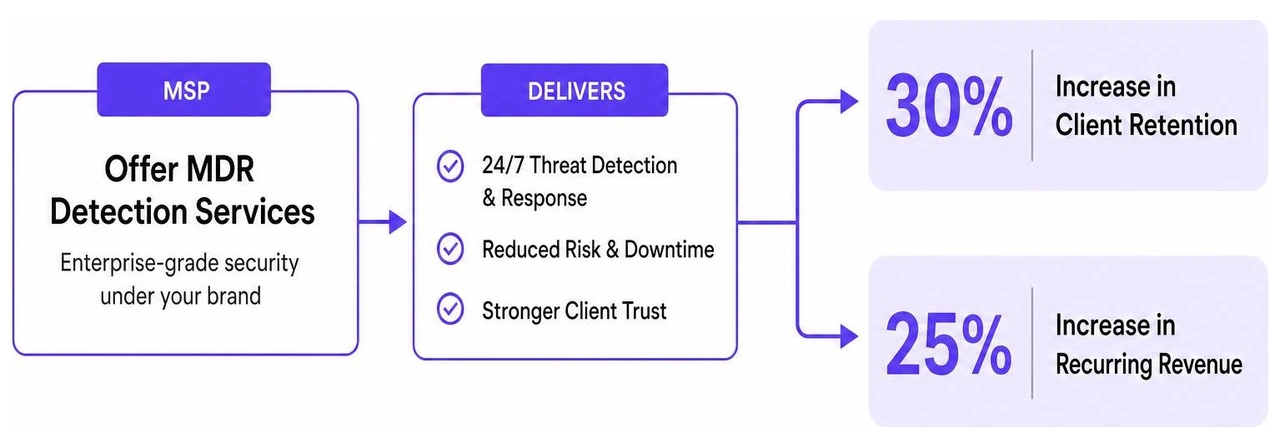
By partnering with an MDR provider, MSPs can instantly offer enterprise-grade security operations under their own brand. This shifts the relationship with clients from a basic IT utility provider to a strategic security partner, resulting in:
To maximize these benefits, MSPs must pair detection with Proactive Incident Response Services. This proactive stance ensures that when an anomaly is detected, containment happens immediately.
For a complete framework on how to structure these operations, consult our Cybersecurity Incident Response Guide 2026.
Alert fatigue is one of the greatest operational hazards for any IT team. When security tools generate hundreds of daily notifications—the vast majority of which are harmless background noise—analysts naturally begin to ignore them. This is how critical alerts get missed.
Modern MDR services solve this through aggressive noise reduction. By filtering, deduplicating, and correlating telemetry at the platform level, MDR reduces the volume of alerts by up to 90%.
The remaining alerts are triaged by a professional SOC before they ever reach your dashboard. This means your team only receives high-fidelity, validated alerts that require action, supported by 247 Threat Response Services to handle the heavy lifting of mitigation.
To prove the value of your MDR service to both your internal leadership and your clients, you must track concrete performance metrics. The Gartner Market Guide for Managed Detection and Response Services highlights several key performance indicators (KPIs) that define operational excellence:
Modern regulatory frameworks no longer view cybersecurity as an optional IT expense. Whether your clients operate in healthcare (HIPAA), process credit card payments (PCI-DSS), or handle European citizen data (GDPR), they face strict compliance mandates regarding data protection and incident reporting.
Many of these regulations specifically require continuous monitoring, log retention, and rapid incident response. Meeting these requirements through point solutions is incredibly difficult and expensive.
MDR services simplify compliance by providing a centralized repository of security telemetry, continuous monitoring, and documented incident response timelines. This structured approach ensures your clients can easily demonstrate compliance during audits.
However, compliance is only a baseline. True risk management requires continuous visibility into your vulnerabilities. Traditional vulnerability scanning is no longer sufficient; indeed, Vulnerability Management Is Dead if it only looks at internal software patches once a month.
Instead, organizations need Comprehensive Continuous Attack Surface Management to monitor all external assets, cloud environments, and shadow IT in real time. By adopting this approach, you can Find Your Gaps Before Attackers Do, closing security holes before they can be exploited.
Traditional security tools rely on signatures—known patterns of malicious code—to block threats. This leaves them blind to zero-day exploits (newly discovered vulnerabilities with no existing patch) and AI-driven attacks that dynamically alter their code to avoid detection.
MDR services address this by focusing on behavioral analysis and active threat hunting. Instead of looking for a specific file signature, MDR platforms monitor what a file or user does. If a trusted application suddenly attempts to modify system registries or harvest credentials, the platform flags the behavior as anomalous.
Because attackers are constantly evolving, you must Prepare To Be Hacked by building a resilient detection architecture that assumes perimeter defenses will eventually fail, focusing instead on rapid containment.
Building an in-house SOC is cost-prohibitive for most small to medium-sized businesses and the MSPs that serve them. Staffing a 24/7/365 SOC requires a minimum of 8 to 12 full-time security analysts to account for shifts, holidays, and turnover. When you add the cost of SIEM software, threat intelligence feeds, and ongoing training, the annual operational expense quickly reaches hundreds of thousands of dollars.
MDR offers a highly predictable, subscription-based pricing model. By sharing the infrastructure and analyst pool across many clients, MDR providers deliver enterprise-grade security at a fraction of the cost of building an in-house operation. This allows MSPs to allocate resources toward client relationships and business development rather than managing security infrastructure.
Modern MDR platforms are built for modular integration, allowing you to leverage and enhance your existing security investments rather than starting from scratch.
The platform integrates seamlessly with your current tools via APIs, ingesting telemetry from your endpoint protection, firewall, email security, and cloud providers to correlate this data into a single timeline.
This co-managed approach allows your internal team to maintain visibility and collaborate with the SOC, ensuring a coordinated response to any validated threat without disrupting your established workflows.
Selecting an MDR partner is one of the most important decisions your MSP will make. The right partner should act as an extension of your team, providing the technology, expertise, and operational support you need to scale.
At WhiteDog Cyber, we provide a co-managed, white-label cybersecurity platform specifically designed for MSPs. We combine a curated, actively managed security stack with a 24/7 SOC, threat hunting, and full incident response—which is fully included in our MDR, XDR, and DDR offerings with no emergency fees.
Our platform integrates your existing tools into a single, correlated security timeline, eliminating tool sprawl and dramatically reducing dwell time. We are so confident in our process that we offer a 30-day onboarding guarantee with no added fees.
If you are ready to scale your security operations, protect your clients with 24/7 monitoring, and grow your recurring revenue, we are here to help. Explore our Msp Soc As Service to see how we can transform your security offering.
To take the next step in validating your clients' security posture and identifying hidden vulnerabilities, learn more about our Penetration Testing Services today.


Upgrade your MSP email gateway security in 2026. Ditch legacy failures, embrace AI-driven ICES, Zero Trust, and unified protection against phishing & BEC.

Run better cyber security health checks with MSPs: Boost resilience, cut risks, and ensure compliance via continuous monitoring and NIST-aligned audits.

Discover how cyber security health checks strengthen your defenses, reduce risk, and support compliance across regulated industries and SMEs.

Discover co-managed security for MSP: Share responsibilities, boost efficiency, and scale cybersecurity without losing control.

Master your CMMC compliance assessment with this definitive guide covering levels, timelines, and certification requirements for DoD contractors.

Master CMMC compliance certification for DoD contractors. Guide to levels, assessments, timelines & prep for FCI/CUI security.