Cybersecurity
July 29, 2026
AWS Managed Security Services: Compare Providers Survival Guide - Learn about aws managed security services
MSP risk reduction works when you make risk a repeatable service process, not a once-a-year assessment. Start by inventorying privileged tools, client access, vendors, and critical data; rank the highest-likelihood and highest-impact risks; then enforce baseline controls, test recovery, document exceptions, and review residual risks with clients.
A practical first cycle is:
MSPs have an unusually large blast radius. One compromised technician account, RMM platform, or vendor can affect many client environments at once. Third parties were involved in 30% of confirmed breaches in 2024, up from 15% the year before, making vendor oversight and access control core operational concerns.
Risk reduction also supports clearer client conversations. It gives teams evidence for insurance renewals, compliance reviews, contracts, and quarterly business reviews, while helping clients understand which security decisions require their approval and budget.
I am Shahin Pirooz, a cybersecurity and technology executive with more than two decades of experience building cloud, managed services, and security programs. In this guide, I will show how MSP risk reduction can strengthen service delivery without adding unnecessary operational complexity.
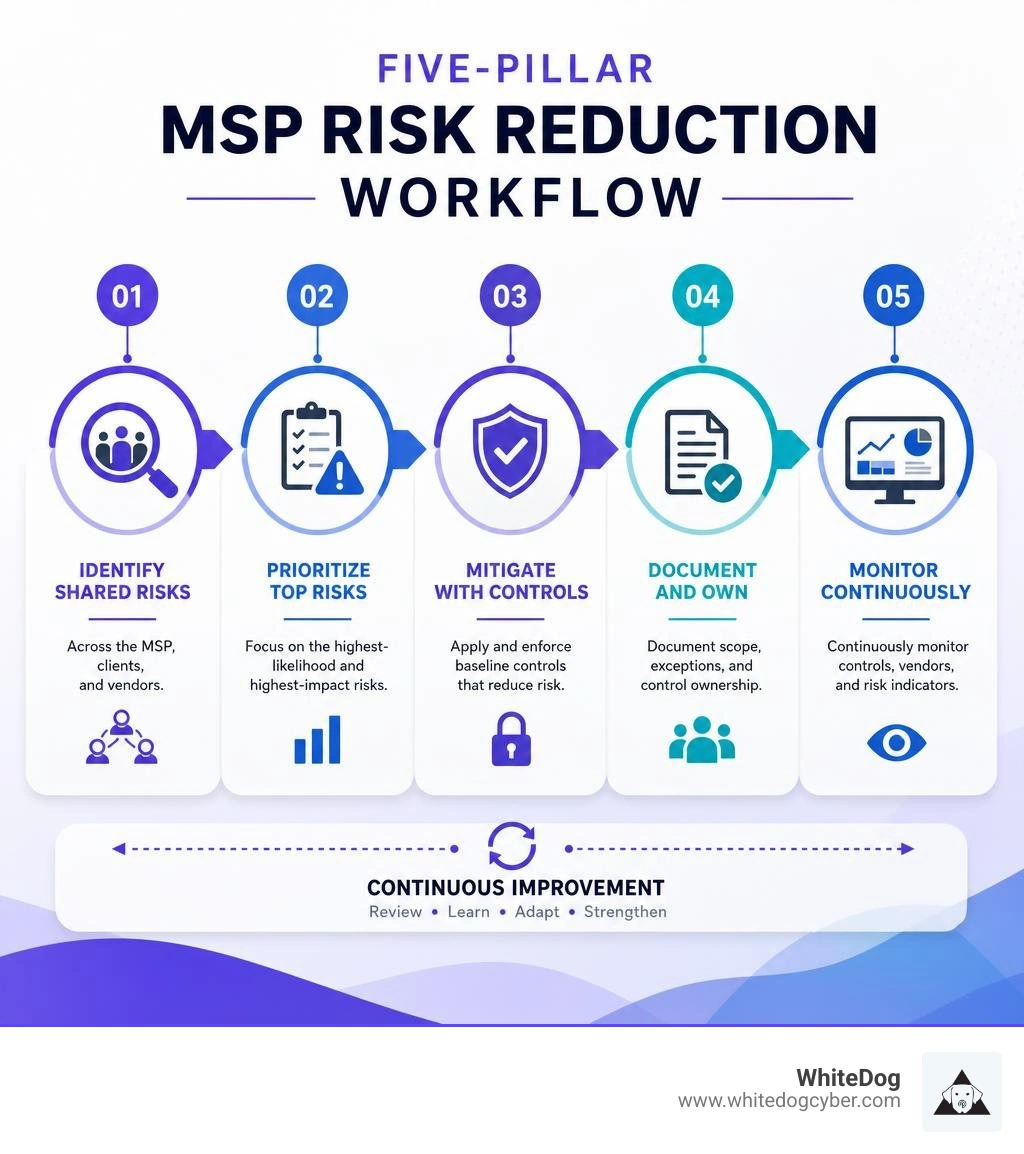
Important MSP risk reduction terms:
Service providers operate in a threat landscape where minor configuration errors can trigger systemic failures. The primary attack vectors threatening MSP environments remain consistent: credential abuse (accounting for 22% of initial intrusions), vulnerability exploitation (20%), and phishing campaigns. In small-to-midsize business environments, 88% of data breaches involve ransomware. For an MSP, these incidents are amplified by the operational trust models that underpin multi-tenant infrastructure.
Focusing on exotic threats before mastering standard controls leaves critical attack paths open. The five most common operational and security failures across all service verticals are:
To systematically evaluate these threats, service providers should establish a structured risk evaluation model such as a 5x5 Likelihood and Impact Matrix or Failure Mode and Effects Analysis (FMEA).
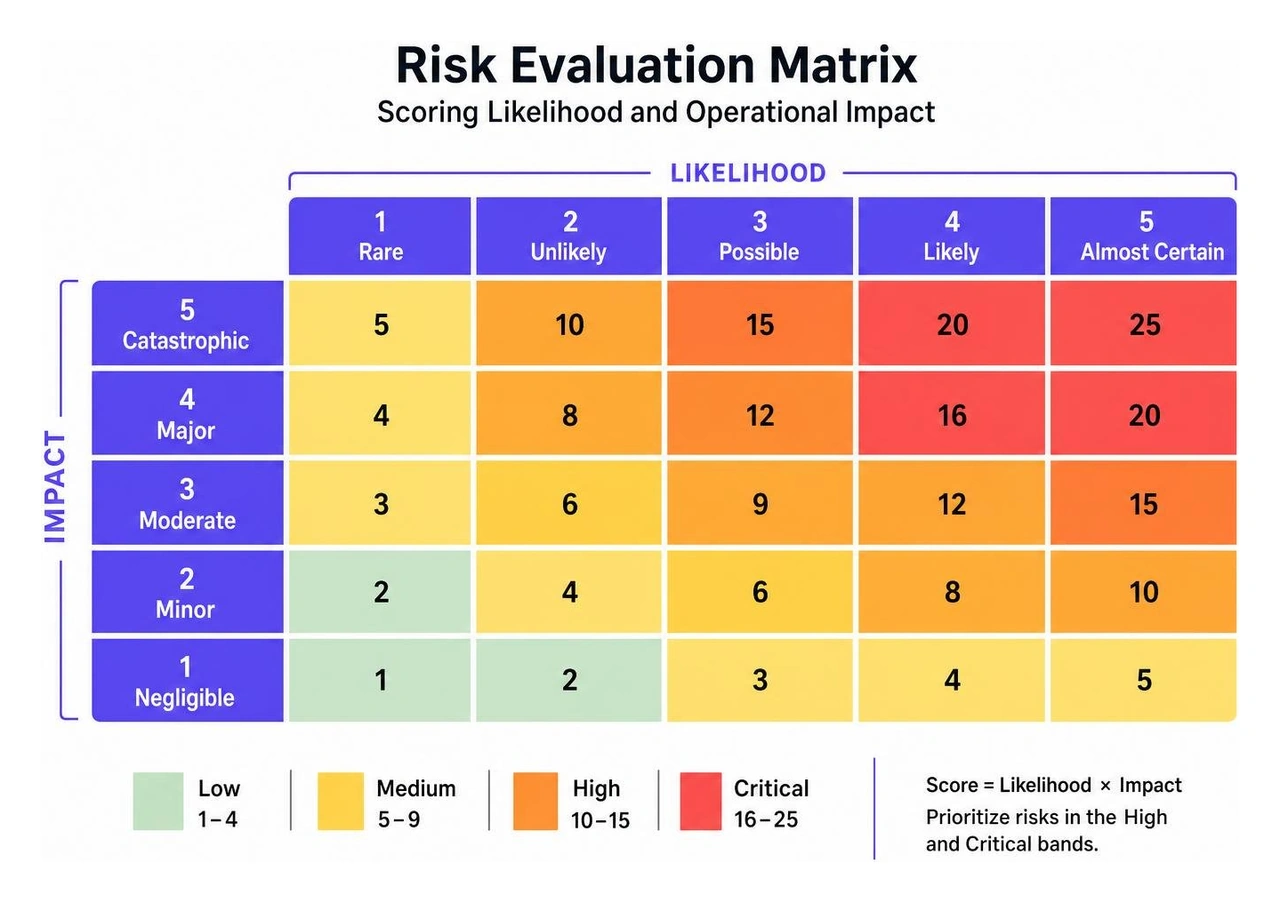
Scoring risks on a 1-to-5 scale for both likelihood (Rare to Almost Certain) and impact (Negligible to Catastrophic) provides clear severity bands: Low (1–4), Medium (5–9), High (10–15), and Critical (16–25).
Prioritizing vulnerabilities must also align with operational advisories rather than theoretical scores alone. The CISA guidance for MSPs and customers emphasizes remediating vulnerabilities cataloged in CISA’s Known Exploited Vulnerabilities (KEV) database. Vulnerabilities actively weaponized in the wild represent immediate operational exposure and must take precedence over high-CVSS theoretical flaws that lack exploit mechanisms.
A foundational vulnerability for many service providers is the internal security parity gap. Holding clients to strict compliance and technical standards while tolerating lax internal practices creates significant operational and legal liability. Technicians who bypass multi-factor authentication (MFA) for administrative convenience or share privileged accounts across customer tenants undermine tenant security.

Internal risk reduction begins with standard operational disciplines:
Modern IT delivery relies on integrated software supply chains, creating significant concentration risk. The remote monitoring and management (RMM) market is concentrated among 3 to 4 major vendors, while professional services automation (PSA) is led by 2 to 3 platforms. A single security vulnerability in one of these central applications can allow threat actors to compromise hundreds of service providers and thousands of downstream business networks in a single campaign.
Industry telemetry highlights the expanding scope of supply chain vulnerability:
Managing 20 to 30 disparate point products creates operational blind spots and alert fatigue, compounding supply chain risk. Organizations often find success in achieving unified security across vendor ecosystems by consolidating management layers, streamlining integrations, and reducing vendor sprawl.
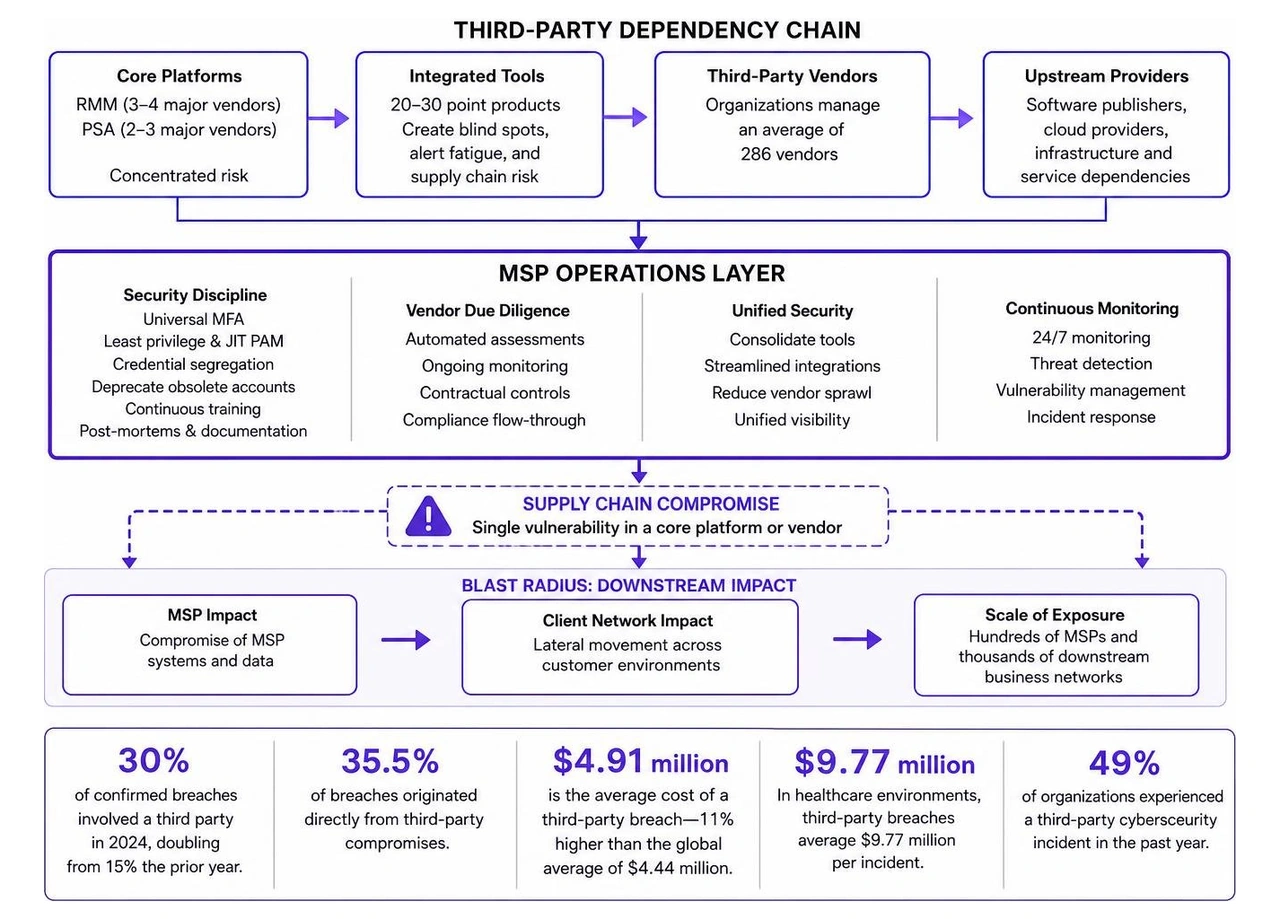
Because modern organizations manage an average of 286 third-party vendors while typical internal third-party risk management (TPRM) teams operate with fewer than nine people, service providers must establish automated vendor due diligence.
Regulatory mandates now enforce third-party vendor oversight across multiple jurisdictions:
To help clients navigate these obligations, providers can implement structured supply chain compliance strategies that track vendor inventories, verify SOC 2 Type II reports, audit sub-processor access controls, and maintain clear exit and data portability plans.
Technical controls alone cannot protect an organization if its legal agreements fail to define operational scope and limit exposure. Unclear Master Services Agreements (MSAs) and Statements of Work (SOWs) leave service providers exposed when security incidents occur.
For practical insights into structuring service agreements, review MSP cybersecurity liability practices. Key contractual components include:
When clients decline essential security measures such as 24/7 security monitoring, endpoint detection, or multi-factor authentication, do not rely on verbal agreements. Require the client's executive sponsor to sign a formal Risk Acceptance Waiver detailing the specific protection declined, the operational risks involved, and an explicit release of provider liability for breaches stemming from that gap.
The cyber insurance market acts as a de facto regulator for managed services. Underwriters require verified implementation of specific controls before issuing policies or processing claims:
During a claim investigation following a security breach, forensic auditors compare four distinct records: the representations made on insurance applications, the commitments in service contracts, the actual telemetry logs within security tools, and logged client exception tickets. Discrepancies—such as claiming universal MFA on an application when MFA was only active on external firewalls—give underwriters legal justification to rescind policies and deny coverage.
Maintaining alignment across these records helps avoid operational disputes, preventing cyber insurance displacement risks where post-incident audit discrepancies lead carriers to mandate external incident response teams and displace incumbent service providers.
To maintain coverage, pair first-party Cyber Liability Insurance (which covers incident forensics, public relations, notification costs, and extortion demands) with third-party Technology Errors and Omissions (E&O) Insurance (which covers professional liability and service delivery failures).
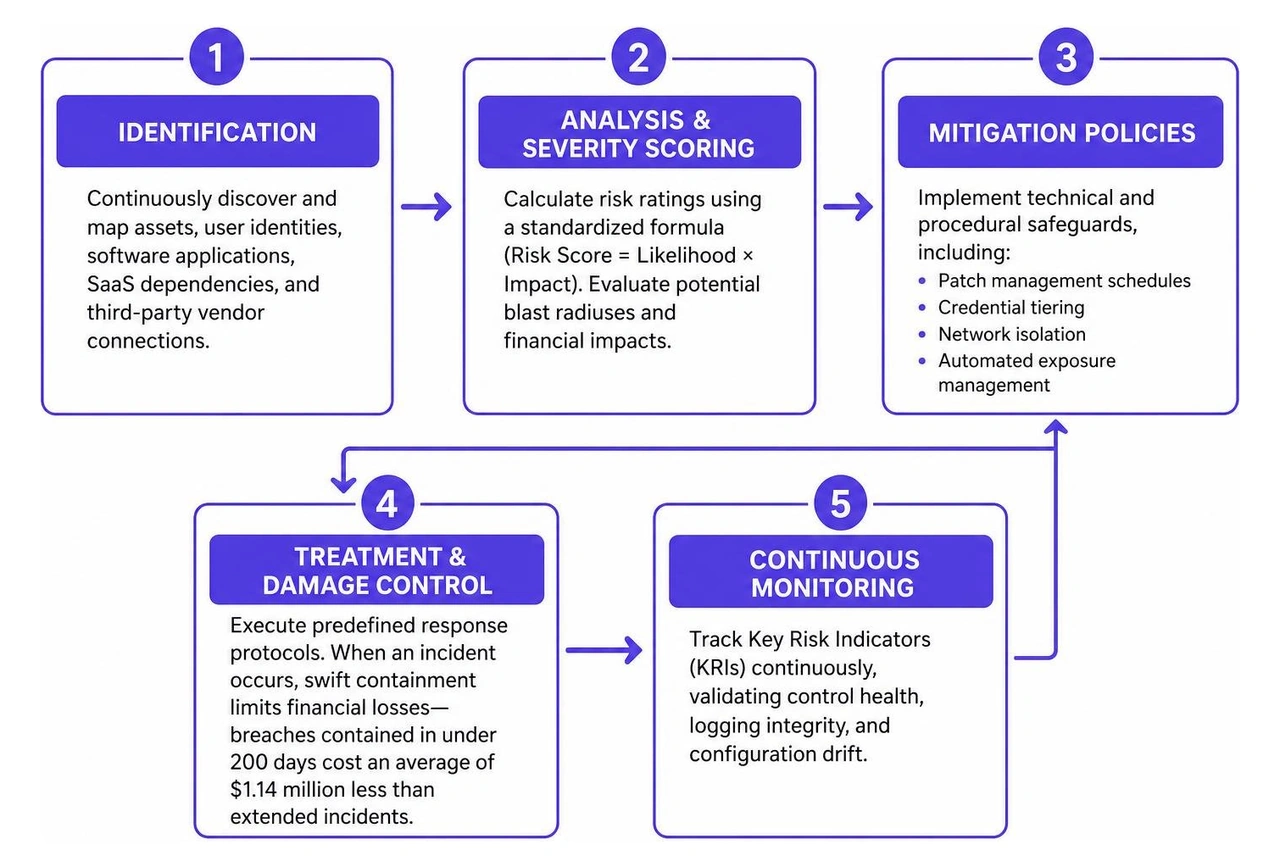
Operational risk reduction requires a continuous lifecycle embedded into everyday service operations rather than an isolated annual event.
| Treatment Strategy | Operational Definition | Practical MSP Example |
|---|---|---|
| Mitigate | Deploy technical or procedural controls to reduce likelihood or impact. | Deploying managed endpoint protection and enforcing phishing-resistant MFA. |
| Transfer | Shift financial impact to an external third party. | Securing comprehensive Cyber Liability and E&O policies; requiring vendor warranties. |
| Accept | Formally acknowledge residual risk when mitigation is cost-prohibitive. | Documenting a legacy line-of-business server running in an isolated VLAN with a signed client waiver. |
| Avoid | Eliminate exposure entirely by discontinuing the risky activity or service. | Refusing to support unpatched, end-of-life operating systems lacking vendor security updates. |
Risk management conversations should be regular components of client Quarterly Business Reviews (QBRs). Presenting security through a business-focused lens builds executive alignment and reinforces service value.
Target operational metrics for a healthy client risk dashboard include:
Building a mature risk reduction framework provides service providers with clear opportunities to introduce high-value advisory and managed compliance offerings.
The vendor risk management market is projected to reach $51.34 billion by 2030, driven by regulatory oversight and rising breach costs. Because 73% of financial institutions operate with two or fewer full-time employees managing vendor risk, mid-market organizations often rely on trusted providers for third-party oversight.
Service providers can expand their service catalog with dedicated risk offerings:
Providers looking to operationalize and package these capabilities can review practical methodologies for scaling MSP security offerings across diverse customer environments.
Formal, comprehensive risk assessments should be conducted at least annually across internal operations and client environments. However, risk management must also include continuous telemetry monitoring alongside ad-hoc reviews triggered by major operational changes, such as adopting new core software, migrating infrastructure, or responding to high-severity zero-day disclosures.
Aggregation risk refers to the operational vulnerability where a single centralized compromise—such as an RMM platform vulnerability or a compromised master administrative credential—cascades across all managed client environments simultaneously. For service providers, aggregation risk multiplies legal liability, breach notification mandates, and financial damages across their entire customer base from a single intrusion point.
When a client declines critical security controls (such as MFA, EDR, or immutable backups), the service provider should:
Operational risk reduction is a continuous discipline that strengthens service delivery, simplifies compliance audits, and builds long-term client trust.
At WhiteDog Cyber, we deliver a Unified Cybersecurity Platform combining MDR, XDR, Delta Detection & Response (DDR), exposure management, correlated intelligence, and 24/7 SOC expertise, offering unified visibility across email, DNS, identity, endpoint, network, cloud, and data through modular integration rather than a rip and replace approach.
Our offerings provide clear capabilities designed to fit your operational model:
WhiteDog does not replace your existing Microsoft Security or Microsoft 365 investments. Instead, our platform complements and extends your Microsoft environment, helping you maximize the value of your current investments. By leveraging continuous attack surface management and 24×7 security operations built on correlated intelligence, we help teams identify threats earlier and respond with confidence.
To see how unified visibility and 24/7 SOC expertise can strengthen your service delivery, explore our comprehensive risk reduction solutions today.


AWS Managed Security Services: Compare Providers Survival Guide - Learn about aws managed security services

Ultimate Checklist for Comparing Cyber Security Managed Service Providers - Learn about cyber security managed service providers

Quantum computing may not replace today's AI data centers overnight, but it could fundamentally change the economics of compute. Learn what comes next.

Discover the top benefits of ZTNA over VPN: enhanced security, reduced attack surface, scalability & seamless access for hybrid work. Ditch VPN now!

Protect your clients with an email threat detection MSP that stops advanced phishing, BEC, and ransomware before damage occurs.

Master cybersecurity incident response training to strengthen enterprise defenses, reduce dwell time, and accelerate threat containment with WhiteDog’s Delta Detection & Response (DDR).