Cybersecurity
October 27, 2026
Learn how organizations can implement zero trust architecture with continuous verification, stronger access controls, and reduced cyber risk.
MSP SOC as service is a model where managed service providers partner with an external Security Operations Center to deliver 24/7 threat monitoring, detection, and response to their clients — without building that capability in-house.
Here is what that means in practice:
| What You Get | What You Skip |
|---|---|
| 24/7 threat monitoring and triage | Hiring 10-12 specialized analysts |
| Expert incident response (included in MDR, XDR, and DDR) | $1M+ annual SOC build cost |
| AI-assisted detection and correlation | Tool sprawl and vendor fatigue |
| White-label reporting for clients | Alert burnout for your team |
| Compliance support (HIPAA, PCI DSS) | Months of infrastructure engineering |
The pressure on MSPs right now is real. Threats are more sophisticated. Clients expect around-the-clock protection. And 67% of organizations say talent shortages are blocking their security growth. There are an estimated 2.7 million unfilled cybersecurity positions globally — so hiring your way out of this problem is not realistic for most MSPs.
Meanwhile, cyberattacks do not follow business hours. Attackers deliberately strike after hours, knowing most security teams do not. When a breach goes undetected, the costs add up fast — businesses take an average of 50 days to detect a breach and another 30 to contain it, with an average cost of $276,323 per incident.
The result? More MSPs are moving away from reactive, tool-heavy security stacks and toward a unified, managed operations model. In fact, 90% of organizations now prefer an outsourced or hybrid SOC approach — with only 9% planning to build entirely in-house.
This guide breaks down exactly how MSP SOC as service works, what to look for in a provider, and how to use it to grow your business without burning out your team.
I'm Shahin Pirooz, a cybersecurity executive with over 20 years of experience building Managed Security and Cloud Services — including pioneering some of the earliest MSP SOC as service delivery models. In this guide, I'll walk you through what actually works, based on what I've seen in the field.
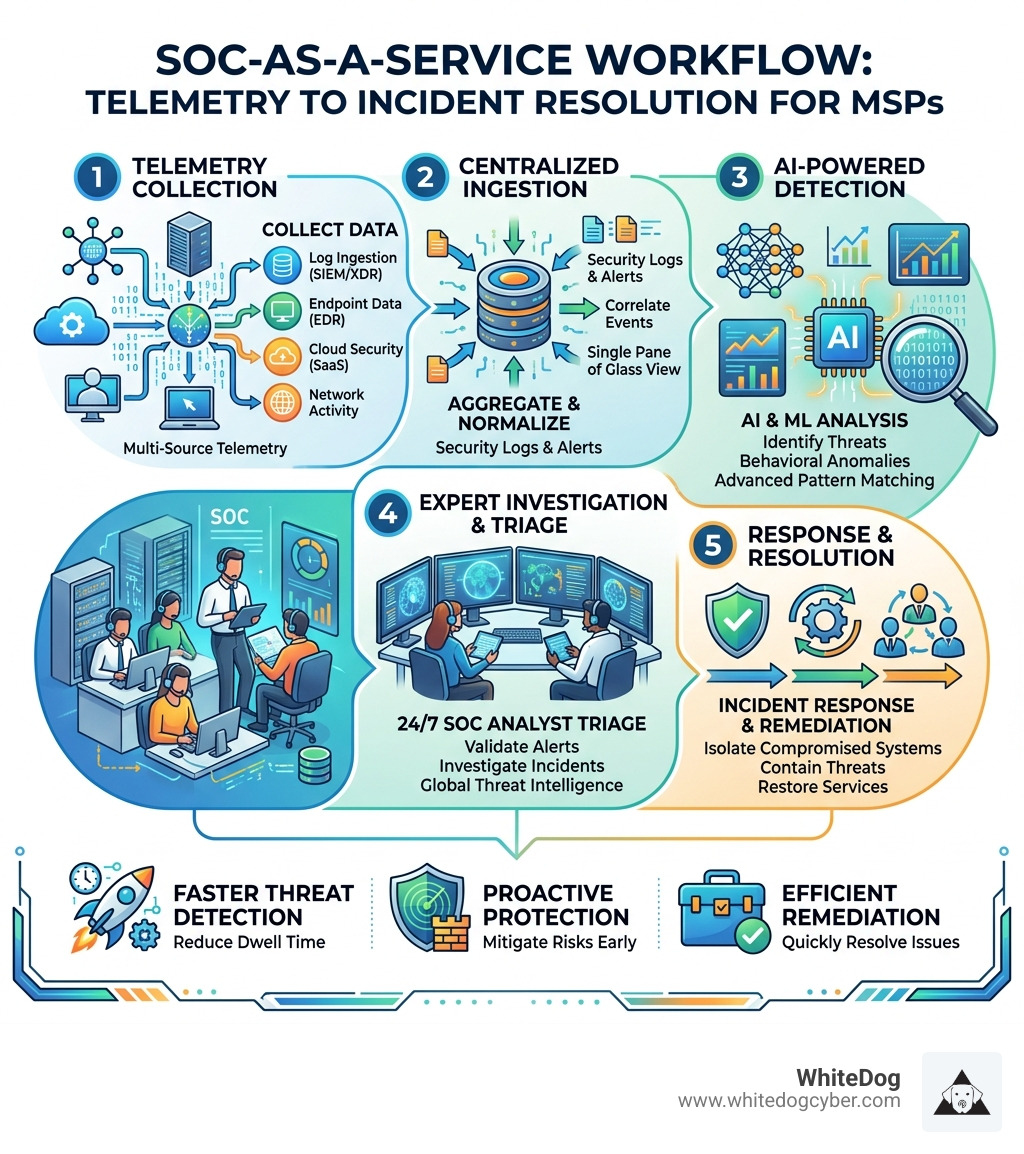
For years, the standard MSP security model was "preventative." You sold antivirus, a firewall, and maybe some email filtering. But as we move through 2026, prevention alone is no longer enough. The "AI threat era" has arrived, and hackers are using automation to find cracks in the perimeter at lightning speed.
Modern MSP SOC as service shifts the focus from just building walls to active, 24/7 monitoring and response. It’s no longer about whether a tool is installed; it’s about who is watching the console when a credential is stolen at 3:00 a.m. on a Sunday. By leveraging a MDR in Cyber Security approach, we can move beyond the "set it and forget it" mentality.
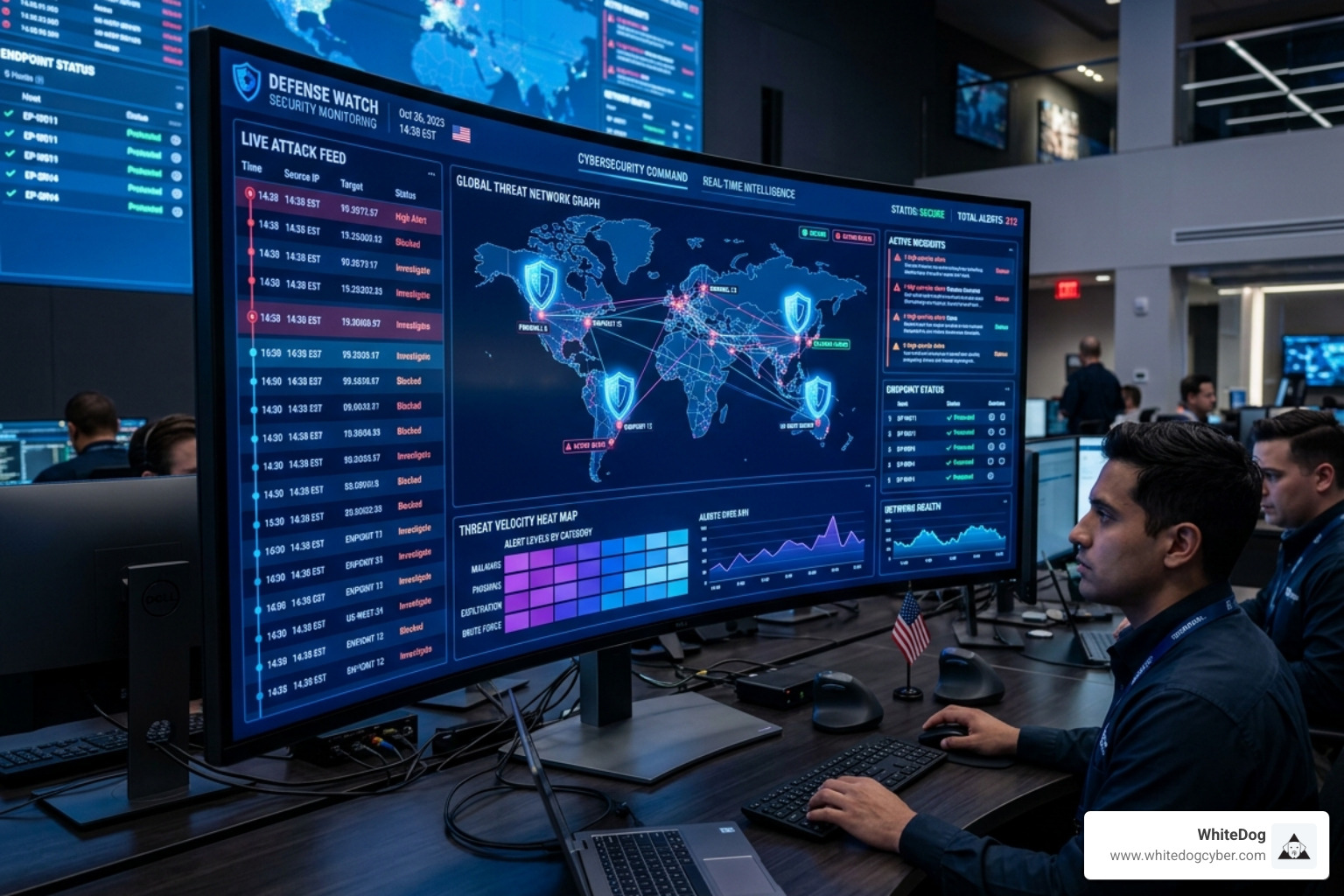
This shift is particularly vital for regional players, such as those providing Cincinnati Managed Security Services, who face the same sophisticated global threats as Wall Street firms but often with tighter local talent pools. A managed SOC acts as your "cyber defense backbone," providing a unified dashboard where telemetry from endpoints, networks, and cloud environments is correlated into a single, actionable timeline.
One of the biggest hurdles to MSP growth is the "hiring trap." To take on a bigger client, you need more engineers. But engineers are expensive and hard to find. MSP SOC as service breaks this linear relationship between headcount and revenue.
When you outsource the SOC, you can bid on larger, more complex contracts that require 24/7 coverage and strict SLAs. This not only increases your top-line revenue but also improves client retention. Clients are less likely to leave a partner who provides deep visibility and rapid incident response. We’ve seen that Scaling Your MSP Security Offerings with WhiteDog allows providers to transition from "the IT guy" to a "trusted security advisor," which commands higher margins and longer contract terms.
The "messy world" of cybersecurity often involves managing dozens of disconnected tools. If your SOC doesn't talk to your PSA, your team ends up doing manual data entry—the ultimate productivity killer.
Effective MSP SOC as service relies on robust API connectivity. The goal is to collect raw telemetry from everywhere—Microsoft 365, Azure, AWS, and various endpoints—and normalize it. When the WhiteDog Cybersecurity Platform Now Integrates with Major PSA Brands, it ensures that when the SOC identifies a threat, a ticket is automatically generated in your workflow. This eliminates "swivel-chair" management and ensures nothing falls through the cracks.
Let’s talk numbers. Many MSP owners think, "I'll just hire two security guys and call it a SOC." Unfortunately, the math doesn't work that way. To provide true 24/7/365 coverage, accounting for shifts, weekends, vacations, and sick leave, you need a minimum of 10 to 12 full-time analysts.
| Expense Category | In-House SOC (Estimated) | Outsourced SOCaaS |
|---|---|---|
| Staffing (10-12 Analysts) | $1,000,000+ / year | Included in service fee |
| Technology Stack (SIEM/XDR) | $150,000+ / year | Included |
| Infrastructure & Facilities | $100,000+ / year | $0 |
| Training & Certifications | $50,000+ / year | Included |
| Total Estimated Overhead | $1.3M+ per year | Fractional, per-asset cost |
Beyond the raw salary costs, there is the "talent gap" risk. 90% of organizations report skills gaps on their security teams. If your lead analyst leaves for a big tech firm, your SOC is effectively dark until you can find a replacement—a process that currently takes months.
The Scientific research on cybersecurity skills gaps and workforce shortages confirms that the global shortage of 2.7 million professionals makes recruiting a constant uphill battle. By choosing a partner Built for Service Providers: Ready to Scale, you offload the HR nightmare of recruiting, training, and retaining specialized talent, allowing you to focus on client relationships.
For a long time, the SIEM (Security Information and Event Management) was the "brain" of the SOC. But traditional SIEMs have a major flaw: they are noisy. They ingest everything and spit out thousands of alerts, most of which are false positives. 71% of SOC practitioners worry they will miss a real attack buried in a flood of alerts.
Modern MSP SOC as service uses a more sophisticated mechanism: Open XDR.

Instead of just collecting logs, an Open XDR platform:
This process is critical for preventing burnout. Scientific research on IT professional burnout and alert fatigue shows that 60% of IT professionals are currently experiencing burnout. By using a platform designed for Simplified Security for MSPs: Escape Contract Chaos and Tool Overload, we can reduce the volume of alerts by up to 90%, ensuring that when your team (or ours) gets a notification, it actually matters.
A SOC is only as good as its playbooks. When a threat is detected, what happens next? In a mature MSP SOC as service model, the response is governed by SOAR (Security Orchestration, Automation, and Response) playbooks aligned with the MITRE ATT&CK framework.
This isn't just about technical "whack-a-mole." It’s about risk reduction. For instance, if a ransomware-like behavior is detected, the platform can automatically isolate the affected endpoint while a human analyst investigates. This reduces "dwell time"—the period an attacker spends in your network before being caught. Currently, it takes a business an average of 50 days to detect a breach; our goal is to bring that down to minutes.
Furthermore, How MSPs Are Expanding with WhiteDog shows that operationalized security is the key to passing audits. Whether your clients need to meet HIPAA, PCI DSS, or SOC 2 requirements, a managed SOC provides the "audit evidence"—continuous logs, incident reports, and remediation summaries—needed to prove compliance. As WhiteDog Introduces Fully Managed Cybersecurity Solutions to Support Scaling MSPs, the focus remains on providing enterprise-grade security that is easy for an MSP to explain to a business owner.
While the terms are often used interchangeably, there is a nuance. Managed Detection and Response (MDR) is a service outcome—it's the "what" you are getting (detection and response). SOC-as-a-Service is the "how"—it's the outsourced team and facility providing that MDR outcome. Some SOCaaS providers only offer "alerting" (they tell you there's a fire), while a true partner like An MSP's Best Friend provides the "firefighters" who actually help put the fire out.
Absolutely. In fact, small MSPs have the most to gain. A small shop cannot afford a $1M/year in-house SOC, but they can afford a per-user or per-device fee. This allows a two-person MSP to offer the same level of security as a global enterprise. Our approach focuses on modular integration with your current stack rather than a "rip and replace" strategy. You can Never Buy Another Security Tool and still be operational in a matter of days, not months.
Compliance is all about "proof." A managed SOC provides the continuous monitoring and logging required by frameworks like HIPAA and PCI DSS. When an auditor asks, "Who was monitoring your network on Christmas Eve?" you have a documented report showing our 24/7 coverage. This is a massive value-add for Cincinnati Managed Security Services providers looking to serve the healthcare or financial sectors.
The era of "set it and forget it" security is over. To protect your clients and grow your business in 2026, you need more than just tools—you need operations.
At WhiteDog, we provide a Unified Cybersecurity Platform that acts as a curated, actively managed security stack. We don't just give you another SIEM to manage; we provide an integrated ecosystem where best-in-class tools are correlated and operated by our 24/7 SOC.
Whether you are looking for Open XDR for unified visibility or our top-tier Delta Detection & Response (DDR) for fully managed 24/7 protection, we are here to help you scale. Incident response is included in all our MDR, XDR, and DDR offerings, eliminating the need for separate IR retainers. We offer a 30-day onboarding guarantee and a "no added fees" policy, ensuring you can grow your margins without surprises.
Stop fighting the talent war and start winning the security war. Explore Our Managed Security Solutions today and see how we can help you get your weekends back while providing enterprise-grade protection to your clients.


Learn how organizations can implement zero trust architecture with continuous verification, stronger access controls, and reduced cyber risk.

Build a practical enterprise cybersecurity framework spanning identity, endpoint security, cloud, network, and data protection to reduce risk and improve resilience.

Compare endpoint protection solutions with this guide covering EPP, EDR, and Open XDR to reduce risk and strengthen your security posture.

Strengthen your DNS security with this guide to threats, DNSSEC, encryption, and enterprise defense best practices.

Learn how Cylance BlackBerry Protect uses AI-driven MTD to secure mobile endpoints, integrate with Microsoft Intune, and strengthen your SecOps.

Learn how an AWS security observability platform reduces alert fatigue, improves threat detection, and supports HIPAA compliance with proactive visibility.