Cybersecurity
September 29, 2026
Master AWS Security Hub for unified cloud security posture, compliance automation, and streamlined SecOps workflows.
At its core, penetration testing - often called pen testing - is the practice of testing your defenses by safely attempting to breach them. While automated security tools look for known bugs, human security professionals use ethical hacking techniques to think like an adversary. They search for logical flaws, misconfigurations, and multi-step attack vectors that automated tools consistently overlook.
Understanding your posture requires recognizing the difference between automated scanning and true penetration testing. Automated vulnerability assessments provide a broad list of potential flaws across your environment. However, they cannot confirm whether a vulnerability is exploitable in practice, nor can they measure the operational damage an attacker could inflict. Because breach response, downtime, legal exposure, and customer trust all carry material business impact, active security validation remains a critical enterprise risk management practice. To explore how professional assessments fit into an overall security strategy, review our overview on penetration testing services.
| Assessment Feature | Automated Vulnerability Assessment | Manual Penetration Testing |
|---|---|---|
| Primary Focus | Automated scanning for known flaws | Exploitation of verified vulnerabilities |
| Execution Method | Software-driven continuous or periodic scans | Human-led offensive analysis and chaining |
| Depth of Insight | Identifies broad system weaknesses | Demonstrates real business impact and risk |
| False Positive Rate | High; requires manual review | Low; findings are validated via exploit |
| Business Value | Establishes a baseline patch inventory | Tests security controls, response, and policy |
For technical teams evaluating baseline standards, the NIST Technical Guide to Information Security Testing and Assessment offers additional context on how enterprise assessments are structured.
While penetration testing evaluates targeted systems to uncover vulnerabilities, ethical hacking serves as an overarching discipline. Within this field, organizations utilize different testing models based on their operational objectives:
Organizations do not conduct pen tests simply to generate technical reports; they do so to manage risk and satisfy regulatory mandates. Attack velocity is rising sharply, with hyper-volumetric DDoS attacks growing by 700% year-over-year. Organizations must validate their defenses against evolving threats.
Beyond proactive risk reduction, compliance frameworks mandate rigorous security testing. For example:
Every assessment begins by defining the level of information and access provided to the testing team. Selecting the right model shapes the scope and focus of the engagement:
Before any testing begins, teams establish strict Rules of Engagement (RoE). The RoE defines explicit testing windows, IP address boundaries, sensitive production targets to avoid, and emergency contact protocols.
Different attack surfaces require specialized testing methodologies:
Proactive leaders take steps to find your gaps before attackers do, using structured scoping to safeguard critical systems.
Standardized frameworks (such as PTES and NIST SP 800-115) break a complete security assessment down into seven execution phases:
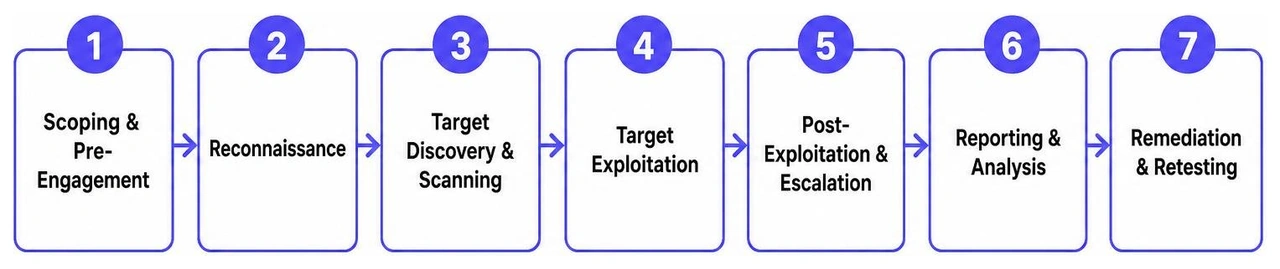
Ethical hackers rely on specialized operating systems and toolsets to conduct assessments:
To organize findings effectively, security teams map attack paths directly to the MITRE ATT&CK framework, standardizing how tactics and techniques are categorized.

Rigorous testing requires verified technical competence. Security practitioners frequently maintain industry-recognized certifications, such as:
Organizations seeking accredited assessment partners should review guidelines for certified penetration testing standards to ensure high-quality execution.
While a manual pen test yields essential insights, its value degrades over time. Systems undergo configuration changes, employees join and leave, software updates are deployed, and new zero-day vulnerabilities emerge daily. This drop in visibility over time is known as security drift.
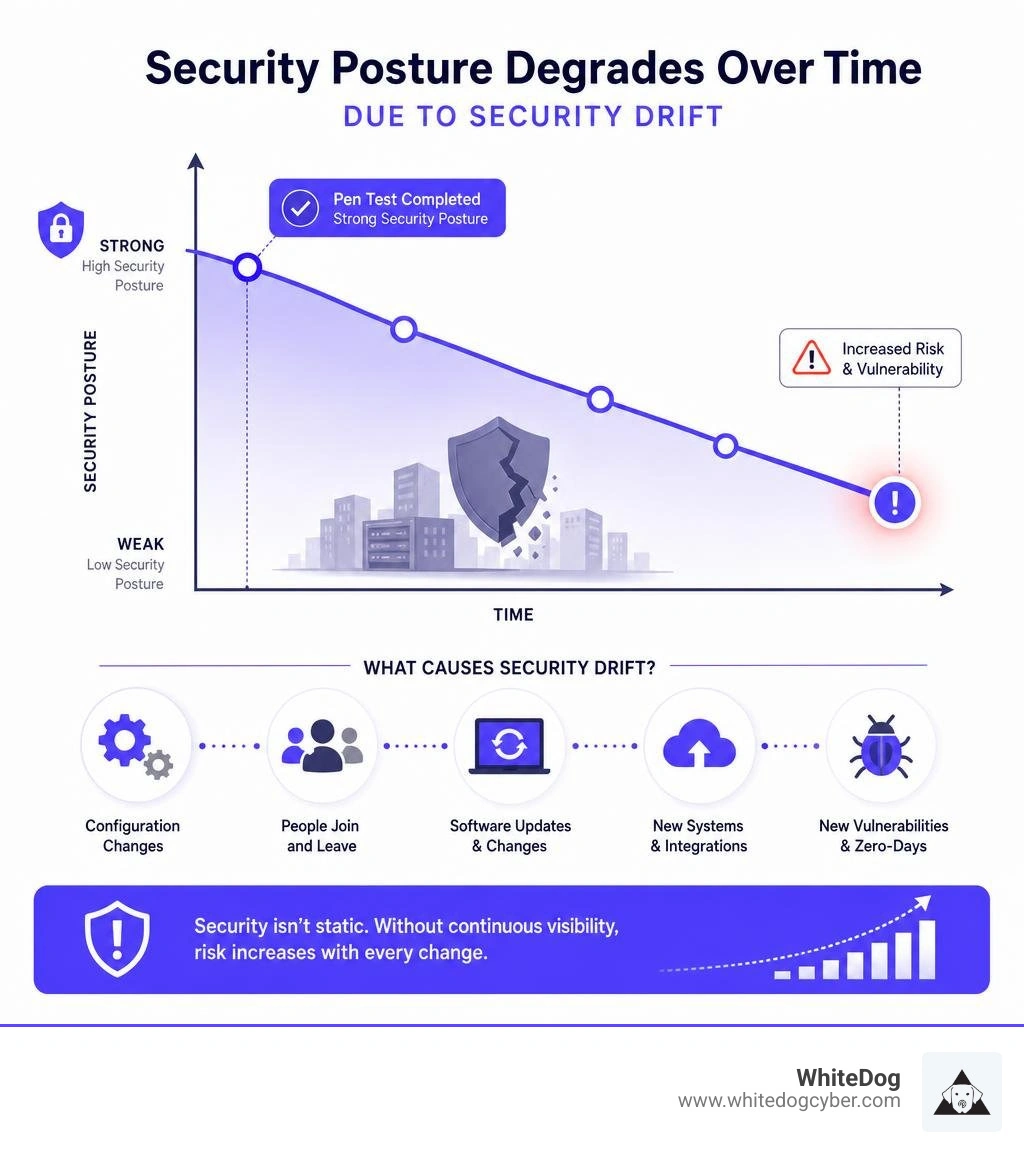
Relying solely on an annual point-in-time test creates critical blind spots. Gartner research indicates that organizations adopting continuous exposure management programs will be three times less likely to suffer a breach by 2026. Security leaders must recognize why your pen test is already outdated shortly after completion, and understand why passing a pen test doesn't prevent breaches if continuous visibility is absent.
Automated vulnerability scanners rely on static databases to match software versions against known vulnerability lists, often generating false positives. Manual penetration testing actively attempts controlled exploitation to verify whether a vulnerability poses actual risk, demonstrating real-world impact across complex systems.
Organizations should conduct comprehensive penetration tests at least annually to satisfy regulatory standards like PCI DSS. However, assessments must also take place following major network modifications, infrastructure migrations, application releases, or corporate acquisitions.
Following an assessment, teams must prioritize remediation based on business risk, patch identified vulnerabilities, update security policies, and perform post-test re-testing. Re-testing verifies that security fixes were implemented correctly without introducing technical regressions.
A manual penetration test provides a vital snapshot of your security posture. However, modern threats evolve rapidly, and periodic testing alone cannot guard against daily exposure shifts. True cyber resilience requires pairing point-in-time assessments with continuous visibility and proactive threat management.
WhiteDog bridges this gap by delivering a Unified Cybersecurity Platform that acts as a curated, actively managed security stack. Rather than forcing a rip-and-replace approach, our platform emphasizes modular integration, seamlessly supporting your existing tools, our curated stack, or a combination of both.
Unlike traditional SIEM-centric approaches that flood security teams with disconnected log alerts, WhiteDog's platform mechanism collects raw telemetry across email, DNS, identity, endpoint, network, and cloud environments. The platform filters, deduplicates, and correlates data across all streams, normalizes it to specific organizational assets, enriches findings with threat intelligence, and produces prioritized detections that reveal complex attack chains across your enterprise.
This correlated intelligence powers our continuous attack surface management and 24/7 SOC operations across our MDR, XDR, and top-tier Delta Detection & Response (DDR) offerings. Our security analysts continuously investigate, triage, and respond to threats in real time, with incident response fully included across MDR, XDR, and DDR. WhiteDog empowers your organization to detect threats earlier, eliminate dwell time, and maintain an evergreen security posture with confidence. Discover how to enhance your security program through comprehensive continuous attack surface management.


Master AWS Security Hub for unified cloud security posture, compliance automation, and streamlined SecOps workflows.

Learn how AWS delta detection response stops cloud alert noise by tracking state drift and securing Delta Lake workloads.

Master modern threat detection with unified visibility across cloud, identity, and AI agents for faster response.

Learn how cloud security protects your data in 2026, covering shared responsibility, zero trust, and posture management to prevent breaches.

Verify AWS KMS FIPS compliance with this step-by-step guide covering FIPS 140-3 HSMs, endpoints, and auditing for regulatory alignment.

Navigate security compliance requirements across ISO 27001, SOC 2, and GDPR with a strategic blueprint for sustainable compliance management.