Cybersecurity
October 15, 2026
Learn how Cylance BlackBerry Protect uses AI-driven MTD to secure mobile endpoints, integrate with Microsoft Intune, and strengthen your SecOps.
The types of online threat facing organizations today span everything from automated malware to highly targeted human manipulation — and they are growing in both volume and sophistication. According to ENISA's Threat Landscape 2023, ransomware and denial-of-service attacks alone accounted for nearly half of all observed cyber incidents in the EU during the reporting period. Meanwhile, over 70% of businesses worldwide have faced a ransomware attack in the past two years.
Here is a quick overview of the most common types of online threats:
| Threat Type | What It Does | Who It Targets |
|---|---|---|
| Malware | Damages, steals, or disrupts systems | Everyone |
| Ransomware | Locks files and demands payment | Businesses, healthcare, infrastructure |
| Phishing | Tricks users into revealing credentials | Individuals, employees |
| DDoS Attacks | Overwhelms services with traffic | Websites, online platforms |
| Social Engineering | Manipulates people into harmful actions | Employees, executives |
| Man-in-the-Middle | Intercepts communications | Public Wi-Fi users, financial transactions |
| Zero-Day Exploits | Attacks unknown, unpatched vulnerabilities | All software users |
| Supply Chain Attacks | Compromises trusted vendors to reach targets | Enterprises, government |
| Insider Threats | Abuse of legitimate access | Organizations with privileged users |
| Data Breaches | Unauthorized access to sensitive data | Any organization holding personal data |
No organization is too small to be a target. Cybercriminals use automation to scan millions of systems at once. Nation-states run long-term campaigns against critical infrastructure. Malicious insiders exploit the access they already have. The threat surface is wide — and it keeps expanding.
Understanding what you are up against is the first step toward building a defense that actually works.
I'm Shahin Pirooz, a senior cybersecurity and technology executive with over two decades of experience building managed security and cloud services, and helping organizations navigate the full spectrum of types of online threat — from commodity malware to advanced persistent threats. In this guide, I'll walk you through the threat landscape clearly and practically, so you know exactly what risks your organization faces and how to address them.
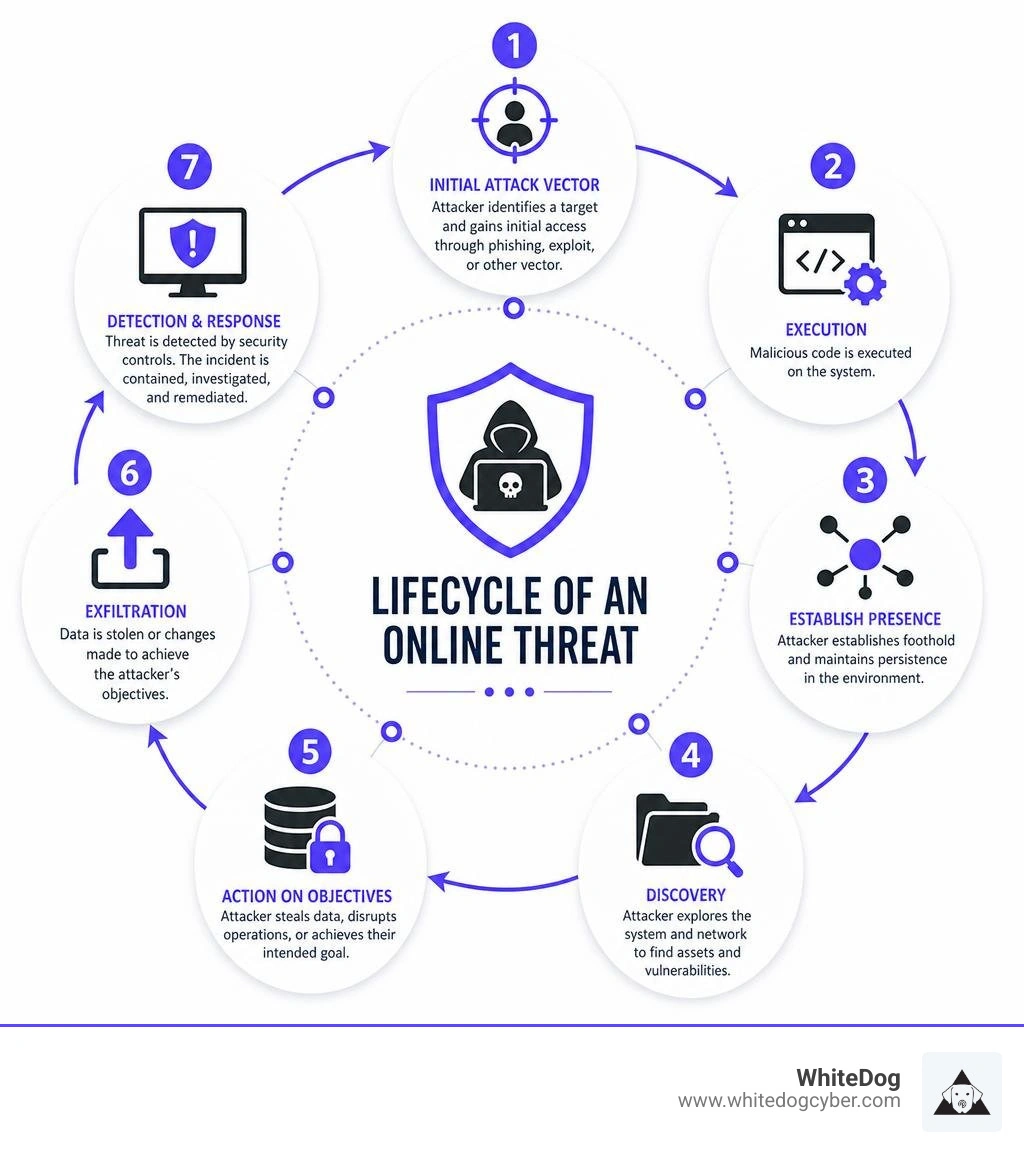
To mount an effective defense, enterprise security leaders cannot treat cyber threats as a single, monolithic problem. Instead, we must categorize them systematically to allocate resources, define ownership, and deploy appropriate controls. By looking at threats through an organized taxonomy, we transition from reactive firefighting to structured, proactive risk management.
A highly effective way to organize these risks is through the lens of the Open Threat Taxonomy - v1.1a , which divides potential vectors into four fundamental dimensions: Technical, Personnel, Resource, and Physical.
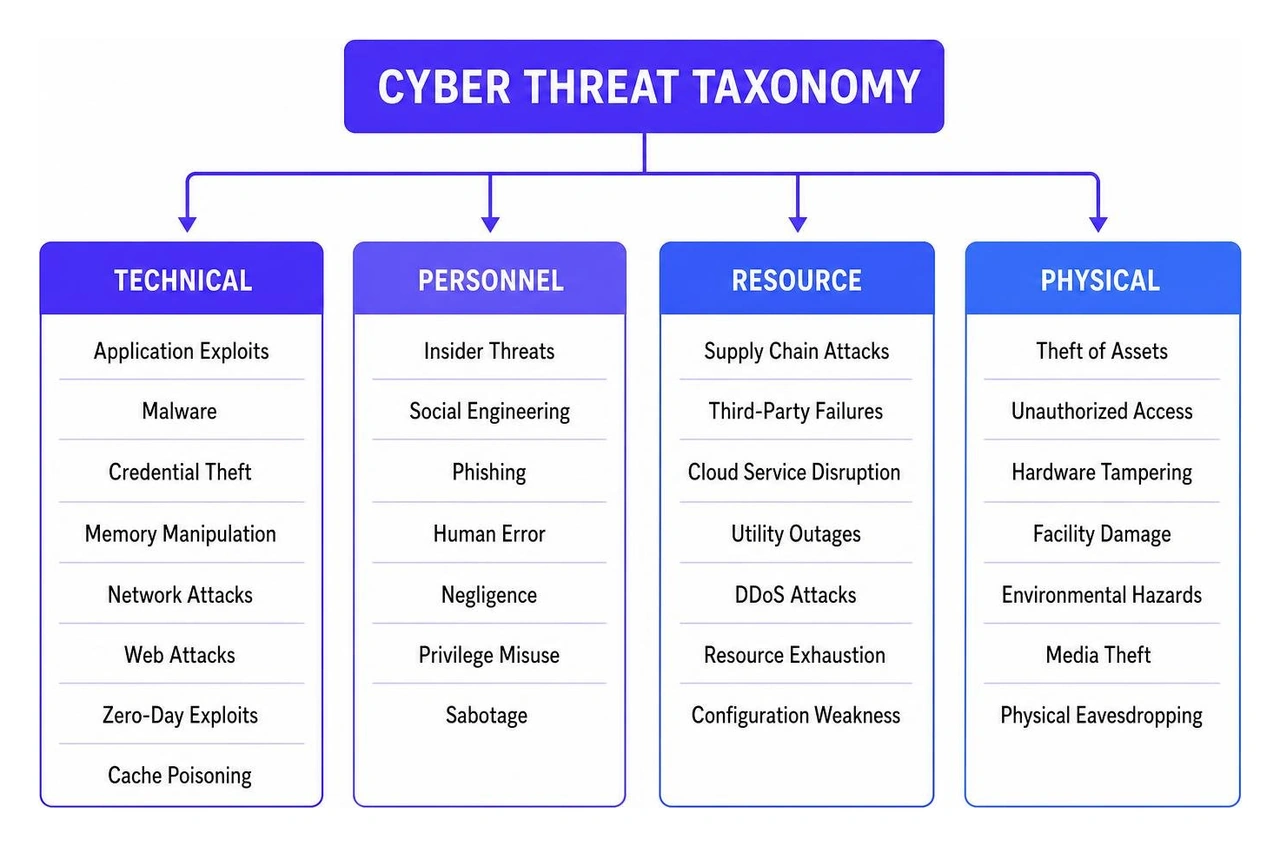
To understand how these categories translate into enterprise risk, we must map them directly to their operational impacts.
| Threat Category | Specific Threat Action | Target Asset | Enterprise Impact |
|---|---|---|---|
| Technical | SQL Injection / API Exploitation | Databases & Web Apps | Unauthorized data exposure, system compromise |
| Personnel | Business Email Compromise (BEC) | Financial Operations | Direct financial loss, credential harvesting |
| Resource | Upstream Software Dependency Compromise | Software Build Pipeline | Downstream customer breaches, brand damage |
| Physical | Local Console Exploitation | On-Premises Servers | Complete bypass of logical network controls |
By aligning your defenses with these distinct categories, you can ensure your security strategy addresses every facet of enterprise risk. For a deeper dive into how these categories intersect with modern business infrastructure, see our comprehensive analysis of Internet Security Threats.
Modern cyber threats do not occur in a vacuum. Every successful attack is the result of a threat actor exploiting a vulnerability within your attack surface using a specific technical vector. As organizations undergo digital transformation, their attack surface expands to include hybrid cloud environments, mobile workforces, IoT devices, and complex supply chains.
Understanding the mechanics of these exploits requires us to analyze both the technical methods used and the motivations of the actors behind them:
Regardless of the actor, the technical execution of an attack relies on finding a path of least resistance through your defenses.
Malware remains a highly prevalent technical threat vector. Historically, malware relied on file-based delivery—convincing a user to download an executable file or open a malicious email attachment. Today, malware has evolved to bypass traditional signature-based detection entirely.

Ransomware, which represented 17 percent of all cyberattacks in 2022, has transitioned from simple automatic file-locking to multi-extortion schemes. Modern ransomware actors not only encrypt local files using public-key encryption (where the decryption key remains on the attacker's server), but they also exfiltrate sensitive data beforehand, threatening to leak it publicly or notify regulatory bodies if the ransom is not paid.
Simultaneously, we have seen a massive rise in fileless malware. Instead of writing malicious code to the physical disk, fileless attacks exploit legitimate, native system administration tools like PowerShell, Windows Management Instrumentation (WMI), or active memory. Because these attacks "live off the land" using trusted operating system processes, traditional antivirus programs often fail to flag them as anomalous.
Furthermore, threat actors now leverage machine learning to create polymorphic attacks. These are malware variants that automatically alter their code signature with every iteration to evade detection while maintaining their malicious payload. To understand how these advanced variants operate, read our technical brief on AI and Polymorphic Attacks: A Growing Cybersecurity Threat.
For a broader taxonomy of malicious code, you can explore the resources provided by the industry experts at IBM on Types of Cyberthreats | IBM .
While technical exploits target software code, social engineering targets the "human operating system." These attacks manipulate psychological triggers—such as urgency, fear, curiosity, or authority—to bypass technical controls.
Phishing remains the primary entry point for social engineering. However, the tactics have evolved far beyond generic spam emails:
As highlighted in the ENISA THREAT LANDSCAPE 2023 , the professionalization of cybercrime has made these human-centric attacks highly efficient. Attackers now use generative AI to draft flawless, localized phishing templates at scale, eliminating the spelling and grammatical errors that historically served as red flags for end-users.
Threat actors also target the underlying network protocols and infrastructure that facilitate communication. These exploits aim to disrupt service availability or intercept data in transit.
Distributed Denial of Service (DDoS) attacks overwhelm an online service, application, or network infrastructure with artificial traffic from a distributed network of compromised devices (botnets). While some DDoS attacks are designed for pure disruption, others are used as tactical smoke screens to distract security operations teams while the attackers execute a quieter, targeted data exfiltration campaign elsewhere on the network.
On the local level, network exploits often target wireless communications:
These structural vulnerabilities exist because many foundational internet protocols were built with a focus on open communication rather than security. For a historical perspective on this challenge, read our resource on why The Internet Was Never Meant to Be Secure.
For years, the standard enterprise security strategy was straightforward: install an endpoint detection and response (EDR) agent on every laptop and server, set up a network firewall, and assume the perimeter was secure.
However, in today's hybrid, cloud-centric operating environment, this approach is no longer sufficient. Relying solely on endpoint security creates critical blind spots:
This reality makes a layered defense strategy essential. If you rely on a single defensive tool, a single failure point can compromise your entire environment.
When an organization fails to manage the full spectrum of types of online threat, the consequences extend far beyond a temporary IT inconvenience. The fallout can permanently damage an enterprise's operational viability and financial health.
To protect your organization, you must look beyond the endpoint. Read our detailed analysis on why Endpoint Security Isn't Enough to understand how attackers exploit these structural gaps.
To defend against sophisticated, multi-vector attacks, organizations must transition from a model of static trust to one of dynamic risk.
Traditional security architectures operated on the assumption that anything inside the corporate network perimeter was trusted, while everything outside was untrusted. Today, this model is obsolete. Attackers regularly bypass the perimeter, and once inside, they exploit this implicit trust to move laterally without restriction.
A modern security posture must be built on the principles of Zero Trust:
By shifting from static perimeters to continuous, real-time risk evaluation, you can neutralize attacks even after a perimeter breach occurs. Learn how to implement this shift in our guide on Static Trust vs Dynamic Risk: How Attacks Bypass Security.
Defending an enterprise against modern types of online threat is fundamentally an operational challenge. Security teams do not suffer from a lack of security tools; they suffer from tool sprawl. The average enterprise runs dozens of disconnected security solutions, each generating thousands of alerts daily. This high volume of alerts leads to alert fatigue, allowing critical indicators of compromise to go unnoticed.
An effective defense requires a unified security platform that consolidates telemetry from endpoints, network traffic, cloud environments, and identity providers into a single, cohesive workflow. Rather than suggesting a "rip and replace" approach, we emphasize modular integration, allowing you to connect and enhance your existing security investments without disruption.
Our platform approach is designed to eliminate this noise and accelerate response times:
This operational flow ensures your security team can focus on containing confirmed threats rather than chasing false positives.
When an attack occurs, the most critical metric is dwell time—the duration an attacker remains undetected within your environment. The longer an attacker has access, the more damage they can cause. Minimizing dwell time requires a highly coordinated, rapid incident response workflow.
A robust incident response capability must operate 24/7/365. Cybercriminals do not limit their attacks to standard business hours; in fact, they actively target weekends and holidays to maximize disruption.
Our Security Operations Center (SOC) provides continuous monitoring, proactive threat hunting, and immediate containment capabilities. Incident response is fully included across our Open XDR, MDR, and Delta Detection & Response (DDR) offerings, ensuring you have immediate access to expert containment without administrative delays. When a threat is detected, our analysts can isolate compromised endpoints, revoke compromised credentials, and block malicious traffic in real time, stopping an attack before it can spread.
To optimize your organization's readiness, review our structured Cybersecurity Incident Response Workflow and learn why, when an attack occurs, Attackers Will Get In: Speed Is Your Defense.
To achieve operational efficiency, organizations must transition away from managing individual, siloed security tools and move toward a unified visibility model. This is where modern detection and response frameworks deliver immense value.
Depending on your organization's internal resources and security maturity, we provide three tiers of operational defense:
To understand how these components work together to protect your business, read our guide on Why a Layered Defense Is Critical.
A data breach is a deliberate, malicious cyberattack where an unauthorized actor actively penetrates an organization's security defenses to steal or access sensitive data. Conversely, a data leak is an unintentional exposure of data, typically caused by internal misconfigurations, unpatched software vulnerabilities, or human error (such as an employee accidentally saving sensitive files to an unsecured public cloud storage bucket). Both events can result in severe financial and regulatory penalties under frameworks like GDPR, but their root causes and prevention strategies differ.
Traditional antivirus software relies primarily on signature-based detection, which matches files against a database of known malware signatures. A zero-day exploit targets a software vulnerability that is completely unknown to the software vendor and the cybersecurity community. Because no signature or patch exists for this exploit, traditional antivirus programs do not recognize it as malicious. Bypassing these exploits requires advanced behavioral analysis, which monitors system activity for anomalous behaviors rather than matching file signatures.
Supply chain attacks are highly dangerous because they exploit established trust relationships. Instead of attacking a highly secured enterprise directly, threat actors target a third-party vendor, software dependency, or service provider with weaker security controls. Once the attackers compromise the vendor's software or access credentials, they can ride "piggyback" into the target enterprise's network. Because the vendor's software is signed and trusted, the malicious activity often bypasses standard network perimeter defenses and moves laterally undetected.
The landscape of types of online threat is constantly evolving, but your organization's defense doesn't have to be a reactive guessing game. Managing these risks requires moving away from disconnected security tools and toward a unified, operationally efficient security posture.
At WhiteDog, we provide a co-managed cybersecurity platform designed specifically to eliminate tool sprawl, reduce dwell time, and protect your operational continuity. By consolidating your telemetry into a single correlated timeline and backing it with our 24/7 SOC and expert threat-hunting teams, we help you significantly reduce enterprise risk.
Whether you need unified visibility through Open XDR, fully managed security with MDR, or our top-tier Delta Detection & Response (DDR) protection, we deliver the comprehensive capabilities your organization needs to stay secure.
Let us help you transition from reactive firefighting to proactive, operational security. Explore our curated security solutions at WhiteDog Solutions.


Learn how Cylance BlackBerry Protect uses AI-driven MTD to secure mobile endpoints, integrate with Microsoft Intune, and strengthen your SecOps.

Learn how an AWS security observability platform reduces alert fatigue, improves threat detection, and supports HIPAA compliance with proactive visibility.
Learn how to check DNS security across your infrastructure with a 5-step audit, including DNSSEC, email records, and CAA validation.

Master enterprise risk reduction with this detailed guide covering ERM frameworks, AI governance, and cybersecurity strategies for 2026.

Compare top AWS incident response solutions for rapid remediation, automated triage, and containment with native tools and expert escalation paths.

Harden your Amazon Linux firewall with firewalld and nftables to meet STIG compliance, block lateral movement, and secure AWS EC2 hosts.