Understanding Vulnerability Scanning in Modern Cybersecurity Architecture
Vulnerability scanning forms an essential baseline for enterprise security, allowing organizations to catalog software components and uncover known flaws across infrastructure, applications, network endpoints, and cloud workloads. Basic static scans check system packages when software is staged, built, or deployed. Continuous scanning can broaden this coverage to evaluate application dependencies, third-party libraries, and newly published vulnerabilities across active assets in real time.
However, a vulnerability scan only reveals static, known exposures in code, operating systems, or configurations—not how an attacker might exploit an environment dynamically. Integrating vulnerability management with runtime behavioral analysis is essential to detect suspicious activity, anomalous processes, and privilege escalation that static scans cannot see.

Core Models of Vulnerability Scanning: Basic vs Continuous Deep Inspection

Securing modern enterprise pipelines requires full visibility into what software packages, system components, and third-party dependencies are running across environments. When evaluating scanning architectures, security teams choose between point-in-time scanning and continuous deep vulnerability assessment.
| Dimension | Basic Static Scanning | Continuous Deep Inspection |
|---|
| Scanning Approach | Package and configuration matching | Broader dependency and context-aware correlation |
| Package Coverage | Operating system packages only | OS packages, language dependencies, and nested binaries |
| Scan Triggers | Scheduled or manual on-demand triggers | Event-driven, continuous, and automated monitoring |
| Vulnerability Intelligence | Standard public vulnerability feeds | Public vulnerability feeds, vendor advisories, and curated CVE databases |
| Re-Scan Frequency | Manual or triggered by new deployments | Automated whenever new CVEs or exploits are disclosed |
| Operational Overhead | Higher manual triage due to false positives | Lower operational noise through contextual deduplication |
| Deployment Scope | Isolated local repositories or endpoints | Multi-environment, hybrid cloud, and distributed pipelines |
Vulnerability Detection Engines and Threat Intelligence Feeds
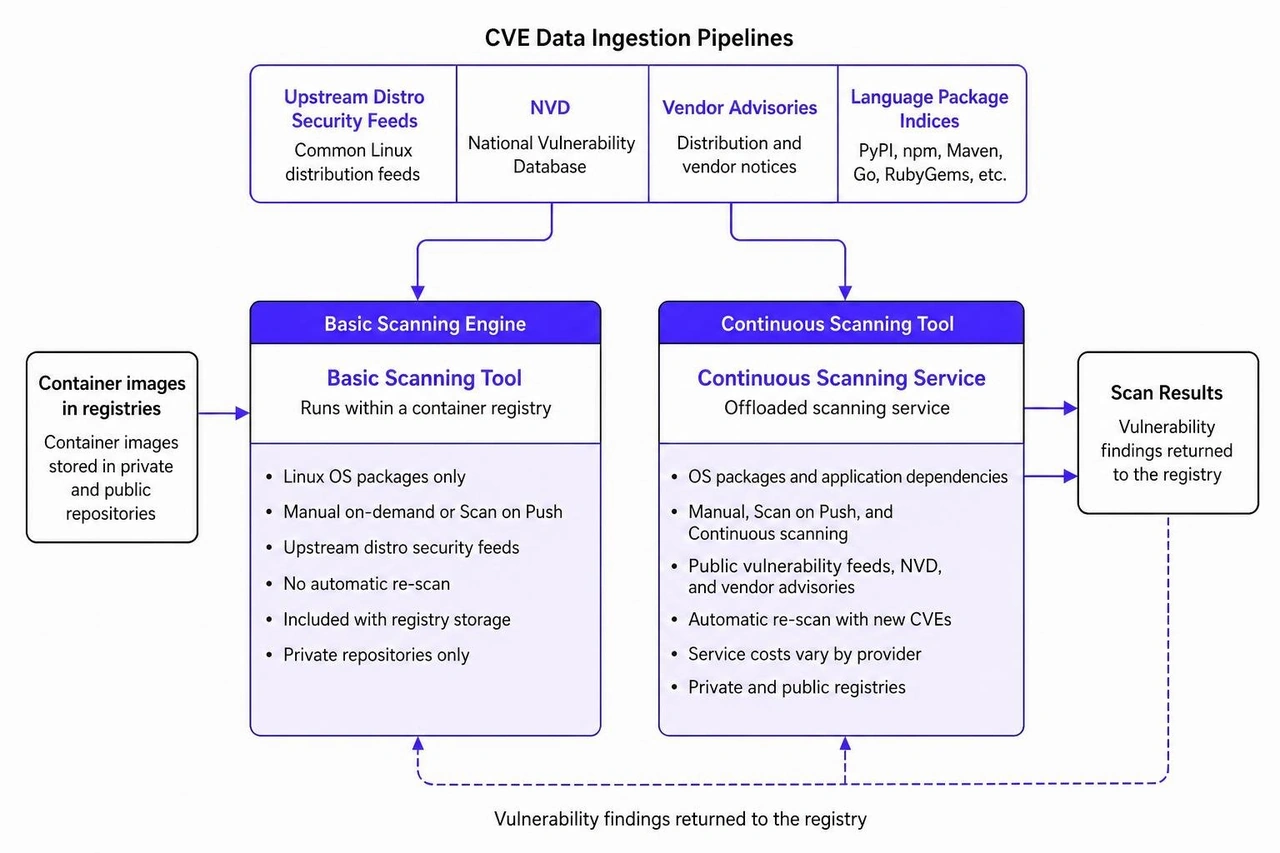
Vulnerability scanning engines operate by analyzing package manifests, binary hashes, and configuration states against curated vulnerability databases. Basic scanning models parse static package manifests to identify matching Common Vulnerabilities and Exposures (CVEs).
Some vulnerability management platforms aggregate data from upstream distribution feeds, the National Vulnerability Database (NVD), vendor security bulletins, and open-source language package repositories to understand how automated feeds match dependencies and prioritize actionable risks at enterprise scale.
Understanding Package Coverage and Detection Discrepancies
Basic scanning typically inspects operating system packages installed through native system managers on servers and hosts. However, modern applications bundle complex language runtimes—such as Python, Node.js, Java, Go, or Ruby—alongside proprietary business logic. If an application embeds a vulnerable open-source library within an otherwise clean host or platform, basic system scans will report zero vulnerabilities despite critical risk at the application layer.
Conversely, more comprehensive tools evaluate both operating system layers and language runtime dependencies. They also apply patch backport intelligence to eliminate false positives, confirming whether a reported flaw has already been mitigated by downstream distribution maintainers before raising an alert.
Establishing Continuous Scanning Controls and Operational Boundaries
Implementing structured vulnerability scanning requires establishing consistent policies across all infrastructure components, software repositories, and build pipelines. Standardizing scanning prevents blind spots and unmonitored services from reaching production. Performing a comprehensive Cloud Security Audit helps organizations uncover unmanaged workloads and unpatched software stacks.
Automating Baseline Security Policies
Scanning configurations should be enforced through centralized policies and Infrastructure as Code (IaC) templates. Modern security governance frameworks leverage automated policy sets to ensure that all newly provisioned infrastructure, hosts, and application workloads inherit mandatory continuous scanning configurations by default.
Continuous Assessment Windows vs Point-in-Time Scans
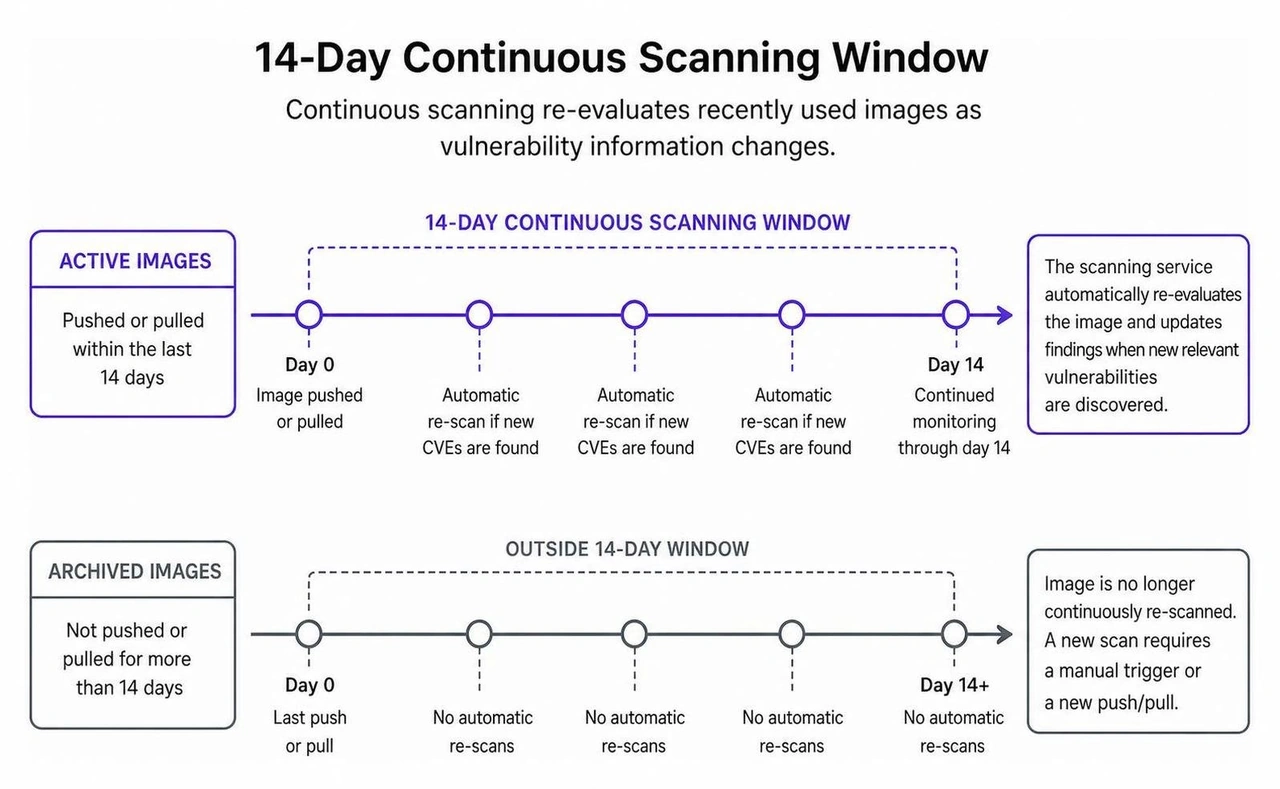
Traditional scanning creates a false sense of security because point-in-time checks only capture vulnerabilities known at the moment of execution. If a critical zero-day or high-severity CVE is published hours after a deployment, static scan reports quickly become outdated.
Continuous scanning platforms solve this gap by retaining dependency inventories and continuously cross-referencing active workloads and assets against newly released threat intelligence feeds. When a new vulnerability emerges, the platform immediately flags affected assets without requiring manual rescanning or re-deployments.
Programmatic Vulnerability Management via APIs
Enterprise security platforms query vulnerability findings programmatically using REST APIs and automated CLI tooling. Extracting raw vulnerability payloads allows security operations teams to correlate severity scores, exploitability metrics (such as EPSS), and available patch versions directly into centralized operational dashboards.
Shifting vulnerability management earlier into the software development lifecycle prevents known weaknesses from entering production environments. By automating scans within continuous integration and continuous delivery (CI/CD) pipelines, development teams receive real-time feedback on code dependencies and infrastructure artifacts, providing centralized visibility across the entire development and deployment lifecycle.
Enforcing Quality Gates in Continuous Integration
Modern automated pipelines evaluate build artifacts, configuration files, and software packages against strict security thresholds before allowing deployment. Security workflows implement automated vulnerability scanning steps within continuous integration pipelines to establish automated quality gates. Pipelines can automatically block builds when severe, exploitable vulnerabilities exceed predefined risk tolerances.
Event-Driven Orchestration and Incident Response
When a vulnerability scanning system completes an analysis or identifies a newly disclosed risk, event streaming services publish automated notifications. Security operations teams use these events to automate remediation workflows, such as quarantining vulnerable systems, alerting on-call engineers, or generating tracking tickets.
Connecting scan telemetry with comprehensive incident response workflows ensures rapid mitigation before threats escalate. Incident response platforms can integrate with monitoring and security operations workflows to streamline triage and containment across multi-cloud and hybrid environments.
Managing Vulnerabilities and Why Behavioral Analysis is Essential
Static vulnerability management is an indispensable security discipline, but it represents only one facet of modern defense. Relying entirely on static scanning leaves organizations vulnerable to post-exploitation attacks, zero-day vulnerabilities, stolen credentials, and memory-only exploits that package scanners cannot see.
Adhering to proven infrastructure security practices and following an enterprise Cloud Security Guide 2026 helps organizations eliminate legacy software components and minimize exposure before deployment.
Prioritizing and Suppressing Non-Actionable Vulnerability Findings
Vulnerability scanning frequently generates extensive lists of low-risk or unfixable findings in underlying OS packages, leading to severe alert fatigue. Effective vulnerability management requires customizable suppression rules that filter out noise based on:
- Specific CVE identifiers with no known exploit path
- Package dependencies that are not invoked during execution
- Vulnerability severity thresholds (e.g., CVSS below 7.0)
- Non-production environments or isolated sandbox workloads
Suppressing non-actionable findings allows analysts to focus attention on critical, high-impact exposures.
Why Behavioral Analysis is a Critical Component of Security
While vulnerability scanning catalogs theoretical risks in static software, runtime behavioral analysis observes what workloads, users, and systems actually do in real time. Static scans cannot detect malicious runtime behavior, including:
- Execution of living-off-the-land binaries and fileless malware
- Abnormal outbound network connections and data exfiltration
- Compromised credentials used to move laterally across systems
- Privilege escalation and unauthorized modification of core system configurations
- Zero-day exploits against software with clean vulnerability reports
Continuous behavioral analysis monitors processes, system calls, network telemetry, and identity interactions across endpoints, networks, and cloud environments. By correlating static vulnerability findings with real-time behavioral anomalies, security teams can immediately determine whether an active runtime event stems from a known unpatched vulnerability or an entirely new attack vector.
Frequently Asked Questions about Vulnerability Scanning
Different scanning engines utilize distinct vulnerability feeds, correlation algorithms, and package parsing methods. Basic scanners often report raw CVE counts based strictly on package version numbers, while other tools cross-reference vendor security advisories, patch backports, and specific runtime dependencies to filter out false positives and provide more accurate results.
How does continuous vulnerability scanning differ from point-in-time scanning?
Point-in-time scanning inspects software only when manually triggered or when a new version is built. Continuous scanning maintains an inventory of software components and actively evaluates them against newly discovered CVEs as threat intelligence feeds update, ensuring organizations remain aware of risks in existing deployments.
Why isn't vulnerability scanning sufficient on its own for complete security?
Vulnerability scanning only identifies known, static weaknesses in software packages and configurations. It cannot detect zero-day exploits, compromised user credentials, insider threats, or malicious in-memory actions. Runtime behavioral analysis is necessary to monitor active operations and identify anomalous or malicious behavior in real time.
Conclusion: Building a Resilient Security Posture Through Scanning and Behavioral Analysis
Securing modern digital environments requires a comprehensive, defense-in-depth strategy that unifies pre-deployment inspection with runtime monitoring. While static vulnerability scanning provides a vital baseline for discovering known package flaws, unpatched software, and configuration weaknesses, it accounts for only half of the security lifecycle.
True operational resilience is achieved when static scanning and runtime behavioral analysis operate in tandem. Pre-deployment scanning hardens systems and reduces the overall attack surface before workloads go live, while continuous behavioral analysis observes active operations to detect living-off-the-land techniques, anomalous processes, zero-day exploits, and lateral movement in real time. By correlating static vulnerability intelligence with dynamic runtime signals, security teams can rapidly contextualize alerts, accelerate incident response, and maintain robust defense across complex hybrid and multi-cloud ecosystems.