Cybersecurity
October 22, 2026
Compare endpoint protection solutions with this guide covering EPP, EDR, and Open XDR to reduce risk and strengthen your security posture.
Endpoint protection helps secure laptops, desktops, and servers against malicious activity. A strong endpoint protection platform should reduce the attack surface, scan for malware in real time, detect suspicious behavior, and give security teams one place to manage policies and alerts. When comparing products, test those capabilities on your own devices and check how well each product works with your existing tools.
The best choice is not always the product with the highest review score. A pilot can reveal whether an agent slows devices, creates too many alerts, or leaves gaps in what your team can see. Plan for a phased rollout and decide who will investigate and act on alerts before you deploy widely.
For teams using Microsoft security tools, WhiteDog is designed to complement those investments, not replace them. Delta 360 (Δ360), built on WhiteDog’s Open XDR framework, adds a unified operational and security layer across Microsoft and third-party tools. It helps teams correlate signals, improve visibility and security hardening, detect threats, manage exposures, and support response. Open XDR provides unified visibility and detection; managed 24/7 SOC response and incident response are included in WhiteDog’s MDR, XDR, and top-tier Delta Detection & Response (DDR) offerings. Continuous attack surface management and 24/7 security operations build on correlated intelligence to help identify threats earlier and respond with confidence.


An Endpoint Protection Platform (EPP) is security software deployed on managed endpoints—including workstations, laptops, virtual desktops, physical servers, and cloud workloads. Its primary purpose is to safeguard these assets against both known and unknown cyber threats through multi-layered prevention, detection, and mitigation controls.
Modern endpoint defense operates on a defense-in-depth model. Traditional antivirus tools relied almost exclusively on static signature matching, which looked for known file hashes. Today's threat landscape involves fileless malware, living-off-the-land binaries (LOLBins), memory injection, and zero-day vulnerabilities. To protect users effectively, an EPP combines static pre-execution inspection with dynamic behavioral analysis, identifying malicious activity based on system behavior rather than recognizable file attributes.

When evaluating prospective tools, security teams must ensure that essential preventative controls are native to the platform. An enterprise-grade solution must include:
Understanding how preventative controls feed into behavioral surveillance is foundational when assessing the broader EDR solution meaning across modern defensive architectures.
Managing endpoint controls across thousands of geographically dispersed, hybrid, and remote workers requires a robust cloud-native architecture. Legacy on-premises management servers required complex VPN routing and ongoing infrastructure maintenance, leaving off-network devices vulnerable.
Cloud-native platforms provide centralized management through a single administrative console, facilitating uniform policy enforcement and instant telemetry ingestion. Multi-tenant administrative frameworks allow distributed organizations to configure tailored rule sets across business units without sacrificing centralized visibility. Adopting cloud based endpoint management ensures that devices receive real-time intelligence updates, policy changes, and automated remediation workflows regardless of physical network boundaries.
Selecting the right defensive platform requires balancing security efficacy against operational overhead. A tool that stops every threat but paralyzes developer machines or generates hundreds of uncontextualized alerts each morning introduces severe friction.
| Architectural Dimension | Cloud-Native Security Platforms | Traditional On-Premises Architectures |
|---|---|---|
| Telemetry Ingestion | Continuous streaming directly to elastic cloud storage | Batched uploads contingent on local network connection |
| Agent Resource Overhead | Lightweight kernel/user-mode agent with cloud analysis | Heavy local processing and signature updates |
| Policy Synchronization | Immediate global policy propagation across all nodes | Dependent on internal network reachability or VPN |
| Scalability | Frictionless expansion without hardware procurement | Requires scaling database servers and management nodes |
| Maintenance Burden | Managed entirely by vendor; automated backend updates | Periodic manual server patching, upgrades, and backups |
When analyzing potential vendors, reviewing verified enterprise user sentiment provides clarity beyond marketing claims. Evaluating Top Endpoint Protection Vendors across independent industry benchmarks highlights how solutions perform under real-world conditions.
Beyond aggregate ratings, look closely at qualitative metrics: deployment velocity, administrative simplicity, driver stability, and general willingness to recommend. High false-positive rates divert analyst attention from critical incidents, making contextual signal-to-noise ratio a key evaluation factor.
No defensive tool operates in isolation. Enterprise security relies on a coordinated ecosystem where endpoints share context with identity providers, firewalls, and data protection repositories.
Prioritize platforms that offer open API extensibility and bi-directional integration capabilities. Your endpoint platform must stream high-fidelity event telemetry directly into downstream orchestration pipelines, security information and event management (SIEM) tools, or consolidated data lakes. Platforms that force security teams into proprietary silos hinder cross-domain investigation and delay incident containment.
Enterprise security teams have uncovered critical best practices when deploying endpoint security at scale:
Deploying preventative software is only the baseline step in securing enterprise environments. Real-world incidents consistently demonstrate that standalone endpoint security isn't enough to neutralize sophisticated multi-stage attacks that exploit identity weaknesses, cloud misconfigurations, and external attack surfaces.
Preventative controls will inevitably be tested by advanced attackers using legitimate credentials or exploiting novel zero-day vulnerabilities. Modern security strategies must connect initial host-level prevention with broader detection, active threat hunting, and exposure management.
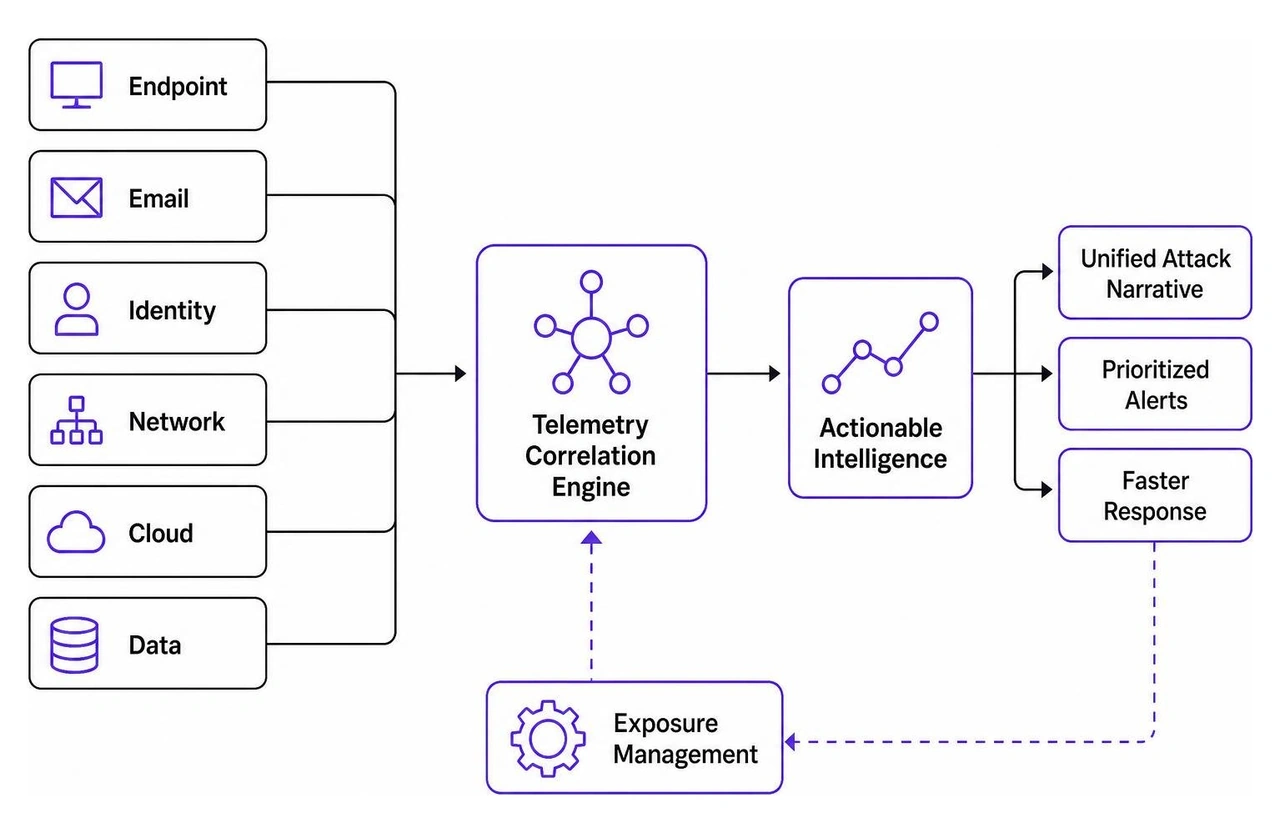
To stay resilient, organizations must correlate endpoint telemetry with security data from email gateways, identity providers, DNS layers, network sensors, and cloud workloads. Correlated intelligence reduces alert fatigue by grouping related events into a unified attack narrative. Furthermore, integrating continuous exposure management allows teams to identify misconfigurations and prioritize software patching before vulnerabilities are actively exploited.
By combining automation, machine intelligence, and experienced security analysts, operations teams can quickly separate benign background noise from high-risk adversary behavior.
An Endpoint Protection Platform focuses primarily on pre-execution and execution-phase prevention—blocking known malware, exploits, and unauthorized system behaviors. In contrast, endpoint detection and response focuses on post-execution visibility, continuous event logging, behavioral detection, threat hunting, and active containment capabilities when an intrusion bypasses initial defenses.
Continuous attack surface management discovers exposed assets, insecure remote services, and unpatched software across the enterprise. By assessing these risks contextually, organizations can proactively harden systems and prioritize vulnerabilities, driving meaningful XDR risk reduction across on-premises and multi-cloud footprints.
Organizations often deploy diverse security tools across identity, email, cloud, and endpoint environments. WhiteDog's Open XDR architecture integrates data from these disparate tools without forcing a disruptive rip-and-replace of existing investments. Choosing to unify security tools with Open XDR provides cohesive visibility, cross-domain threat correlation, and streamlined incident triage across all defensive layers.
Comparing and deploying endpoint protection solutions requires evaluating prevention capabilities, operational overhead, and integration potential. While robust host-level defenses remain essential, true resilience comes from uniting endpoint telemetry with identity, cloud, network, email, and data layers into a synchronized defensive posture.
At WhiteDog, our Unified Cybersecurity Platform simplifies security operations by connecting visibility, detection, response, and risk management. Emphasizing modular integration rather than a rip-and-replace approach, our Open XDR framework integrates seamlessly across your environment. For organizations utilizing Microsoft environments, Delta 360 (Δ360) adds a unified operational and security layer across Microsoft and third-party tools to improve correlation, visibility, security hardening, threat detection, exposure management, and response.
Whether leveraging our Open XDR architecture for unified visibility and detection or partnering with our 24/7 SOC through our MDR, XDR, or top-tier Delta Detection & Response (DDR) services—with incident response included across MDR, XDR, and DDR—our continuous attack surface management and security operations build on correlated intelligence to help you identify threats earlier, eliminate noise, and respond with confidence.


Compare endpoint protection solutions with this guide covering EPP, EDR, and Open XDR to reduce risk and strengthen your security posture.

Strengthen your DNS security with this guide to threats, DNSSEC, encryption, and enterprise defense best practices.

Learn how Cylance BlackBerry Protect uses AI-driven MTD to secure mobile endpoints, integrate with Microsoft Intune, and strengthen your SecOps.

Learn how an AWS security observability platform reduces alert fatigue, improves threat detection, and supports HIPAA compliance with proactive visibility.

Learn how to check DNS security across your infrastructure with a 5-step audit, including DNSSEC, email records, and CAA validation.

Master enterprise risk reduction with this detailed guide covering ERM frameworks, AI governance, and cybersecurity strategies for 2026.